
Stablecoins after GENIUS: what 29 founder interviews say changed between 2025 and 2026
Onchain data to October 2026 and a hand-screened read of every stablecoin conversation on Crypto Coin Show since January 2025: supply flat near $300 billion, usage at records, founders moving to payments, yield as the fault line.
Key findings
- Stablecoin conversations doubled as a share of the show, from 13% of CCS interviews in 2025 to 25% in 2026, and stablecoins went from the main subject of one episode to seven; the market agreed, with OpenTrade raising $17 million in May 2026, Ground $3.6 million in June and OpenPayd agreeing a $1.1 billion Nasdaq listing in June.
- The conversation moved from DeFi plumbing to payments: chain liquidity fell from 36% of stablecoin episodes to 6%, while business and consumer payments rose from 18% to 44%, matching market data that shows supply up only 9% in the year to September 2026 while adjusted payment volume hit a record $1.79 trillion in June 2026.
- Consumer payments appeared as a new theme in 2026 at 28% of stablecoin episodes, with wallets, cards and neobanks from Ramp Network, Veera, Virgo and Brave built for people who do not think of themselves as crypto users; Brave alone brings 121 million monthly users as of June 2026.
- The GENIUS Act came up in 1 of 11 stablecoin conversations in 2025 and 10 of 18 in 2026, as guests described it as the permission enterprises needed; regulators missed the July 18, 2026 rulemaking deadline and Treasury issued the first rule to take effect on September 30, 2026, keeping the January 18, 2027 start date.
- Yield is the fault line: 2026 guests described the distributor rewards window that the OCC's February 2026 proposal and the March 2026 Clarity Act draft would narrow to activity-based rewards, and the Clarity Act then failed 49 to 50 in the Senate on September 15, 2026, leaving the question with regulators.
- Demand is coming from emerging markets and the bottleneck is fiat ramps and banking partners, not blockchains: six of 18 2026 guests built for Latin America, Africa or Southeast Asia, five named bank access as the constraint, and Tron's $94.8 billion of almost pure USDT on October 6, 2026 is the onchain footprint of that demand.
- The incumbents are arriving: 21 banks including Goldman Sachs, Bank of America and Citi said on September 2, 2026 they would launch a joint dollar stablecoin in the first half of 2027, SoFi moved a $25 billion card programme to its own stablecoin on September 24, 2026, and Kresus told the show on October 5, 2026 that banks are already piloting tokenized deposits.
Crypto Coin Show published 161 founder and executive interviews between January 1, 2025 and September 29, 2026, and three more in the first week of October. This report combines two sources: onchain market data on the stablecoin market, refreshed to October 6, 2026, and a hand-screened read of every one of those interviews for what the people building on dollar tokens were actually working on, and how that changed after the GENIUS Act became law in July 2025.
The short answer is that stablecoins stopped being crypto plumbing and became a product. Supply has barely grown in a year, but usage has, and the founders on the show moved with it: in 2025 the typical stablecoin guest was a chain or DeFi protocol talking about USDC liquidity; in 2026 it was a payments company, a fintech or a yield provider using stablecoins to move or pay dollars for people who never think of themselves as crypto users. This expanded edition adds a company-by-company read of the 2026 guests, a timeline that puts the episodes next to the policy calendar, and a checklist for investors and builders.
Who this is for: investors, fintech and payments operators, policy staff and founders who want to know what the people actually shipping stablecoin products said in 2026, and where their claims line up with, or run ahead of, the onchain numbers.
Key metrics
| Measure | Value |
|---|---|
| Total USD stablecoin supply | $307.6 billion (October 6, 2026) |
| Supply growth, September to September | +66% (2024 to 2025) vs +9% (2025 to 2026) |
| USDT / USDC supply | $184.2 billion / $74.3 billion (84% of the market combined, October 6, 2026) |
| Adjusted stablecoin payment volume, H1 2026 | $8.82 trillion (Visa) |
| USDC share of adjusted payment volume | About 70% |
| Largest chains by stablecoin supply | Ethereum $146.5 billion, Tron $94.8 billion, Solana $16.8 billion (October 6, 2026) |
| Short-dated Treasuries bought by issuers since 2023 | About $200 billion (IIF, September 2026) |
| GENIUS Act in force | By January 18, 2027 at the latest |
| CCS stablecoin episodes, 2025 / 2026 | 11 of 88 / 18 of 73 |
Stablecoins after GENIUS by the numbers
Primer: what counts as a stablecoin
A stablecoin is a token designed to hold a fixed value, almost always one US dollar. They differ mainly in what backs them:
- Fiat-backed coins such as USDT, USDC, PYUSD and RLUSD hold cash and short-dated Treasury bills and let approved customers redeem one token for one dollar. The issuer earns the interest on those reserves.
- Crypto-backed coins such as DAI and USDS are overcollateralized by crypto held in smart contracts.
- Synthetic or delta-neutral coins such as Ethena’s USDe and Aegis’s YUSD hold crypto and hedge its price with short futures, paying out the funding income as yield.
- Yield-bearing Treasury tokens such as BlackRock’s BUIDL and Ondo’s USDY pass interest through to holders. Some trackers, including DefiLlama, count them as stablecoins; they are securities in most jurisdictions and are covered in our tokenization report.
The GENIUS Act creates a US licence for “payment stablecoins” backed one to one by high-quality liquid assets, and bars issuers from paying interest to holders. That single rule, who gets the reserve yield, runs through almost every argument in this report. For the basics of how reserves, minting and redemption work, see our Learn guide What is a stablecoin?
Market data
Supply stalled for a year
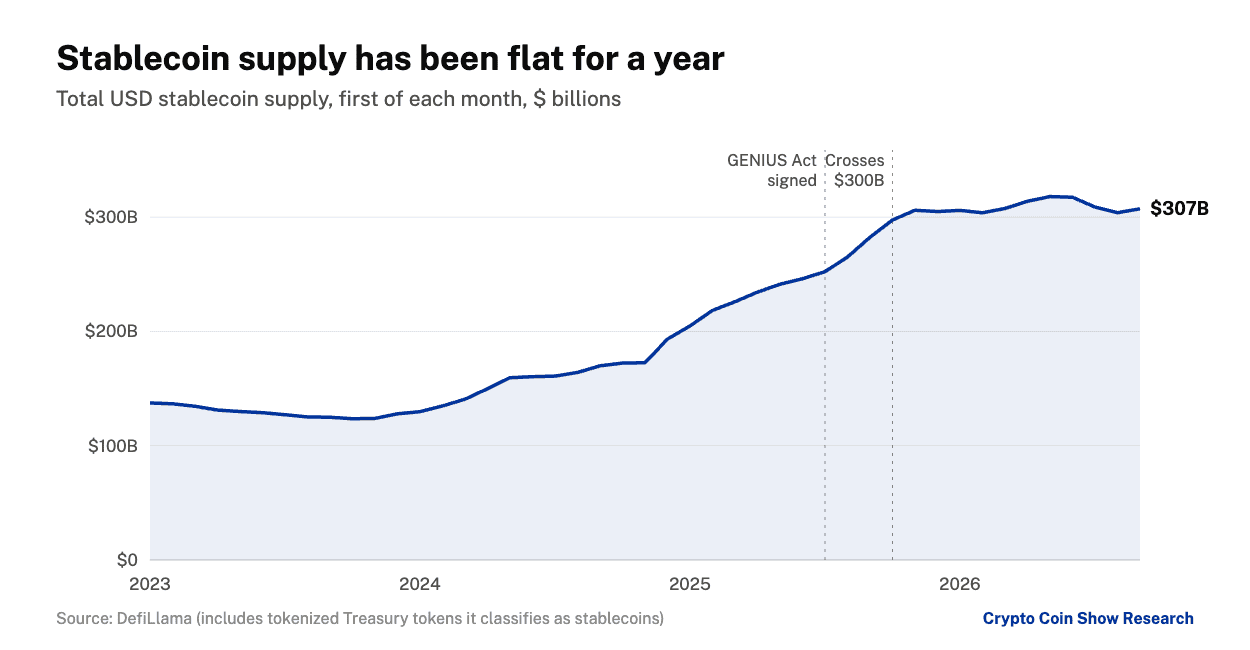
Total supply grew 66 percent in the year to September 2025, crossing $300 billion in October. In the twelve months since, it has grown 9 percent and has moved sideways between roughly $304 billion and $318 billion, including the first monthly declines in four years this summer. On October 6, 2026 DefiLlama recorded $307.6 billion, up 0.4 percent on the week and about 1 percent on the month.
Two issuers still hold most of the market
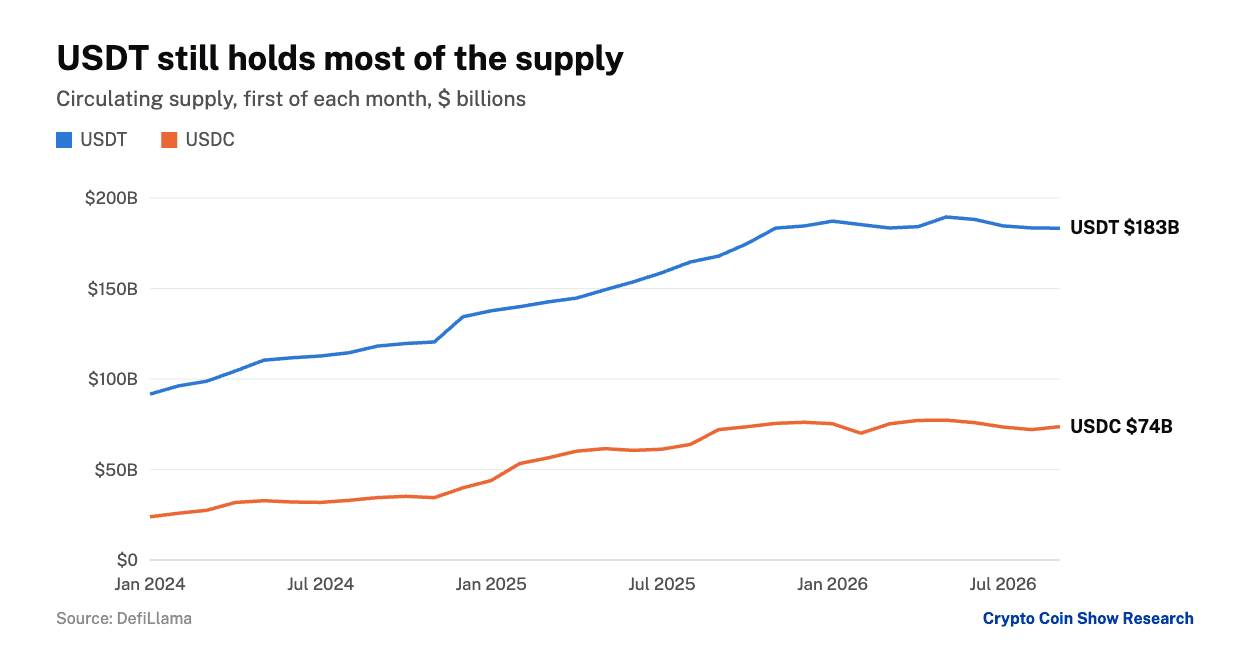
USDT and USDC together hold 84 percent of supply. USDT’s lead widened through 2025 and it has held about $183 billion to $189 billion all year; USDC more than tripled from early 2024 to early 2026 and has since traded in a $70 billion to $77 billion range. Both issuers spent 2026 proving their reserves to a new standard: Tether published its first full audit, a KPMG opinion on its 2025 statements showing $6.8 billion of reserves above liabilities on August 13, 2026, and Circle reported $668 million of reserve income for the second quarter of 2026 on August 5. Circle also took a $100 million investment from Binance on September 22, 2026, paired with a five-year agreement to promote USDC, which is a distribution deal in everything but name.
Supply and usage tell different stories
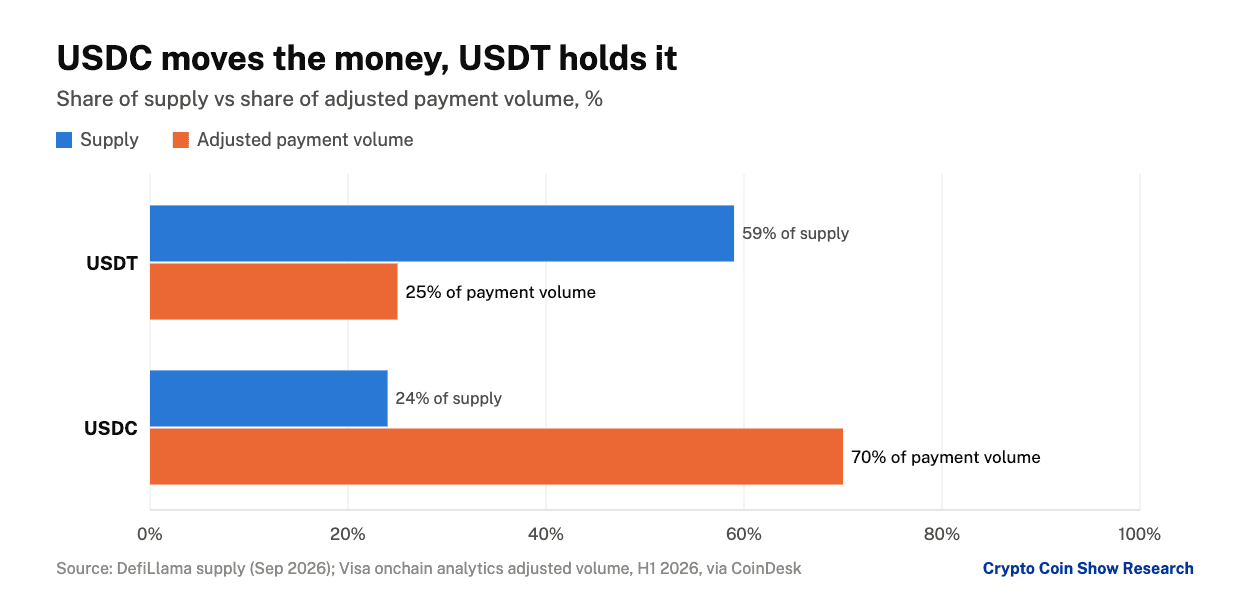
Measured by adjusted payments, which strip out bots and exchange shuffling, the order flips. USDC carries about 70 percent of volume on a quarter of supply, while USDT carries about a quarter of volume on three-fifths of supply. Adjusted volume reached a record $1.79 trillion in June 2026, up 125 percent year over year. Fewer idle dollars sit in stablecoins, and the ones that remain move faster.
The card networks confirm the direction. Visa said on its April 29, 2026 earnings call that stablecoin settlement had reached a $7 billion annual run rate, up more than 50 percent in a quarter, across more than 160 stablecoin-linked card programmes and nine blockchains. On September 24, 2026 SoFi began settling its Mastercard card programme, expected to exceed $25 billion a year, in its own SoFiUSD stablecoin. Neither number shows up in supply. Both show up in volume.
Where stablecoins live
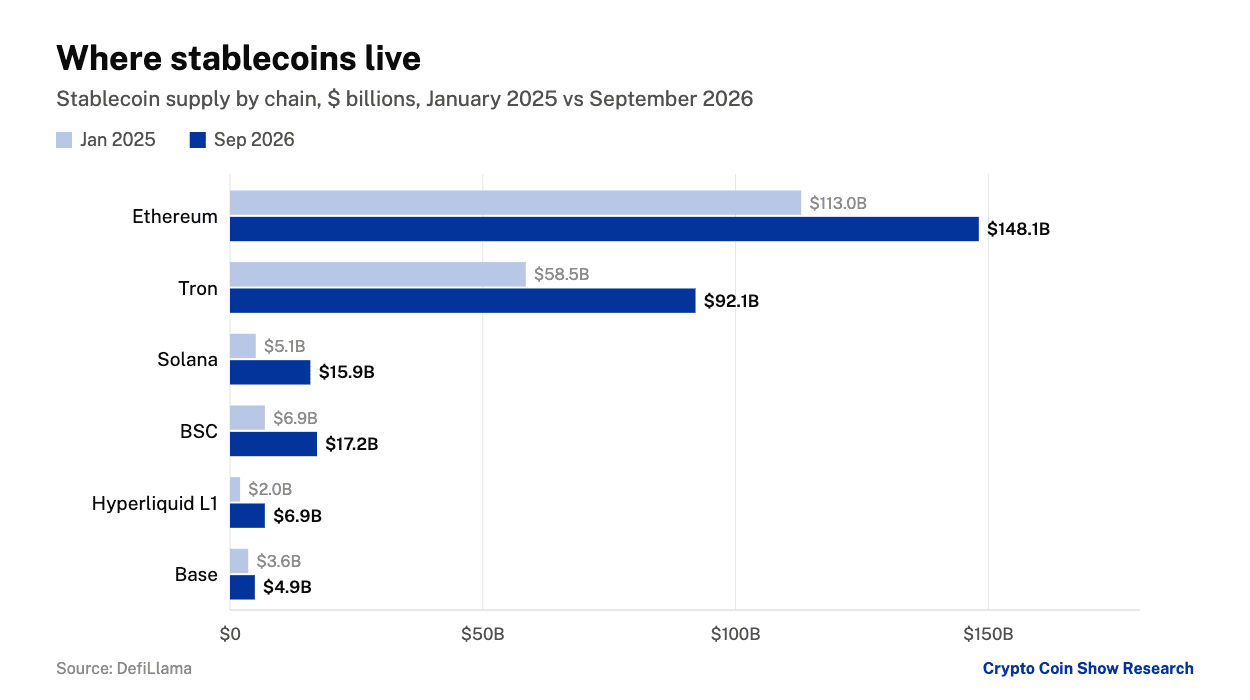
Ethereum and Tron still hold the bulk of supply, but the fastest growth since January 2025 was elsewhere: Solana roughly tripled to $16.8 billion, BNB Chain roughly doubled to about $13 billion and Hyperliquid’s L1 more than tripled to $7.5 billion. Robinhood Chain, which only launched on July 1, 2026, held $1.08 billion on October 6, enough for 13th place. New chains are winning stablecoin balances by giving them something to do, which is the same point the founders in this dataset made.
| Chain | Stablecoin supply (Oct 6, 2026) | 30-day change | Note |
|---|---|---|---|
| Ethereum | $146.5B | About flat | Home of most USDC and roughly half of USDT |
| Tron | $94.8B | About flat | Almost entirely USDT; the emerging-market remittance rail |
| Solana | $16.8B | +2.4% | Roughly tripled since January 2025 |
| BNB Chain | $13.3B | n/a | USD1 and USDT heavy |
| Hyperliquid L1 | $7.5B | n/a | USDC as perp collateral |
| Base | $5.3B | n/a | Default chain for Ramp Network’s wallet |
| Arbitrum | $3.8B | +2.9% | Joined Paxos’s Global Dollar Network on October 5, 2026 |
| Robinhood Chain | $1.08B | +4.7% | Launched July 1, 2026; built on Arbitrum |
The challengers are still small
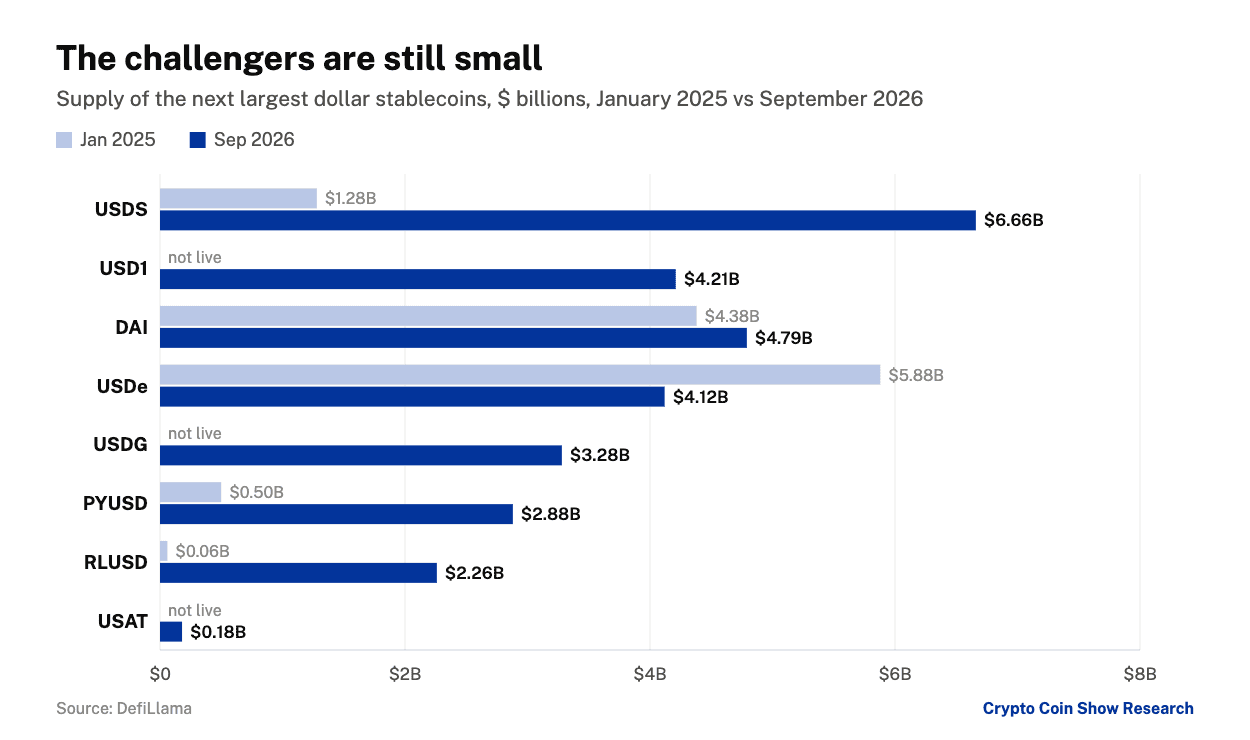
Plenty of new dollar tokens launched, but none has broken $7 billion. World Liberty Financial’s USD1, Paxos’s Global Dollar and Ripple’s RLUSD grew from nothing or near nothing, PayPal’s PYUSD grew about sixfold, and Sky’s USDS grew about fivefold. Ethena’s USDe is smaller than it was in January 2025, having shrunk from its 2025 peak, though it added 14 percent in the thirty days to October 6. Tether’s US-regulated USAT, launched in January 2026 through Anchorage Digital Bank, holds about $180 million. The biggest challenger does not exist yet: on September 2, 2026, 21 financial institutions including Goldman Sachs, Bank of America, Citi, Wells Fargo, UBS, Deutsche Bank, Santander and MUFG said they would form a company to issue a dollar stablecoin in the first half of 2027, with a euro version to follow.
Landscape
| Stablecoin | Issuer | Backing | Supply (Oct 6, 2026) | 30-day change |
|---|---|---|---|---|
| USDT | Tether | Fiat reserves | $184.17B | +0.4% |
| USDC | Circle | Fiat reserves | $74.33B | -0.5% |
| USDS | Sky | Crypto collateral | $6.78B | +2.8% |
| USDe | Ethena Labs | Delta-neutral crypto | $4.96B | +13.9% |
| DAI | Sky (formerly MakerDAO) | Crypto collateral | $4.80B | -0.2% |
| USD1 | World Liberty Financial | Fiat reserves | $4.44B | +4.2% |
| USDG | Paxos (Global Dollar Network) | Fiat reserves | $3.08B | -3.6% |
| PYUSD | PayPal (issued by Paxos) | Fiat reserves | $2.91B | -0.3% |
| RLUSD | Ripple | Fiat reserves | $2.50B | +3.7% |
The reserve trade behind it all
The reason the yield fight matters so much is the size of the pile. Stablecoin issuers have bought roughly $200 billion of short-dated Treasuries since 2023 according to the Institute of International Finance’s Global Debt Monitor of September 23, 2026, a pace that now exceeds Japan’s purchases of short-term paper, and a San Francisco Fed paper on September 28 put the potential at about $400 billion by 2030. At the 13-week bill yield of about 4.15 percent on October 5, 2026, the reserve behind $307 billion of stablecoins earns on the order of $12 billion to $13 billion a year. Almost none of it reaches the holder. The 2026 guests on the show built their companies in the gap between that number and zero.
What the founders say
The dataset
The desk screened all 161 episodes by hand, starting from the archive’s Stablecoins & Payments tag (32 episodes) and a keyword search of every episode’s show notes, key takeaways and transcript. An episode is counted when stablecoins are its main subject or a significant part of the product being discussed. Episodes that mention stablecoins only in passing are excluded, as are payment episodes that do not involve stablecoins, such as Bitcoin merchant payments and crypto debit cards. That leaves 29 episodes: 11 from 2025 and 18 from 2026.
Measured against the whole show, stablecoin conversations made up 13 percent of episodes in 2025 and 25 percent in 2026 to date. The CCS Interview Index counted Stablecoins & Payments at 22 percent in 2026 using the automatic tag alone; the difference comes from hand screening, which removed tagged episodes that were not about stablecoins and added untagged ones that were.
| Measure | 2025 | 2026 |
|---|---|---|
| Episodes published | 88 | 73 |
| Stablecoin episodes | 11 | 18 |
| Share of all episodes | 13% | 25% |
| Stablecoins as the main subject | 1 | 7 |
| GENIUS Act discussed in the conversation | 1 of 11 | 10 of 18 |
Six findings
1. Stablecoins went from a side topic to a main subject
The share of the show about stablecoins roughly doubled, from 13 to 25 percent, but the bigger change is depth. In 2025 only Aegis, which issues a Bitcoin-backed, delta-neutral stablecoin, was built around one. In 2026 seven episodes were: OpenTrade, CMT Digital, OpenPayd, Buck, Higlobe, Ramp Network and Ground. Several of those guests run companies that exist only because stablecoins do. The capital markets agree with the booking desk: OpenTrade raised $17 million in May 2026, Ground raised $3.6 million in June, and OpenPayd agreed a Nasdaq listing at a $1.1 billion valuation in June, all on stablecoin business models.
2. The conversation moved from DeFi liquidity to payments
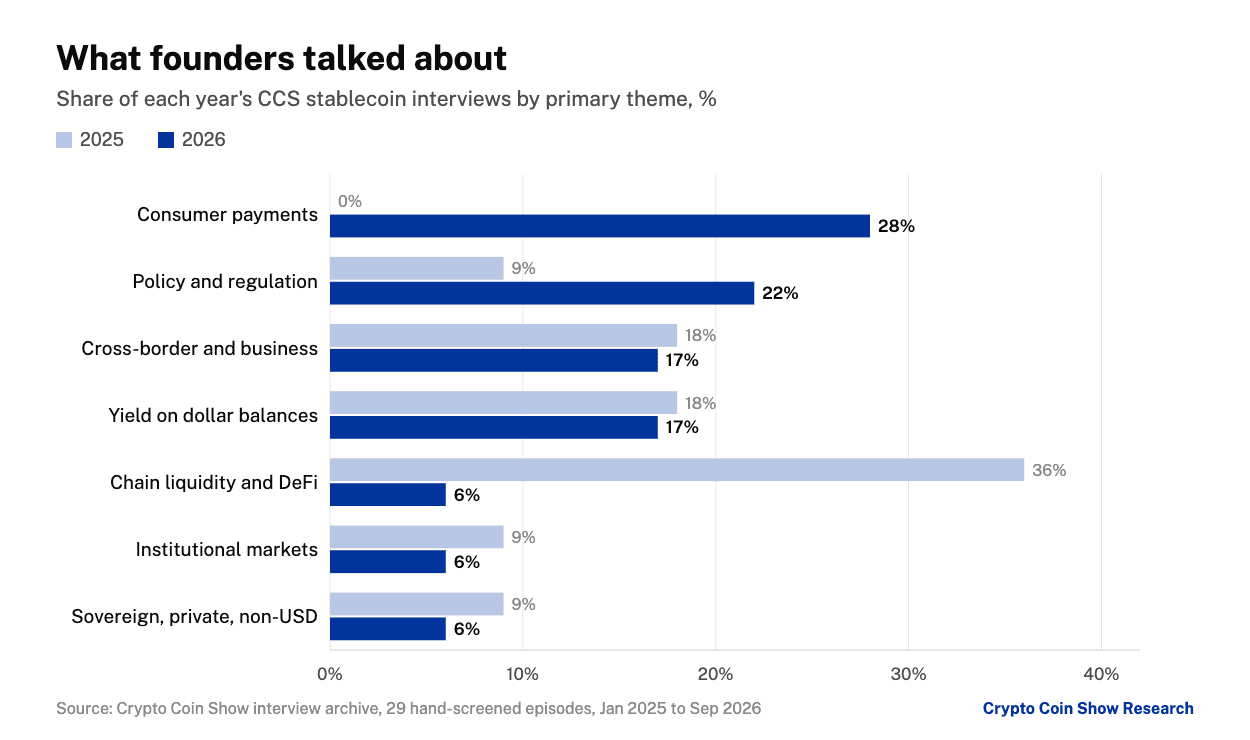
In 2025 the largest theme, at 36 percent of stablecoin episodes, was stablecoins as liquidity for a chain or protocol. Sonic cited more than $500 million in bridged USDC and native issuance with Circle; Nibiru, Injective and Centrifuge discussed stablecoins as the collateral and settlement asset of their ecosystems. In 2026 that theme fell to 6 percent, a single episode.
Payments took its place. Episodes about moving money, for businesses or consumers, rose from 18 percent of stablecoin conversations to 44 percent. Consumer payments did not exist as a theme in 2025 and made up 28 percent in 2026: Ramp Network launched a wallet it described as a global Venmo on stablecoin rails, Veera said 35 to 40 percent of crypto-sector employees are now paid in tokens and stablecoins, Virgo named stablecoin payments as one of two pillars of mass adoption, and Brave, in two episodes, positioned stablecoins as the on-ramp for its roughly 120 million mostly non-crypto users, including a GENIUS Act-compliant card and x402 payments for AI agents. The market data points the same way: supply flat, adjusted volume up 125 percent, card settlement growing faster still.
| Primary theme | 2025 | 2026 | Change |
|---|---|---|---|
| Consumer payments and onboarding | 0% | 28% | +28 pts |
| Policy and regulation | 9% | 22% | +13 pts |
| Cross-border and business payments | 18% | 17% | -1 pt |
| Yield on dollar balances | 18% | 17% | -1 pt |
| Chain liquidity and DeFi collateral | 36% | 6% | -30 pts |
| Institutional capital markets | 9% | 6% | -3 pts |
| Sovereign, private and non-USD designs | 9% | 6% | -3 pts |
3. The GENIUS Act became the reference point for enterprise adoption
The GENIUS Act came up in one of the 11 stablecoin conversations in 2025 and in ten of the 18 in 2026. Guests described it less as a rulebook than as permission. Lux Thiagarajah of OpenPayd called enterprise use of stablecoins the biggest shift he had seen since the Act, noting that before it the only non-crypto clients using them were startups, and that Mastercard, Visa and Stripe were now embedding them. Sam Hallene of CMT Digital said the Act gave institutions “the rules of the road” to issue a compliant stablecoin and that large technology companies were now working on their own. Staci Warden of the Algorand Foundation called it the industry’s biggest unlock. Teymour Farman-Farmaian of Higlobe compared it to the moment licensed streaming made music piracy irrelevant: the product existed since 2014, the legitimacy arrived with the law.
The guests were also clear that the law is not finished. Chris O’Brien of Venable pointed out that implementing rules were still being written. The Act takes effect on the earlier of January 18, 2027 or 120 days after final rules, according to Chapman and Cutler’s rulemaking tracker. Regulators missed the July 18, 2026 statutory deadline with ten proposals and no final rules, the Federal Reserve added two more proposals on September 24, 2026 covering reserves, capital and the application path for bank issuers, and Treasury published the first rule to actually take effect on September 30: an interim final rule setting up the Stablecoin Certification Review Committee, which confirms that issuers above $10 billion must be federally regulated and pushes the smaller state-licensed path out to a January 2028 certification deadline. Hallene told the show in March he expected the Act to be effective by June or July 2026; the calendar proved him optimistic by at least six months.
4. Yield is the fault line, and the guests saw it coming
Yield held steady at 17 to 18 percent of stablecoin episodes, but the 2026 conversations named the fight that now dominates Washington. The GENIUS Act bars issuers from paying interest to holders. Reid Cuming of Ground, which sells an API that embeds onchain yield into neobanks and exchanges, described the “aperture” that remains for distributors such as exchanges and custodians to pass rewards on, said rewards would have to be tied to activity such as lending or liquidity provision rather than to passive holding, and said Ground was designed to work whether that window stays open or closes. Jeff Handler of OpenTrade said tens of millions of users, mostly in Latin America, already earn interest on dollar accounts powered by OpenTrade without knowing it. Hallene went furthest: if yield sharing is allowed, he said, it will change the banking model and pull deposits into fintech apps, and if it is banned the ban will be hard to enforce and will end in litigation.
That is exactly the ground regulators and banks are contesting. The OCC’s February 2026 proposal would create a rebuttable presumption against yield paid through affiliates or related third parties, the Clarity Act draft of March 24, 2026 banned rewards on passive balances while allowing activity-based ones, which is the compromise Cuming described three months later, and eight banking groups pushed the Senate to tighten the rewards language before its September 15 vote. That vote failed 49 to 50, over ethics provisions and election-year politics rather than yield, which leaves the rewards question with the regulators for now. Europe is moving the other way at the same time: on September 22, 2026 the European System of Central Banks pushed to extend MiCA’s yield ban to lending and staking rewards.
5. The demand is outside the United States
Six of the 18 stablecoin guests in 2026 located their growth in emerging markets. Teymour Farman-Farmaian of Higlobe described “infinite demand” from a billion-person middle class in the global south that wants to save and send in dollars, against traditional transfers that cost about 6 percent and take five days; Higlobe’s users, he said, move $5,000 to $6,000 a month each. OpenTrade said its fastest growth came from Latin American companies offering dollar accounts. VALR described an explosion of cross-border stablecoin activity across Africa, where remittances cost 7 to 8 percent. Ramp Network reported strong recent growth in Latin America even though the US, Europe and the UK still make up 60 to 70 percent of its volume, Veera targets gig workers in Southeast Asia, Latin America and Africa, and Hallene credited Tether with capturing global-south demand for dollars from people who do not necessarily trust US institutions. Tron’s $94.8 billion of almost pure USDT is the onchain footprint of that demand.
6. The bottleneck is ramps and banks, not blockchains
No guest in 2026 said blockchains were too slow or too expensive for stablecoin payments. Five of them said the hard part is the connection to the banking system. Higlobe called local on- and off-ramps the primary barrier in emerging markets, built country by country with local exchanges and two bank partners for redundancy. Przemek Kowalczyk of Ramp said users drop off at payment rejection and KYC, not technical complexity. OpenPayd cited fragmented regulation, licensing costs and the difficulty of securing banking partners. VALR said it has struggled for years to open bank accounts in many African countries simply because it is a crypto company, and Veera described banking relationships and fiat ramps as the point where the experience breaks. The infrastructure problem the show heard about in 2026 is regulatory and commercial, not technical. OpenPayd’s answer, announced September 2, 2026, was to buy its way in: 43 US state money-transmitter licences through the acquisition of MSB USA.
The companies building it: 2026 on the show
The personal layer of this report. Each company below sat down with Crypto Coin Show in 2026. We summarise what the founder or executive told us, add one or two facts we verified from outside the interview, and say what it means for the thesis that stablecoins became a product. Company figures quoted from the interviews are the guests’ own and were not independently verified unless a source is given.
OpenTrade: the yield engine under Latin American dollar accounts
Jeff Handler, COO and co-founder, came to OpenTrade from Centre, the Coinbase and Circle venture that governed USDC, and told us on February 10, 2026 that the missing piece he saw there was yield infrastructure: fintechs could hold digital dollars but could not pay their customers anything on them. OpenTrade now sells money-market and real-world-asset returns on stablecoin balances to fintechs, neobanks and exchanges, mostly outside the United States, and Handler said tens of millions of people in Latin America earn interest on a dollar account that runs on OpenTrade without knowing it. Trust, he argued, matters more than regulation: a digital dollar only works if people believe there are real dollars behind it. Outside the interview, The Block reported on May 6, 2026 that OpenTrade raised $17 million led by Mercury Fund and Notion Capital with a16z crypto participating, after passing $200 million in deposits in 2025, and launched the SIERRA liquid yield token. Why it matters: OpenTrade is the clearest case of yield reaching end users through a distributor rather than an issuer, which is precisely the arrangement the OCC proposal and the Clarity Act drafts are trying to define.
CMT Digital: the investor who called stablecoins the marginal Treasury buyer
Sam Hallene, partner at CMT Digital, the venture and trading arm of a Chicago market-structure firm founded in 1997 with more than 100 crypto investments including Circle and Coinbase, told us on March 27, 2026 that 2026 is the year crypto becomes boring, in a good way: capital markets plumbing moving onchain for cost reasons. On stablecoins he made three calls. First, stablecoins are now the marginal buyer of US Treasuries, which gives Treasury a reason to want them to grow. Second, the market will be oligopolistic, with Tether owning the global south, Circle owning business users and distribution deciding everything else. Third, yield sharing will be banned on paper and hard to enforce in practice. Six months on, the IIF’s $200 billion figure supports the first call, the Binance-Circle deal and the 21-bank consortium support the second, and the September 15 Senate failure left the third unresolved. Where his claims and the data part: his expectation that GENIUS would be effective by mid-2026 missed, and his “sub-$75,000” Bitcoin reference in March had become “over $126,000” by the time Nexo’s COO sat down with us in May, a reminder that macro moved faster than policy this year.
OpenPayd: the FX desk that put a stablecoin leg in the trade
Lux Thiagarajah, chief commercial officer and a former JP Morgan FX trader, explained on March 30, 2026 how OpenPayd runs multi-currency accounts in 38 currencies through one API, quotes FX at about 5 basis points against the 1.75 percent a retail bank charges, and settles a USDT-to-dollars-to-euros conversion in about 15 minutes. His structural point was that stablecoins are replacing the dollar leg of FX: clients trade EUR against USDC instead of EUR against USD, and the largest exchanges, CFD brokers and increasingly non-crypto enterprises run on the same rails. He also named the bottleneck plainly: fragmented regulation, licensing costs and banks that will not open accounts for crypto companies. Outside the interview, OpenPayd agreed on June 2, 2026 to list on Nasdaq through a merger with Titan Acquisition Corp at a $1.145 billion valuation, disclosing more than 1,100 customers in 180 countries including eToro, OKX and Kraken and more than $240 billion of annualised volume, and on September 2 it acquired 43 US state money-transfer licences. Why it matters: a public stablecoin payments company with a bank-grade FX desk is what “stablecoins as a product” looks like on a stock exchange.
Veera: a self-custody bank for people paid in stablecoins
Sukhdeep Bhogal, co-founder and CEO, told us on February 27, 2026 that Veera is a crypto bank rather than a neobank: earn, invest, borrow and spend in one self-custodial app, with passkey onboarding in about 30 seconds and no seed phrase. His target users are gig workers and freelancers in Southeast Asia, Latin America, Africa and the Middle East, and his most quoted claim was that 35 to 40 percent of people employed in the crypto sector are already paid in tokens and stablecoins. Veera pairs that with a Visa card, multi-chain yield vaults, tokenized gold with about 70,000 holders, and a utility token planned for the second quarter of 2026. Outside the interview, Invezz reported on January 16, 2026 that Veera had raised $10 million in total from CMCC Titan Fund, Sigma Capital and others, with 2 million downloads, 220,000 monthly active users and more than 500,000 onchain transactions a month. Why it matters: Veera is the consumer-payments theme in one product, and its growth depends on the ramps and card partners it does not control.
Buck: 10 percent without being a stablecoin at all
Dan Hillery, head of treasury, walked us through Buck on April 8, 2026: a savings token minted with USDC and backed by Strategy’s STRC, the variable-rate perpetual preferred stock that adjusts its monthly coupon to hold a $100 price. Buck streams that coupon to holders, targeting 10 percent a year, and Hillery’s argument for sustainability was that STRC sits several times overcollateralised by Bitcoin on Strategy’s balance sheet with decades of dividend coverage. Over the four months before the interview, he said, Bitcoin had fallen about 45 percent while STRC held near $100. Three audits and monthly attestations back the contracts. Why it matters, and where it conflicts with the rest of the dataset: Buck is not a payment stablecoin and never claims to be, so the GENIUS yield ban does not touch it. It is a yield product that uses a stablecoin as its on-ramp, and its 10 percent depends on a single issuer’s equity structure rather than on Treasury bills. The guests who sell stablecoin yield to banks would not touch that risk; the guests who sell it to retail have to compete with it.
Higlobe: the stablecoin sandwich for the global south
Teymour Farman-Farmaian, co-founder and CEO, formerly of Google, Spotify and the Bitcoin custodian Xapo, told us on April 16, 2026 that Higlobe gives contractors and businesses in Argentina, Colombia, Brazil, Mexico, the Philippines and, next, India a US dollar account that settles in under 60 seconds through a bank-stablecoin-bank sandwich the user never sees. It charges no transfer fee and earns instead on FX margin, a debit card, a 3 to 4 percent yield product and loans against receivables. He is FinCEN-registered and SOC 2 certified, runs two bank partners for redundancy, and said the real barrier in every country is the invisible on- and off-ramp, built one local exchange at a time. His GENIUS Act take was the most vivid in the dataset: stablecoins existed since 2014 but became legitimate with the law. Outside the interview, Securities.io’s April 21, 2026 profile confirms the 2020 founding and the USDC-based global account model; Higlobe has not published user or volume totals. Why it matters: Higlobe is the finding-five and finding-six company in one, emerging-market demand met by ramp-building rather than by new chains.
Ramp Network: eight years of on-ramps, now a wallet
Przemek Kowalczyk, co-founder and CEO, told us on May 1, 2026 that after eight years of selling fiat-to-crypto rails in more than 150 countries, the places users still drop off are payment rejection by banks and card networks and KYC, not anything technical. His fix is to remove decisions: a multichain wallet that holds USDC on Base as its core balance, abstracts the chain and the stablecoin brand, and is pitched as a global Venmo for sending dollars from the US to Brazil. Europe and the US are still 60 to 70 percent of volume; Latin America is where growth is. Outside the interview, Cointelegraph reported the wallet launch on April 17, 2026, available everywhere except the EU pending additional MiCA steps, with passkeys and optional key export, after Ramp had served more than 10 million users through partner apps. Why it matters: Ramp is the one company in the dataset that sold the ramps for a decade and then concluded the ramp itself had to disappear into a payment app.
Nexo: a lender coming back to a country with rules
Neil Steinhardt, COO and principal of Nexo US, spoke to us from Consensus Miami on May 28, 2026 about why Nexo, which calls itself the second largest crypto lender in the world and operates in more than 100 jurisdictions, is re-entering the United States through Bakkt’s regulated infrastructure. His argument was about codified law versus discretionary enforcement: the GENIUS Act on the books and the Clarity Act in prospect gave a company that left in 2022 enough certainty to come back, and he expected Clarity to pass. Outside the interview, Nexo announced the US return on February 16, 2026, citing more than $371 billion of processed transactions since 2018 and a product set of yield programmes, an exchange and crypto-backed credit lines. Where the claim and the data part: the Clarity Act he expected to pass failed 49 to 50 on September 15, 2026. Why it matters: Nexo is the policy theme in person, a yield business whose US product design now depends on rules the Senate has not finished writing.
Ground: Stripe for onchain yield, built for either outcome
Reid Cuming, CEO and co-founder, previously a co-founder of the tokenization platform Superstate, told us on June 30, 2026 that neobanks and exchanges sit on trillions of dollars of idle customer balances and lack the engineering to put them to work onchain. Ground’s API does that for them across lending protocols, structured products and staking, with the blockchain hidden as an infrastructure layer. His reading of GENIUS was the most precise in the dataset: issuers cannot pay yield, distributors can, but the yield must come from activity rather than passive holding, and he called that compromise fair while noting it forces banks to ask whether passing on 25 to 50 basis points of a 3 to 4 percent reserve yield is defensible. He expects tokenized deposits to become a major category within a year and institutions to move up the risk curve into tokenized Treasuries and commercial paper. Outside the interview, The Block reported on June 24, 2026 that Ground raised a $3.6 million pre-seed co-led by Bain Capital Crypto and ParaFi, supporting Aave, Morpho, Maple and Kamino across Ethereum, Solana and layer 2s. Why it matters: Ground is a bet that the distributor window stays open in some form, and a hedge in case it does not.
VALR: Africa’s largest exchange and the bank-account problem
Farzam Ehsani, co-founder and CEO and formerly blockchain lead at Rand Merchant Bank, told us on July 8, 2026 that VALR serves more than 1.7 million registered users and around 1,800 to 2,000 corporate clients from South Africa, where it is licensed, into a continent of 54 countries where remittances cost 7 to 8 percent and crypto adoption grew 52 percent year over year. Stablecoins, he said, are driving an explosion of cross-border activity, and the hard part is not demand but banking: VALR has struggled to open accounts in many African countries because it is openly a crypto company. The fix is partnerships, including Onafriq for mobile money in local currencies. Outside the interview, VALR announced on July 3, 2026 the launch of more than 200 Hyperliquid perpetual markets spanning equities, indices, commodities and FX inside its regulated platform. Why it matters: VALR is finding six in its purest form, a profitable, licensed operator whose constraint is a correspondent-banking problem that no blockchain upgrade can solve.
Brave: 120 million users and a stablecoin on-ramp hidden in a browser
Brave appeared twice. Luke Mulks, VP of business operations, told us on September 18, 2026 that Brave has more than 120 million monthly and 50 million daily users, most of whom never touch crypto, and that BAT Roadmap 4.0 aims to turn the browser into a self-custody wallet anyone can use, with a GENIUS-compliant rewards card, a wallet waitlist past 100,000 signups and x402 support so AI agents can pay in stablecoins. Nine days later Drew Potter told us at the Blockchain Futurist Conference that Brave had reached 121 million monthly users in June 2026, adding 3.5 million in a month, and that stablecoins are the on-ramp precisely because the balance does not move. Outside the interview, Brave’s own BAT Roadmap 4.0 post of July 9, 2026 commits to the BravePay stablecoin protocol, a card issuer to be named later, x402 and MPP support, prototype testing in autumn 2026 and the sunset of ad notifications by the end of 2026. Why it matters: Brave is the largest non-crypto audience in the dataset by an order of magnitude, and it chose stablecoins, not BAT, as the thing those users will actually hold.
Two conversations outside the dataset
Two 2026 episodes sit just outside the 29 but belong in this report. Johann Kerbrat, SVP and general manager of crypto at Robinhood, told us on September 29, 2026 that Robinhood Chain, launched July 1 on Arbitrum, reached $1.6 billion of TVL and $2.2 billion of assets in three months, with 190 tokenized stocks, more than 70 percent of stock-token trading happening outside exchange hours, gas capped at about 30 cents and about 7 percent on stablecoin balances through a Raydium earn product. Stablecoins were the settlement layer rather than the subject, which is why the episode is not counted, but the $1.08 billion of stablecoins that moved onto the chain by October 6 is the single clearest data point for the claim that new chains win balances by giving them something to do. Galaxy Research’s July 30, 2026 analysis had already placed the chain in the top five globally by daily DEX volume within weeks of launch.
Dr Jordan Knecht of Kresus, published October 5, 2026, a week after the dataset closes, described the competitor stablecoins are about to meet: banks running RFPs and testing tokenized deposits and certificates of deposit in the UAE and El Salvador, mostly out of public view, under GENIUS and Clarity frameworks and regulatory sandboxes. His warning to institutions was that waiting for a regulatory green light costs 18 to 24 months of build time, and that tokenizing is the easy part next to liquidity, custody, settlement and core-banking integration. Kresus did not name clients and we could not independently verify its deployments, so we report the claims as the guest’s own. Why it matters: Cuming predicted tokenized deposits would be a major category within a year; Knecht says the pilots are already running. Deposit tokens are the banks’ answer to the yield question, because a deposit can pay interest and a payment stablecoin cannot.
Company snapshots
The eight guests for whom stablecoins were the main subject of the conversation. Figures are as reported by each guest.
| Company | Guest | What it does | Episode |
|---|---|---|---|
| Aegis | Ermin Sharich, CEO | Issues YUSD, a Bitcoin-backed, delta-neutral stablecoin that pays holders the funding income from its hedge. | May 2025 |
| OpenTrade | Jeff Handler, COO and co-founder | Lets fintechs and neobanks pay RWA-backed yield on stablecoin balances; says its fastest growth is in Latin America. | Feb 2026 |
| CMT Digital | Sam Hallene, Partner | Crypto venture investor whose 2026 thesis treats stablecoins as the marginal buyer of US Treasuries. | Mar 2026 |
| OpenPayd | Lux Thiagarajah, CCO | Multi-currency accounts in 38 currencies through one API, with USDC and USDT settlement alongside bank rails. | Mar 2026 |
| Buck | Dan Hillery, Head of Treasury | A savings token backed by Strategy’s STRC preferred stock, targeting 10 percent a year. | Apr 2026 |
| Higlobe | Teymour Farman-Farmaian, CEO | Dollar accounts for the global south using a bank-stablecoin-bank “sandwich” that settles in under 60 seconds. | Apr 2026 |
| Ramp Network | Przemek Kowalczyk, CEO | Fiat on- and off-ramps in 150+ countries; launched a multichain wallet pitched as a global Venmo on stablecoin rails. | May 2026 |
| Ground | Reid Cuming, CEO and co-founder | An API that embeds onchain yield into neobanks and exchanges, built to work whether stablecoin rewards are restricted or not. | Jun 2026 |
Policy timeline
| Date | Event |
|---|---|
| Jul 18, 2025 | GENIUS Act signed into law, creating a federal licence for payment stablecoins |
| Oct 2025 | Stablecoin supply crosses $300 billion |
| Jan 2026 | Tether launches USAT, a US-regulated stablecoin issued through Anchorage Digital Bank |
| Feb 25, 2026 | OCC proposes GENIUS rules, including a presumption against yield paid through affiliates or related third parties |
| Mar 24, 2026 | Clarity Act draft bans rewards on passive stablecoin balances, allows activity-based rewards |
| Apr 10, 2026 | FDIC proposes GENIUS rules for the issuers and banks it supervises |
| Jul 18, 2026 | Statutory one-year rulemaking deadline passes with ten proposals and no final rules; Fed, NCUA and Treasury proposals open alongside the OCC and FDIC |
| Sep 2, 2026 | 21 banks announce a joint dollar stablecoin company for the first half of 2027 |
| Sep 14, 2026 | Eight banking groups urge the Senate to tighten stablecoin rewards in the Clarity Act |
| Sep 15, 2026 | Clarity Act fails a Senate cloture vote, 49 to 50 |
| Sep 24, 2026 | Federal Reserve proposes reserve, capital and application rules for Board-supervised issuers |
| Sep 30, 2026 | Treasury issues its first GENIUS rule, an interim final rule on the Stablecoin Certification Review Committee; comments close November 30 |
| Jan 18, 2027 | Latest date the GENIUS Act takes effect |
| Jan 18, 2028 | Deadline for initial state regime certifications under the Treasury rule |
How we got here: a timeline
Where the guests disagree
What should back a stablecoin. Aegis argued that fiat-backed coins carry banking-system risk, citing the 2023 scare when part of Circle’s reserves were caught at Silicon Valley Bank, and backs its coin with hedged Bitcoin instead. OpenTrade’s Handler argued the opposite: a digital dollar only works if people trust there are real dollars behind it, and regulation is one part of earning that trust. The market sided with Handler in 2026: fiat-backed coins are 95 percent of supply and the GENIUS Act writes their reserve menu into law.
Who should keep the yield. Ground and OpenTrade want yield passed to the end user through platforms. Nexus Labs launched its own Treasury-backed stablecoin, USDX, so the chain itself captures the reserve income and uses it to fund its ecosystem. Buck sidesteps the stablecoin rules altogether with a savings token backed by Strategy’s STRC preferred stock, targeting 10 percent. Kresus describes a fourth answer: banks keep the deposit, tokenize it, and pay interest the way deposits always have.
One dollar or many. Hallene expects an oligopoly: under GENIUS there is little an issuer can do with its collateral to stand out, so distribution decides the winners. Sign’s Xin Yan expects many stablecoins, not all of them dollars, with governments bridging their own CBDCs into onchain stablecoins. The 21-bank consortium, with its dollar-first, euro-second, G7-later plan, is a bet on both at once.
Dollars or Bitcoin as the payment rail. Outside the dataset, Mark Zalan of GoMining told us on June 29, 2026 that GoBTC Pay settles merchant payments in Bitcoin on layer one at a 0.2 percent acquiring fee, against the stablecoin companies’ view that the unit of account has to be the dollar. Even Zalan conceded merchants need fiat off-ramps country by country, which is the same bottleneck Higlobe and VALR described, just with a different asset in the middle.
How fast it grows. In October 2025 Lee Bratcher of the Texas Blockchain Council cited projections of $3 trillion in stablecoins by 2030. Supply has been flat at about $300 billion in the year since. If the volume data is the better guide, the growth is showing up in how often each dollar moves rather than in how many dollars are issued.
What the data means for investors and builders
- Who holds the reserve yield in this business? The issuer, a distributor, a chain treasury or the user. Every 2026 guest sits in one of those four boxes, and the OCC and Clarity Act language will decide which boxes stay legal. Ask before you invest or integrate.
- Is the yield tied to activity or to holding? Under the March 2026 Clarity draft and the compromise Ground described, activity-based rewards survive and passive interest does not. A product whose economics need passive rewards is carrying regulatory risk it may not be pricing.
- Where are the bank accounts? VALR, OpenPayd, Higlobe and Ramp all named banking access as the constraint. Count a company’s bank partners, licences and ramp countries before you count its chains.
- Does supply or volume tell this company’s story? Supply is flat and volume doubled. A payments or settlement business should show up in adjusted volume and card run rates; a business that needs supply growth to work is swimming against the 2026 tide.
- Which issuer, and does it matter to the user? Ramp and Brave hide the stablecoin brand entirely. If the end user never sees USDC or USDT, the issuer’s margin is the distributor’s to negotiate, as Binance did with Circle in September 2026.
- Is the demand domestic or emerging-market? Six of 18 guests built for the global south. Check whether the regulatory story (GENIUS, US licences) and the demand story (Latin America, Africa, Southeast Asia) belong to the same product.
- What happens to the product on January 18, 2027? Issuers above $10 billion must be federally regulated; smaller ones face a state certification process with a January 2028 deadline. Anyone integrating a non-USDT, non-USDC coin should know which path its issuer is on.
- Is a tokenized deposit the real competitor? Banks can pay interest on a deposit token and cannot on a payment stablecoin. If 21 banks and the pilots Kresus describes land in 2027, the yield advantage flips to the incumbents.
What to watch into 2027
If the 2026 pattern holds, the next year of stablecoin conversations on the show will be about distribution and the plumbing around it: final GENIUS rules before the January 2027 deadline, whether the OCC’s limits on third-party yield survive, and whether the Clarity Act returns after the midterms. On the product side, the 2026 guests point to three things: dollar accounts for the global south, stablecoin cards and wallets aimed at people who do not use crypto, and payments made by AI agents rather than people, a theme covered in our Crypto x AI report. Competition among issuers is also shifting inside the United States, where Tether now offers USAT alongside USDC, and where the banks are about to arrive.
- November 30, 2026: comments close on Treasury’s SCRC rule. The first GENIUS rule in force sets the $10 billion line between state and federal paths; the comment file will show whether smaller issuers fight the 360-day transition.
- Late 2026: final OCC and FDIC rules. Whether the OCC keeps its presumption against affiliate-paid yield decides the business model of OpenTrade, Ground and every exchange rewards programme.
- January 18, 2027: the GENIUS Act takes effect. Unlicensed issuers lose the right to call their token a payment stablecoin in the US; watch how USDT, USAT and USDC are treated on US platforms that day.
- Post-midterm Senate: does the Clarity Act come back? It failed 49 to 50 on September 15, 2026 on ethics language rather than yield. A new Congress in January 2027 restarts the clock, and the rewards compromise will be renegotiated.
- First half of 2027: the 21-bank dollar stablecoin. Goldman Sachs, Bank of America, Citi, Wells Fargo, UBS and Deutsche Bank among others said they would form the company in late 2026 and launch in H1 2027. The first bank-consortium coin tests Hallene’s oligopoly thesis.
- Autumn 2026 to 2027: Brave’s card and BravePay prototypes. Brave promised prototype invitations this autumn and an issuer announcement. A stablecoin card inside a 120-million-user browser is the largest consumer test in the dataset.
- Q4 2026: OpenPayd’s Nasdaq listing closes. The first public stablecoin-payments infrastructure company at scale gives the market a quarterly read on enterprise stablecoin volumes.
Glossary
- Payment stablecoin
- The GENIUS Act’s legal category: a dollar token backed one to one by cash, Treasury bills and similar assets, redeemable at par, whose issuer may not pay interest to holders.
- GENIUS Act
- The Guiding and Establishing National Innovation for US Stablecoins Act, signed July 18, 2025, which creates federal and state licensing paths for payment stablecoin issuers and takes effect by January 18, 2027.
- Clarity Act
- The broader US market-structure bill that passed the House and failed a Senate cloture vote 49 to 50 on September 15, 2026; its drafts carried the rules on stablecoin rewards.
- Reserve income
- The interest an issuer earns on the Treasury bills and deposits backing its tokens. Circle reported $668 million of it for the second quarter of 2026.
- Distributor rewards
- Yield passed to stablecoin holders by an exchange, wallet or neobank rather than by the issuer. The GENIUS Act does not ban them; the OCC proposal and Clarity Act drafts try to limit them to activity-based programmes.
- Adjusted transaction volume
- Visa’s measure of stablecoin payments after removing bot activity, exchange internal transfers and other non-economic flows. It hit $1.79 trillion in June 2026.
- Stablecoin sandwich
- Higlobe’s term for a cross-border payment that enters as local bank money, crosses borders as a stablecoin and exits as local bank money, with the user seeing only the two bank legs.
- On-ramp and off-ramp
- The services that convert bank money into stablecoins and back. Five of the 18 2026 guests named them, not blockchains, as the bottleneck.
- Delta-neutral stablecoin
- A token such as Ethena’s USDe or Aegis’s YUSD backed by crypto whose price is hedged with short futures, paying the funding income to holders.
- Tokenized deposit
- A bank deposit represented as a token on a blockchain. Unlike a payment stablecoin it can pay interest, which is why banks prefer it and why Kresus says they are piloting it.
- x402
- A protocol that uses the HTTP 402 status code so software, including AI agents, can pay for web resources in stablecoins without a human checkout step. Brave is building it into its browser.
- Stablecoin Certification Review Committee
- The Treasury-led body created by the GENIUS Act to certify that state regimes are substantially similar to the federal one, set up by Treasury’s September 30, 2026 interim final rule.
Methodology
Interviews: all 161 long-form interviews published on cryptocoinshow.com between January 1, 2025 and September 29, 2026. Each episode was screened from its published show notes, chapter list, key takeaways and auto-generated transcript. The 29 episodes counted were each assigned one primary theme and marked as either stablecoins as the primary subject or a significant topic by the CCS editorial desk. GENIUS Act counts reflect whether the Act was discussed in the transcript, by either the host or the guest. Three episodes published or referenced outside the dataset (Robinhood Chain, Kresus, GoMining) are discussed in the text but not counted. Figures quoted for companies (users, volumes, costs, yields) are as reported by the guests and were not independently verified unless an outside source is cited; where we cite a raise, listing or launch, the source and date are given inline. Transcripts are machine-generated and quotes were checked against context.
Market data: supply, issuer and chain figures are from DefiLlama, taken on October 6, 2026 for current values and on September 30, 2026 for the charts, using first-of-month readings for time series. DefiLlama counts some yield-bearing Treasury tokens as stablecoins, so its total runs a few billion dollars above trackers that exclude them; the landscape table excludes them. Chain totals include bridged supply and do not sum to the market total. Payment volumes are Visa’s adjusted onchain figures as reported by CoinDesk and Forbes; card settlement figures are from Visa’s April 29, 2026 earnings call as reported by Payment Expert. Treasury holdings are from the IIF Global Debt Monitor of September 23, 2026 as reported by Crypto Coin Show.
Disclosures: the archive reflects who was booked on the show, not the market as a whole. Some interviews are produced as part of paid distribution packages. No company in the dataset had input into this report. This report is for information only and is not investment advice.
Sources
- DefiLlama: Stablecoins dashboard and chains view, October 6, 2026
- Yahoo Finance: Treasury’s first GENIUS Act rule draws a $10 billion line through the stablecoin market, October 1, 2026
- Federal Reserve Board: Requests public comment on two proposals related to Board-supervised payment stablecoin issuers under the GENIUS Act, September 24, 2026
- Federal Register: GENIUS Act requirements and standards for FDIC-supervised permitted payment stablecoin issuers, April 10, 2026
- Sullivan & Cromwell: OCC proposes regulations to implement the GENIUS Act, March 2026
- Chapman and Cutler: GENIUS Act rulemaking tracker, accessed October 6, 2026
- Cointelegraph: Federal agencies miss GENIUS Act deadline, July 19, 2026
- The Defiant: Latest Clarity Act draft bans rewards on passive stablecoin balances, March 24, 2026
- CoinDesk: Banks escalate stablecoin rewards fight as Senate prepares for a Clarity Act vote, September 14, 2026
- CoinDesk: Crypto Clarity Act flames out in failed US Senate vote, September 15, 2026
- CoinDesk: European central banks push to expand stablecoin yield ban, September 22, 2026
- CoinDesk: Circle’s USDC is leaving Tether behind in the stablecoin volume race, July 6, 2026
- Forbes: The stablecoin market shrank for the first time in four years, watch the volumes instead, July 27, 2026
- Payment Expert: Visa Q2 2026 earnings, stablecoin settlement run rate, April 29, 2026
- Cointelegraph: SoFi moves $25 billion card programme to stablecoin settlement with Mastercard, September 24, 2026
- Cointelegraph: Circle Q2 revenue falls short of Wall Street estimates, August 5, 2026
- CoinDesk: Tether says it completed long-promised Big Four audit, August 13, 2026
- Circle: Binance invests $100 million in Circle and renews commercial agreement for five years, September 22, 2026
- Decrypt: Goldman Sachs, BofA among 21 banks planning joint dollar stablecoin launch, September 2, 2026
- Crypto Coin Show: Stablecoin issuers now hold more US Treasuries than Japan (IIF and San Francisco Fed data), October 1, 2026
- Sumsub: Tether officially launches USAT stablecoin, January 2026
- The Block: OpenTrade raises $17M to expand stablecoin yield infrastructure after topping $200M TVL, May 6, 2026
- The Block: Superstate co-founder raises $3.6 million pre-seed for Ground, June 24, 2026
- FinTech Futures: OpenPayd to list on Nasdaq via SPAC merger at $1.1bn valuation, June 2, 2026
- Digital Transactions: OpenPayd prepares for a US launch as big banks plan for a dollar stablecoin, September 2, 2026
- Invezz: Veera raises a total of $10M backed by Sigma Capital, CMCC Titan Fund and more, January 16, 2026
- Cointelegraph: Ramp Network launches self-custodial wallet without third-party dependencies, April 17, 2026
- Securities.io: Teymour Farman-Farmaian, co-founder and CEO of Higlobe, interview series, April 21, 2026
- Business Wire: Nexo returns to the US, February 16, 2026
- Markets Media: Africa’s largest crypto exchange launches Hyperliquid perpetuals, July 3, 2026
- Brave: BAT Roadmap 4.0, July 9, 2026
- Galaxy Research: Robinhood Chain launch analysis, July 30, 2026
- Crypto Coin Show: How OpenTrade is enabling stablecoin yield for fintechs in 2026, February 10, 2026
- Crypto Coin Show: CMT Digital on stablecoins and tokenization reshaping capital markets, March 27, 2026
- Crypto Coin Show: OpenPayd settles cross-border payments in minutes across 38 currencies, March 30, 2026
- Crypto Coin Show: Higlobe moves cross-border payments in under 60 seconds, April 16, 2026
- Crypto Coin Show: Ground embeds onchain yield into every financial platform, June 30, 2026
- Crypto Coin Show: How VALR became Africa’s largest crypto exchange, July 8, 2026
- Crypto Coin Show: Brave’s plan to bring self-custody payments to 120 million users, September 18, 2026
- Crypto Coin Show: How Robinhood built its own blockchain, September 29, 2026
- Crypto Coin Show: Why banks are building for Web3 in silence (Kresus), October 5, 2026
Appendix: the 29 episodes
| Date | Guest | Company | Theme | Stablecoin role |
|---|---|---|---|---|
| 2025-02-05 | Mirza Uddin | Injective Labs | Chain liquidity and DeFi collateral | Significant topic |
| 2025-03-19 | Bentzi Rabi | Utila | Cross-border and business payments | Significant topic |
| 2025-04-09 | Jeroen Offerijns | Centrifuge | Chain liquidity and DeFi collateral | Significant topic |
| 2025-04-30 | Michael Kong | Sonic Labs | Chain liquidity and DeFi collateral | Significant topic |
| 2025-05-13 | Ermin Sharich | Aegis | Yield on dollar balances | Primary subject |
| 2025-05-26 | Unique Divine | Nibiru | Chain liquidity and DeFi collateral | Significant topic |
| 2025-06-16 | Sam Dorrer | Echo | Yield on dollar balances | Significant topic |
| 2025-10-06 | Lee Bratcher | Texas Blockchain Council | Policy and regulation | Significant topic |
| 2025-10-17 | Xin Yan | Sign | Sovereign, private and non-USD designs | Significant topic |
| 2025-10-24 | Ali Beikverdi | HollaEx | Cross-border and business payments | Significant topic |
| 2025-11-19 | Charles Allen, Roshan Robert, Sidney Powell | BTCS, OKX US, Maple Finance | Institutional capital markets | Significant topic |
| 2026-01-13 | Erik Balsbaugh | Open Frontier | Policy and regulation | Significant topic |
| 2026-02-10 | Jeff Handler | OpenTrade | Yield on dollar balances | Primary subject |
| 2026-02-20 | Daniel Marin | Nexus Labs | Chain liquidity and DeFi collateral | Significant topic |
| 2026-02-27 | Sukhdeep Bhogal | Veera | Consumer payments and onboarding | Significant topic |
| 2026-03-05 | Staci Warden | Algorand Foundation | Policy and regulation | Significant topic |
| 2026-03-19 | Guy Itzhaki | Fhenix | Sovereign, private and non-USD designs | Significant topic |
| 2026-03-27 | Sam Hallene | CMT Digital | Institutional capital markets | Primary subject |
| 2026-03-30 | Lux Thiagarajah | OpenPayd | Cross-border and business payments | Primary subject |
| 2026-04-08 | Dan Hillery | Buck | Yield on dollar balances | Primary subject |
| 2026-04-16 | Teymour Farman-Farmaian | Higlobe | Cross-border and business payments | Primary subject |
| 2026-04-27 | Chris O’Brien | Venable LLP | Policy and regulation | Significant topic |
| 2026-05-01 | Przemek Kowalczyk | Ramp Network | Consumer payments and onboarding | Primary subject |
| 2026-05-14 | Adam Cai | Virgo | Consumer payments and onboarding | Significant topic |
| 2026-05-28 | Neil Steinhardt | Nexo US | Policy and regulation | Significant topic |
| 2026-06-30 | Reid Cuming | Ground | Yield on dollar balances | Primary subject |
| 2026-07-08 | Farzam Ehsani | VALR | Cross-border and business payments | Significant topic |
| 2026-09-18 | Luke Mulks | Brave | Consumer payments and onboarding | Significant topic |
| 2026-09-27 | Drew Potter | Brave | Consumer payments and onboarding | Significant topic |
| Date | Guest | Company | Why it is referenced |
|---|---|---|---|
| 2026-06-29 | Mark Zalan | GoMining (GoBTC Pay) | Bitcoin merchant payments; excluded by the screening rule, cited as the counter-view on the payment rail |
| 2026-09-29 | Johann Kerbrat | Robinhood | Tokenized stocks were the subject; stablecoins the settlement layer, cited for the chain-balances finding |
| 2026-10-05 | Dr Jordan Knecht | Kresus | Published after the September 29 cutoff; cited for tokenized deposits |
Disclosure: Some Crypto Coin Show interviews are produced as part of paid distribution packages; no company in this report had input into it. This report is for education and information only and is not investment, legal or tax advice.
Crypto Coin Show Research publishes original analysis built from CCS's own archive and public data. Figures are as stated at publication and are not investment advice. Reuse with attribution and a link.