
Ian Balina / Token Metrics
Token Metrics launches AI Crypto Morning Briefing, Ian Balina on signal over noise
In this episode
Crypto news is infinite — and most investors still start the day with noise instead of signal. Ian Balina, Founder & CEO of Token Metrics, breaks down how an AI-powered AI Crypto Morning Briefing turns scattered markets, headlines, and on-chain data into actionable judgment across email, podcast, YouTube, and X.
You’ll learn:
- How Token Metrics pivoted from charts to a daily briefing product
- How the system verifies claims, sources, and numbers before publishing
- What prediction markets (like Polymarket) reveal that price charts often miss
- A simple framework for staying grounded when crypto headlines get emotional
- Why $TMAI exists, and what behavior it is designed to incentivize
tokenmetrics.com · @tokenmetricsinc on X · Watch on Refinitiv
- Token Metrics pivoted from analytics platform to AI-driven market desk that curates 50+ data sources into daily briefings.
- The platform verifies and sources information through multiple QA levels and AI agents before publishing to prevent misinformation.
- Token Metrics uses prediction markets like Polymarket to add context to news and show portfolio impact scenarios.
- AI-powered automation enables real-time content delivery across email, podcast, YouTube, and X without human editorial delays.
- Premium subscribers receive real-time alerts on smart money movements detected through on-chain data from sources like Nansen.
Chapters
Transcript
Read the full transcript
I'm Ashen Addison from the Crypto Coin Show, and today on Blockchain Interviews, we have with us Ian Balina, founder and CEO of Token Metrics. He's to discuss crypto analytics and moving into AI-powered crypto insights and taking as much advantage of artificial intelligence as we can. It's hard to keep up with the progress, and there's a beautiful synergy between AI and
blockchain. It's just about utilizing that to the max, and Token Metrics has some great insights into that. Ian, welcome to the show, and thanks for taking the time. Yeah, absolutely. Pleasure to be here. It's It's been a while. Definitely. Yeah, you know, we've been We've been going since the 2017 days, and a lot has changed. And now with the interaction of AI into blockchain,
it's going even faster, and the institutional adoption and just trying to stay on top of the markets, we need AI to stay on top now. It's It's It's not a an option. It's a necessity. And your team at Token Metrics have been building this analytics platform for many years now and evolving with the times, now adding in as much artificial intelligence as you can to stay on top.
Can you talk about Token Metrics and the evolution as AI continues to integrate in? Sure. So, Token Metrics has been around since 2018. We launched back in 2019 at the bottom of a of a bear market, and in essence, we were an analytics platform to help crypto traders and investors find alpha in crypto. So, we had crypto research, help people find investments
like Polygon, Helium Network, Chainlink, and others. But during the evolution of Token Metrics, we were adding a lot of analytics and data, and we're AI-driven since inception. But now, the market in AI has completely shifted and completely changed. So, as of later of last year, in November, Token Metrics actually pivoted away from being purely analytics-driven to now
kind of trying to stick to where the puck is going, all right? Cuz we're seeing a lot of data is now being consumed via LLMs, via chatbots, whether it's Open AI, whether it's Gemini, whether it's Claude. And initially, we were building an API to give people that data, but what we realized is that's not really our specialty. That's not really our niche. Our niche is providing people
research and alpha and insights in the crypto market to help them build big portfolios in crypto. So, now the pivot of Token Metrics is we're basically an AI-driven market desk. So, we start with scouring tons and tons of data. So, over 50 50 different data sources from well-known media publications like CoinDesk to on-chain data like DeFi Llama, Nansen,
and others, and we built an AI pipeline that can in real time understand all that data and give you a free daily newsletter. So, think of Think of it kind of like an AI-driven market desk, right? Something whether that would work for both retail users and people who run a hedge fund office, people who run actual institutions, right? I myself have a venture fund,
right? So, we're trying to cater to both audiences to give them the alpha without having to stay doomscrolling on crypto Twitter all day. Mhm. Definitely. It's nice to be in the company as a retail investor of institutions and hedge funds, you know, reading that same information. And I was going to ask about crypto Twitter. I Maybe it's just me. I feel like
there's a lot of people in crypto that first thing they do when they get up or to the office, they open crypto Twitter and start scrolling, and it's a bit of an organized mess unorganized mess or they go to AI, some of these LLMs and say like "What's new today in crypto?" How How is different is the catered information using AI on Token Metrics
versus just asking an LLM, "Hey, what's new today?" Great question. So, like take myself for instance. I was busy running both a crypto fund, both Token Metrics, and also creating content and doing just busy on other kinds of different tasks. I didn't always have the time to sit on a computer or to be on my phone, although I was on my phone a lot of
times on crypto Twitter trying to find the next alpha, trying to find the next token that matters, right? So, rather than having to stay glued to the screen or glued to your phone, we built an AI-driven pipeline that curates all those data feeds and tries to find what actually matters for the day. And that's put out via our daily pulse, which is a free newsletter. Then for our
premium groups, we have even more alpha signals, basically a private community and more real-time signals. For example, if a new token launches and we see the smart money piling up into it based on-chain data from Nansen, which we can cross-reference with other different signals we have, we can then put out an alert to our community, for instance, or to our subscribers.
But in general, we built a very detail-oriented pipeline that takes more than 50 different feeds, goes through multiple levels of QA, especially now with in the age of AI and AI agents, we've built different AI agents that can go through and basically qualify whether or not it matters, and only the items that matter for the day are put out as our five items worth
following for the day. So, we basically sift through all that noise for you and give it to you as a free feed, but we also put it out as different forms of content. We put it out on X, we put it out on Discord. We also have a an AI-driven podcast for those of you who who don't like to read.
[clears throat and laughter]
You can also just go to Spotify,
iTunes, find Token Metrics Daily Pulse, and it's an AI-driven podcast. Why this matters is because everything is fully automated and AI-driven, we can put out qualified and sourced and verified information at the speed of AI. Mhm. Right? So, before you even wake up, there'll be a podcast telling you the top news of the day. All right? And everything is sourced,
everything is verified, everything's stored in a database. The entire engine basically learns So, any mistakes it makes, it can learn and improve every single day. So, it's taking stuff that would have taken days or even weeks for an editorial team of humans to go through and verify, we've just automated that entire pipeline to happen
in real time. That's incredible, and I was going to ask about the pieces of content. You mentioned like five main pieces because there's so much to cover, and it's pretty broad from just looking at the Bitcoin price or Ethereum and then diving into seed rounds or upcoming token sales, which can have a lot more noise or can be more opaque in a sense that we don't
know if you know, if this is the next 100X or if this is going to die in the next week. Yeah. So, with that, you did mention there about advanced analytics through Nansen and things like that. How do you balance the sort of the mainstream crypto news like like Bitcoin and those more speculative investment opportunities? So, the more the more high-risk,
high-reward opportunities are in our premium group, but with the daily pulse channel that's free, it's basically getting the news that matters, right? So, market data, Bitcoin price, sourcing over 40 different news feeds to filter out what news actually matters for you and your portfolio. Mhm. But what really makes it even more unique is it's not just giving
you the news. It's telling you how is this going to affect your portfolio. Mhm. And what's the actual play, right? So, we don't provide financial advice per se, but we tell you what to watch out for, right? For example, tomorrow, they might cut interest rates or they might not cut interest rates, right? That's the big news that could affect your portfolio. Mhm. So, then our AI
takes that and then goes to Polymarket, sees what the odds are, and tells you the actual odds, right? So, for today's newsletter, it said the odds are 0% based on Polymarket. Mhm. So, we kind of add more color to the news using verified what data. So, you're you're getting the whole picture. And it tells you if they cut rates, this is how it will affect your portfolio and the
market. If they don't, this is how it will affect your portfolio. So, it gives you that second-order thinking when it comes to following the markets. Definitely, that's a nice touch adding in Polymarket. I just saw a chart that was showing that Kalshi had way more profits than than Polymarket, but maybe that's because they're gouging, and it's not actually the
highest volume, but
Yeah, that's actually not quite true because I did see they announced their $1 billion market minus bracket
[snorts]
kind of marketing campaign, but to my understanding, Polymarket does not actually charge fees, right? As much as Kalshi. So, that's kind of deceiving. Polymarket gives more traffic than
Kalshi, right? But Polymarket is not charging fees cuz they're trying to kind of just get users and get product market fit. I mean, they already have product market fit, but they want to kind of gain complete market share of the market. So, for us, we actually prefer using Polymarket just cuz everything's on-chain. Their API is user-friendly. So, we source all that
data, and we put that into our daily pulse. Mhm. How much do you think there is an importance that the AI reads Polymarket and prediction markets for interest rates? Generally, that contract, I think, is pretty high volume, but there as more markets come up for more different types of future events, some of them might not be as reliable. You know, how
much does the AI weigh in on that? Great question. So, we filter out any Polymarket markets that have less than 100K in liquidity, right? So, for example, if it's taking a news item like the Fed cutting rates tomorrow or the price of Bitcoin by the end of the month, it's only looking at liquid markets. Any markets that are illiquid, it will toss out, right? So,
we built the in that QA control, right? That editor, that quant all inside the same newsletter. Mhm. That's good to know. And with the on the premium side, you mentioned more speculative investments, upcoming launches. How do you verify signal versus the noise? You know, I think a lot of people that get their potential investments from from crypto Twitter, you know,
they're they're scrolling through and they might see a new platform that hasn't existed or starting to go viral, but there are a lot of sort of internal marketing campaigns or you know, galaxy campaigns of people to push things to sort of generate hype around potential projects. Doesn't mean that they're going to be successful, but maybe the internal metrics are not
as good as you think. How do you balance that or how does the AI balance that in Token Metrics when looking at upcoming launches for new projects? Good question. So we basically have three products or three plans, three paid plans. And the first one is signal. Now in terms of filtering out all the noise, so with us with signals it's it's not about having
noise of different altcoins or different tokens on pump.fun. We go through and we filter everything out based on liquidity. All right, that's first first of all most important thing in crypto. As somebody who's been in crypto for almost 10 years, liquidity matters, especially in bear markets. So tokens can dry up very quickly. So we have a bunch of different metrics.
We look at the safety score. So how safe is the actual token to trade? Right? Meaning that we run 100 pump checks, scam checks, especially if they're tokens on DEXs. We want to make want to make sure all that's filtered out. The then what we add in is additional other filters, for example, like smart money. All right, so we have an alpha score which goes through and using different
providers, Nansen, others, Helius, Dune Analytics, we can look at the on-chain token holders of that token. Make sure that it's not heavily held by any whales who can just dump on you. Make sure that there's smart money in it. That's probably the biggest one this cycle and even last cycle is are there smart money people who've done well, people who've been early
investors or holders of other winning tokens, whether it's Shiba Inu, for example, right? So that puts a smart money score into it and that's part of the alpha score. So these scores kind of help us curate and filter out and only find the tokens actually worth keeping an eye on. The cool thing is we're doing this for both tokens on centralized exchanges and DEXs, but even prediction
markets, Polymarket, for example, right? Polymarket has been a huge market this cycle. But how do you find the right market to trade? Right? So the cool thing is with this entire pipeline and thanks to the help of AI, we're able to let's say you want to bet on sports. We're able to get all the liquid markets on Polymarket. Then we cross-reference them
with other data sets. For example, with sports, we have we have actual odd odds APIs from bookmakers and we can see if there's a big divergence between bookmaker odds and Polymarket odds and see if the spread makes enough money and post that as a signal to our community. Very interesting. And do you think with Polymarket, you know, it's the a very broad it's getting broader
with not just politics and crypto, but sports and other world events. Do you see the same audience that potentially the original, you know, 2017-2021 crypto people are just trading whatever they can make money on and not necessarily just crypto? To be honest, yeah. I mean, I think there are two audiences. You have those who just kind of staunchly about
crypto maxis and then you have those who just want to make money. All right? [laughter] All right, sometimes degens want to degen. So but with us the way we have it kind of set up, on non-crypto markets, we have a higher threshold for posting. All right? We just typically twice as much. All right, so for example, if you have Polymarket on betting on the price of
Bitcoin versus a Polymarket on Champions League scores, all right? The champion score is going to be twice as much alpha before we post it. But the cool thing is we cross-reference that with other data sets, right? As I mentioned, right? We can see the odds from other bookmakers and see if Polymarket is diverging from that. Mhm. Interesting. And do you guys get
into equities or other like precious metals or other investments that aren't Polymarket, sports betting kind of related and not crypto? Not directly. In our alpha plan where we kind of provide more research. So we have a monthly playbook that we look at different asset classes. So we cover crypto, we cover Bitcoin, ETH, SOL, kind of like the majors. We cover the Mag 7 which
will take basically high growth tech stocks. So think like your Nvidia, your Microsoft and all that. Right? The FANG plus all the AI stocks. Then we also add in gold and also silver. Mhm. Okay. Well, that's great kind of giving people a broader picture on which which market is doing well, which one is peaking. And this is basically a monthly report we put out.
So going back to our roots of being research driven. So we have signal for those who just want signals and we have research for those who do who want research. And then for those who do want more of a community, we also have a round table which is kind of more well, kind of like a crypto networking, right? So if you want to find other people who maybe
manage their own capital, whether it's a family office, whether they're traders, quants, DeFi or builders, people who kind of want to have more of a community meeting in person. We have a monthly round table kind of share alpha. Well, that's really nice. What is one of the mistakes you see for people that just look at headlines without necessarily going into the AI
analytics of it. I think before or at least crypto people, they would see traditional headlines, news headlines and think, okay, we don't trust the news. It's more about the context of who wrote that headline. But I feel like in crypto, people that's not exactly the same. People see a headline about an upcoming launch or a high liquidity coin and they just take
it at face value. Yeah, you can't really do that in crypto. You have a lot of people who have, I would say, ulterior motives in terms of making money, especially on crypto Twitter or KOLs or what have you. That's why it's really good to kind of create a diverse data set to kind of cross-corroborate and see is this actually telling the true story, right?
So if somebody says we're about to have altcoin season, right? What numbers actually back that up, right? And that's what our AI pipeline does. It can look at the Bitcoin to altcoin season indicator. It can look at the price of altcoins, the price of option markets, price of open interest. So all these different data sets, it can just pull in all that data. You don't have to
be an expert in it. The AI is the expert in it. It will double-check, cross-reference everything and tell you is this bullish or bearish in the long run. That's really nice. And I'd love to hear if you have any of these insights, you know, right now it's mid-March and we're seeing a resurgence, Bitcoin price hitting 75,000. Ethereum was up 10% in a day.
Tom Lee and Michael Saylor continue to buy a lot and that's potentially leading to an altcoin season. Based on the, you know, the AI in Token Metrics, do do you see this right now, the market that we're in, as, you know, some momentum towards the upside and potentially getting into to altcoin season? I mean, I won't say altcoin season yet,
but this week and probably till end of the month, things are very bullish for Bitcoin. Bitcoin has been going up, right? And even the odds on Polymarket say that Bitcoin has a high chance of going up for the rest of the month and getting up to 80K, if not crossing 80K. But I think what you have to watch out for is Bitcoin doing well. Basically,
Bitcoin has its run. Once it has its run, it kind of stabilizes, not crashes, stabilizes. People then take profits from Bitcoin and even other large large tokens like ETH. ETH's had a pretty good run recently. And so once those two are doing well, then capital flows into those altcoins on those chains. All right? So that's what I would look out for is the ratio between Bitcoin and
ETH, Bitcoin and SOL once Bitcoin goes up and stabilizes. Definitely. If it doesn't stabilize and goes back down, then we're probably not going to see any flow into the altcoins. Yeah. I mean, well, the only thing I would keep an eye out for, I don't know when this gets posted, but for example, interest rates. Not necessarily what they say tomorrow,
but what kind of the temperament is. Are they hinting at cutting rates later on in the year? If that is, that would be a bullish signal for assets. If they're if they're hawkish, then it's very bearish. Mhm. Okay. That's good to know. And you mentioned the in-person round table. That sounds pretty cool and the different plans. It is there a crypto or
government
virtual. It's actually virtual, but we do have kind of like the option for people in the group to kind of meet up at conferences. So for example, different conferences, people can kind of coordinate and we have we like to kind of network people inside the group, all right? Based on their levels of interest. So we're building more of a community. So the model actually has
been inspired by Tiger 21. I don't know if you heard of them. It's basically kind of like a private mastermind for investors, typically $20 liquid or more, where they kind of stress test and share their portfolios, how they view in the market, and they have other members kind of give their feedback. So we're taking kind of that same model and applying it
towards crypto. We don't have the $20 million liquid net worth requirement per se, but other people who have larger portfolios where they can present to the people in the community virtually via Zoom and Hangouts and get feedback and input, right? So, it's kind of like stress testing your portfolio while also giving putting you in contact with other people who might have the
same interests as you. Definitely. And I think that's great. And I understood, yeah, it for the most part is virtual unless you're meeting up at at the crypto conference. But I think it's great to be able to talk to people, especially if you can see how dedicated they are and they're utilizing all the AI they can. I'd be even more inclined to be friends with
them and follow them and find dedicated people. So, my second part of that question was with the community members and the governance playing a role in potentially shaping the future of the platform or interacting on the crypto side, is there a token or crypto play inside of Token Metrics as well? Yes, yes. So, we currently do have a
token, a TMI token that's tradeable on DEXes, Gate, MEXC, and others, Bitpanda. And that actually gives you access to the platform. So, you basically if you have the token, you can just verify and it'll put you in part of our private Discord where you get access to everything. Discord is kind of like the hub of our research and our content and signals. Plus, we also send
it out via email to our newsletter. So, we have two two different tiers, right? As mentioned, the free one which gives you pretty much most of what you need. But those who want want more deeper re- research, more alpha, they can obviously join Token Metrics premium network. Definitely. And I am have been subscribed to the daily email for
many years. And you guys are on top of it or at least the AI is in staying on top. There's a lot of news coming out recently, which is great. A good sign for the markets. And yeah, you guys are keeping me in check. So, I do appreciate that. I'm definitely going to check out the Discord and the advanced parts as well. You know, we don't have too much time left, Ian, but maybe
you can touch on one last part on the AI, something, you know, of special that you could note in what you what you normally wouldn't have caught or what kind of information that you personally if not most of it wouldn't have seen if it wasn't for the AI in Token Metrics keeping you up to date. Yeah, I mean, I think I'm pretty much
everything, right? Cuz it's so hard to keep on keep tabs on everything in crypto, right? So, I have an AI pipeline or AI market desk, which is kind of what we're doing now at Token Metrics, that I can take the news, cross-reference that with what's on chain, all right? With let's take with crypto exchanges on CEXes to DEXes to prediction markets, getting the
odds, and putting all that together to give you an actual bullish or bearish signal. It's very tough to do, right? I mean, humans could do it, but it would take a lot of time, all right? And people are busy. So, being able to kind of create something that's fully automated that can just constantly kind of have its tentacles out in the market, watching over 50 different data feeds
and tell you the things that actually matter, right? Sifting through all those 50 feeds and finding the five things that actually matter and telling you how this will impact your portfolio in the future. I if I had this, I would have been able to navigate the market much much easier. Like to be honest, I don't even read the news news- newsletter as much, right?
Cuz I love the podcast. Mhm. Right. So, every take walks, first thing I do, I play the Token Metrics signal post podcast and it tells me what matters in 5 to 10 minutes. Mhm. That's really nice. And yeah, I'm going to I've been reading the newsletter, but you know, I love podcasts on 1.5 to X Yeah. information flowing. What's the best way for people to subscribe to the
free newsletter and then get involved in the round table and deeper in if they want to get like on top of the news? Yeah, just go to tokenmetrics.com, sign up for the newsletter, put in your email. Then at the bottom in the middle of the page, you can get more information on the different products we have from signal to alpha to round table. Sounds great, Ian. I'll leave that in
the show notes below as well. Appreciate your insights and just staying on top of crypto news for us with AI and I'm utilizing it as much as I can for our business to still so much to keep up on. I really love the interaction between the prediction markets and also more more speculative investments. I don't I don't think people just go to any of these LLMs and
ask for what is brand new. It's really hard to find those sources. You know, it can tell you the price of Bitcoin today, but it really can't find those things that the hedge funds and the institutionals are who's investing in early stage rounds and you know, as we both like to do, try to get involved in these early stage investments to
be the next Bitcoin or at least the next 100X. So, I really appreciate your insights and your time that you've put into Token Metrics and would love to follow up again in the near future. Sounds good. Thanks for having me.
Related coverage
 5 Days Left — Win a Bitcoin 2026 Pro PassApr 5, 2026
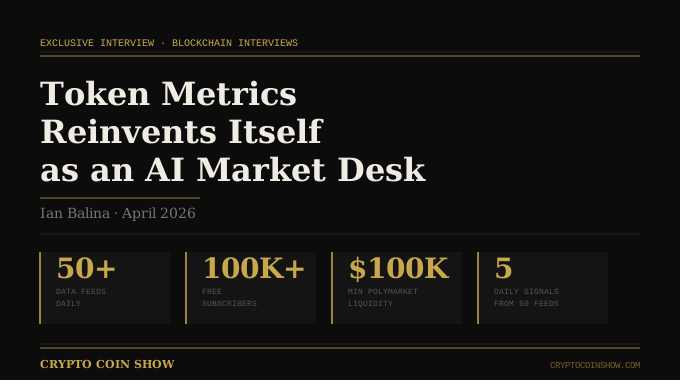 Token Metrics Reinvents Itself as an AI Market DeskApr 3, 2026
More interviews
 How Birdeye bootstrapped to 5,000 enterprise clientsOct 7, 2026
 How Anvil lets you use crypto as collateral without sellingOct 6, 2026
 Pawel Mastalerz on how Daski helps AI agents navigate the webOct 6, 2026
 Why banks are building for Web3 in silenceOct 5, 2026
 How TrendTrader Pro raised $1M for a token buyback fundOct 2, 2026
 Illia Polosukhin on NEAR's privacy features and AI agents in 2026Oct 1, 2026