Republicans and Democrats clash over crypto self-certification loopholes at Senate hearing
The Senate Banking Committee exposed a fundamental divide Wednesday over how tightly to regulate crypto markets, with Republicans backing a light-touch framework and Democrats demanding stronger guardrails against self-certification loopholes and conflicts of interest. This clash sets up a critical test of whether institutional-grade regulation can pass Congress before the industry consolidates further under political favor.
- Senator Tim Scott and four GOP colleagues unveiled “market structure principles” defining digital assets as commodities or securities based on use, mirroring the House CLARITY Act.
- Democratic Senator Raphael Warnock attacked a provision allowing companies to self-certify as decentralized and avoid SEC or CFTC registration entirely.
- Former CFTC Chair Timothy Massad testified the self-certification carve-out constitutes “a regulatory black hole” enabling regulated activity to migrate to unregulated venues.
- 1 House-approved bill advancing crypto definitional framework through committee in June
- 2 Principal regulatory bodies (SEC and CFTC) whose enforcement jurisdiction the GOP framework would clarify
- 4 Republican senators co-authoring joint market structure principles for Senate action
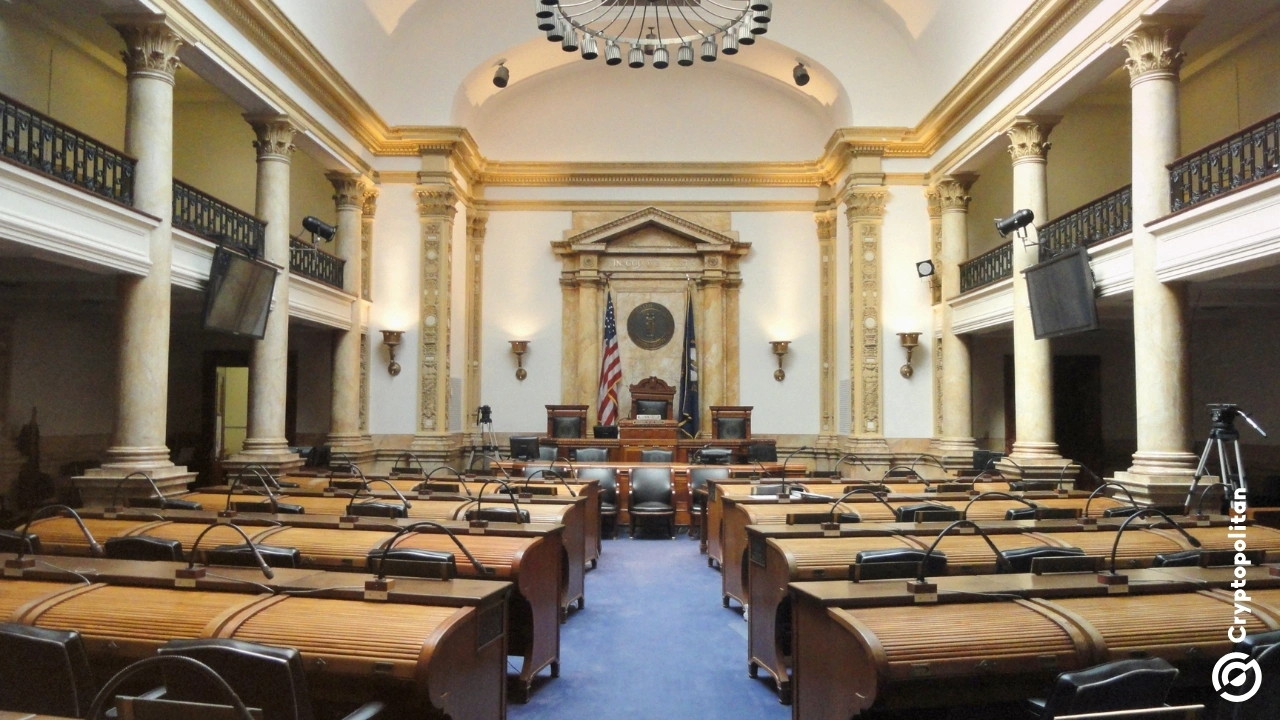
The Senate Banking Committee hearing Wednesday crystallized the regulatory stalemate that has delayed a unified national crypto framework for years. Republican senators, led by Committee Chair Tim Scott of South Carolina, advanced a light-touch approach that would establish clear asset definitions and split enforcement authority between the SEC and CFTC, without, they argued, stifling innovation. Democrats countered that the proposals contain dangerous loopholes that benefit well-connected insiders and leave retail investors exposed to fraud and self-dealing.
GOP Framework Mirrors House Bill That Defines Assets by Intended Use
Senator Tim Scott and his Republican counterparts, Cynthia Lummis of Wyoming, Thom Tillis of North Carolina, and Bill Hagerty of Tennessee, released a joint statement outlining their market structure principles. The proposal would classify digital assets as securities or commodities based on how they function in the marketplace, not merely their initial offering structure. That approach tracks closely with the CLARITY Act, which the House approved and advanced through committee in June.
Our job is to set clear, light-touch guardrails to protect investors, stop fraud, and allow responsible innovation to flourish.
Senator Tim Scott, Committee Chair
Scott emphasized that legislators must specify which tokens qualify as securities and which as commodities, a distinction the SEC and CFTC have applied inconsistently for years, creating enforcement confusion.
The GOP framework also promises to establish clear jurisdiction lines between the two agencies, a structural change long sought by institutional participants frustrated by overlapping and conflicting guidance.
Democrats Flag Self-Certification Loophole as Enabler of Regulatory Arbitrage
Senator Raphael Warnock of Georgia mounted the hearing’s sharpest challenge, targeting a provision that would allow companies to declare themselves “decentralized” and thereby avoid registration with either the SEC or the CFTC. Warnock cited recent activity involving President Donald Trump and his family members, who have endorsed or launched tokens approaching exchange listings with little regulatory scrutiny.
He argued that political connections are increasingly determining market access, undermining any claim that the marketplace operates as a fair or free system.
Timothy Massad, former CFTC Chair, testified that the carve-out for self-certified decentralized entities would create “a regulatory black hole.”
Massad warned that the language would permit large, functionally centralized operators to migrate regulated activity into unregulated venues simply by claiming decentralization status. He recommended tighter definitional boundaries and a framework that captures both centralized and decentralized systems while blocking unjust loopholes.
Democratic senators echoed his concern that the current text lacks adequate consumer protections and fails to address conflicts of interest now embedded in the marketplace.
Hagerty Predicts Eventual Democratic Alignment on Broader Market Structure
Senator Bill Hagerty dismissed the hearing’s partisan tension as routine legislative friction.
He predicted that Democrats who previously backed stablecoin legislation would ultimately support broader market structure reforms once negotiations continued.
Hagerty’s confidence reflects Republican conviction that the substantive gains, clear asset definitions, reduced regulatory uncertainty, unified national standards, will eventually prove compelling enough to overcome initial Democratic resistance.
The House will soon debate its own digital asset legislation, and if both chambers approve compatible versions, the United States could establish its first comprehensive national crypto regulatory framework, a longtime goal as the technology moves mainstream.
The CCS read. We see institutional adoption hinged on certainty, not speed. A broad self-certification carve-out would create two-tier markets: regulated venues for risk-averse institutions, unregulated ones for favored insiders. The GOP framework’s strength lies in asset definition clarity; its weakness is tolerating regulatory arbitrage. Democrats have the leverage to demand a tighter carve-out before moving forward.
The House will debate its digital asset bill in the coming weeks; if both chambers advance compatible language, a conference committee must reconcile the self-certification language and Democratic guardrails before final passage. Watch whether Warnock’s conflict-of-interest framing gains Democratic votes or whether Hagerty’s prediction of eventual alignment proves correct.