Uniswap’s StablePair hook pools hold 82% less TVL than comparable v3 stablecoin pairs
Uniswap Labs has launched StablePair Hook, a Uniswap v4 hook (a smart contract module that changes how a liquidity pool prices and charges swaps) that replaces flat trading fees with a rate that moves block by block around a fixed reference price. The design aims to let liquidity providers keep more of the value created when a stablecoin pool drifts and gets corrected, but a review of the mechanism shows three structural gaps that can still erode LP returns.
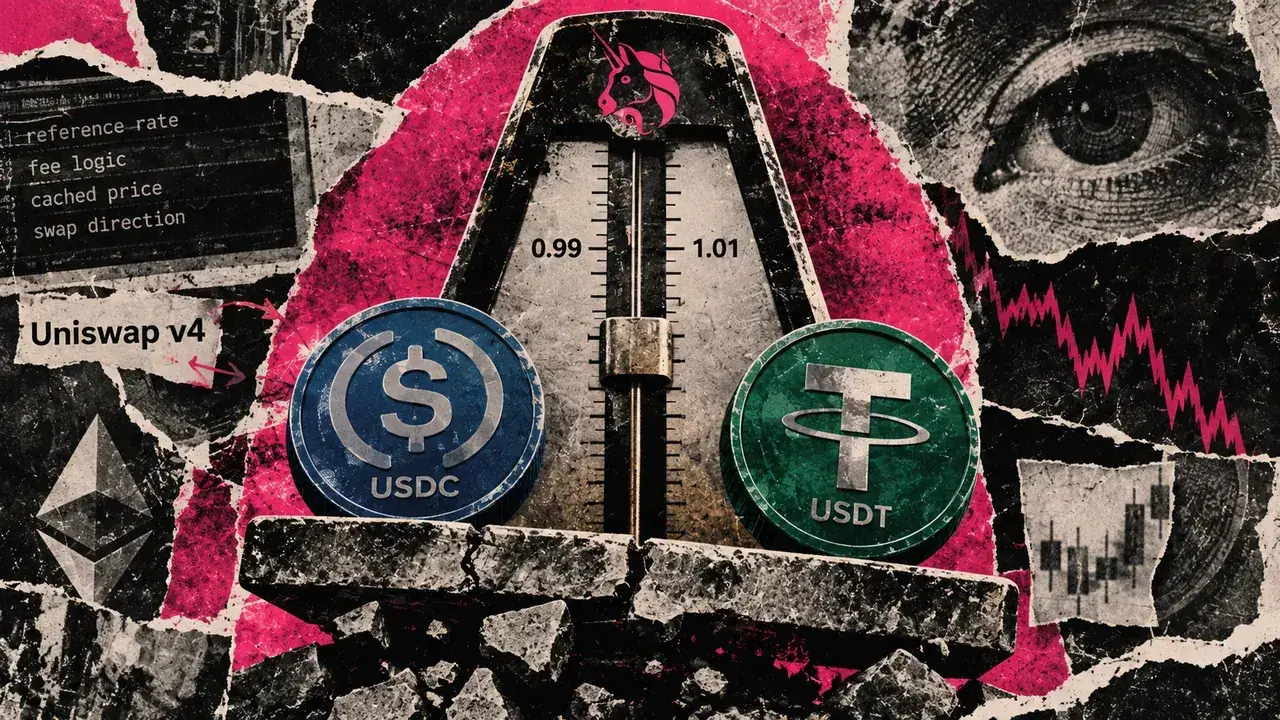
- The hook’s fee logic compares a cached pool price against a stored reference rate, never consulting an external market feed.
- On Sept. 30, 2026, the USDC/USDT StablePair pool held about $6.1 million in TVL versus $34.2 million in a comparable legacy v3 pool.
- $200B total H1 2026 stable-pair DEX volume, about 4% of crypto spot trading
- $6.1M StablePair pool TVL versus $34.2M in the older v3 pool
Uniswap Labs announced the two Ethereum pools, USDC/USDT and USDC/USDG, on Sept. 10, 2026. A CryptoSlate analysis of the hook’s documentation found that the mechanism’s benefit to LPs depends entirely on a configured reference rate holding, not on any live market check.
Uniswap Replaces a Flat Fee With a Block-by-Block Spread
Under a static fee, both sides of a trade pay the same rate, handing most of the value from a price correction to arbitrage bots, according to Uniswap’s Sept. 16 explanation. StablePair Hook instead measures, on every swap, how far the pool’s price sits from a reference rate set at pool creation, which for USDC/USDT is exactly 1:1 per the hook’s deployment documentation.
Inside a narrow band around that reference, both directions pay a fee calibrated to hold a fixed bid and ask. Outside the band, swaps that push the price further away pay zero fee, while swaps correcting it face a fee that decays like a Dutch auction until someone takes it.
Uniswap says the design captures the “vast majority” of rebalancing profit for LPs rather than ceding it to bots.
CryptoSlate Finds the Reference Rate Has No Market Check
CryptoSlate’s review identifies the first structural gap: the fee rule compares the cached pool price only against the stored reference, never an external oracle. The hook’s block-price caching mechanism takes the first swap in each block to set the price used for that block’s fee calculations, which removes a same-block fee exploit but leaves later trades exposed to stale inputs if the live price crosses the reference mid-block.
The second gap is economic rather than technical. If an issuer shock cuts one stablecoin’s external value below its reference, a sale of the weakening coin can read to the hook as moving the pool “away” from parity and earn zero fee, even though it reflects genuine price discovery rather than a temporary imbalance the hook is meant to correct.
The third gap concerns governance. Uniswap’s documented role model gives governance control over live fee configurations and implementation upgrades, meaning the reference benchmark itself can change. The fee rules that split trades by direction can shield LPs from bot-driven spread capture, but they cannot verify issuer solvency or restore a token’s redemption value once it depegs.
Early Volume Data Leaves the Return Claim Untested
CryptoSlate pulled Uniswap interface stats on Sept. 30, 2026, showing the USDC/USDT StablePair pool at roughly $6.1 million in TVL with $117.9 million in 24-hour volume around 15:59 UTC, and the USDC/USDG pool at about $2.6 million in TVL with $8.7 million in volume around 15:57 UTC. A comparable Ethereum USDC/USDT v3 pool charging a flat 0.01% showed about $34.2 million in TVL, $15 million in 24-hour volume, and $1,100 in 24-hour fees around 16:02 UTC, more than five times the StablePair pool’s locked value despite lower turnover.
The observations were not synchronized and the StablePair panels supplied no comparable absolute fee total or realized position-level return. Testing Uniswap’s claim that the hook captures the “vast majority” of rebalancing profit would require matching periods, active liquidity ranges, fee income, and inventory valuation across both pool types.
Uniswap says OpenZeppelin reviewed a non-upgradeable predecessor’s core fee mechanism from Feb. 9 to 13, 2026, and resolved the same-block fee-splitting issue through block caching, but the later upgradeability and governance role model fell outside that review.
The hook’s permanent address permissions exclude remove-liquidity callbacks and custom accounting deltas, so upgrades cannot block LP withdrawals or alter swap amounts to skim extra fees, though withdrawal rights say nothing about the market value of what an LP ultimately holds.
The CCS read. We read this less as a flaw in Uniswap’s code and more as a reminder that dynamic-fee hooks shift risk rather than eliminate it. LPs who ported liquidity into StablePair pools are now underwriting reference-rate integrity rather than bot-driven spread capture, a trade-off that only pays off if governance keeps the benchmark accurate and no pegged asset loses value faster than fees accrue.
Uniswap has not published a timeline for extending StablePair Hook beyond its two Ethereum pools or for governance to revisit the reference-rate update process, leaving open whether future upgrades will add an external price check the current design lacks. Integrators are directed to the deployment documentation to monitor configuration changes directly, since governance retains the sole authority to alter the benchmark LPs are now priced against.