XYO taps Autonomys to store machine data while Layer One proves its origin
Robots, sensors and AI systems generate far more data than any verification chain should hold. XYO’s answer is to keep the proof on XYO Layer One and move the bulk of the data to Autonomys.
- XYO is integrating XYO Layer One with Auto Drive, the decentralized permanent storage platform on the Autonomys Network.
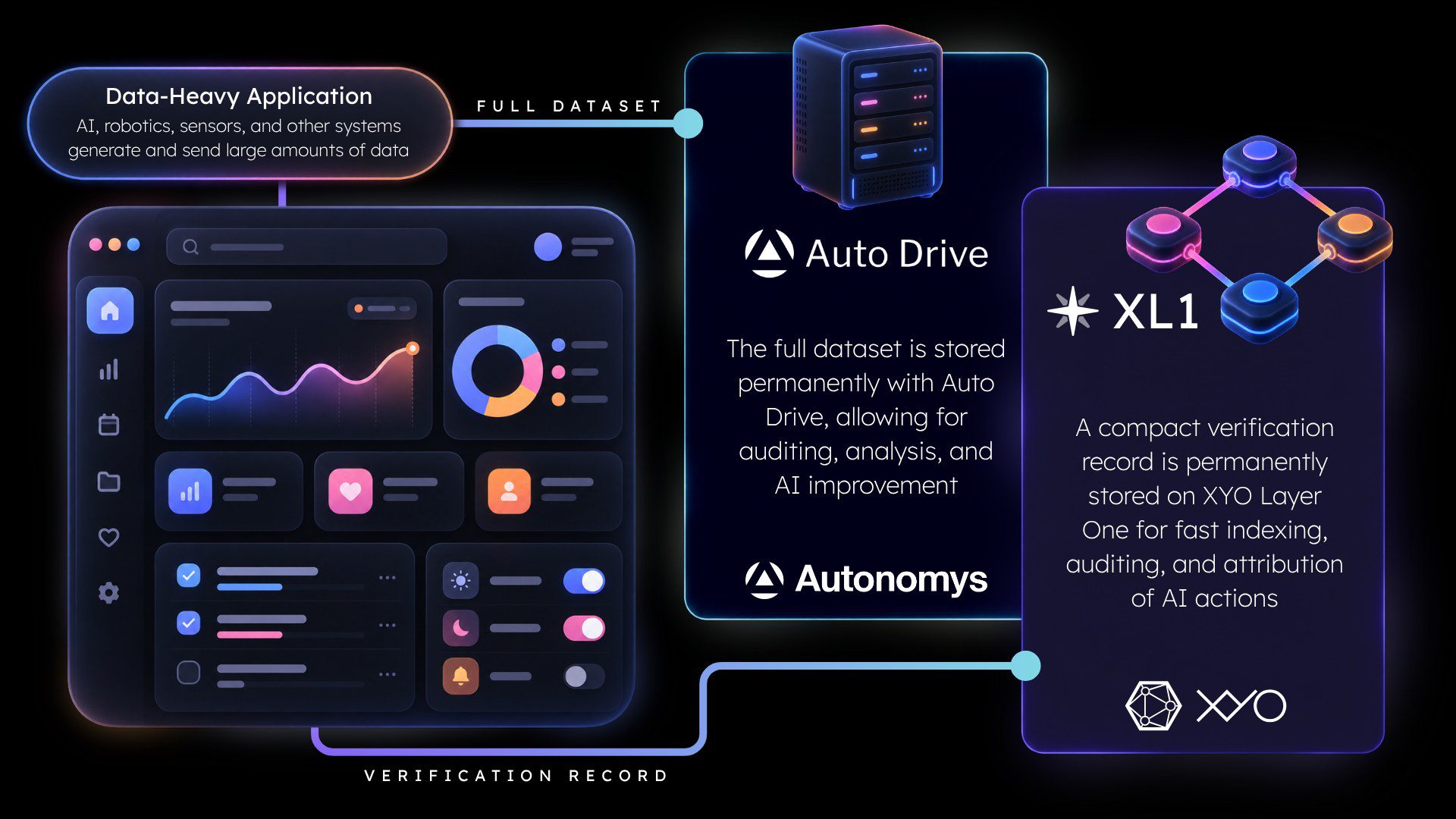
- Auto Drive holds the full dataset, while XYO Layer One records a signed, verifiable transaction that establishes where that data came from.
- The first release is an open-source developer sample, with the XYO AI SDK as the path into AI applications and more documentation promised as the integration grows.
Verification chains were never meant to be file cabinets
Every data-focused blockchain eventually hits the same wall. The record that proves something happened is small. The data surrounding that event is not.
A single action by a robot can come with video, sensor readings and system logs. An AI model can produce large outputs and supporting datasets. A DePIN network can stream machine data around the clock. Writing all of that directly to a base layer is expensive and slow, and it is not what a verification chain is built for.
XYO is addressing that directly. In an announcement on its blog, the company said it is partnering with Autonomys to connect XYO Layer One with Auto Drive, so developers can store large datasets permanently on-chain through Autonomys while XYO Layer One creates the verifiable record tied to them.
“XYO Layer One is built for data-heavy applications, but not every piece of data belongs directly on XYO Layer One. Autonomys gives developers a strong storage layer that complements the verification capabilities of XYO.”
Arie Trouw, CEO, CTO and Co-Founder, XYO
Autonomys stores the data, XYO proves where it came from
The design is a clean separation of jobs.
Autonomys handles storage. Data uploaded through Auto Drive is erasure-coded, spread across independent storage nodes and archived into the Autonomys Network as part of its chain history. It stays retrievable by content identifier, meaning the address of the data is derived from the data itself. Developers reach it through SDKs, APIs and an S3-compatible interface, so teams used to cloud storage workflows do not have to rebuild their tooling to go decentralized.
XYO handles provenance. XYO Layer One records the signed transaction that links to the stored dataset and establishes its origin. The heavy payload lives on Autonomys; the proof of where it came from lives on XYO.
“Machines are generating more data than most infrastructure was built to handle. Autonomys makes it possible to store that full dataset permanently on-chain, and XYO Layer One adds a verification layer that proves where it came from. Together, developers get data that lasts and data they can trust.”
Todd Ruoff, CEO, Autonomys
An open-source sample is the starting point
The integration starts small on purpose. XYO has released an open-source developer sample that stores an application payload through Auto Drive, confirms the data can be retrieved, and ties that process to a signed transaction finalized on XYO Layer One.
XYO describes it as a starting architecture rather than a finished product. Developers building AI applications can bring the same pattern in through the XYO AI SDK, which CCS covered when it went live, pairing verified provenance on XYO Layer One with larger datasets held on Autonomys.
The use cases XYO points to include robotics logs, sensor records, AI-generated data, media and historical datasets: anything large or continuously growing that needs to be both kept and trusted.
“This expands what developers and businesses can build around XYO. It makes much larger datasets practical without sacrificing verification.”
Markus Levin, Co-Founder, XYO
Provenance is becoming the core question for DePIN and AI
As AI models train on, and act on, machine-generated data, whether that data is real and unaltered moves from an academic question to a commercial one. The same is true in DePIN, where networks reward participants for data that has to be proven genuine before it is worth anything. Levin made the same case on the show when he walked through XYO Layer One’s data infrastructure.
Pairing a permanent storage network with a verification chain is a pragmatic answer: neither chain has to pretend to be the other, and XYO Layer One gets a storage option without taking on the cost and bloat of hosting everything itself.
The CCS read. XYO has been making the case for verified real-world data since long before AI provenance was a talking point, and this partnership is the practical version of that thesis. Keep the proof lean on XYO Layer One, put the heavy data somewhere built to hold it permanently, and developers get both. The open-source sample is the part to watch, because adoption comes down to how quickly a builder can try the pattern and ship something with it.
XYO says additional documentation and examples will follow as the collaboration develops. The signals that matter next are production deployments beyond the sample, which DePIN and robotics teams adopt the pattern first, and how XYO AI SDK users put it to work.
Disclosure: XYO Network is a sponsor of Crypto Coin Show.