If the Fed trusts this single 2.2% metric, Bitcoin could break $65.3k and ignite a path to $68k
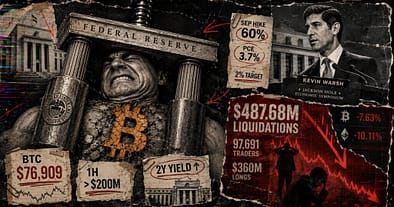
Federal Reserve Chair Kevin Warsh’s undisclosed weighting of inflation metrics has created uncertainty that is directly pricing Bitcoin volatility, with traders now assigning 66% odds to a September rate hike based on conflicting signals across five different inflation gauges ranging from 2.2% to 3.7%. Institutional investors face a binary question: whether Warsh will anchor his policy stance to headline inflation still 1.7 percentage points above target, or to the Dallas Fed’s trimmed-mean PCE at 2.2%, barely above the Fed’s 2% goal, a choice that could move Bitcoin toward $68,000 if the dovish reading wins his favor.
- Dallas Fed trimmed-mean PCE at 2.2% versus headline PCE at 3.7%: a 1.5-point spread defining Fed policy uncertainty
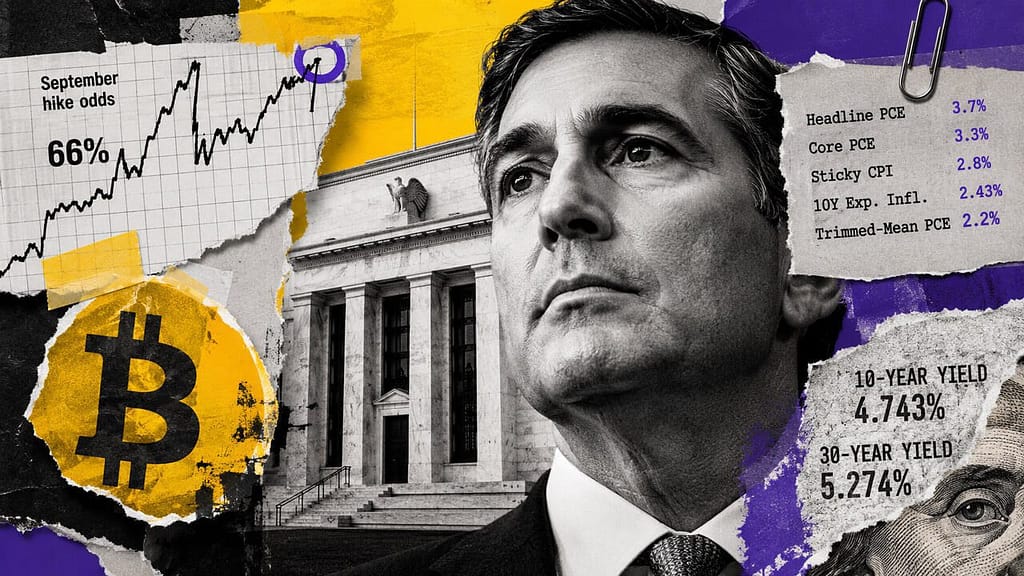
- Rate markets assign 66% probability to September FOMC hike; Atlanta Fed tracker showed 83% on July 29, illustrating repricing speed
- Warsh has declined to disclose his reaction function, leaving both next inflation readings and metric weighting as unknown variables
- 2.2% Dallas Fed trimmed-mean PCE, closest to Fed’s 2% target among five active measures
- 3.7% Headline PCE inflation, still 1.7 percentage points above the Federal Reserve’s stated goal
- 66% Rate market probability of September FOMC rate hike based on current economic signals
Bitcoin is trading near $63,000 as traders reckon with a Federal Reserve operating under a partly opaque inflation framework that could determine whether the next policy move tightens or loosens monetary conditions.
The source of the confusion is not academic: Federal Reserve Chair Kevin Warsh has defined his reaction function around “underlying inflation” while explicitly declining to disclose how he weighs the five separate inflation indicators now active across the Fed’s analytical apparatus.
That refusal to specify his metric hierarchy has created a pricing vacuum for both equities and crypto assets, since markets cannot arbitrage between conflicting signals when they do not know which signal matters most to the person holding the rate-decision lever.
The inflation dashboard itself speaks to the depth of disagreement among Federal Reserve staff economists. Headline Personal Consumption Expenditures inflation stands at 3.7%, more than 80 basis points above the Fed’s 2% target. Core PCE, excluding volatile food and energy, sits at 3.3%, still substantially elevated.
The Atlanta Fed’s sticky-price CPI, which weights items that change prices infrequently, has fallen to 2.8%, showing some cooling in persistent inflation. Yet the Cleveland Fed’s 10-year expected inflation measure reads 2.43%, suggesting long-term anchoring.
The outlier that may matter most is the Dallas Fed’s trimmed-mean PCE at 2.2%, a broad inflation measure that strips out the extremes on both tails and lands just 20 basis points above the Fed’s goal.
Warsh’s Refusal to Rank Inflation Metrics Leaves Bitcoin Pricing Two Unknowns at Once
Warsh told reporters that the Fed’s January strategy document retains PCE as its formal inflation objective, then invoked Goodhart’s Law, the economic principle that any measure chosen as a target ceases to be a good measure, and signaled the central bank could revisit its entire strategy framework in January 2027.
That hedge opens the door for his operative judgment to derive from a wider toolkit than the official framework specifies. The result is that Bitcoin traders and institutional investors must now price simultaneously the next actual inflation readings and the unknown weight Warsh will assign to each metric when it arrives.
A 3.7% headline reading would typically support tighter monetary policy, creating headwinds for risk assets. A 2.2% trimmed-mean figure, by contrast, gives the Fed substantial room to pause rate hikes when long-term expected inflation is anchored near 2.43%. The gap between these two readings is not a technicality: it is the entire market signaling problem.
Markets can price a known Fed reaction function; they cannot efficiently price a reaction function whose inputs remain hidden.
This opacity has accelerated repricing cycles. Rate market probabilities for a September hike jumped to 66% by late July, while the Atlanta Fed’s own probability tracker showed 83% probability on July 29, a 17-point swing in just days, signaling how quickly institutional money repositions when new economic data arrives without a clear policy anchor.
Federal Reserve Creates Task Forces to Rebuild Its Inflation Measurement Framework
Warsh has initiated a structural response to the measurement ambiguity by creating five monetary-policy task forces on July 9, signaling that the Fed itself recognizes its current inflation lens as incomplete.
The Data Sources group, headed by economist Raj Chetty, venture capitalist Doug McMillon, and economist Kevin Murphy, will seek timelier economic information to replace or supplement the lagging traditional indices that typically arrive weeks after the period they measure.
A parallel Inflation Frameworks group will reconsider how the central bank interprets the drivers of inflation itself, a more fundamental rethink than simply gathering faster data.
Warsh has stated his intention to review these task force findings before his Jackson Hole speech in late August, creating the possibility that the groups’ early recommendations could materially influence his August public commentary and shape expectations before the September FOMC meeting.
This timeline matters because Jackson Hole represents the Fed chair’s clearest annual platform for signaling shifts in framework or emphasis, and any hint that Warsh favors one inflation metric over others could narrow the pricing uncertainty Bitcoin and equity markets currently face.
The formal policy calendar then offers two hard decision points: the September 15-16 FOMC meeting, where the committee will release updated Summary of Economic Projections reflecting all members’ rate forecasts, and January 2027, when Warsh can formally revise the Fed’s strategy statement if the task forces recommend it.
Three Dissenting FOMC Votes Signal Brewing Disagreement Over Hike Timing
The Fed’s most recent decision to hold rates at 3.50% to 3.75% masked underlying disagreement that could presage policy fracture. The FOMC voted 9-3 to maintain the current range, with Beth Hammack, Neel Kashkari, and Lorie Logan supporting a quarter-point increase.
Three dissenting votes in favor of tightening is unusually high for a hold decision, suggesting that a meaningful bloc within the committee views inflation as insufficiently controlled and current rates as too accommodative.
This dissent is the institutional equivalent of a warning flag: if headline inflation ticks upward or Core PCE remains sticky in the next reading, those three votes could flip to form a majority position for a hike.
Warsh’s framework opacity, combined with this three-vote dissent, creates asymmetric risk for institutional positioning. A dovish surprise, where the Fed signals it will weight the 2.2% trimmed-mean PCE heavily and skip September, would likely propel Bitcoin decisively higher, toward the $65,300-$68,000 range implied in current options pricing.
A hawkish surprise, where Warsh signals that headline inflation still matters most or aligns with his three dissenters, would create sharp downside pressure as rate hike probabilities spike.
Long-term Treasury yields have already begun pricing in the longer-end uncertainty. The 10-year yield ended July near 4.743%, and the 30-year reached 5.274%, its highest level in 19 years, reflecting investor conviction that real rates may remain elevated regardless of near-term Fed decisions.
This long-end repricing suggests that institutional capital is hedging against the possibility that Warsh’s task forces recommend a more restrictive overall framework, even if near-term rate hikes pause.
Jackson Hole Speech Could Narrow Inflation Metric Hierarchy Before September Vote
Warsh’s August Jackson Hole address represents the most concrete near-term catalyst for reducing pricing uncertainty. By explicitly flagging his intention to review task force work before the speech, he has created a window where he could partially disclose his metric hierarchy without formally committing the entire Fed to a new framework. A statement as simple as “the Atlanta Fed sticky-price CPI and Dallas Fed trimmed-mean