China vows retaliation after Pentagon blacklists Alibaba, Baidu, and BYD
The Pentagon’s addition of Alibaba, Baidu, BYD, and NIO to a military-linked blacklist marks an escalation in US-China tech decoupling that directly threatens institutional crypto investors’ exposure to Chinese tech equities and blockchain infrastructure partnerships. Beijing’s explicit threat of “resolute and forceful countermeasures” signals that retaliatory measures could extend beyond these four companies to other sectors where Western crypto firms maintain operational or financial ties.
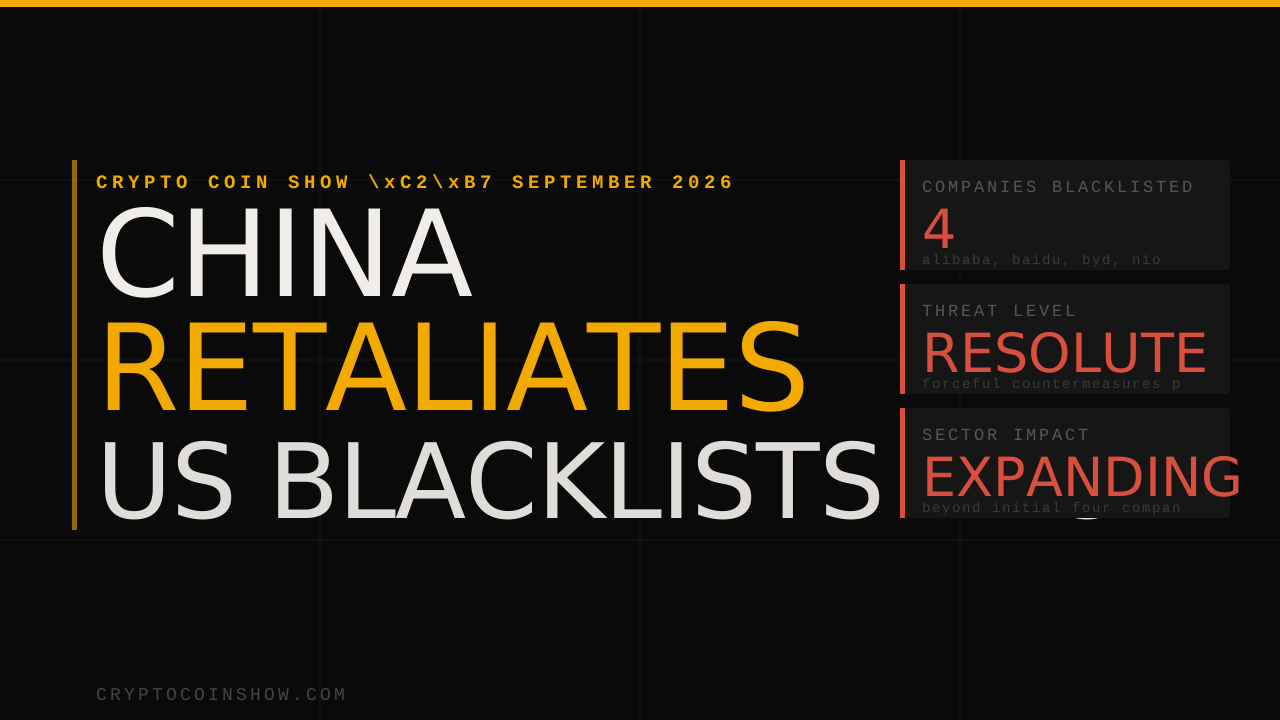
- Pentagon added Alibaba, Baidu, BYD, and NIO to Section 1260H list tied to Chinese military support activities.
- China’s Ministry of Commerce threatened unspecified retaliation and demanded US remove all companies from the blacklist immediately.
- Simultaneous implementation of stricter financial data rules by Chinese regulators signals Beijing is hardening data controls across sectors.
- 4 firms added to Pentagon blacklist, including two major cloud and EV technology providers.
- 2030 deadline by which US Defense Department must annually update the Section 1260H list by law.
- 6 agencies jointly issued new Chinese financial data classification rules including People’s Bank of China.
The Pentagon’s decision to add four major Chinese technology and automotive companies to its Section 1260H military-linked list represents a new phase in US-China technological separation, one with direct implications for institutional investors holding positions in Chinese tech equities or operating blockchain infrastructure dependent on cross-border data flows.
The updated list, released this week, names Alibaba, Baidu, BYD, and NIO alongside solar manufacturers Trina Solar and JA Solar Technology.
While the 1260H designation does not automatically trigger export bans or block US customer relationships, it signals to international financial markets that Washington views these firms as operationally connected to Chinese military advancement, a classification that can restrict US supplier access, complicate future M&A activity, and trigger secondary sanctions risk for institutions maintaining significant holdings.
China’s response was swift and unambiguous. The Ministry of Commerce issued a formal statement on Saturday condemning the Pentagon’s action as exceeding legitimate national security concerns and representing governmental overreach designed to suppress Chinese business competitiveness.
Beijing’s language went beyond diplomatic protest: officials explicitly warned that failure to reverse the decision would result in “resolute and forceful countermeasures,” with the US bearing full responsibility for consequences.
The Chinese embassy in Washington, through spokesman Liu Pengyu, rejected the premise entirely, arguing that Chinese firms comply with all applicable laws in their operating jurisdictions and called on the US to establish a “fair, just and non-discriminatory environment.”
Pentagon List Carries No Automatic Export Ban but Signals Upstream Financing Risk
The Section 1260H list, which US law requires the Defense Department to update annually through 2030, functions as a preliminary identification mechanism rather than an enforcement tool with immediate legal teeth.
Companies named on the list face the right to petition the Pentagon for review and submit evidence challenging their designation, a process Alibaba has already indicated it intends to pursue.
However, the list’s strategic importance lies in its signaling function: it flags to foreign governments, financial institutions, and supply chain partners that the US government considers these entities relevant to Chinese military capability development, which can trigger secondary screening by other regulators and reduce institutional appetite for equity or debt exposure.
The distinction between 1260H and the Commerce Department’s separate Entity List is material for portfolio managers. The Entity List carries mandatory restrictions on access to US technology and components, directly constraining business operations. The 1260H list operates upstream, in the financial and reputational space.
An institution holding Alibaba, Baidu, or BYD equity while simultaneously maintaining US government contracts, banking relationships, or compliance obligations faces potential conflicts: regulators may scrutinize connections between the two entities, and compliance departments may require divestment to avoid reputational or regulatory exposure.
The four companies added this week represent roughly 500 billion dollars in combined market capitalization as of recent trading, making their removal from investable indices a material event for passive and active strategies alike.
Alibaba’s public statement that the designation carried “no basis” reflects the company’s legal exposure but understates the market impact. The firm operates Aliyun, a cloud infrastructure platform with significant presence in Southeast Asia and offering blockchain services, infrastructure that US and allied institutional investors rely on for certain regional operations.
Any escalation of sanctions or restrictions could force rearchitecture of those systems, creating operational friction and cost increases for clients.
China Tightens Financial Data Controls as Retaliation Risk Spreads Across Sectors
On the same day Beijing issued its retaliatory warning, six Chinese regulatory agencies, including the Cyberspace Administration of China and the People’s Bank of China, jointly announced stricter rules governing financial information services. The new framework requires firms to classify all data into four categories: core, important, sensitive general, and routine general.
Each classification level carries different security requirements, audit obligations, and cross-border transfer restrictions based on the information’s military or economic sensitivity and the damage potential if leaked.
The move signals that China is not merely responding defensively to Pentagon actions but advancing a parallel hardening of domestic data controls that will constrain how foreign institutions access Chinese financial markets and manage their operational data.
For cryptocurrency market participants and blockchain infrastructure operators, the timing matters. Chinese regulators have already implemented broad data security laws in recent years; this sectoral rule for financial services indicates that Beijing views financial-sector data, which includes cryptocurrency trading data, custody records, and transaction logs, as strategically sensitive.
Crypto exchanges with significant Chinese user bases, institutional lending platforms accepting collateral from Chinese entities, and blockchain firms offering settlement or clearing services connected to Chinese financial markets face new compliance burdens and potential restrictions on data residency and cross-border transmission.
US and European institutions that rely on Chinese market data for trading algorithms, risk modeling, or institutional research will need to rebuild data pipelines to comply with the four-tier classification system or face delays and increased friction.
The regulatory announcement framed the new rules as necessary to manage risk in a growing financial information services sector. However, the simultaneous escalation of trade restrictions against major technology firms suggests the measures are part of a coordinated defensive stance by Beijing.
Officials stated the rules would “standardize the development” of financial information services as data volumes expand, language consistent with security-driven restriction rather than market facilitation.
Retaliatory Measures Could Extend Beyond Named Firms to Broader Technology and Financial Sectors
China’s threat of unspecified countermeasures carries particular weight given Beijing’s track record of using regulatory tools to pressure foreign firms and restrict market access in response to US sanctions.
Previous retaliation cycles have included enforcement actions against foreign tech companies, restrictions on data flows, blocking of US agricultural imports, and targeted restrictions on sectors where Chinese and American firms compete.
The current environment, characterized by simultaneous escalation on military-linked company designations and financial data regulation, suggests Beijing is preparing a multi-vector response.
Institutional crypto investors should monitor three specific risk vectors.
First, Chinese regulators could expand the financial data rules to explicitly restrict crypto trading data or custody records from cross-border transmission, effectively creating a data localization requirement that forces exchanges and custodians to choose between serving Chinese customers or maintaining international operations.
Second, Beijing could expand blacklist restrictions to include US firms or foreign entities with significant Chinese operations, triggering symmetric retaliation against American technology and financial services companies.
Third, China could use enforcement discretion to selectively restrict or audit foreign firms accused of non-compliance with data rules, creating operational uncertainty and compliance costs for institutions already exposed to the named Chinese companies.
Watch for Beijing’s next formal statement on countermeasures within the next 14 days, which may specify whether retaliation will target additional companies, sectors, or whether it will expand restrictions on data flows and financial services access. Simultaneously, monitor whether the Pentagon removes any of the four companies from the 1260H list following their petitions for review, as such reversal would signal room for diplomatic resolution; conversely, if additional Chinese firms are added to 1260H or Entity List by the Commerce Department in coming weeks, it would confirm an escalatory trajectory that increases the probability of Chinese regulatory retaliation reaching crypto and blockchain service providers.