Government AI tracks insider trading as bots take over prediction markets
Prediction markets processed over $44 billion in wagers last year as automated bots seized control of major platforms, now running 30% of active accounts on Polymarket and capturing 14 of the top 20 earner positions. Regulators are deploying AI surveillance tools to combat insider trading risks, with the CFTC investigating hundreds to thousands of suspicious accounts after criminal charges were filed against a U.S. Army officer for allegedly betting on classified intelligence.
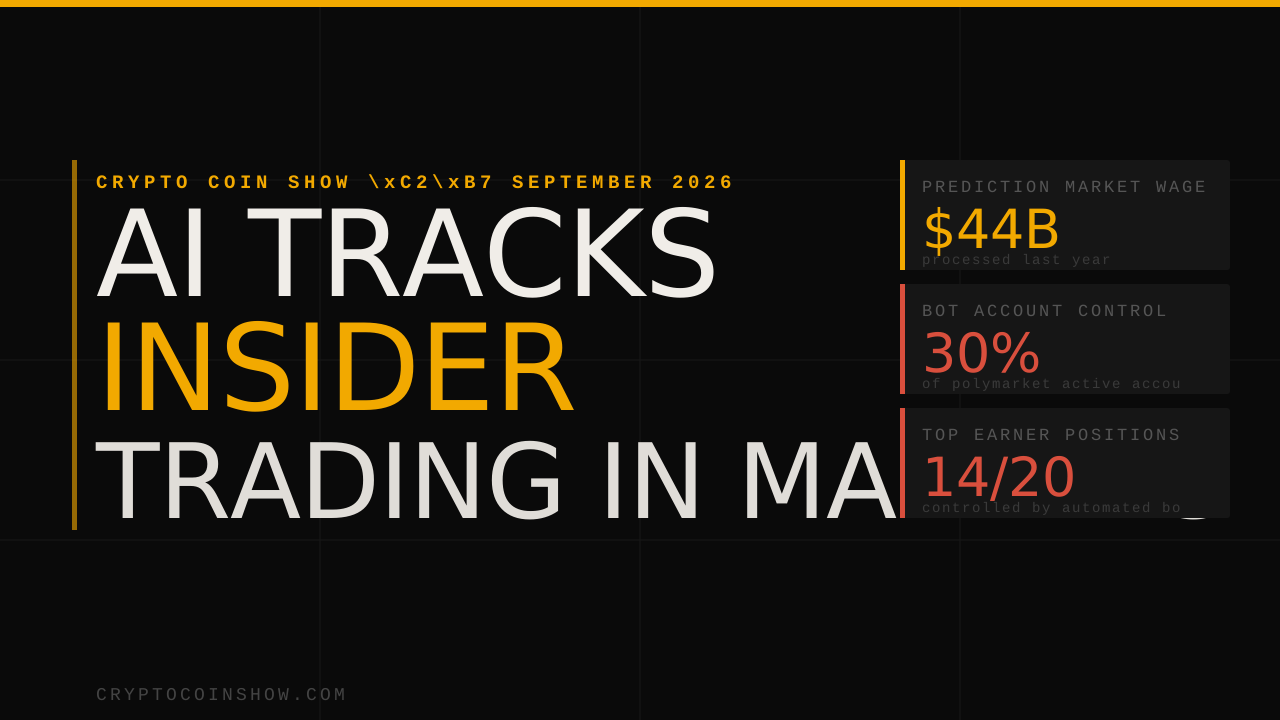
- Automated bots control 30% of Polymarket active accounts, including 14 of the top 20 earning positions on the platform
- Polymarket volume fell 8.9% to $10.2 billion in April while rival Kalshi surged 13% to $14.8 billion in the same month
- CFTC investigating hundreds to thousands of suspicious trading cases using AI tools and blockchain analytics to detect anomalies
- $44B Total prediction market wagers processed in the past year globally
- 30% Share of Polymarket active accounts now run by automated trading bots
- 8.9% Monthly volume decline for Polymarket in April versus prior month
The prediction market sector has reached institutional scale, with over $44 billion in annual wagers flowing through platforms like Polymarket and Kalshi, yet the ecosystem faces a critical structural shift: machines now dominate the markets that were originally conceived as human forecasting tools.
Automated trading bots have become so effective at extracting profits that they occupy 14 of the top 20 earner positions on Polymarket, the largest U.S. platform, while operating 30% of all active accounts.
This bot proliferation arrives as regulators and lawmakers intensify scrutiny over insider trading on these platforms, following the first criminal charges filed in the United States against a U.S. Army Special Forces soldier accused of using classified intelligence to place winning bets on Venezuelan political developments.
Bots capturing majority of top earnings while Polymarket loses market share to Kalshi
Polymarket’s dominance in prediction markets is eroding faster than most institutional traders realized. The platform’s April volume fell 8.9% month-over-month to $10.2 billion in total wagers, down from $11.2 billion in March, marking its first monthly decline since August.
The timing is significant: Polymarket was simultaneously rebuilding its U.S. regulatory footprint while facing a barrage of criticism from Congress over insider trading vulnerabilities.
Kalshi, Polymarket’s principal competitor, capitalized on the opening. The platform’s April volume jumped 13% to $14.8 billion, exceeding Polymarket’s figure and signaling a structural shift in market share.
For institutional investors tracking prediction market infrastructure, the divergence matters because it suggests regulatory uncertainty and reputational damage can materially redirect capital flows, even within an emerging asset class.
Polymarket’s retreat coincides with heightened political pressure, whereas Kalshi has maintained a more cautious compliance posture that appears to be attracting conservative institutional participants seeking reduced regulatory risk.
The bot dominance on Polymarket adds another layer of concern for human traders evaluating the platform’s long-term viability as a price discovery mechanism.
Congressional pressure targets government employees profiting from classified intelligence on prediction markets
In March, Senator Elizabeth Warren and more than 40 other members of Congress sent a formal letter to the Commodity Futures Trading Commission demanding explicit rules banning federal employees from using non-public information to trade on prediction markets.
The lawmakers cited the agency’s existing authority: the CFTC already classifies event contracts as swaps under its jurisdiction, meaning federal restrictions on insider trading should theoretically apply. Yet enforcement has been sporadic until now, with no clear guidance issued to government employees about the rules’ scope or penalties.
The CFTC maintains that event contracts are a type of swap subject to its jurisdiction, and, therefore, it should ensure that federal employees understand existing restrictions on prediction market insider trading.
Congressional letter to CFTC
The legislative pressure intensified following a pattern of suspicious trades that caught regulators’ attention. Several Polymarket users placed winning bets on sensitive geopolitical events, including military actions in Venezuela and potential conflict with Iran, bets placed shortly before official announcements or military operations.
The most egregious case involved a U.S. Army Special Forces soldier who was arrested and charged with criminal insider trading after allegedly using classified intelligence to bet on the arrest of Venezuelan President Nicolás Maduro.
This marked the first criminal prosecution for insider trading on a prediction market in U.S. history, setting a precedent that regulators appear determined to enforce broadly.
CFTC deploys AI surveillance across prediction markets detecting hundreds to thousands of suspect accounts
The CFTC is responding to the bot proliferation and insider trading risks with artificial intelligence surveillance systems. CFTC Chairman Michael Selig disclosed that the agency now uses AI tools to scan vast volumes of trading data, identify anomalous behavior patterns, and flag suspect accounts for human investigator review and potential subpoena.
The agency has also partnered with blockchain tracking firms like Chainalysis to monitor offshore platforms including Polymarket, which operates outside the traditional U.S. regulatory perimeter.
According to an AIMPACT update from May 15, the CFTC’s AI infrastructure combines blockchain analytics with market anomaly detection technologies to monitor both cryptocurrency-based and traditional financial market activity. The scale of the investigation is substantial: Selig stated the agency is actively investigating hundreds to thousands of potential insider trading cases.
This number suggests the CFTC is casting a wide net, moving beyond high-profile prosecutions to systematize detection of lower-level violations.
For institutional investors in prediction markets, this represents a significant regime shift, from ad hoc enforcement to industrial-scale algorithmic surveillance capable of flagging unusual profit patterns, price movements ahead of news, and other statistical anomalies that suggest information leakage.
Selig emphasized that AI has become essential as prediction market data volumes grow exponentially. Without machine learning systems capable of processing millions of daily trades, the CFTC would lack the analytical capacity to identify insider trading patterns at all.
The combination of bot-driven market activity and regulatory AI creates a feedback loop: bots generate massive data volumes through high-frequency trading and strategy testing, which regulators then must analyze algorithmically, which in turn trains new detection models that may themselves be deployed as trading systems.
Future enforcement will target U.S. users masking locations through offshore platforms
CFTC leadership has signaled that enforcement will accelerate beyond current cases. Selig stated the agency will pursue action against U.S. citizens and government employees who attempt to mask their location by routing trades through offshore platforms or anonymizing wallets.
This represents a clear departure from the CFTC’s previous posture of treating prediction markets as a lower-priority enforcement area compared to futures and derivatives.
The enforcement expansion will likely focus on three categories: government insiders using classified information, sophisticated traders using privacy tools to evade detection, and individuals trading on sensitive national security events. None of these categories is limited to Polymarket; they apply across all prediction market platforms accessible to U.S. traders.
Kalshi, which is CFTC-regulated and operates within the U.S. regulatory framework, may face lighter scrutiny than offshore competitors, potentially accelerating its market share gains versus Polymarket.
The CFTC’s stated commitment to prosecute location-masking traders, combined with the ongoing investigation into hundreds to thousands of accounts, suggests institutional investors should expect the first wave of enforcement actions within the next two to four quarters. Polymarket’s position depends on whether it can accelerate its compliance infrastructure and convince Congress that U.S. regulation, rather than outright bans, can address insider trading risks; Senator Warren’s coalition will likely push for legislative action if CFTC enforcement appears inadequate by mid-2025.
Original reporting: cryptopolitan.com