Uber offered €33 per share for Delivery Hero, but investors want €40+
Uber’s €33-per-share bid for Delivery Hero undervalues the German food delivery platform by institutional investor standards, with major shareholders openly demanding €40 or higher, a gap that signals prolonged negotiation and regulatory uncertainty ahead. The failed CEO transition and activist pressure at Delivery Hero, combined with competing interest from DoorDash, have created a complex M&A landscape that threatens to derail Uber’s broader ambition to consolidate European food delivery into its travel and mobility platform.
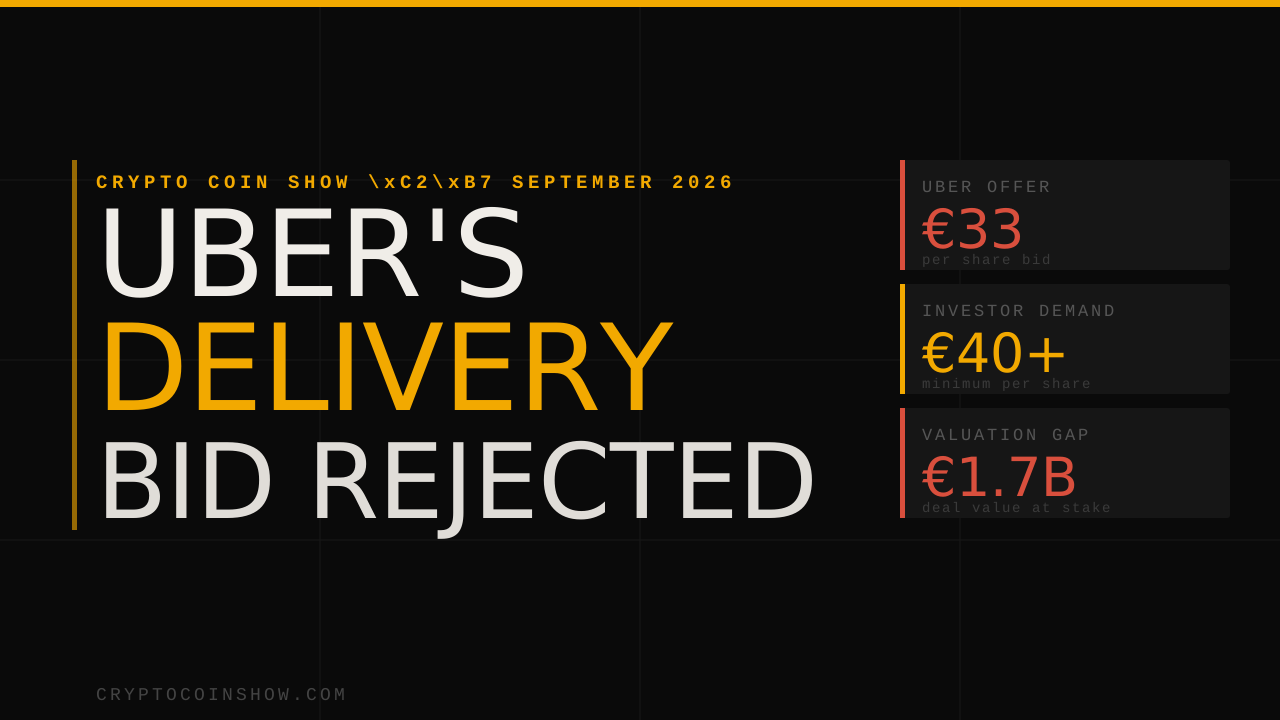
- Uber bid €33 per share for Delivery Hero, valuing the company at approximately €1.7 billion at its 19.5% stake level.
- Major institutional shareholders have explicitly rejected the offer, demanding €40 or more per share, a 21% premium over Uber’s current bid.
- DoorDash is competing for the Middle Eastern assets (Talabat and HungerStation), forcing Delivery Hero’s board to weigh a full sale against a split transaction.
- €33 Uber’s offer price per share versus shareholder demand threshold
- 19.5% Uber’s current stake in Delivery Hero, up from 7% recently
- 25% Platform booking growth at Uber in first quarter year-over-year
Uber launched a formal acquisition offer for Delivery Hero on Saturday at €33 per share, valuing the struggling German food delivery company at roughly $38.29 per share in dollar terms. The price arrived just 1.76% below Delivery Hero’s Friday closing price, but institutional shareholders have made clear they will not accept the bid at that level.
Multiple major investors have independently signaled to both Uber and DoorDash that they expect at least €40 per share, roughly $46.41, creating an immediate 21% gap between what Uber is offering and what the market believes the company is worth.
The timing coincides with a leadership crisis at Delivery Hero: CEO Nikolai Oestberg stepped down last week amid pressure from activist investors demanding a strategic overhaul, leaving the board to negotiate a potential sale from a weakened position.
Uber rapidly built 19.5% stake while activists pushed Delivery Hero CEO out
Uber’s aggressive accumulation of Delivery Hero shares happened in tandem with the food delivery platform’s internal turmoil. The ride-hailing giant escalated its position from 7% to 19.5% in recent weeks, building a holding now worth around €1.7 billion on the company’s current valuation.
This move effectively positioned Uber as Delivery Hero’s largest shareholder before formally tabling an acquisition bid, a negotiating posture that mirrors classic takeunder plays where an acquirer builds a blocking stake and then tables a below-market offer, betting that the seller’s board will face pressure to negotiate rather than walk away.
That bet appears to have misfired. Delivery Hero’s board has not accepted the offer and is instead evaluating multiple strategic options, including the possibility of splitting assets rather than selling the entire company as a going concern.
The board’s deliberation suggests that institutional shareholders, who have already forced out the CEO and are clearly coordinating with each other, retain enough collective power to reject a deal they view as underpriced, even with Uber now controlling nearly one-fifth of the company’s shares.
Uber’s stock fell 1.5% to 1.6% on the news of the bid, suggesting that investor sentiment on Delivery Hero’s European business remains tepid at best.
DoorDash’s competing interest in Talabat complicates the full-sale scenario
A full acquisition of Delivery Hero by Uber is no longer the only option on the table. DoorDash has been conducting its own conversations with Delivery Hero investors and appears focused specifically on acquiring the company’s Middle Eastern portfolio, Talabat and HungerStation, rather than the entire business.
This selective interest fundamentally changes the negotiation dynamics: instead of a single buyer with monopoly power, the board now faces a scenario where it might unlock greater shareholder value by splitting the company and selling regional assets to different acquirers.
The Middle Eastern delivery market has emerged as a critical battleground for the global food delivery majors, and DoorDash’s interest underscores the region’s strategic importance. Talabat and HungerStation operate in high-growth markets where Uber’s presence is less dominant than in Europe or the United States.
By pursuing a split transaction, Delivery Hero’s board could potentially sell the European and South Korean businesses to Uber while monetizing the Middle Eastern assets at full market value to DoorDash or another bidder, a structure that would almost certainly exceed the per-share prices both major shareholders and institutional investors are currently demanding.
The board has not yet disclosed its strategic preference, but the fact that it is actively considering both a full sale and a split indicates that shareholders have retained meaningful leverage. Institutional investors have already made their minimum acceptable price clear at €40 per share; a split transaction would likely need to meet or exceed that threshold in combined value to gain approval.
Uber’s broader platform ambitions collide with food delivery valuation reality
Uber’s interest in Delivery Hero sits within a larger corporate strategy to evolve from a ride-hailing company into a comprehensive travel and lifestyle platform.
At its Go-Get event in New York, held just ahead of earnings, Uber unveiled a suite of new features designed to position the app as a one-stop booking platform: hotel reservations covering over 700,000 properties worldwide through a partnership with Expedia, restaurant reservations, voice-command booking through an AI assistant, and new services like Shop for Me and Eats for the Way.
The company is attempting to retain users and drive higher average transaction values by expanding the range of services accessible from a single application.
A fully integrated Delivery Hero acquisition would fit cleanly into that strategy, particularly in European markets where Delivery Hero holds strong positions and local brand recognition. However, the valuation gap suggests that capital markets do not yet assign substantial value to Uber’s platform-bundling thesis.
Uber reported first-quarter revenue of $13.2 billion, up 14% year-over-year, and platform bookings reached $53.7 billion, a 25% increase. The company also beat earnings estimates, delivering 72 cents per share against a 69-cent consensus forecast. BMO Capital Markets maintained a buy rating on May 21, signaling that core business momentum remains intact despite the Delivery Hero friction.
Yet Uber’s stock is down 11% year-to-date and 17% over the past 12 months, suggesting that investors remain skeptical of growth stories requiring major M&A to play out.
The valuation disconnect is stark: Uber is willing to pay €33 per share for Delivery Hero based on its operational earnings and market position, but shareholders believe €40 or more is justified.
That gap reflects either a genuine disagreement about the business’s intrinsic value or, more likely, Uber’s assessment that acquiring Delivery Hero at €33 per share fits Uber’s capital allocation framework while shareholders expect Uber to pay a premium for strategic and platform value.
The question is whether Uber will close that gap or whether DoorDash or another bidder will emerge as the ultimate acquirer.
Delivery Hero’s board is expected to announce its strategic decision imminently, with sources indicating that a preference for either a full sale, a split transaction, or a rejection of both Uber and DoorDash bids in favor of remaining independent will determine whether this deal closes, stalls at a higher price point, or collapses entirely. Watch for board communications in the coming weeks regarding the formal response to Uber’s bid and any formal process management decision.
Original reporting: cryptopolitan.com