
MANTA price prediction 2026-2032: Will Manta Network survive or crash?
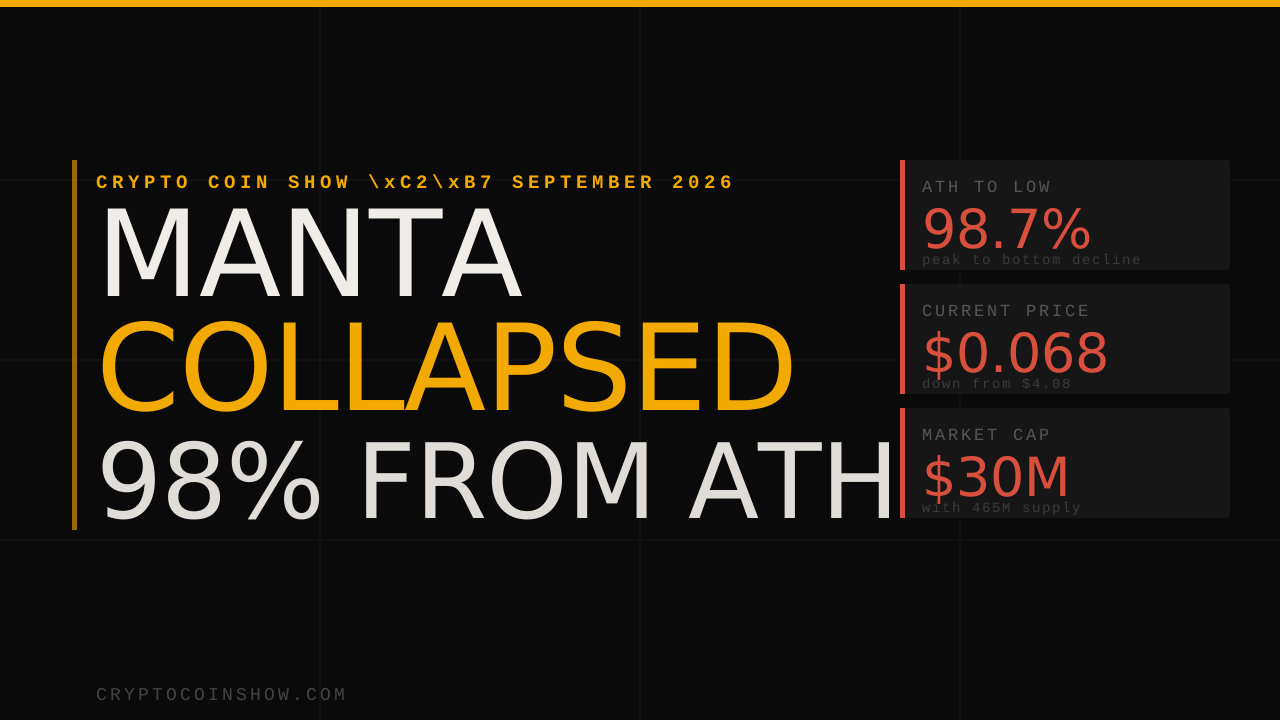
Manta Network’s native token MANTA has collapsed 98% from its all-time high of $4.08 in March 2024 to a current price near $0.068, raising fundamental questions about the modular zero-knowledge rollup’s long-term viability for institutional investors. Technical analysis reveals mixed signals amid medium volatility, with near-term recovery potential constrained by bearish sentiment and a bloated token supply of 465 million coins against a diminished $30 million market cap.
- MANTA price crashed to $0.053 on October 11, 2025, a 98.7% decline from its $4.08 all-time high recorded March 13, 2024
- Current trading at $0.068 with $30 million market cap and 465.43 million circulating supply, generating just $6.74 million in 24-hour volume
- Technical forecasts predict recovery to $0.8 by 2026 and $5 by 2032, contingent on network adoption and token economics restructuring
- 98.7% Decline from all-time high in March 2024 to lowest point in October 2025
- $30M Current market capitalization versus $465.43M token circulating supply ratio
- 2026-2032 Forecast period for potential recovery to $0.8 and $5 price targets respectively
Manta Network, which launched its token in September 2023 to immediate market enthusiasm, now trades at levels 98.7% below its peak, crystallizing a common pattern in emerging blockchain infrastructure plays: rapid hype-cycle adoption followed by structural revaluation as market participants assess actual technology differentiation and token utility.
At $0.068, MANTA ranks among the lowest performers in the Layer 2 and modular execution space, where competing solutions like Arbitrum, Optimism, and Polygon have maintained significantly higher valuations despite their own volatility.
The protocol positions itself as a modular zero-knowledge rollup for Ethereum with integrated Solidity smart contract support and a compliance-focused decentralized identity layer, but these technical attributes have not yet translated into user adoption metrics or developer activity sufficient to arrest the token’s decline.
Token Supply Dilution and Market Cap Compression Create Structural Headwind
The core issue facing MANTA holders is not only price depreciation but the mismatch between circulating supply and enterprise value.
With 465.43 million tokens in circulation generating just $30 million in market capitalization, the per-token value sits near institutional irrelevance thresholds, where transaction costs and custody complexity exceed the fundamental upside potential for traditional fund allocation.
For comparison, Ethereum’s market cap of approximately $2 trillion across 120 million ether equates to roughly $16,700 per coin; even Arbitrum, a more directly comparable Layer 2 solution, trades with a market cap in the low single-digit billions across a much smaller token float.
Manta’s tokenomics reveal limited scarcity mechanisms and no evident token burn schedule or deflationary policy that would reduce supply overhang. The 24-hour trading volume of $6.74 million represents only 22% of the total market cap, indicating shallow liquidity that amplifies slippage on institutional-sized trades.
This liquidity profile makes large position accumulation or exit practically difficult, restricting the capital pools that can meaningfully participate in any recovery narrative.
The protocol must either demonstrate rapid user growth and transaction volume scaling, or implement aggressive tokenomics reforms, potentially including supply reduction, staking incentives, or revenue-sharing mechanisms, to restore institutional confidence.
Technical Setup Signals Neutral Ground Between Continued Decline and Bounce
On-chain and charting indicators present a conflicted picture. The 14-day Relative Strength Index (RSI) hovers at 53.54, precisely at the midpoint between bearish and bullish territory, reflecting indecision.
The 50-day and 200-day simple moving averages sit at $0.06493 and $0.08112 respectively, placing current price between these averages and suggesting the token lacks a sustained directional impulse. The Fear and Greed Index registers 47, classified as neutral, confirming that neither panic selling nor irrational exuberance is driving the current tape.
Manta’s 24-hour price movement of +0.6% and reported volatility of 3.19% (medium range) indicate constrained intraday swings typical of low-volume, low-conviction trading. Resistance sits at $0.06973, only 2.7% above current levels, while support anchors at $0.06567 just 3.5% below, creating a narrow band unsuited to significant capital deployment.
The green day count of 15 out of 30 reflects genuine price oscillation rather than trending movement, and the MACD formation shows red candles below the signal line, presaging negative momentum on the 4-hour timeframe.
This technical stalemate is common in post-bubble altcoin structures where the token must either absorb new fundamental catalysts or face continued sideways compression. Without a material protocol announcement, partnership, or demonstrable network metric improvement, technical recovery to resistance levels remains a trading range phenomenon rather than a structural reassessment.
Recovery Thesis to $0.8 by 2026 Requires Proof of Network Activity
Forecasts predicting MANTA recovery to $0.8 by 2026, a 1,076% increase from current levels, rest implicitly on the assumption that Manta Network will capture meaningful Ethereum ecosystem developer mindshare and generate sustained transaction volume.
The protocol’s technical positioning as a modular ZK rollup with native privacy and compliance features addresses real institutional demand, particularly in regulated finance and enterprise applications. However, this positioning has failed to generate competitive advantage against entrenched alternatives.
Arbitrum dominates the modular rollup landscape with established ecosystem depth, developer tooling, and institutional partnerships. Polygon, while technically distinct, has achieved far greater transaction throughput and brand recognition.
For Manta to achieve a 1,000%+ recovery, the protocol would need to either capture a distinct use case, such as serving jurisdictions requiring regulatory compliance or privacy-first infrastructure, or accelerate adoption among decentralized finance protocols and NFT platforms where transaction volume directly correlates to token value capture.
Current publicly available data on Manta’s daily active users, total value locked (TVL), and transaction throughput relative to competitors is unavailable in the source material, making independent validation of the $0.8 target impossible.
Any recovery thesis must hinge on institutional demand for ZK rollup infrastructure exceeding current market expectations, a scenario that requires both protocol execution and macroeconomic conditions favoring risk-on digital asset allocation.
2032 Price Target of $5 Hinges on Market Maturation and Token Supply Dynamics
Extrapolating to a $5 price target by 2032 implies a market cap of approximately $2.3 trillion, an assumption that would require MANTA to rival Ethereum’s current valuation across a similar or larger use-case footprint.
This forecast is inherently speculative and contingent on multiple unresolved variables: whether modular rollup architectures become the dominant Ethereum scaling solution, whether Manta’s specific feature set (privacy, compliance, ZK proofs) generates irreplaceable utility, and whether token supply remains static or experiences planned reductions through governance.
The 2032 horizon also assumes sustained institutional adoption of cryptocurrency infrastructure, stable or favorable regulatory environments in major jurisdictions, and the absence of superior competing technologies.
Seven years is sufficient time for Layer 2 architectural preferences to shift, for new protocols to emerge, or for Ethereum’s core scaling solutions to evolve in ways that reduce demand for modular rollups altogether. The price prediction thus reflects an optimistic scenario within a narrow technological pathway, not a base-case outcome.
Without explicit commitments from Manta’s development team regarding tokenomics reforms, adoption roadmap milestones, or partnership announcements, the $5 forecast remains a speculative ceiling rather than a probable outcome.
Institutional