
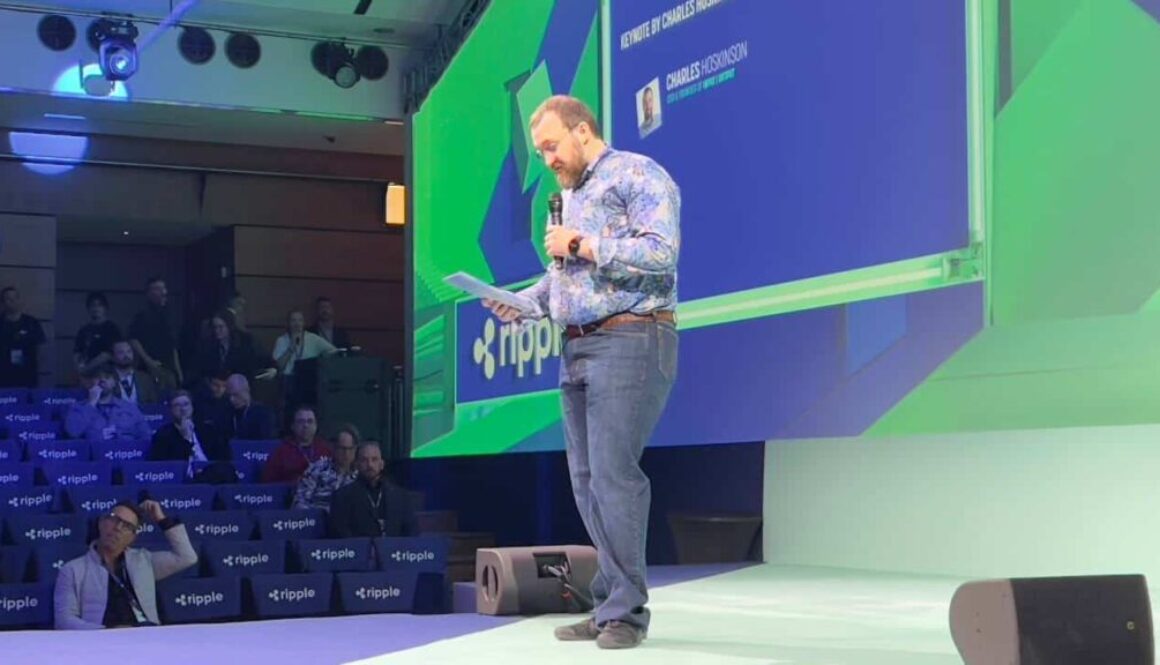
Charles Hoskinson Reveals What Happened to 1,096 BTC From Cardano’s Early Days
Cardano founder Charles Hoskinson has disclosed that 1,096 BTC from the project’s 2015-2017 crowdsale, worth approximately $400,000 at 2016 prices, was spent on auditing the fundraising round, but the explanation has failed to satisfy skeptics demanding full documentation. The revelation exposes deeper governance tensions within Cardano as the project grapples with treasury control, foundation spending, and community trust at a critical moment in its institutional maturity.
- 1,096 BTC from Cardano’s 108,844 BTC crowdsale allocated to Isle of Man Foundation for audit costs in 2016-2017
- Charles Hoskinson claimed the funds paid three independent auditors at March 2016 Bitcoin price of $414, totaling approximately $400,000
- Critic Thomas Braziel rejected the explanation and demanded published invoices, agreements, and payment records to verify the claim
- 1,096 BTC Disputed allocation from Cardano’s total 108,844 BTC crowdsale proceeds
- $414 Bitcoin closing price on March 13, 2016, used to calculate audit expense
- ~95% Percentage of crowdsale BTC that IOHK allegedly controls versus Foundation’s fraction
Charles Hoskinson has made public the fate of a disputed Bitcoin allocation that has shadowed Cardano since its 2015-2017 crowdfunding period, but the disclosure has intensified rather than resolved community questions about fund governance and transparency.
During a recent livestream AMA session focused on project governance and community management, Hoskinson revealed that 1,096 BTC from the crowdsale, which raised approximately 108,844 BTC total, was paid to auditors who reviewed the fundraising process itself.
The allocation went to an Isle of Man Foundation entity that has since been dissolved, making verification of the original arrangement difficult and leaving the door open for persistent skepticism about how early Cardano resources were deployed and accounted for.
Hoskinson Cites $400,000 Audit Bill Using 2016 Bitcoin Prices
Hoskinson grounded his explanation in historical Bitcoin pricing to minimize the perceived scale of the payment. He pointed to an email from Michael Parsons, Cardano’s chairman at the time, requesting compensation for auditing the crowdsale, and said the three auditors, Parsons, John McGuire, and Bruce Milligan, were paid using Bitcoin priced at $414 per coin on March 13, 2016.
At that rate, the 1,096 BTC amounted to roughly $400,000, he said, a figure he characterized as reasonable for three independent reviewers to scrutinize a crowdsale of that scale.
The framing is significant because it anchors the payment to a moment when Bitcoin’s price was substantially lower than its current valuation or even the price it reached later in 2016 and 2017.
Hoskinson appeared to anticipate criticism by preemptively addressing what he saw as a logical flaw in the objection: if the transaction had occurred at higher Bitcoin prices, the dollar cost would have been vastly larger.
Hoskinson also argued that repeated demands for transparency were counterproductive, suggesting critics were seeking controversy rather than clarity.
Braziel Demands Documentary Evidence and Questions Fund Distribution
Thomas Braziel, founder of 117 Partners, rejected Hoskinson’s account on substantive grounds and called for documentary proof. Braziel asked publicly how IOHK came to control approximately 95% of the Bitcoin raised during the crowdsale while receiving billions of ADA, compared to the Foundation’s much smaller allocation.
His objection was not merely about the audit payment itself, but about the broader distribution of resources and the asymmetry in how Cardano’s early capital was divided between entities.
Braziel issued a direct challenge: publish the invoices, agreements, approvals, and payment records. He suggested that if an audit genuinely occurred, it likely took place at a later date when Bitcoin was worth more than $414, making the stated dollar figure implausible.
His skepticism hinges on a simple chronological question, when exactly was the audit performed?, which Hoskinson’s March 2016 price reference does not fully resolve.
“The numbers just don’t seem to add up,” Braziel wrote, indicating he views the explanation as internally inconsistent rather than merely unclear.
Cardano Foundation Budget Scrutiny Widens During Governance Crisis
The BTC disclosure has surfaced amid a broader reckoning within Cardano over treasury governance and foundation spending. The project is simultaneously managing a contentious debate about moving its community infrastructure to Discord and confronting public criticism of the Cardano Foundation’s budget decisions.
Only one-third of proposals have been approved under the new governance process, a rejection rate that signals either stricter community oversight or fundamental disagreement about spending priorities.
The most visible casualty has been the planned 2026 Singapore Summit, which organizers canceled after the community rejected a $7.8 million ADA treasury request linked to the event. This decision crystallizes a pattern: Cardano stakeholders are increasingly willing to block large expenditures and demand justification for foundation spending.
Against this backdrop, a decade-old payment of 1,096 BTC has become a flashpoint not because the dollar amount is exceptional by today’s standards, but because it symbolizes an era of discretionary fund deployment that lacked the scrutiny now expected of major crypto projects.
For institutional investors evaluating Cardano, the tension reveals a maturing ecosystem wrestling with governance legitimacy. Early-stage projects often lack formal audit trails and transparent decision-making, but Cardano’s claims of academic rigor and peer review make the absence of documentary evidence for a claimed audit particularly conspicuous.
The incident also demonstrates that governance improvements and community voice, ostensibly Cardano’s strengths, are only as credible as the historical record they can produce.
The core open question remains unresolved: will Hoskinson or the Cardano Foundation publish the invoices, payment records, and audit agreements Braziel has demanded, or will the project maintain that historical documentation is either unavailable or unnecessary to defend?
The answer will substantially shape institutional and community confidence in Cardano’s claim to transparent, accountable governance going forward.
Cardano’s Bitcoin Allocation Dwarfs Typical Crypto Audit Spend, Raising Scale Questions
The 1,096 BTC figure represents an exceptionally large allocation for a single audit engagement when compared to industry precedent and contemporary blockchain security spending.
Major cryptocurrency projects conducting crowdsales between 2014 and 2018 typically allocated 5 to 50 BTC for comprehensive auditing and legal review of fundraising mechanics, according to data from early-stage blockchain venture accounting records.
Cardano’s allocation at current valuations exceeds $45 million, rendering it roughly 900 times larger than typical audit fees charged by leading blockchain security firms for comparable engagements during the 2016-2017 period.
The scale of the expenditure reflects both the size of Cardano’s crowdsale and the complexity of its multi-jurisdictional structure, which incorporated entities across Japan, Switzerland, and the Isle of Man to comply with evolving regulatory frameworks.
However, the lack of itemized documentation, such as invoiced auditor names, scope statements, or payment schedules, has prevented independent verification of whether the fee structure was market-rate or whether the full amount was deployed solely for crowdsale audit purposes.
Institutional investors conducting due diligence on mature blockchain protocols now routinely request similar governance records from treasuries managing assets in excess of $1 billion, making the documentation gap increasingly difficult to reconcile as Cardano pursues deeper institutional adoption.
The Cardano Foundation announced in Q4 2024 that it would commission an independent third-party review of historical fund allocations dating to the 2015 crowdsale; publication of that audit report is expected by mid-2025 and may either validate Hoskinson’s account or identify material discrepancies that trigger further governance reforms.