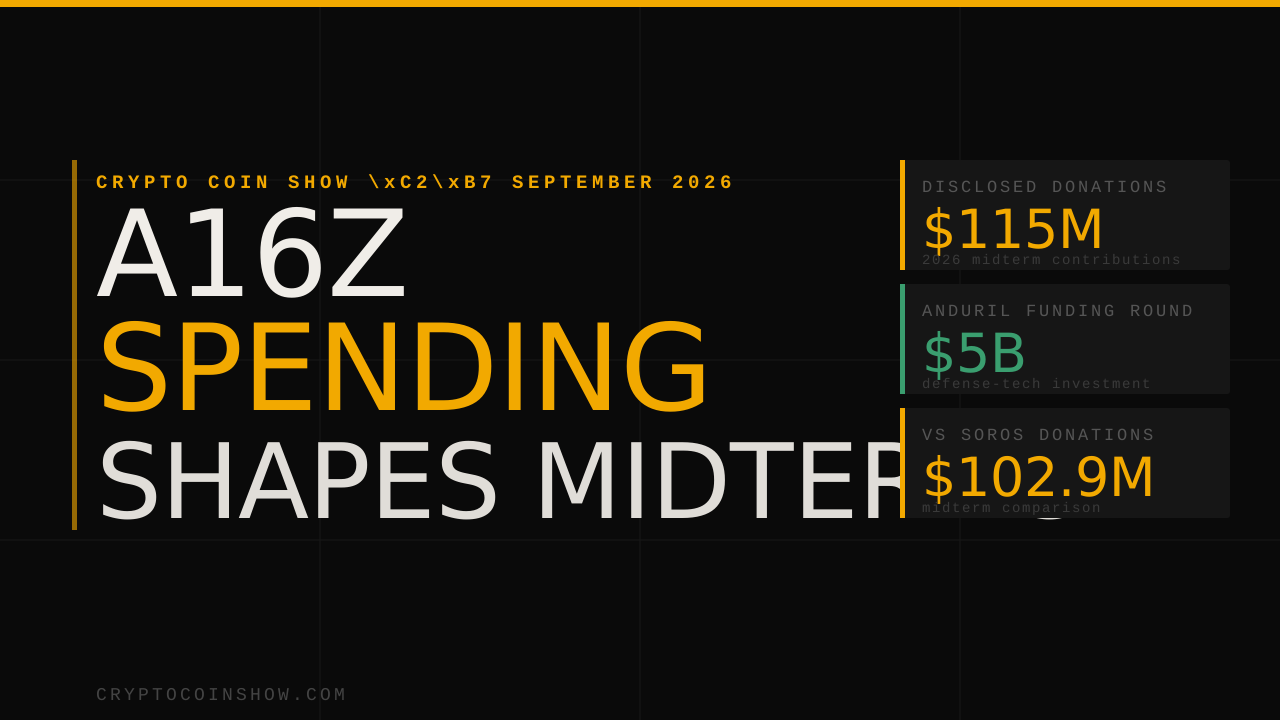
a16z emerges as big spender, directing cash into Anduril, US mid-terms
Andreessen Horowitz has emerged as the 2026 U.S. midterm election cycle’s largest disclosed donor with $115 million in contributions, simultaneously backing a $5 billion funding round for defense-tech startup Anduril, signaling how venture capital is now directly shaping both regulatory capture and national security procurement outside traditional lobbying channels. For institutional crypto investors, the pattern reveals a16z’s strategy to engineer favorable policy conditions for Web3 through political spending while diversifying into defense infrastructure, a sector with government-guaranteed revenue streams.
- a16z has donated $115 million in disclosed federal contributions to 2026 midterms, exceeding Soros ($102.9 million) and Elon Musk ($85 million) combined.
- Anduril raised $5 billion in Series H funding led by Thrive Capital and a16z, valuing the defense-tech company at $61 billion with operational autonomous weapons factory in Ohio.
- a16z committed $23 million to Fairshake super PAC and $50 million to pro-AI super PAC to support crypto-friendly and tech-aligned candidates in midterm races.
- $115M a16z political donations to 2026 midterms versus Soros at $102.9 million
- $5B Anduril Series H valuing defense startup at $61 billion, up from prior rounds
- $10B a16z total crypto capital across five dedicated Web3 funds launched to date
Andreessen Horowitz has become the single largest disclosed donor in the 2026 U.S. midterm election cycle, channeling $115 million through various political vehicles and its founders’ personal contributions.
The figure, revealed in New York Times analysis, exceeds longtime Democratic megadonor George Soros and Tesla CEO Elon Musk, marking a watershed moment in venture capital’s direct intervention in electoral politics.
On the same day this spending pattern surfaced publicly, the firm announced a co-led $5 billion funding round for Anduril Industries, a defense-technology company building autonomous weapons systems, valuing the startup at $61 billion.
The dual announcement illustrates how a16z is simultaneously reshaping the political landscape and securing stakes in sectors directly dependent on favorable government procurement and regulatory policy.
a16z donates $115 million while backing crypto-friendly candidates through Fairshake super PAC
The venture capital giant’s political spending reflects an explicit shift in strategy following perceived hostility from the Biden administration toward crypto and AI policy. Marc Andreessen, a16z co-founder, has described himself as a “single-issue voter” focused exclusively on conditions favorable to tech startup formation and scaling.
The firm allocated $47.5 million to Fairshake, a crypto-focused super PAC, and $50 million to Leading the Future, a super PAC backing pro-AI policy candidates. Additionally, a16z committed $23 million to Fairshake affiliates specifically targeting midterm races where crypto-friendly candidates face competitive contests.
This concentration of capital in electoral channels represents a departure from traditional tech lobbying models. Rather than restrict influence to inside-the-Beltway advocacy shops, a16z is funding the election of officials who will write the rules governing its portfolio companies and regulatory jurisdiction over digital assets.
Marc Andreessen has spent significant time in personal advisory capacity to the Trump administration on technology policy, positioning the firm to shape AI, cryptocurrency, and national security technology rules directly.
The scale of spending, $115 million in disclosed contributions across the firm and its founders, exceeds most individual corporations’ annual lobbying budgets and signals a16z’s view that regulatory outcomes merit direct electoral investment.
The crypto super PAC strategy is particularly material to institutional investors. Fairshake spending focuses explicitly on electing representatives who will advance crypto-favorable legislation and regulatory clarification, areas where the sector has faced legal uncertainty and enforcement risk under prior administrations.
Anduril’s $61 billion valuation backed by a16z capital and Ohio autonomous weapons factory
Anduril Industries closed a $5 billion Series H funding round led jointly by Thrive Capital and a16z, bringing the defense-technology startup’s valuation to $61 billion.
The company operates an operational autonomous weapons manufacturing facility in Ohio and plans to scale production of four distinct weapons platforms by end of 2026: Fury combat drones, Roadrunner interceptors, Barracuda cruise missiles, and a classified system.
The funding explicitly targets Arsenal-1, Anduril’s mass-production platform designed to replace expensive, long-cycle defense procurement models centered around platforms like $3 billion naval ships with cheaper, rapidly iterable autonomous systems.
For institutional investors, the Anduril investment reveals a16z’s diversification into government-backed revenue streams alongside its Web3 exposure. Unlike consumer or enterprise software ventures dependent on market adoption, defense-technology companies operate within government procurement frameworks with multi-year contract security and congressional funding certainty.
Anduril’s investor letter framing emphasizes replacing traditional defense industrial complex procurement with cheaper, mass-produced autonomous systems, a thesis that aligns directly with U.S. strategic competition concerns and budgetary priorities.
By backing Anduril with capital while simultaneously funding politicians who shape defense spending bills, a16z is hedging crypto regulatory risk against infrastructure sectors where government spending is legislatively mandated.
The Ohio manufacturing facility represents tangible capital deployment into productive capacity rather than speculative venture plays. Anduril has already secured customer relationships within U.S. military and allied defense agencies, meaning the Series H round funds expansion of existing procurement relationships rather than product-market fit validation.
This contrasts sharply with typical venture capital deployment models and suggests a16z is betting on sustained government spending on autonomous defense systems regardless of administration or electoral outcome.
a16z crypto division raised $10 billion across five funds amid political spending surge
The firm’s crypto-dedicated capital reached approximately $10 billion across five Web3-focused funds, with the fifth fund announced in May 2025 raising $2.2 billion. This crypto allocation arrives alongside broader 2025 fundraising that exceeded $15 billion across multiple verticals, bringing a16z’s total assets under management to over $90 billion.
The venture capital giant raised $6.75 billion for growth-stage companies, $1.7 billion each for applications and infrastructure segments, and $1.176 billion for American Dynamism, its national security and government technology vertical.
The timing of expanded crypto fund deployment during peak midterm political spending reveals a16z’s integrated strategy: building capital reserves for digital-asset startups while simultaneously funding electoral infrastructure to generate favorable regulatory conditions for those companies.
Institutional crypto investors should note that a16z’s $10 billion crypto commitment operates within a broader capital base of $90 billion-plus, meaning crypto exposure represents a concentrated thesis rather than the firm’s primary allocation.
However, the scale of dedicated crypto capital ($10 billion) matches or exceeds the total venture capital deployed into blockchain by most other institutional firms, positioning a16z portfolios as structural beneficiaries of pro-crypto regulatory shifts.
The $2.2 billion fifth crypto fund signals a16z’s conviction that the regulatory environment is shifting toward clarity and market expansion. Fund deployment typically follows anticipated regulatory windows or legislative action.
Marc Andreessen advises Trump administration while betting on sustained crypto policy shifts
Marc Andreessen’s personal advisory role within the Trump administration on technology policy creates an unusual feedback loop: a16z funds campaigns to elect pro-crypto politicians, then engages with those administrations to shape actual regulatory outcomes.
This arrangement differs from traditional lobbying relationships by operating at the founder-to-executive level rather than through hired advocacy staff.
Andreessen’s stated position as a “single-issue voter” prioritizing startup-friendly conditions over traditional ideological boundaries suggests his political engagement will persist regardless of electoral outcomes, provided policymakers adopt favorable crypto and AI postures.
For institutional investors in crypto assets, this structure matters because regulatory clarity and enforcement discretion depend on executive-branch agencies like the SEC, CFTC, and FinCEN rather than congressional legislation. By embedding founder-level influence within administrations, a16z gains advantage in shaping enforcement priorities, rule-making timelines, and regulatory interpretation of digital-asset classifications. The defense-technology investment alongside political spending suggests a16