Supreme Court declines to hear First Amendment challenge to the SEC’s Gag Rule
The Supreme Court declined to review a constitutional challenge to the SEC’s Gag Rule, leaving the door open for a future administration to reinstate a 50-year-old policy that bars settled defendants from publicly denying wrongdoing. The decision comes weeks after the SEC already rescinded the rule unilaterally, creating legal uncertainty for crypto firms and others bound by past settlement silencing clauses.
- Supreme Court rejected Powell v. SEC without comment, leaving First Amendment question unresolved despite May rescission
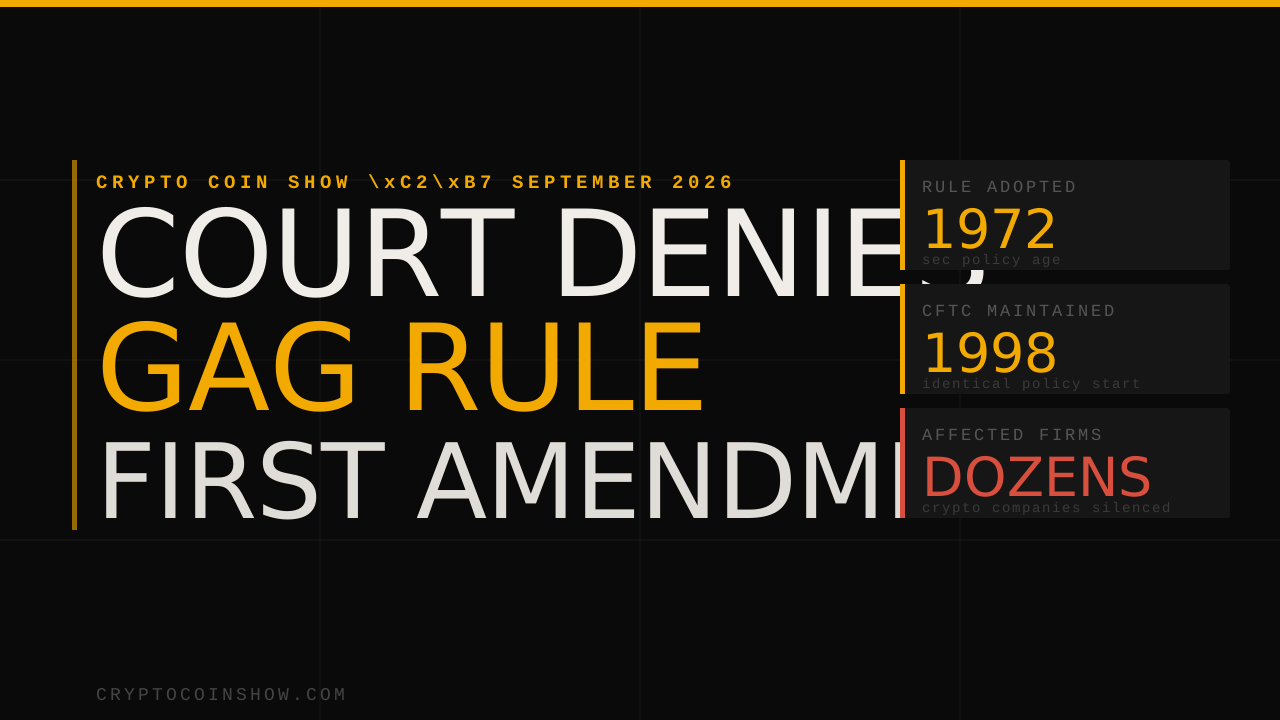
- SEC adopted Rule 202.5(e) in 1972; CFTC maintained identical policy since 1998 before both agencies withdrew it
- Dozens of crypto companies remain bound by no-deny clauses in past settlements with no constitutional shield against future enforcement
- 50 years Duration of SEC Gag Rule from adoption in 1972 until rescission
- $75,000 Penalty Thomas Powell paid in 2021 SEC settlement barring public denial
- June 2024 Month CFTC rescinded its version of the rule following SEC action
The U.S. Supreme Court on Monday rejected a constitutional challenge to the SEC’s Gag Rule without issuing an opinion or dissent, effectively sidestepping a First Amendment question that could have provided lasting legal protection to settled defendants.
The move handed a procedural victory to the SEC under Chairman Paul Atkins, whose agency had already rescinded the controversial 50-year-old policy in May, before the justices even considered whether to hear the case.
Thomas Powell, an oil and gas securities dealer who settled SEC charges in 2021 under the restriction, had challenged the rule through the New Civil Liberties Alliance as an unconstitutional restraint on speech. His case, Powell v. Securities and Exchange Commission, argued that a settlement clause preventing him from publicly denying regulatory allegations violated his First Amendment rights.
SEC Rescinds 50-Year Silencing Rule Before Court Could Rule on Its Constitutionality
Rule 202.5(e), adopted by the SEC in 1972, forbade defendants from making public statements denying wrongdoing after settling enforcement actions. The restriction applied regardless of whether a defendant admitted guilt or settled without admitting liability.
Defendants could remain silent or admit wrongdoing, but the rule explicitly prohibited a third option: contending they had done nothing wrong. Over decades, the policy accumulated high-profile critics, including Tesla’s Elon Musk and venture investor Mark Cuban, who both publicly argued it violated settled defendants’ speech rights.
In May 2024, the SEC announced it would rescind the rule entirely and would not enforce no-deny clauses in any future settlements. The agency also committed to not reopening prior enforcement cases to enforce those historical silencing provisions against defendants who now wished to speak.
The CFTC, which had maintained an identical rule since 1998, followed suit in June with its own rescission and equivalent commitment to past settlements. Yet the Supreme Court’s denial of review means the constitutional question remains unresolved in federal law.
The Powell case’s lawyers at the NCLA argued strenuously that the rule’s administrative rescission did not mute the underlying constitutional issue. In a June reply brief, the NCLA warned that rules “rescinded overnight, can also be reinstated overnight,” and faulted the government for failing to provide enforceable assurance the Gag Rule would not return under a different administration.
Former U.S. Solicitor General Greg Garre, who advocated that the court accept the case, contended that a formal Supreme Court precedent was necessary to establish that federal agencies cannot compel Americans to surrender First Amendment rights as a condition of settling disputes.
Crypto Defendants Left Unprotected as Constitutional Shield Remains Uncertain
The implications for the cryptocurrency industry are direct and material. Dozens of crypto firms settled SEC enforcement actions during recent years under the now-rescinded Gag Rule and remain contractually bound by no-deny clauses in those agreements.
Without a Supreme Court precedent explicitly prohibiting such restrictions, a future administration could theoretically seek to enforce those dormant clauses or impose them again on new settlements.
The crypto sector has faced intensified SEC enforcement since 2021, with the agency pursuing actions against major platforms including Coinbase, Binance, and Kraken on allegations ranging from operating unregistered exchanges to selling unregistered securities.
The SEC itself acknowledged in recent months what it termed “flaws” in its prior crypto enforcement strategy. The agency moved to dismiss seven cases against firms including Coinbase, Binance, and Kraken, a recognition that certain positions it had aggressively pursued lacked legal foundation.
Firms that settled earlier, however, cannot easily reopen those agreements even if the SEC’s legal reasoning later proved unsound, and they remain subject to settlement terms negotiated under pressure with limited recourse.
The absence of a constitutional floor means settled crypto defendants cannot reliably predict whether they will be permitted to publicly contest the allegations against them or provide their own account of disputed regulatory interactions. Some settled defendants may wish to clarify their regulatory history to investors, counterparties, or the public but remain contractually muted.
Others may simply want to correct factual inaccuracies in SEC enforcement filings without the legal risk of violating a settlement’s no-deny clause, a clause that, while currently unenforced, has not been declared unconstitutional.
Future Administration Could Reinstate Restriction Without Legal Barrier
The Supreme Court’s refusal to hear the case leaves the constitutional pathway unbarred for a future executive branch to reinstate no-deny restrictions or enforce them against current settled defendants. The SEC’s May rescission was an administrative act, not a statutory change or constitutional ruling.
A new administration with a different enforcement philosophy could reverse the rescission by reissuing the rule. The NCLA’s legal point, that an administrative rescission provides no durable protection, becomes legally dispositive once the Supreme Court declines to offer a First Amendment shield.
The timing of the SEC’s rescission was instructive: the agency moved to withdraw the rule weeks before the Supreme Court’s conference on whether to grant review. That sequence allowed the SEC to argue the Powell case had become moot, eliminating the justices’ need to address the underlying constitutional question.
The Supreme Court granted the SEC’s mootness argument and denied the petition without further discussion. This procedural outcome suits the current SEC leadership but leaves future defendants and future administrations in uncertain legal territory.
Crypto firms and other settled defendants will likely monitor the 2025 administration’s approach to enforcement and regulatory policy closely. The SEC under Paul Atkins has signaled a more dismissive stance toward certain crypto enforcement actions, but that posture could shift under different leadership. The unresolved constitutional question means a future SEC chair could theoretically resurrect the Gag Rule or begin selectively enforcing no-deny clauses without facing a binding Supreme Court precedent. The next concrete test will come if a new administration either explicitly revives the rule or begins enforcing historical no-deny clauses against settled defendants who attempt to publicly speak about their cases.