
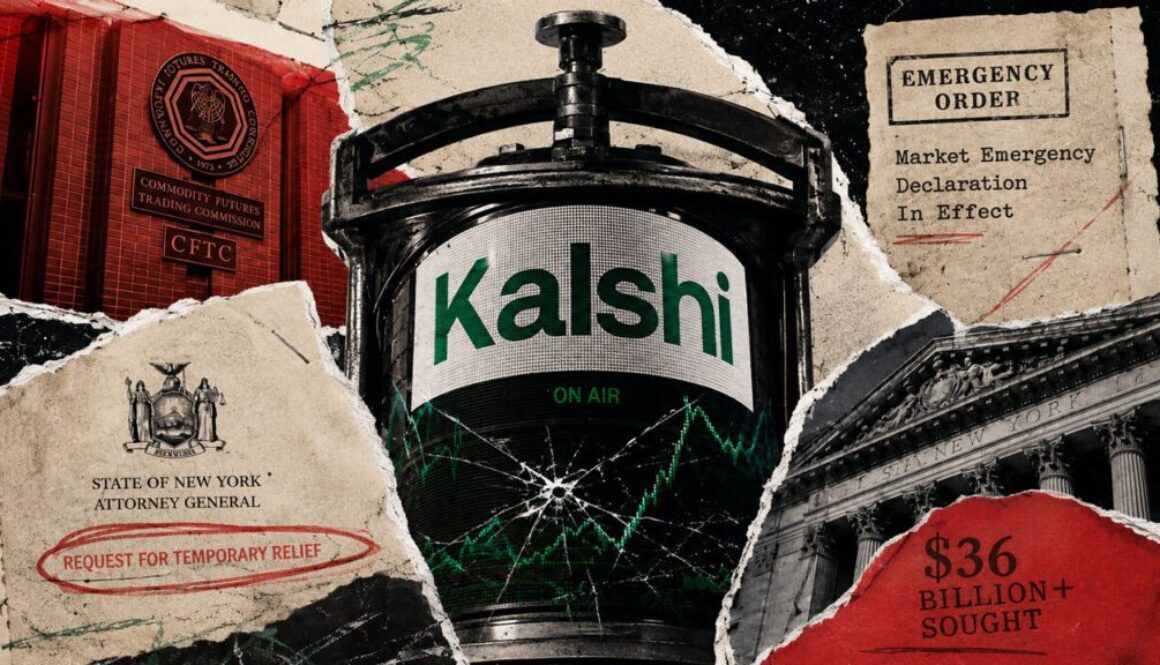
A $36 billion lawsuit just turned Kalshi’s $40 billion valuation race into a federal market emergency
The CFTC has ordered prediction-market exchange Kalshi to continue operating after New York’s $36 billion enforcement action threatened to shut down the platform, marking the first major federal intervention in a jurisdictional war between state gambling regulators and federal derivatives oversight. The clash signals a critical inflection point for institutional crypto and derivatives investors assessing regulatory risk in event-contract markets and the precedent-setting power of federal authority over state enforcement.
- CFTC directed Kalshi to keep operating on August 11 after New York’s enforcement campaign created what the exchange called a market emergency
- New York Attorney General seeks $36 billion in damages, triple the alleged unlicensed gambling gains, plus forced surrender of all proceeds
- CFTC has filed lawsuits against six states (Arizona, Connecticut, Illinois, New York, Rhode Island, Wisconsin) to override state gambling laws on prediction markets
- $36 billion Damages New York seeks from Kalshi, triple the alleged unlicensed gambling gains
- $40 billion Valuation Kalshi targets even as the exchange faces regulatory and legal pressure
- 6 states CFTC has sued to prevent application of state gambling laws to federal derivatives exchanges
On August 11, the Commodity Futures Trading Commission took the extraordinary step of ordering KalshiEX LLC to continue operating under federal commodity-exchange standards, rejecting New York’s enforcement effort as a threat to the integrity of interstate derivatives markets.
The order came after Kalshi declared a market emergency tied to New York Attorney General Letitia James’ July 31 lawsuit, which alleges the exchange operates unlicensed sports prediction markets in violation of state gambling law.
New York’s complaint seeks a court injunction forcing Kalshi to cease operations, surrender all proceeds from alleged violations, and pay civil penalties equal to three times those gains, a calculation that could exceed $36 billion.
The move represents the sharpest clash yet between state gaming regulators and the federal derivatives authority over who controls event-contract markets, and it places institutional investors in the middle of a jurisdictional test case with implications for the entire prediction-market sector.
CFTC Chairman Says New York Enforcement Threatens National Derivatives Order
CFTC Chairman Michael Selig framed New York’s lawsuit not as consumer protection but as regulatory overreach that would destroy an interstate market under federal jurisdiction. In his order, Selig argued that New York is attempting to force Kalshi to “waste away under its iron curtain of state gaming laws” before federal courts have issued final rulings on the underlying legal questions.
He emphasized that Congress did not intend federally regulated derivatives exchanges to operate under a patchwork of state gambling statutes, and that platforms like Kalshi by design operate across state lines by matching bids and offers from users in multiple jurisdictions before settling trades through clearinghouses backed by national market infrastructure.
“New York has no business regulating these interstate financial markets,” Selig said, invoking the CFTC’s statutory duty to maintain order in them.
The CFTC’s position rests on a fundamental reading of federal commodity law: prediction markets on CFTC-regulated exchanges are derivatives contracts subject to federal oversight, not gambling products subject to state licensing.
Under that framework, Kalshi’s compliance with CFTC core principles, including surveillance, capital standards, and customer protection rules, displaces any requirement for a gaming license from New York.
The regulator’s intervention signals that it will actively defend that jurisdictional boundary, even against enforcement actions from states with strong consumer-protection records and significant gambling-regulatory apparatus.
Six-State Lawsuit Campaign Signals Broader CFTC Push to Preempt State Gaming Laws
The Kalshi order is not isolated. Over recent months, the CFTC has filed lawsuits against six states, Arizona, Connecticut, Illinois, New York, Rhode Island, and Wisconsin, challenging state laws that would restrict or prohibit prediction markets on federally regulated exchanges.
The agency has also filed amicus briefs in related cases before federal appellate courts and the Massachusetts Supreme Judicial Court, positioning itself as a systematic challenger to state-level gambling enforcement. That escalation reflects a strategic decision by the CFTC to litigate its way to jurisdictional clarity rather than wait for congressional action or court rulings to accumulate.
For institutional investors, the implications are two-fold. First, the CFTC’s aggressive posture suggests that prediction-market platforms with federal registration will have significant legal cover against state enforcement, reducing regulatory risk in the near term.
Second, the breadth of the six-state campaign indicates the CFTC sees prediction markets as strategically important to its regulatory remit and is willing to expend political capital to defend them, a signal that may influence how institutional capital weights early-stage platforms like Kalshi relative to competitors in less contentious markets.
Kalshi’s Valuation Climb Continues Despite Legal Uncertainty and Expansion of New York Scrutiny
Kalshi’s fundraising and valuation trajectory have accelerated even as legal risk intensified. The exchange has been pursuing a valuation of approximately $40 billion, a mark that would place it among the most highly valued prediction-market platforms globally.
That valuation climb underscores investor confidence that federal intervention will ultimately protect the platform’s operating license and revenue model, even if litigation extends over years.
However, New York’s enforcement campaign is broadening beyond the initial July 31 lawsuit. Attorney General James has signaled intent to scrutinize prediction markets more broadly, not merely Kalshi’s legal status.
That expansion matters to institutional investors because it suggests that even if Kalshi ultimately prevails on the federal-versus-state jurisdictional question, state gaming regulators may continue to apply pressure through consumer-protection claims, tax enforcement, or secondary claims against platform operators.
The CFTC’s protective order prevents a near-term shutdown, but it does not eliminate regulatory friction or the possibility of costly litigation settlements.
Institutional investors now face a binary outcome: either the CFTC’s federal authority and litigation campaign will establish clear preemption of state gambling laws, or a settlement or appellate loss could force platforms to adopt geography-specific restrictions or licensing requirements that fragment the market.
What to Watch: Federal Appeals Court and Potential State Compromise on Licensing Standards
The immediate legal path forward involves federal court review of both New York’s enforcement action and the CFTC’s broader lawsuit against the six states. The CFTC has indicated it will defend Kalshi’s operating status in district and appellate courts, and those rulings will likely set binding precedent for how federal derivatives law applies to state gaming statutes.
A federal appellate victory for the CFTC would establish that state gaming commissions have no authority to license or restrict CFTC-regulated prediction markets, even if those platforms accept users in their jurisdictions.
Conversely, if New York prevails on any material claim, whether on the core licensing question or on narrower consumer-protection or tax claims, it would signal that states retain enforcement authority even over federally regulated platforms.
That outcome would likely force Kalshi and competitors to negotiate licensing agreements or geographic exclusions, fragmenting the national market and reducing the addressable customer base. It would also expose the $40 billion valuation to significant pressure, as investor returns would depend on platforms’ ability to operate uniformly across state lines.
The critical next step is whether federal district courts in New York and other states will issue preliminary rulings on the merits of the CFTC’s preemption argument before trial, a decision that typically arrives within 6-12 months and will clarify whether institutional investors should price in near-term regulatory clarity or protracted litigation risk. Investors should also monitor whether New York’s Attorney General attempts to reach a settlement with Kalshi that might include licensing or compliance concessions, which could signal that the state is willing to compromise on the core jurisdictional question despite the CFTC’s public hard line.