
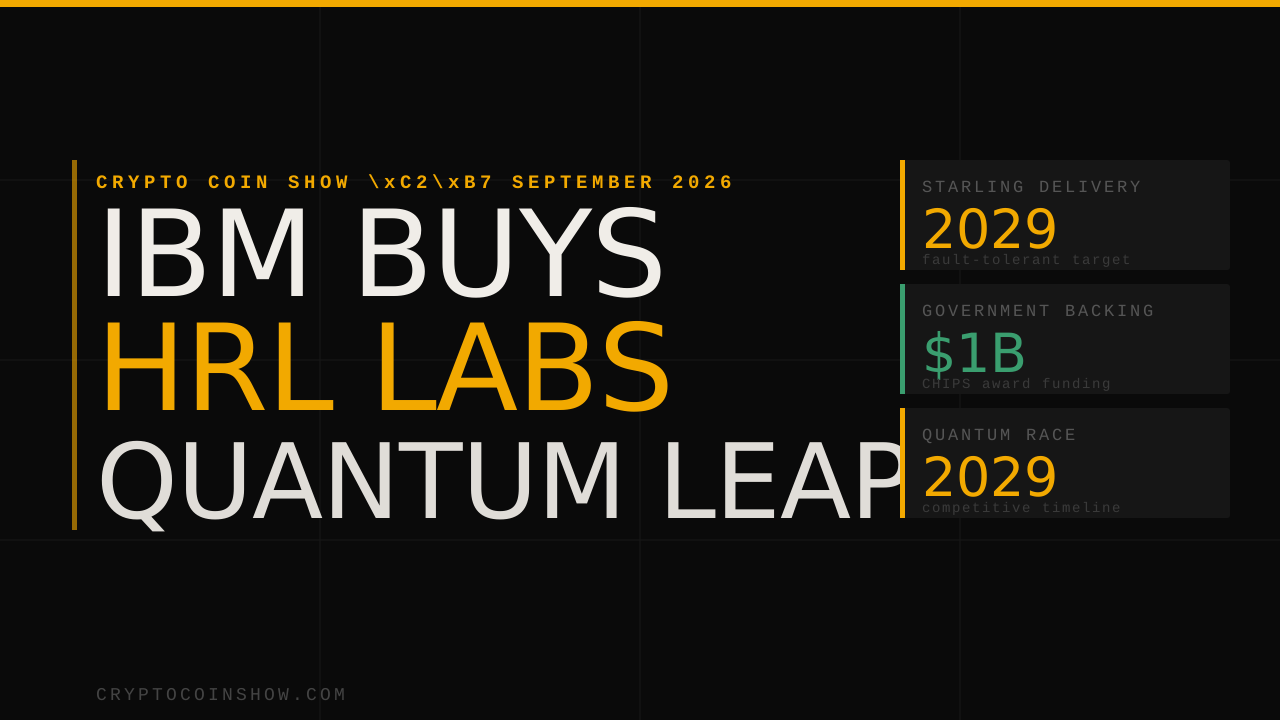
IBM completes HRL Laboratories buyout to speed its quantum roadmap
IBM has closed its acquisition of HRL Laboratories to accelerate development of Quantum Starling, a fault-tolerant quantum computer the company aims to deliver by 2029. The deal signals IBM’s confidence in meeting an ambitious timeline while competing for government funding and enterprise adoption in a race toward commercially viable quantum systems.
- IBM completed HRL Laboratories acquisition to speed quantum computing roadmap toward 2029 Starling delivery target
- IBM demonstrated cooled modular cryogenic cells in Poughkeepsie that link via short connections instead of long noisy cables
- U.S. government backing includes $1 billion CHIPS award for Anderon foundry in Albany to fabricate quantum wafers for multiple vendors
- 2029 Target year for IBM Quantum Starling fault-tolerant system delivery before end of decade
- 20,000x Expected computational power increase of Starling compared to current quantum hardware
- $2 billion Total U.S. government quantum computing initiative spanning nine firms including IBM
IBM has completed its acquisition of HRL Laboratories, integrating the research organization into its quantum computing division as the company accelerates development of Quantum Starling, a large-scale fault-tolerant quantum computer scheduled for delivery by 2029.
The company declined to disclose purchase terms but framed the acquisition as a strategic move to compress the timeline on a project that represents IBM’s flagship bet on near-term quantum commercialization.
IBM already operates more than 90 quantum systems deployed across Fortune 500 companies, universities, and government agencies, a user base that will serve as both early adopters and testbeds for Starling when the system reaches market.
IBM demonstrates modular cryogenic architecture with short-link quantum processor design
The timing of the HRL acquisition announcement coincides with significant technical progress on Quantum Starling’s underlying infrastructure.
On August 19, IBM reported that engineers at its Poughkeepsie, New York facility had successfully linked and cooled the first pair of modular cryogenic cells, each standing approximately eight feet tall and operating below 15 millikelvin, roughly 180 times colder than deep space.
This breakthrough addresses a longstanding engineering constraint in quantum systems: traditional cylindrical refrigeration units required long, noisy connections between processors that degraded qubit coherence and limited scalability.
The new box-shaped modular design places cryogenic cells side by side with short connections joined into a shielded tunnel that maintains each chip near absolute zero while minimizing electromagnetic interference.
IBM’s L-Coupler technology binds multiple processors together so they function as a single logical unit, allowing the system to scale horizontally rather than forcing engineers to stack processors vertically in a single cryogenic vessel.
The company estimates that Starling will eventually house hundreds of processors operating under this modular architecture, enabling computational power roughly 20,000 times greater than current quantum hardware.
The modular approach directly influenced IBM’s decision to acquire HRL Laboratories, whose expertise in quantum systems engineering and materials science aligns with the scaling challenges ahead. By folding HRL’s research capabilities into its quantum division, IBM aims to validate this architecture at production scale before the 2029 target date.
U.S. government backs Anderon quantum foundry with $1 billion CHIPS award matching IBM’s cash commitment
IBM’s quantum ambitions are now embedded in a broader federal strategy to establish domestic quantum manufacturing capacity.
In May, IBM and the U.S. Department of Commerce announced Anderon, described as America’s first pure-play quantum foundry, backed by a proposed $1 billion CHIPS award and $1 billion in matching funding from IBM. The foundry will be headquartered in Albany, New York, and will fabricate 300-millimeter quantum wafers for multiple vendors rather than exclusively serving IBM’s internal needs, a significant departure from IBM’s traditional vertical integration model.
Arvind Krishna, IBM’s Chairman and CEO, stated that IBM’s decades of experience in silicon fabrication would prove essential to developing the broader quantum technology industry. The government and IBM jointly pegged the sector’s economic potential at up to $850 billion by 2040, signaling confidence in quantum computing’s transition from research phase to industrial application.
This public-private partnership reflects Washington’s concern that quantum leadership will determine technological and economic dominance in the coming decade, particularly in cryptography and materials simulation.
A separate $2 billion government quantum computing effort spans nine firms, with IBM in line for approximately $1 billion, GlobalFoundries near $375 million, and D-Wave Quantum, Rigetti Computing, and Quantinuum each receiving roughly $100 million.
IBM shares rose more than 6% when news of the Anderon CHIPS award broke, suggesting investor confidence that federal backing materially de-risks IBM’s quantum roadmap and ensures sustained R&D funding through the 2029 Starling milestone.
Quantum threat to Bitcoin cryptography intensifies investor focus on migration timelines
The convergence of IBM’s hardware progress, government funding, and the Starling timeline has sharpened institutional focus on quantum computing’s most immediate threat: the potential to break Bitcoin’s cryptographic security.
Shor’s algorithm, a quantum computing procedure capable of working backward from a public key to derive the private key, poses an existential risk to any blockchain system relying on elliptic-curve or RSA cryptography. Recent reader polling found that 47% of respondents expect quantum computing to compromise Bitcoin by 2035, a date that sits only six years after Starling’s planned delivery.
Institutional investors and blockchain operators face a critical gap between IBM’s projected Starling timeline and the unknown threshold at which quantum hardware becomes sufficiently powerful to execute Shor’s algorithm at scale.
Google researchers have begun modeling the hardware requirements, but no consensus exists on whether a 2029 system or a system five years later will pose immediate cryptographic risk. This ambiguity has already triggered discussions within Bitcoin and Ethereum developer communities about post-quantum cryptographic migration strategies.
For institutions holding long-term cryptocurrency positions or operating blockchain infrastructure, the HRL acquisition and Anderon foundry represent concrete evidence that quantum computing is transitioning from theoretical threat to engineered milestone.
The pace of IBM’s progress, reinforced by $1 billion in federal matching capital and the addition of HRL’s engineering expertise, suggests that quantum systems capable of attacking current blockchain security may arrive sooner than previously modeled.
IBM has set a clear 2029 deadline for Quantum Starling’s commercial delivery, and the HRL acquisition signals the company is allocating additional engineering resources to meet that schedule. The next critical verification will come from IBM’s demonstration of multi-cell cryogenic systems scaling beyond the current two-cell proof-of-concept, expected within the next 12 to 18 months. Simultaneously, cryptography researchers and blockchain developers are racing to define post-quantum migration standards, the Crypto Coin Show will track whether Bitcoin, Ethereum, and other major networks adopt quantum-resistant signatures before 2035, and whether IBM’s 2029 Starling delivery date accelerates that timeline.