
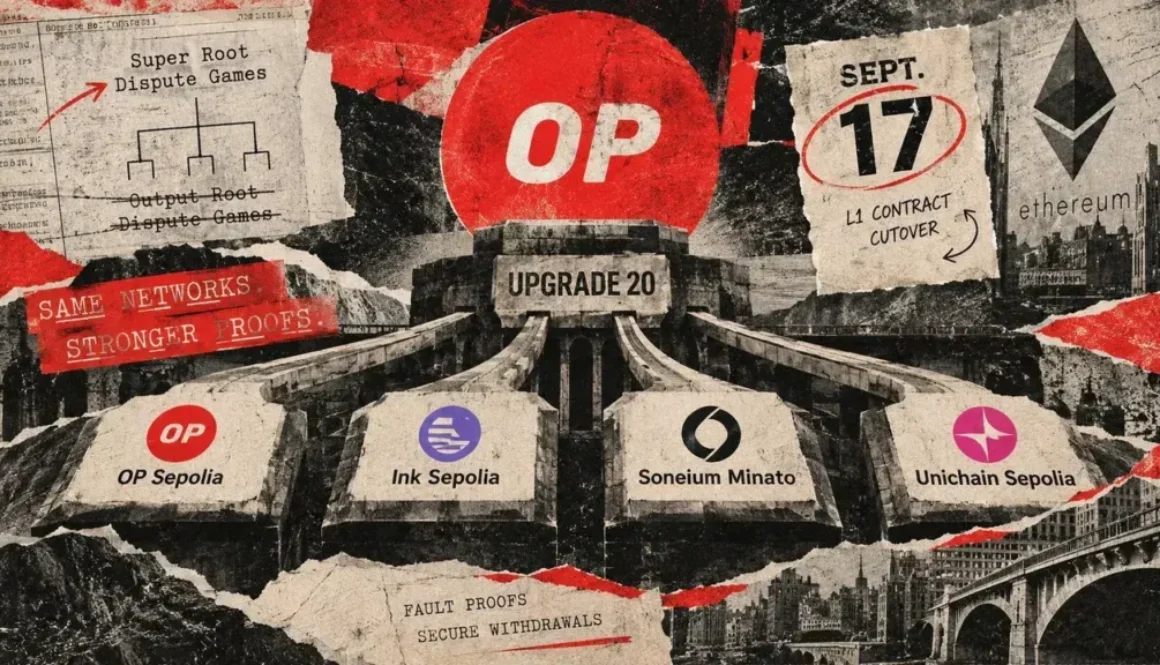
Optimism governance approves Upgrade 20 to enable Superchain interoperability with Super Root Dispute Games
Optimism’s governance approved Upgrade 20 on Tuesday, advancing its fault-proof system toward the architecture needed for cross-chain interoperability on its Superchain. The change shifts dispute resolution from Output Root to Super Root games, a critical prerequisite that avoids having to modify security infrastructure again once multi-chain functionality launches.
- Upgrade 20 moves from Output Root Dispute Games to Super Root Dispute Games, changing how OP Stack chains validate state before Ethereum withdrawals finalize
- Testnet deployment targets September 17 with mainnet execution scheduled for September 24 if seven-day testnet soak completes successfully
- Super Roots use timestamps instead of L2 block numbers, creating the common time reference required for eventual multi-chain dispute systems
- Sept. 24 Targeted mainnet execution date if testnet soak completes cleanly
- 7 days Required healthy testnet performance window before mainnet deployment
- 4 chains Testnets receiving initial Upgrade 20 deployment on September 17
Optimism’s governance voted to approve Upgrade 20 on Tuesday (September 16), clearing the path for a foundational shift in how its network validates state transitions and paves the way for Superchain interoperability. The upgrade moves the layer-2 network’s fault-proof system from Output Root Dispute Games to Super Root Dispute Games, a change first reported by CryptoSlate that alters how OP Stack chains challenge incorrect state before withdrawals are finalized back to Ethereum. Testnet deployment is targeted for Wednesday (September 17) across OP Sepolia, Ink Sepolia, Soneium Minato and Unichain Sepolia, with mainnet execution scheduled for Tuesday (September 24) conditional on a successful seven-day testnet performance window.
Super Roots Replace Single-Chain Anchors for Multi-Chain Readiness
The core technical change replaces how dispute games identify the state being challenged. Existing Output Root games anchor a claim to an L2 block number specific to a single chain. Super Root games instead use timestamps, creating the common time reference that a future multi-chain dispute system will require when Superchain interoperability eventually launches.
This architectural shift allows Super Roots to eventually represent multiple chains at the same timestamp, but Upgrade 20 keeps each chain’s dispute infrastructure separate, each new game still contains the Output Root of only one chain.
Permissioned chains move to game type 5 under the new system, while permissionless fault-proof deployments use game type 9. By making this transition now, Optimism avoids having to modify its security layer again once it activates cross-chain interoperability, reducing friction and risk at a critical juncture.
Bridge Developers and Chain Operators Must Migrate Infrastructure
The upgrade requires immediate work from chain operators and bridge integrations but presents no hardship for ordinary users. Chain operators must update their fault-proof infrastructure around the L1 contract cutover, with op-challenger and op-dispute-mon needing Super Root support before the switch and op-proposer moving to the new RPC and game type when upgraded contracts execute.
Existing configuration must remain available long enough for older Output Root games to complete their lifecycle.
Bridge and withdrawal developers face related changes because applications that inspect dispute games directly can no longer assume a game’s root claim is a single-chain Output Root. Integrations must recognize the new game types and retrieve the appropriate chain-specific root from the Super Root structure. Applications using viem/op-stack for withdrawal proving need version 2.51.0 or later and must pass the initiating transaction’s L2 timestamp through the proving flow. Ordinary users do not need to take action, previously submitted withdrawal proofs remain valid and OptimismPortal continues to accept both dispute-game formats.
Testnet Performance Will Determine Mainnet Timeline
The next decision depends on how the Upgrade 20 changes perform on testnets starting Wednesday.
A clean seven-day run would clear the way for the targeted September 24 mainnet execution, moving OP Mainnet and other participating chains onto the dispute format Optimism intends to use when Superchain interoperability eventually reaches production.
The upgrade also bundles changes to Optimism’s contracts manager and SystemConfig, including safeguards around upgrade sequencing and cleanup of legacy configuration functions following issues identified during Upgrade 19.
The CCS read. Upgrade 20 is a technical prerequisite that removes a future bottleneck rather than a feature release itself, institutional integrators and node operators now carry the migration burden, while interoperability’s timeline and actual multi-chain functionality remain unscheduled. The real test is whether testnet performance confirms this architecture is sound enough to ship to mainnet without additional delays.
Testnet deployment begins Wednesday (September 17), with seven days of monitoring required before Optimism’s governance can confirm mainnet execution for Tuesday (September 24). Any stability issues during the testnet soak will push that mainnet date back and delay Optimism’s readiness for eventual cross-chain activation.