
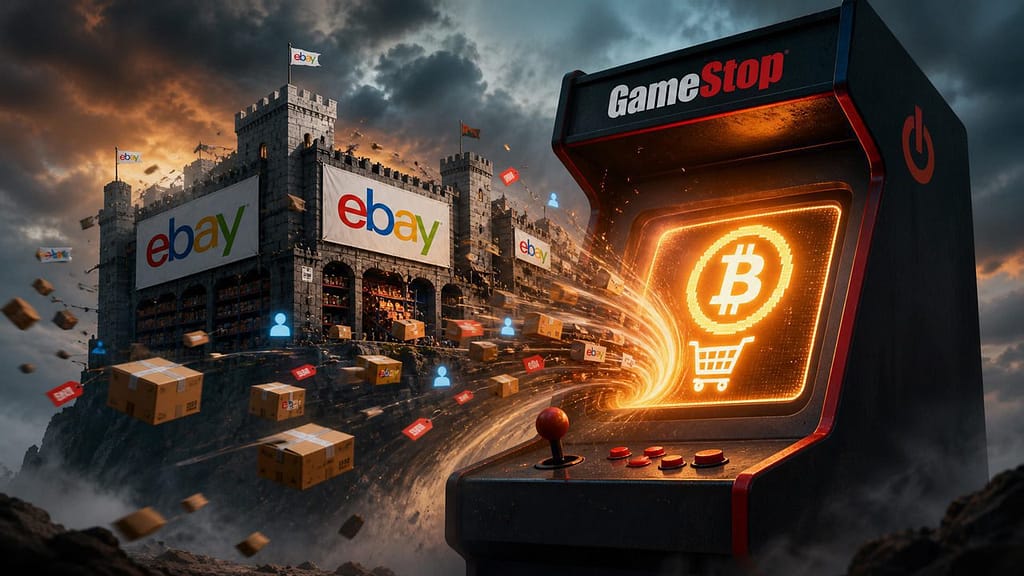
If GameStop buys eBay, Bitcoin payments could suddenly have a 135M-buyer marketplace test case
GameStop’s unsolicited $55.5 billion bid for eBay would create a combined e-commerce platform with 135 million active buyers, a scale large enough to serve as a meaningful test case for Bitcoin payments in mainstream consumer commerce rather than limited to corporate balance sheets. For institutional investors evaluating crypto’s path to adoption beyond speculation and treasury reserves, the transaction signals potential legitimacy for payments infrastructure at consumer scale, contingent on financing and shareholder approval.
- GameStop offered $125 per share on May 4, representing 27% premium to eBay’s 30-day volume-weighted average price and 36% premium to its 90-day average.
- The combined entity would access 135 million active buyers across both platforms, creating a consumer marketplace substantially larger than either company alone.
- GameStop has secured a highly confident financing letter from TD Securities for $20 billion, with the deal’s viability contingent on stock value, additional capital, and eBay shareholder approval.
- $55.5B Stated value of eBay acquisition bid, versus GameStop’s current market capitalization
- 135M Combined active buyers across GameStop and eBay platforms post-acquisition
- $2B Annualized cost reductions GameStop projects within 12 months of deal close
GameStop launched an unsolicited takeover bid for eBay on May 4, offering $125 per share in a 50-50 cash-and-stock proposal that values the marketplace at approximately $55.5 billion. The offer represents a significant 36% premium to eBay’s 90-day average stock price, signaling confidence in GameStop’s strategic vision despite the company being substantially smaller than its target.
The proposal depends on funding from GameStop’s $9.4 billion cash and liquid investment balance as of January 31, a highly confident letter from TD Securities covering up to $20 billion in third-party acquisition financing, and GameStop equity that would constitute roughly half the purchase consideration. eBay’s board said it would review the unsolicited proposal and assess both the cash value and GameStop’s capacity to deliver a binding transaction, while advising shareholders to take no action pending evaluation.
GameStop’s $9.4 billion cash reserve and $20 billion financing letter prove insufficient for deal’s full structure
GameStop’s balance sheet presents the first financing hurdle for a transaction of this magnitude. The company holds approximately $9.4 billion in cash and liquid investments, which covers roughly one-sixth of the $55.5 billion purchase price, even before accounting for transaction costs and operational needs.
The remaining financing depends heavily on TD Securities’ highly confident letter for $20 billion in third-party funding, a conditional commitment that does not constitute a binding financing agreement and remains subject to market, legal, and operational conditions that could change between announcement and closing.
The deal’s financial structure creates a significant valuation risk for GameStop shareholders. Approximately half the purchase price would be paid in GameStop stock, meaning the deal’s total cost to existing shareholders depends directly on where GameStop’s share price settles during the approval and closing period.
If GameStop’s stock declines substantially, either the total consideration rises in share count to maintain the $125-per-share value for eBay shareholders, or GameStop must secure additional cash financing, both outcomes compress value for current GameStop holders.
Market reaction immediately after announcement reflected this concern: GameStop shares fell while eBay shares rose, signaling investor skepticism that GameStop can orchestrate financing and shareholder approval for a transaction several times its current size.
Ryan Cohen’s cost-cutting thesis targets $2 billion in annual reductions across three expense categories
GameStop’s strategic case for acquiring eBay centers on cost discipline and operational reallocation rather than growth at current scale.
The company projects $2 billion in annualized cost reductions within 12 months of closing, broken into three categories: $1.2 billion from sales and marketing efficiency, $300 million from product development consolidation, and $500 million from general and administrative overhead elimination.
These targets appear aggressive relative to eBay’s fiscal 2025 sales and marketing spend of $2.4 billion, implying GameStop would cut that budget in half while maintaining or growing buyer acquisition and retention.
The acquisition thesis extends beyond cost cuts to category expansion and retail integration. GameStop highlights eBay’s underperformance in high-margin verticals including collectibles, authentication, and live commerce, areas where GameStop holds operational expertise from its core physical and digital retail business.
By merging eBay’s 135 million active buyers with GameStop’s collectibles infrastructure and logistics capabilities, the combined entity could theoretically serve niche seller communities and authentication-dependent categories with lower customer acquisition costs than eBay currently incurs.
Whether those cost reductions are achievable depends on execution risk, seller displacement, and whether consolidating two distinct e-commerce cultures produces the projected synergies or operational friction instead.
A 135-million-buyer platform creates a potential Bitcoin payment test case if deal closes
The institutional crypto angle centers on the unprecedented scale such a merger would create for testing Bitcoin as a consumer payment method at mainstream e-commerce volume. Neither GameStop nor eBay currently operates Bitcoin payments at material scale; however, GameStop’s leadership has publicly stated interest in Bitcoin as an inflation hedge and potential strategic asset.
If GameStop acquires eBay and integrates Bitcoin payment rails, either directly or through established payment processors, the combined platform would serve 135 million active buyers, creating a far more credible proof-of-concept for consumer adoption than GameStop’s existing operations or limited corporate treasury deployments elsewhere in the sector.
For institutional investors evaluating crypto’s evolution beyond speculative trading and corporate balance sheet experiments, such a scenario matters because it would demonstrate whether Bitcoin transactions can process at scale within an existing, regulated consumer e-commerce network without degrading user experience or creating material compliance friction.
Mainstream adoption frameworks typically require evidence of consumer willingness to use the technology, merchant acceptance at volume, and seamless integration into existing payment rails, conditions that a 135-million-buyer marketplace could test far more convincingly than smaller trials.
That outcome remains entirely contingent on closing the acquisition, securing shareholder approval, and GameStop leadership actually implementing such a payment integration rather than leaving it as strategic optionality.
eBay’s board is currently evaluating the unsolicited proposal and will determine whether to engage with GameStop, reject the bid, or explore alternatives; the company has provided no timeline for that decision and has advised shareholders to take no action pending review. GameStop’s financing viability depends on TD Securities’ letter converting to binding commitments and eBay shareholder approval, neither of which is assured given immediate market skepticism around deal structure and execution risk. Watch for eBay’s formal response within the coming weeks, any indication from GameStop on securing the back-half of financing beyond TD Securities’ $20 billion letter, and whether Ryan Cohen articulates specific timelines or mechanisms for integrating Bitcoin payments if the acquisition closes, that level of specificity would signal whether the crypto angle is core strategic intent or opportunistic rhetoric to boost shareholder enthusiasm.