
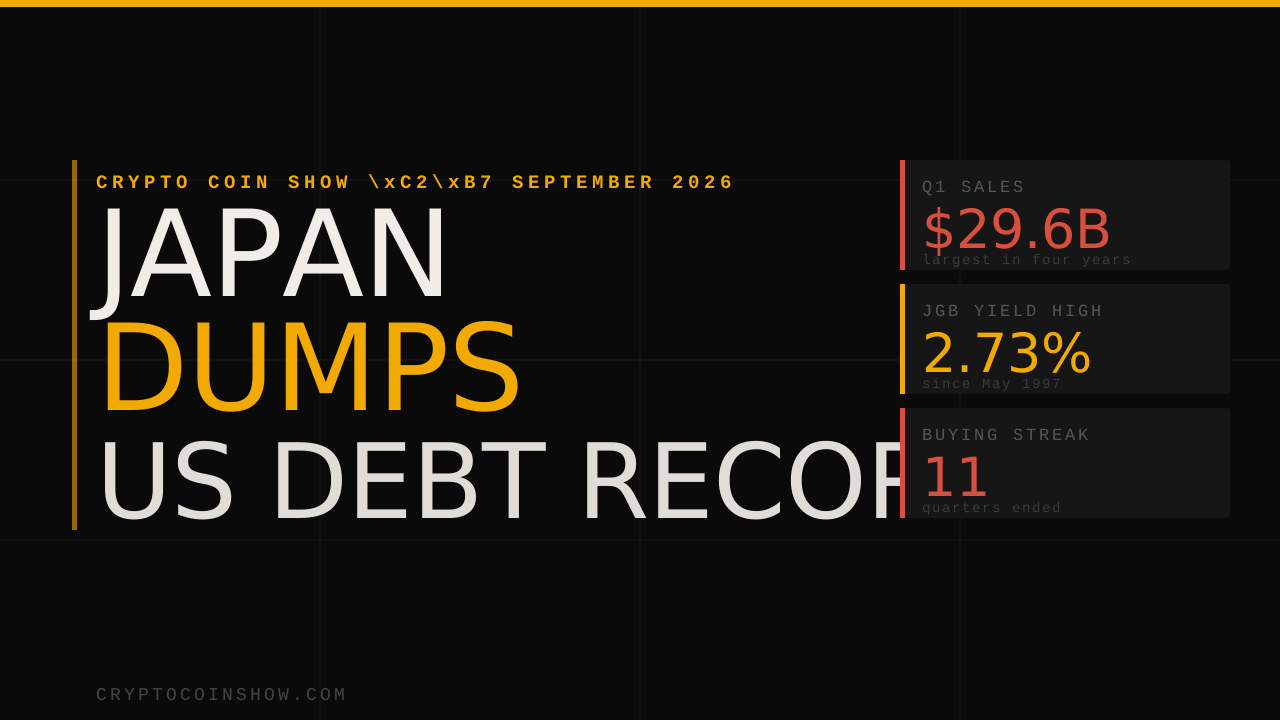
Japan sold $29.6 billion in U.S. debt in Q1 2026
Japanese investors dumped $29.6 billion in U.S. government debt during the first quarter of 2026, their largest quarterly sale in nearly four years, signaling a structural shift in global capital flows as domestic Japanese bond yields hit multi-decade highs. This reversal breaks an 11-quarter buying streak and reflects a fundamental recalculation by one of America’s largest foreign creditors, with implications for Treasury demand and dollar stability that institutional investors must now monitor closely.
- Japanese investors sold $29.6 billion in U.S. debt in Q1 2026, largest quarterly sale since Q2 2022.
- Japan’s 10-year JGB yield reached 2.73%, highest since May 1997, outcompeting U.S. Treasury returns.
- Japan remains the largest foreign holder of U.S. debt at $1.24 trillion, ahead of UK and China.
- $29.6B Japanese quarterly U.S. debt sales in Q1 2026 versus four-year baseline
- 2.73% Ten-year JGB yield, highest since May 1997 compared to prior decade
- $1.24T Total Japanese holdings of U.S. debt versus $897B held by United Kingdom
The pullback by Japanese investors represents a watershed moment in Treasury markets. After purchasing U.S. government-linked debt for 11 consecutive quarters, Japanese institutional accounts swung sharply to selling in Q1 2026, offloading securities at a pace unseen since the second quarter of 2022, when Federal Reserve rate hikes were still in their infancy.
The reversal accelerated during the first two months of the year alone, with $4.14 billion in U.S. agency bonds sold according to U.S. Treasury Department data.
What matters to institutional investors is not merely the quantity sold, but what it signals about relative valuations and capital reallocation at scale. Japan, as America’s largest foreign creditor with $1.24 trillion in total U.S. debt holdings, substantially ahead of the United Kingdom’s $897 billion and China’s $693 billion, wields outsized influence over Treasury demand and pricing.
When the world’s third-largest economy reverses from buyer to seller, it reshapes the global bid for dollar assets and raises questions about the sustainability of current U.S. borrowing costs.
Japanese Bond Yields Soar to 27-Year Highs, Luring Capital Home
The core driver of this capital repatriation is a dramatic repricing of Japanese government bonds (JGBs), which have moved to levels unseen in nearly three decades. The 10-year JGB yield climbed to 2.73%, its highest point since May 1997, while the 30-year JGB yield breached 4% for the first time since the security was launched in 1999.
These moves reflect a structural tightening in Japanese monetary policy and a reassessment of inflation dynamics that has fundamentally altered the relative appeal of domestic versus foreign fixed income.
Behind the yield surge sits a confluence of domestic and external pressures. Prime Minister Takaichi Sanae won a landslide election in February 2026 on a platform of increased public spending and anti-inflation measures, commitments that immediately translated into petrol price subsidies and structural demands on the fiscal budget.
Markets are now pricing in a 25-basis-point rate hike by Japan’s central bank to 1% in June as inflation persists, a tectonic shift for an economy that spent decades in deflation and near-zero rates.
These developments are interacting with one another, and that is creating a compounding effect.
Satsuki Katayama, Japanese Finance Minister
Katayama acknowledged that the yield pressures are not unique to Japan, they reflect a synchronized global deleveraging across bond markets, but the interaction amplifies risk for fiscal sustainability.
For Japanese asset managers, the arithmetic has shifted decisively. A 2.73% 10-year JGB yield, combined with the prospect of positive real rates as inflation moderates, now competes effectively with U.S. Treasuries offering 4.59% on the 10-year, especially when currency hedging costs are factored in.
Japanese institutions no longer face a yield penalty for holding domestic debt, removing a key incentive that sustained their U.S. Treasury purchases throughout 2023 and 2024.
U.S. Treasury Yields Spike Amid Oil Shock and Fed Rate-Cut Reversal
The Japanese selling occurs against a backdrop of violent repricing in U.S. debt markets, driven by geopolitical shock and shifting Federal Reserve expectations. In mid-February 2026, markets had priced in two Fed rate cuts within months, based on disinflationary trends.
That consensus shattered when the United States, in coordination with Israel, conducted strikes against Iran, triggering a 50% surge in oil prices and upending inflation forecasts overnight.
Traders immediately recalibrated to expect Fed rate hikes rather than cuts.
The result has been the steepest backup in Treasury yields since mid-2024. The 2-year yield reached 4.07%, its highest level since early 2025, while the 10-year hit 4.59% after a quarter-point jump in a single week, its most violent weekly move since April 2024.
The 30-year Treasury yield is now tracking toward a two-decade high above 5%. These moves represent a half-percentage-point or greater increase from late February levels across the curve.
The timing is critical for institutional positioning. Japanese investors faced a choice: hold depreciating U.S. bonds in a rising-yield environment, or redeploy capital into JGBs offering asymmetrically higher yields and the certainty of domestic rate normalization.
The Q1 sale reflects a rational reallocation, not panic, but it underscores a fundamental truth for Treasury markets: the structural support from foreign central banks and institutional accounts cannot be taken as permanent when domestic alternatives become competitive.
Budget Pressures Loom as Japan Prepares Second Stimulus Round
The Japanese government’s newly aggressive fiscal stance adds urgency to the JGB yield story and hints at further capital needs ahead. Sanae’s administration, emboldened by electoral victory, has already deployed petrol subsidies and is expected to introduce a supplementary budget later in 2026 to address inflation and support growth.
Such additional issuance will place further upward pressure on JGB yields even as the Bank of Japan slowly unwound its yield-curve control measures.
Economists warn that larger fiscal deficits will only accelerate the need for higher yields to attract investor demand. In a lower-growth, higher-inflation regime, Japan’s debt-to-GDP ratio, already the highest among developed economies, becomes less tenable without yield discipline.
This structural constraint means Japanese officials are unlikely to resist the rise in long-term borrowing costs, creating a more attractive environment for domestic savers and institutions to hold their own government’s debt rather than foreign alternatives.
For U.S. Treasury managers, this shift signals that one of the most reliable foreign bid sources, Japanese accounts that bought U.S. debt for 11 straight quarters, cannot be counted on to absorb supply when relative yields turn unfavorable.
Global Bond Sell-Off Narrows Treasury’s Foreign Buyer Base
The Japanese pullback occurs within a broader global deleveraging cycle that has tightened conditions across major bond markets simultaneously. U.S. Treasury yields, JGB yields, and gilt yields are all rising in tandem, but the magnitudes differ. While the 30-year Treasury has pushed above 5%, the 30-year JGB has reached 4% and UK gilts face their own repricing pressures.
This synchronized sell-off reflects a world where central banks are exiting accommodation faster than markets expected and geopolitical risks, Iran strikes, oil supply shocks, potential escalation, have restored a premium for rate expectations. In such an environment, foreign central bank reserves diversification often accelerates. Japanese authorities may shift holdings toward shorter-duration assets, commodities, or gold to hedge currency and inflation risks,