
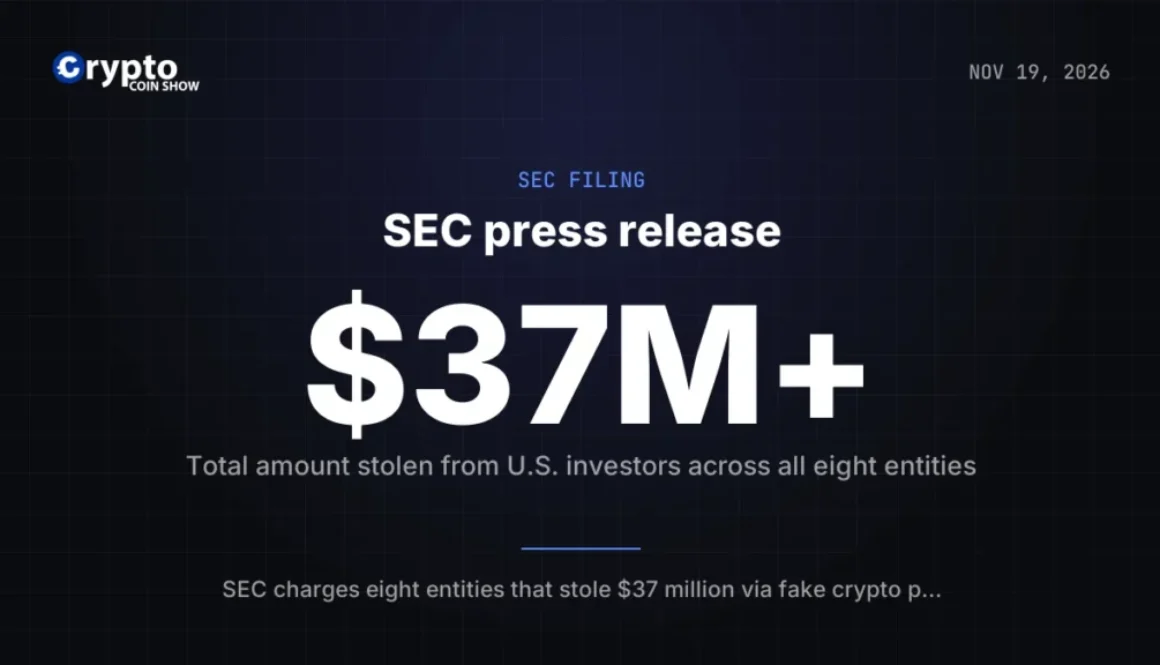
SEC charges eight entities that stole $37 million via fake crypto platforms
The SEC charged eight Colorado-based entities on Thursday, November 19 (today) with defrauding U.S. investors of more than $37 million through fake cryptocurrency trading platforms and investment advisers. The defendants, likely operated by individuals overseas, used social media to lure victims into group chats, then convinced them to deposit funds into counterfeit platforms by forging SEC registration documents and filing false forms with regulators.
- Four adviser-platform pairs operated from August 2024 through May 2026 before operators abandoned each pair after months of fraud
- Defendants created fake SEC certificates and made false filings with SEC, FINRA and FinCEN to appear legitimate
- Victims were initially lured with stock trading advice before being redirected to alleged crypto asset platforms
- $37M+ Total amount stolen from U.S. investors across all eight entities
- 8 Colorado-based entities charged; likely operated by overseas individuals
- 21 Months of operation spanning August 2024 to May 2026
The SEC complaint, filed in U.S. District Court for Colorado, names Advisor WeChat Capital, Tech Brokerage Asset Alliance Ltd., HB Wealth Advisors, IdeaCrypto Exchange LLC, Convergent Wealth Advisors Inc., RealSimple Crypto Exchange Inc., Associated Wealth Advisors Ltd., and Essential Crypto Exchange. The defendants allegedly violated Section 10(b) of the Securities Exchange Act and Rule 10b-5, and four entities also violated the Investment Advisers Act Sections 206(1) and 206(2). Two entities face additional charges under Section 207 of the Advisers Act.
Social Media Luring and Staged Legitimacy
Perpetrators advertised on social media platforms and directed investors to private and group chats where individuals posed as registered investment advisers. The operators first provided authentic-sounding stock trading advice to build trust, then escalated by pushing victims to deposit money into the fake crypto platforms.
To overcome investor skepticism, the defendants deployed multiple legitimacy tactics. “The defendants used a variety of tactics to feign legitimacy, including by making fake SEC certificates, making filings with the SEC, FINRA, or FinCEN, and directing skeptical investors to those certificates and filings,” according to the SEC complaint.
The defendants also directed victims to verify their status using those forged documents.
Four Rotating Platform Pairs and Geographic Obfuscation
The scheme operated through four distinct adviser-platform pairs, with operators rotating to a new pairing roughly every three to four months. This cycling prevented victims from detecting patterns and allowed perpetrators to restart operations under new entity names after each pair was exposed or abandoned.
All eight entities are Colorado-based on paper, but the SEC states the individuals operating them are “likely located overseas.” The complaint does not identify specific operators, nationalities, or precise jurisdictions, leaving the geographic origin and current whereabouts of perpetrators undisclosed.
Regulatory Filings and Removal from Public Records
The SEC has removed a Form D filing by Tech Brokerage Asset Alliance Ltd. and Forms ADV filed by Convergent Wealth Advisors Inc. and Essential Crypto Exchange from the Commission website, effectively delisting them from searchable regulatory databases. This action prevents these fraudulent entities from appearing in investor background checks performed via Investor.gov.
The complaint seeks permanent and conduct-based injunctions, disgorgement of all ill-gotten gains, prejudgment interest, and civil penalties. No settlement has been reached; the matter remains in federal court and contested.
Detection and Investor Protection Steps
Laura D’Allaird, Chief of the SEC Enforcement Division’s Cyber and Emerging Technologies Unit, stated that the agency “continues to seek out and expose fraudulent investment scams that prey on U.S. investors.” The SEC’s Office of Investor Education and Assistance has issued alerts warning that fraudsters use group chats and falsely claim SEC registration.
The SEC has encouraged investors to verify adviser registration and background via Investor.gov before sending money, and to report suspected fraud through its online portal. The agency received assistance from the Hong Kong Securities and Futures Commission, Monetary Authority of Singapore, China Securities Regulatory Commission, and Swiss Financial Market Supervisory Authority, though the document does not detail what intelligence or cooperation each foreign regulator provided.
The CCS read. This scheme exploited the gap between retail investors’ growing appetite for crypto exposure and their inability to distinguish real platforms from convincing fakes. The rotating pair strategy, abandoning platforms after a few months, allowed operators to reset with fresh entity names and avoid detection longer than a single static scheme. That the complaint does not name individual perpetrators or trace funds flow suggests either ongoing investigation or successful obfuscation by overseas operators. Investors who cannot verify adviser licensing in real time through Investor.gov remain at highest risk.
The next concrete event is a court response from the named defendants or their counsel to the SEC complaint filed in U.S. District Court for Colorado. The document does not state a hearing date, motion deadline, or answer deadline. The SEC complaint does not disclose whether any assets have been frozen or recovered, or whether law enforcement from other jurisdictions has opened related investigations.