
Morgan Stanley triggers crypto fee war among rivals
Morgan Stanley has launched cryptocurrency trading on its E*Trade platform at 50 basis points, undercutting Coinbase, Robinhood, and Charles Schwab, signaling that Wall Street’s largest players are now competing directly on crypto fees rather than product differentiation. The move threatens to compress margins across the retail crypto trading industry and forces competitors to choose between matching prices or retreating to premium service positioning.
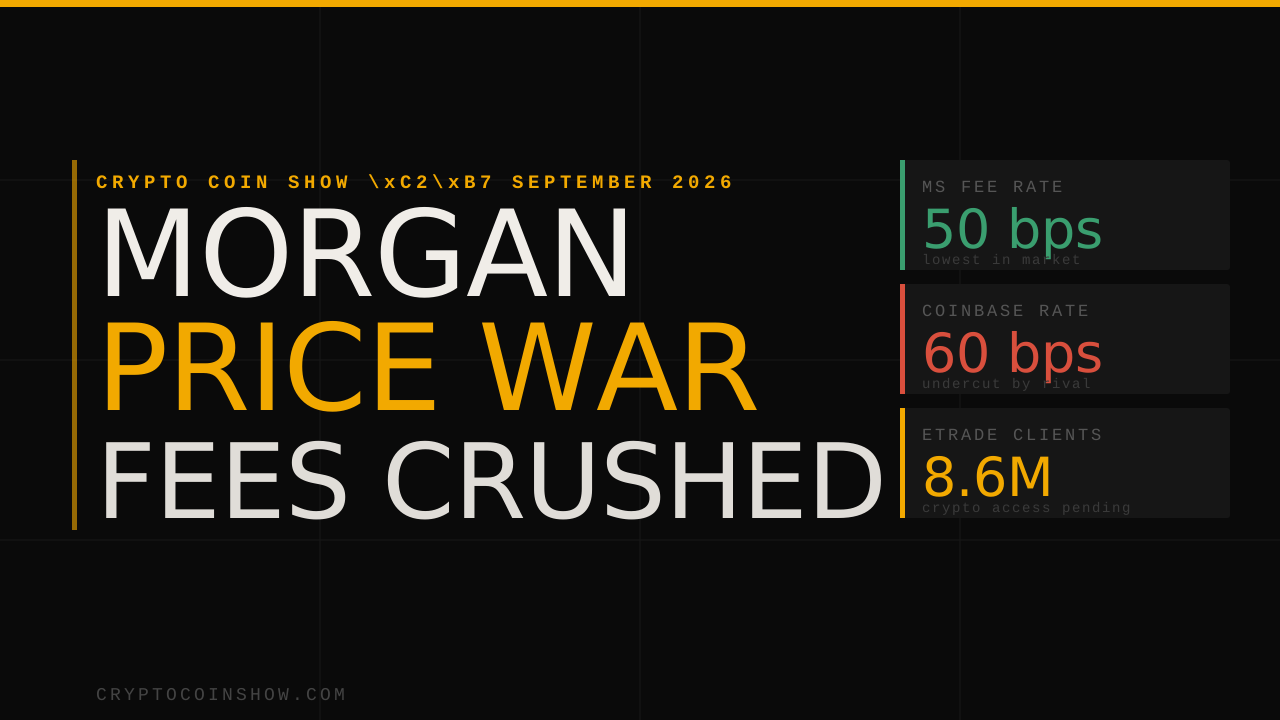
- Morgan Stanley charges 50 basis points on E*Trade crypto trades, below Coinbase’s 60, Schwab’s 75, and Robinhood’s 95 basis points.
- The service will initially support Bitcoin, Ethereum, and Solana before expanding to all 8.6 million E*Trade retail clients later this year.
- The bank frames crypto as gateway to wealth management integration, not a standalone product, signaling structural ambition beyond trading fees.
- 50 bps Morgan Stanley’s crypto trading fee versus 60 bps at Coinbase
- 8.6M E*Trade retail clients eligible for crypto access after full launch
- $13B Morgan Stanley’s E*Trade acquisition price, enabling platform leverage
Morgan Stanley has entered the retail cryptocurrency trading market through its E*Trade subsidiary by pricing Bitcoin, Ethereum, and Solana trades at 50 basis points, lower than any established competitor in the mainstream financial sector.
The pricing structure immediately positions the $1.5 trillion bank as the cost leader among traditional brokerages and crypto-native platforms, forcing rivals to confront a pricing pressure they have not faced at this scale. Coinbase, the largest U.S. cryptocurrency exchange, charges 60 basis points; Charles Schwab, 75; and Robinhood, 95.
The launch represents a strategic deployment of Morgan Stanley’s $13 billion E*Trade acquisition, completed to expand retail reach, into the digital asset space, targeting millions of cost-sensitive investors entering cryptocurrency for the first time.
Morgan Stanley Undercuts Coinbase by 10 Basis Points in Aggressive Retail Push
The pricing gap between Morgan Stanley and Coinbase is narrow but symbolic. Coinbase, which went public in 2021 and has built the largest retail user base in cryptocurrency with roughly 11 million verified users, has relied partly on brand recognition and product depth to justify higher fees than crypto-native competitors.
A 10-basis-point advantage in Morgan Stanley’s favor removes that cushion for smaller traders, where every basis point compounds across thousands of repeated transactions. For investors executing $5,000 trades monthly, the difference between 50 and 60 basis points represents $6 annually, trivial on a per-trade basis but meaningful across a cohort of millions.
The timing underscores Wall Street’s confidence in digital asset adoption. Major financial institutions have accelerated cryptocurrency integration in response to regulatory clarity and rising institutional demand.
By launching at the lowest mainstream price point, Morgan Stanley signals that it views the retail crypto market not as experimental but as core infrastructure worth defending through competitive pricing.
E*Trade already operates with deep market-making relationships and institutional liquidity; adding crypto trading costs the bank relatively little per additional transaction once platform integration is complete.
Robinhood and Charles Schwab now face a choice between matching prices and protecting margins. Robinhood built its brand partly on fee-free stock trading but charges significantly more for crypto than Morgan Stanley. Schwab, acquired TD Ameritrade’s retail base and operates as a full-service brokerage where crypto is secondary to equities and bonds.
Neither has publicly responded to Morgan Stanley’s pricing, but both maintain scale advantages in client retention that fee-matching alone would not overcome.
E*Trade’s 8.6 Million Clients Represent Largest Untapped Crypto User Base
E*Trade’s retail customer base, 8.6 million clients as of the time of the acquisition, dwarfs most crypto-native platforms. Even Coinbase’s total verified user count of roughly 11 million includes inactive and lapsed accounts. The E*Trade rollout begins with a limited release to a subset of existing clients before expanding to the full base later in 2026.
This phased approach allows Morgan Stanley to stress-test infrastructure, monitor fraud and compliance, and refine the user experience without overwhelming back-end systems. The full launch will effectively introduce cryptocurrency trading to millions of retail investors who have never traded digital assets, many of whom already hold equities and bonds through E*Trade.
Market data shows that cost remains the primary switching trigger for retail investors moving between brokerages. A 10-basis-point fee advantage over Coinbase and a 45-basis-point advantage over Robinhood creates a measurable incentive for price-conscious traders to consolidate at E*Trade.
However, convenience and existing account balances generate switching friction; E*Trade clients who already hold portfolios on the platform incur psychological and logistical costs by moving to a separate exchange. Morgan Stanley’s embedded approach, crypto trading available directly within the E*Trade interface, eliminates that friction entirely.
The expansion also signals Morgan Stanley’s confidence in crypto’s regulatory future. Regulators have clarified oversight frameworks for spot bitcoin and ethereum trading, and institutional custody standards now meet bank-grade security requirements.
By dedicating resources to retail crypto on E*Trade, Morgan Stanley commits to the asset class across economic cycles and regulatory cycles, not as a tactical response to temporary demand spikes.
Morgan Stanley Frames Crypto as Wealth Management Integration, Not Standalone Trading
Morgan Stanley’s wealth management executive Jed Finn described the strategy using the phrase “disintermediate the disintermediators”, a statement that reveals the bank’s ambition extends far beyond fee competition. Cryptocurrency exchanges like Coinbase and Kraken positioned themselves as intermediaries replacing traditional brokerages.
Morgan Stanley’s positioning reframes crypto not as a replacement for wealth management but as a component integrated into it. This distinction has profound implications for how the bank allocates engineering resources and how it monetizes the relationship long-term.
Disintermediate the disintermediators.
Jed Finn, Wealth Management Executive, Morgan Stanley
The language signals that Morgan Stanley views crypto holdings as data points in a broader wealth management picture.
A client holding Bitcoin on E*Trade will eventually see tax-loss harvesting calculations that account for crypto positions, portfolio rebalancing recommendations that treat digital assets as alternative allocations, and lending eligibility determined partly by total assets under management including crypto. This integration creates switching costs far higher than a 10-basis-point fee difference.
Once a client’s crypto holdings are linked to their equity portfolio, retirement accounts, and credit products through E*Trade’s systems, moving the crypto position alone becomes logistically difficult.
The wealth management framing also explains why Morgan Stanley can afford aggressive pricing on trading fees: the bank intends to earn returns through higher-margin services downstream.
Fee Compression Across Retail Crypto Industry Accelerates Traditional Finance Competition
Morgan Stanley’s entry into retail crypto trading with aggressive pricing has triggered what industry participants are now calling a “race to the bottom” in execution costs. Coinbase, which has operated at 60 basis points for retail users, now faces direct pressure from a peer with equal regulatory standing and superior distribution.
The comparison between Morgan Stanley and Coinbase is not between a crypto-native platform and a traditional bank, it is between two mainstream financial institutions competing for the same customer base at different price points. This dynamic differs fundamentally from the competitive environment that shaped crypto trading fees over the past decade.
When crypto exchanges competed primarily with each other, fee compression happened through feature differentiation: lower fees paired with better charting tools, community features, or access to obscure altcoins. Morgan Stanley’s entry removes that dynamic.
The bank competes on fees and convenience because it already operates the distribution channel (E*Trade), already maintains the regulatory licenses, and already holds client assets. It does not need to build community or differentiate through product breadth because the product is already embedded in infrastructure that clients use for unrelated purposes.
Robinhood’s 95-basis-point fee now appears exposed. The company built its brand on “commission-free” stock trading and expanded into crypto as a secondary offering. Its crypto fees are four times higher than Morgan Stanley’s, creating a narrative vulnerability: why pay nearly 100 basis points for crypto on Robinhood when E*