
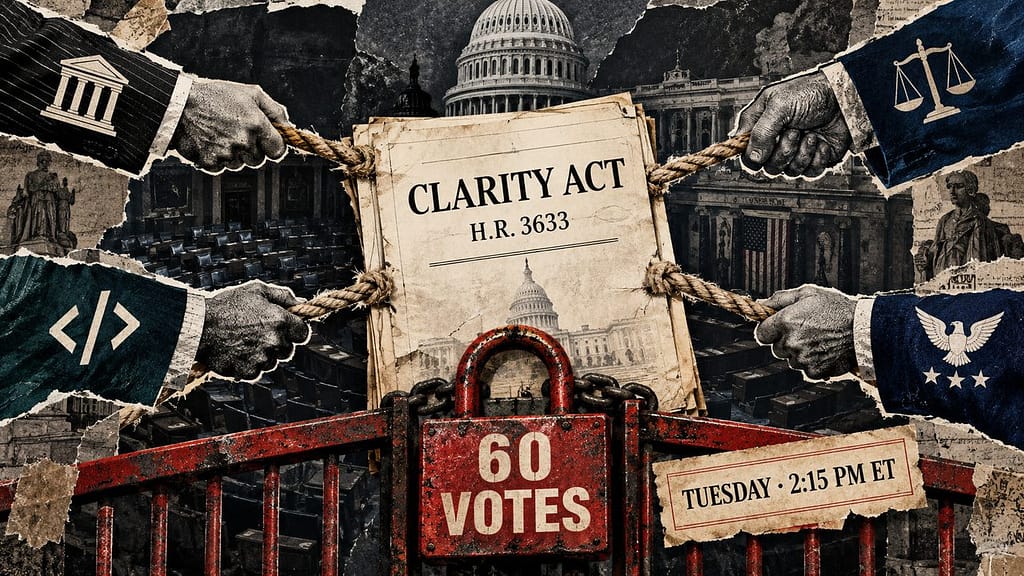
Multiple Senate factions reject revised CLARITY Act hours before cloture vote
The Senate’s revised CLARITY Act faces an unexpected collapse hours before its scheduled cloture vote, with banks, Democrats, state attorneys general, and developer advocates rejecting key compromises that Republicans touted as final. The breakdown threatens passage of the landmark crypto market-structure bill and exposes deep fractures in a coalition that appeared near consensus weeks ago.
- Treasury circuit breaker allows stablecoin-driven deposit flight to occur before intervention, not prevent it, banking groups say.
- New York Attorney General Letitia James leads 18 state attorneys general opposing the bill over weakened state enforcement authority.
- Senate cloture vote scheduled for 2:15 p.m. Eastern Tuesday requires 60 votes; failure blocks Senate floor consideration entirely.
- 126 substantive changes Democrats requested incorporated into final bill text
- 330+ crypto anti-fraud enforcement actions states filed since 2017, now at risk
- 18 state attorneys general joining New York in formal opposition to CLARITY
Senate Republicans released what they called a final version of the CLARITY Act on Friday, claiming to have resolved disputes that had stalled the bill for months. The revision included 126 substantive Democratic demands and new provisions addressing ethics, stablecoin rewards, developers, and prediction markets. Yet within hours, the compromises unraveled, as first reported by CryptoSlate, a coalition of banking groups, Democratic senators, state attorneys general, and blockchain developers rejected the text as insufficient. The cloture vote scheduled for Tuesday will determine whether the Senate can begin debating the bill; passage requires 60 votes.
State attorneys general warn Treasury safeguard arrives too late for community banks
Republicans added a Treasury “circuit breaker” to address warnings that stablecoin rewards could trigger deposit flight from community banks. Under the provision, the Treasury secretary gains authority to intervene if stablecoins cause substantial deposit flight, but only after damage has begun. Treasury Secretary Scott Bessent endorsed the mechanism, saying he would act if stablecoins harm the sector.
Banking groups rejected the reactive approach. Eight trade organizations, including the American Bankers Association and Independent Community Bankers of America, called for an outright prohibition on stablecoin rewards and incentives functioning as deposit interest.
Christopher Williston VI, president of the Independent Bankers Association of Texas, dismissed the Treasury tool as a “meaningless nothing” and “a joke,” arguing regulators should prevent the problem rather than respond to it after losses mount.
The financial sector has lobbied Congress for months to tighten the prohibition, warning that rewards offered through crypto exchanges could make stablecoins functional substitutes for bank deposits and drain funds available for local lending.
New York leads 18 states against bill over preempted enforcement powers
New York Attorney General Letitia James assembled a bipartisan coalition of 18 other state attorneys general to oppose CLARITY, citing its impact on state enforcement authority. James said the bill would weaken state registration and anti-fraud powers while expanding SEC authority to preempt state rules. Her office documented more than 330 crypto-related anti-fraud enforcement actions states have filed since 2017.
The concern reflects a structural tension in the bill: giving federal regulators clearer jurisdiction over crypto markets while narrowing state-level tools.
James warned the legislation would “embolden scammers and potentially strip attorneys general of our authority to protect our states’ investors and their wallets.” This opposition cuts across party lines, undermining Republican claims that the final version had settled the federalism question.
Democratic senators call ethics restrictions on Trump inadequate and unenforceable
The revised text requires covered federal officials with substantial crypto holdings to divest or place assets in qualified blind trusts, with state attorneys general given a role in enforcement. But Democratic staff are circulating arguments that the mechanism lacks teeth. According to Punchbowl News, staff for Senator Elizabeth Warren contend that the Justice Department retains key enforcement authority and that state enforcement can be blocked if White House ethics officials clear the conduct.
The selling point of the compromise was enforcement power independent of an administration that could otherwise overlook its own officials’ conflicts.
Senator Richard Blumenthal rejected the revised language, accusing Trump of using crypto to profit from the presidency and calling the legislation’s restrictions “half measures.” Senator Chris Van Hollen said the bill still contains loopholes involving Trump’s crypto interests and does too little to combat illicit finance and protect consumers. Van Hollen noted he had previously offered amendments to address those concerns, but Republicans blocked them.
Developers lose criminal-law safeguards despite regulatory protections restored
Republicans preserved regulatory protections shielding developers from classification as money transmitters or financial institutions merely for writing software, and extended those protections to miners and validators. However, they removed explicit protections tied to 18 U.S.C. Section 1960, the criminal statute governing unlicensed money transmitting.
Jason Somensatto, director of policy at the Coin Center, called the limitation disappointing, noting that regulatory codification still helps but the absence of criminal-law protections makes Michael Lewellen’s legal challenge against the Justice Department more consequential for the sector’s long-term safety.
Tribal gaming groups reject prediction-market narrowing as insufficient protection
Republicans narrowed decentralized-finance protections so they do not alter derivatives rules or create exemptions affecting prediction markets, hoping to settle concerns from tribal nations and state gaming regulators.
Indian Gaming Association Chairman David Z. Bean said the changes still “do not address the concerns of Indian Country.” The association seeks explicit protections for tribal and state gaming laws and the Indian Gaming Regulatory Act, plus restrictions preventing federally regulated prediction-market platforms from offering sports betting and casino-style contracts.
Bean has argued the legislation would otherwise expand Commodity Futures Trading Commission authority at the expense of tribal sovereignty.
Senator Cynthia Lummis, a leading voice for passage, disputed Bean’s characterization, saying she met with him and the association on June 25 and that the group had been consulted on the fix without expressing opposition at that time. The conflicting accounts suggest the tribal dispute remains unresolved despite the attempted compromise.
Tech sector support stands firm as vote becomes test of Republican coalition-building
Support for the legislation remains strong within parts of the technology and crypto industries. Y Combinator backed the CLARITY Act as “bullish,” arguing that clearer regulatory responsibilities would enable US fintech founders to build blockchain-based products. That backing demonstrates the bill retains backing from core constituencies even as opposition widens across banking, Democratic politics, state enforcement, and tribal sovereignty advocates. The previous effort to advance CLARITY faced similar headwinds, suggesting structural opposition that compromises have not resolved.
Tuesday’s 2:15 p.m. Eastern cloture vote will test whether the concessions Republicans assembled can secure 60 votes to begin Senate floor debate. Failure to reach that threshold would block consideration entirely, leaving Republicans with a heavily revised bill and little evidence the revisions produced a working coalition, forcing a decision on whether to attempt further negotiation or abandon the legislation in this session.