
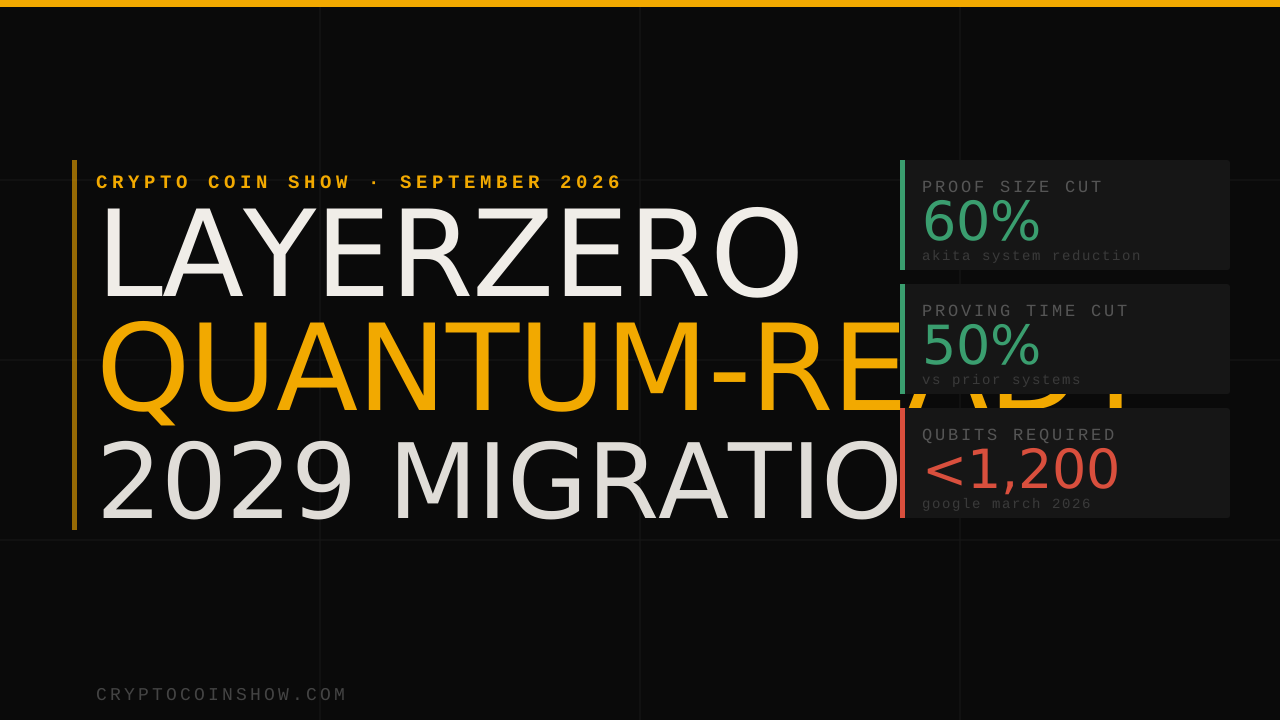
LayerZero deploys quantum-resistant cryptography with 2029 deadline for institutional migration
LayerZero and Coinbase are moving from research to production deployment of quantum-resistant cryptography, setting concrete 2029 deadlines that will force institutional custody systems and blockchain infrastructure to migrate away from vulnerable elliptic-curve encryption. For asset managers and custodians, this signals a window to pilot post-quantum systems before regulatory and technical pressure makes migration mandatory.
- LayerZero shipped Akita, a production-ready zero-knowledge proving system using lattice-based cryptography that cuts proof sizes by 60% and proving time by 50% versus prior systems.
- Google’s March 2026 quantum research showed breaking 256-bit elliptic-curve cryptography could require fewer than 1,200 logical qubits, down sharply from earlier estimates, with Google targeting 2029 for its own post-quantum migration.
- Coinbase hosted a closed Stanford workshop where Bitcoin developers and hardware-wallet makers found no consensus on a single signature scheme, signaling migration will proceed iteratively rather than through an industry-wide standard switchover.
- 65-80 KB Akita proof sizes compared to prior 200 KB benchmarks
- 2029 Target year for Google, Ethereum, and Coinbase quantum-resistant cryptography deployment
- 99.9% Percentage of Coinbase customer assets protected by current security architecture
The cryptography protecting Bitcoin, Ethereum, and most major blockchains faces a concrete, measurable threat from quantum computing that has accelerated faster than previously modeled. According to reporting from Cryptopolitan, LayerZero and Coinbase have begun moving beyond research into production systems designed to withstand quantum decryption. The urgency stems from research released by Google Quantum AI in March 2026, in which Ryan Babbush and Hartmut Neven calculated that breaking the 256-bit elliptic-curve cryptography used by most blockchains could require fewer than 1,200 logical qubits and approximately 90 million Toffoli gates, a dramatic reduction from prior estimates. While Google’s current “Willow” quantum chip operates only 105 physical qubits, the trajectory is forcing institutions to begin planning migrations now.
LayerZero ships Akita with 60% smaller proofs and 50% faster verification
LayerZero has introduced Akita, the first production-ready zero-knowledge proving system built on lattice-based cryptography, the same mathematical foundation that the U.S. National Institute of Standards and Technology has already standardized for post-quantum encryption and digital signatures. Akita compresses proof sizes from 200 kilobytes or larger down to between 65 and 80 kilobytes, cuts proving time by two to three times versus LayerZero’s prior Jolt system, and roughly halves memory consumption. The system will initially be deployed within Jolt, the zero-knowledge virtual machine LayerZero developed with a16z crypto, which powers LayerZero’s Zero blockchain.
These efficiency gains matter to institutional operators because smaller proofs reduce bandwidth and storage costs, while faster proving times lower computational infrastructure expenses at scale.
Coinbase workshop reveals no consensus on Bitcoin’s quantum migration path
Coinbase convened a closed Post-Quantum Bitcoin Workshop at Stanford University in collaboration with cryptographer Dan Boneh and Localhost Research, gathering Bitcoin developers, institutional custodians, and hardware-wallet specialists to compare quantum-resistant signature schemes.
The participants examined multiple candidates but discovered trade-offs in security, transaction size, hardware performance, and key management that prevented agreement on a single best approach.
Coinbase also hosted a separate initiative on post-quantum preparation, emphasizing that a well-tested migration plan matters more than the exact year a quantum attack might occur. The company noted that its current architecture already protects approximately 99.9% of customer assets and stated that any transition will likely occur in phases. In July, Coinbase had already introduced PQ-CoreKMS, a post-quantum version of its key-management system designed to operate alongside current infrastructure during a staged rollout.
Ethereum targets 2029, NIST sets 2030-2035 deprecation deadlines
Ethereum’s roadmap for “Lean Ethereum” targets 2029 for full post-quantum protection across consensus-layer BLS signatures, KZG data-availability commitments, account-level ECDSA signatures, and zero-knowledge proof systems.
Google has named Coinbase, the Stanford Institute for Blockchain Research, and the Ethereum Foundation as collaborators on its 2029 post-quantum migration goal. NIST has signaled its own timeline: deprecating ECDSA by 2030 and disallowing it entirely by 2035.
The convergence of these deadlines means institutional operators have less than five years to pilot, test, and deploy quantum-resistant systems before both regulatory pressure and technical necessity force a broader industry transition.
The absence of consensus on a single Bitcoin signature scheme means different custodians and exchanges may implement different post-quantum solutions during the migration window, creating operational complexity for institutions that manage assets across multiple chains. Watch for announcements from major hardware-wallet makers and custody providers on which specific signature schemes they will support by 2028, and whether Bitcoin’s developer community proposes a soft fork or upgrade to lock in a preferred standard before the 2029-2030 regulatory and technical deadlines take full effect.