Maia 300 reveal could land in September as Microsoft books TSMC capacity for 2027
Microsoft is targeting a September public launch of its Maia 300 AI accelerator and has booked TSMC capacity for over 300,000 units by 2027, signaling a major institutional push to reduce dependence on Nvidia and establish proprietary silicon as core infrastructure. For institutional crypto and blockchain investors, this underscores how legacy tech giants are absorbing the strategic logic of custom silicon, a playbook that began in crypto mining and now defines competitive advantage across enterprise AI.
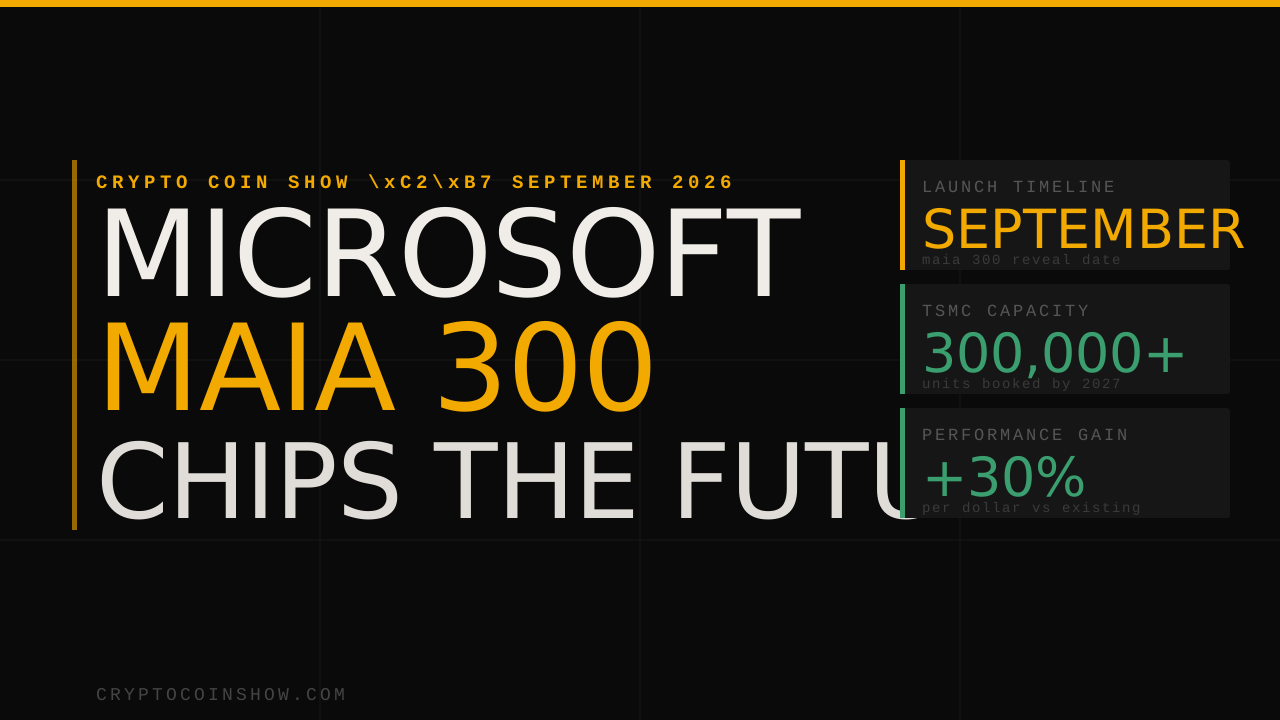
- Microsoft aims to launch Maia 300 in September and secure 300,000+ TSMC units for 2027 delivery
- Maia 300 performs 30% better per dollar than existing hardware, per CEO Satya Nadella in July earnings call
- Microsoft’s longer-term target exceeds one million units, though packaging and component supply may constrain actual volumes
- 300,000+ Maia 300 units Microsoft plans to secure from TSMC for 2027
- 30% Performance-per-dollar advantage over existing hardware, per CEO statement
- 1M+ Long-term unit target Microsoft has set for Maia custom silicon line
Microsoft is moving aggressively to escape Nvidia’s grip on enterprise AI infrastructure. The software giant has reserved substantial manufacturing capacity from Taiwan Semiconductor Manufacturing Company for delivery of its Maia 300 AI accelerator beginning in 2027, with an initial target of more than 300,000 units, a figure that dwarfs the tens of thousands of Maia 200 parts produced to date.
The company plans to publicly unveil the Maia 300 as soon as September, according to reporting by The Information, cementing a shift that CEO Satya Nadella has already signaled: building proprietary chips is no longer optional for companies running hyperscale AI workloads.
The order size reveals Microsoft’s confidence in the Maia roadmap after earlier setbacks. The Maia 200, launched in January 2026, encountered performance issues in early testing that forced delays and limited rollout to only a handful of data centers.
But Nadella disclosed on Microsoft’s July 29 fiscal Q4 2026 earnings call that the current generation runs 30% better on performance per dollar than competing hardware, a claim that, if validated independently, would justify the capital intensity of a custom chip program.
Nadella has been explicit about the goal: reduce reliance on Nvidia. Microsoft is scaling Maia across its own inference workloads for OpenAI and internal models, expanding deployment through Azure AI Foundry and Copilot, and actively selling the hardware to large outside cloud customers.
Azure and other cloud services grew 43% year-over-year in Q4 2026, reaching $90 billion in total company revenue, making custom silicon economics central to margin defense.
Maia 300 enters market as custom silicon race intensifies among hyperscalers
Microsoft is no longer alone in this pursuit. Anthropic confirmed this month it is building an in-house semiconductor team to design custom chips for its Claude models, positioning itself as a potential buyer of Maia 300 units and as a future rival in proprietary silicon.
The shift is structural: in-house chips from Google, Amazon, Meta, and OpenAI were projected to capture 45% of the AI-chip market by 2028, compared with 37% in 2024, a gap driven by the same logic that powered custom ASIC development in blockchain mining years earlier.
For institutional investors, this transition matters because it redistributes margin and leverage across the AI supply chain. Nvidia remains dominant, but the margin compression from custom silicon adoption is real and accelerating. Companies that control their own silicon control their cost structure, their latency profiles, and their roadmap independence.
Microsoft’s investment in Maia reflects a calculation that the capital cost of custom silicon, amortized across hundreds of thousands of units, is now lower than the lock-in cost of perpetual Nvidia dependency at scale.
The competitive logic mirrors what happened in blockchain infrastructure, where early miners moved from commodity GPUs to custom ASIC designs as difficulty and energy costs rose. The same pressure, volume, margin, and supply chain risk, is now driving enterprise AI toward proprietary silicon.
Microsoft’s TSMC order is a bet that AI workloads are sufficiently standardized and proprietary that custom silicon ROI turns positive at production scales in the hundreds of thousands.
TSMC capacity crunch may constrain Maia 300 ramp despite Microsoft’s 300,000-unit target
The physical bottleneck is real. TSMC’s N3 node, the 3-nanometer process on which Maia 300 is built, and its advanced CoWoS packaging technology face supply constraints through 2027, precisely when Microsoft intends to accelerate production.
Microsoft’s longer-term ambition exceeds one million units, but packaging negotiations and component supply shortages could cap actual delivery well below that ceiling.
This timing collision matters for institutional readers evaluating semiconductor and cloud infrastructure dynamics. TSMC is the critical node: it must balance Microsoft’s growth, competing demand from Apple, Qualcomm, Nvidia’s own advanced packaging needs, and AMD’s CPU roadmap.
Microsoft has leverage as a major cloud customer and hyperscaler, but it is not the only one seeking scarce N3 and CoWoS slots. The September launch window may slip further if early Maia 300 production encounters the same test failures that delayed Maia 200.
Microsoft has publicly acknowledged these constraints and framed them candidly to investors. The path to one million units is neither automatic nor certain.
Achieving 300,000 units by 2027 would represent a 10x increase over current Maia 200 volumes and would require not only TSMC capacity reservation but sustained yield and qualification success, a benchmark the previous generation missed on its first attempt.
September launch and 2027 delivery frame a two-year institutional AI infrastructure play
The September public launch is a marketing and validation event. It signals to Azure customers, cloud partners, and enterprise AI buyers that Microsoft’s custom silicon is not a speculative project but a committed infrastructure plank.
Maia 300 will likely enter beta programs with select customers in Q4 2024 or early 2025, giving Microsoft real-world performance data to counter Nvidia’s installed base advantage and locked-in relationships.
The 2027 delivery date, however, is the material one for institutional planning. Two years out, TSMC will have completed its N3 capacity ramps and begun N2 production. Microsoft will have iterated on packaging and component sourcing.
By then, competing custom silicon from Google, Meta, and Anthropic will be operational, creating a crowded market for specialized inference hardware where price and performance per watt, not just absolute FLOPS, determine adoption.
For institutional investors tracking cloud infrastructure, AI chip supply chains, and semiconductor capital allocation, the Microsoft-TSMC reservation is a leading indicator. It suggests that hyperscalers are confident enough in proprietary silicon economics to lock in multi-year TSMC capacity now, at current pricing and timelines.
If Microsoft executes and reaches 300,000 units in 2027, others will accelerate their own custom chip timelines. If supply constraints, yield issues, or performance gaps delay the Maia 300, the entire custom silicon roadmap will compress.
Watch for Microsoft’s September announcement of Maia 300 specifications, pricing, and initial customer commitments. That disclosure will reveal whether the 30% performance-per-dollar claim holds under production scrutiny, and whether major cloud providers or AI labs have already signed long-term purchase agreements. The real test arrives in late 2026 and 2027 when TSMC begins shipping units at scale; any significant miss on the 300,000-unit target or report of yield or packaging delays would signal that custom silicon economics are harder to crack than Microsoft’s public statements suggest.