Luke Davis / Bull Market Blueprint
Luke Davis on why stocks, gold and bitcoin beat bonds in 2026
In this episode
Luke Davis argues that tech and the hyperscalers have carried the whole index in 2026 while most other sectors stalled, and that the fourth quarter of a midterm year has historically been the strongest stretch of the four-year cycle. He also explains why he sees OpenAI and Anthropic priced like hyper-growth companies, and why he would rather own the chip, memory and hyperscaler names they spend their money with.
bullmarketblueprint.com · @lukedavisBMB on X
- Tech and hyperscalers have driven index performance in 2026 while most other sectors stagnated, creating a narrow market rally.
- Q4 of midterm election years historically represents the strongest quarter of the four-year presidential cycle, known as the midterm miracle.
- Long-term investing based on fundamentals and conviction outperforms emotional trading driven by news cycles and short-term narratives.
- OpenAI and Anthropic are priced as hyper-growth companies, but chip manufacturers and hyperscalers that supply them may offer better value.
- Self-managed portfolio success requires formal market education and strategy rather than chasing headlines and making emotion-driven buy and sell decisions.
Chapters
By the numbers
Transcript
Read the full transcript
Do you think that OpenAI and Anthropic are overvalued in that sense? I think they're the most loved and hated companies in the world right now. You either love these companies or you absolutely hate these companies and you don't want anything to do with them. You never want to hear about them again. But often times things are a good investment while they're still hated and they're
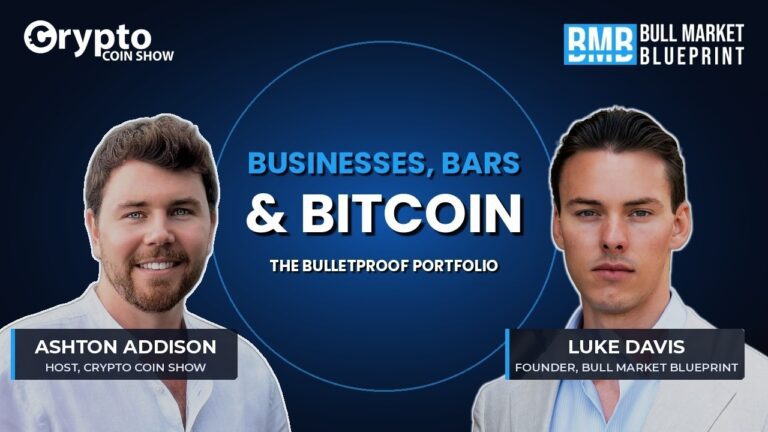
not as good of investment of an investment when they're, you know, well-loved by by the masses and by the media. Ain Addison from the Crypto Coin Show and today on blockchain interviews we have Luke Davis, founder and chief market strategist of Bull Market Blueprint and an old friend of mine. Luke manages his own multisefigure portfolio across stocks, commodities, crypto and
through his inner groups shares his actual positions and the reasoning behind his moves. We're here to discuss the current growing upcoming bull market, the shift in narratives and the merge in blockchain and AI and much more. Luke, welcome to the show.
Ashton, it's great to be here and it's great to be speaking with you again after all these years. I think the last
time we connected was in Tulum about 5 years ago. So, this is great.
Yeah, so much has happened since then. Your network has been growing tremendously. The market's been growing. Crypto Coin Show is bigger. And things are looking up, especially right now in Q4, which I think is normally the most important quarter of the markets. And with this Q4 this year, we're seeing a
lot happening. Maybe the midterms have something to do with it. I would love to get your take on that and everything that's been happening in the last 2 months with crypto pumping up. I would love to start high level on how you've seen 2026 play out from an investment standpoint and do you think Q4 this year is important for investing?
Yeah, great question. I think that 2026
so far has been I would call it a challenging year for most investors because of what happened at the beginning of the year. At least on the equity side of the market, you had this broadening out where you saw international stocks outperforming US stocks. you saw cyclicals and you know more of these real economy companies doing better and that's
typical when you start to see an environment in a in a midterm year where investors get prepared or institutional investors get prepared for the volatility that naturally comes in these years. But I think interestingly enough, what's been happening side side by side to the fact that this is a midterm year is that we're at this rapid sort of inflection point where AI
adoption and use cases as well as just the power of the technology is starting to go parabolic. So really what we saw was that broadening out in the beginning of the year. Then the Iran US war situation started to move markets lower in March and April. There was a massive amount of fear. there was a lot of de-risking both on both on the institutional side and on the retail
side and then when markets bottomed in late March, early April and resumed to the highs, it was all tech and tech left everything behind. So I think that threw a lot of investors off guard. I mean, they may be positioned for a year that was going to be good for AI on the retail side and they probably got spooked out of those positions in March. And then on the institutional side, I
know they were more so positioned into like a broadening out style style year. And it makes sense. Midterm years are usually very choppy. They're they're not necessarily very good up until this exact point, which you brought up the point of Q4. And Q4 in the midterm year is actually arguably the best quarter of the entire presidential four-year cycle when you look at
investing in a on a presidential cycle term. So they call it the midterm miracle. It's the fourth quarter of the midterm year and the first two quarters of the following year. So in this case, you know, the next three quarters of the markets. And as we all know, crypto native investors of course love Q4 because this is where we do see the most performance in the crypto
markets as well. So I think this year sets us up for an interesting Q4 where we can get that midterm miracle effect for equities and that can carry on longer than just the quarter. And I think this also gives crypto a good a good reason to move higher even though we're in a macro environment that's maybe not that supportive for Bitcoin and crypto right now with yield surging
and the dollar surging and everything. You know, I don't want to go on forever on this point, but it's it's an interesting market. So, I think all of 2026 has been a series of head fakes for a lot of people that maybe have a traditional set of rules for the way they approach markets and just challenge after challenge after challenge being thrown at them. And the truth is, if you
own crypto, you own AI related companies and you own quality and you've just held them for the year, you've done you've done pretty good.
Mhm. Definitely. And with those head fakes, it becomes a challenge for these self-managed portfolios. And that's what you're doing with a lot of capital versus handing it to some other adviserss or funds. H how do you manage
what are the tips to managing a self-managed portfolio and not getting caught up in head fakes or short-term narratives and thinking long term?
Yeah, I love the point you made there of thinking long term because I think that's where it all starts. When you're investing with a with a bank or a financial adviser, financial planner, most of the time they're going
to set you up with a long-term strategy because that really is the best way to be invested in markets. I think what's happened in the past 5 or 6 years really since that 2020 2021 era of people getting on Robin Hood and starting to self-invest has almost sort of created this environment where people think they should be jumping in and out of stuff
all the time. and they should be chasing the latest and hottest narrative. And you know, you look at the most successful investors of our of our time, your Stanley Ducken Millers, your Warren Buffetts, your you know, Bill Aman's, their long-term performance has been what's made them wealthy and the investors in their funds wealthy. So retail loves to jump on narratives and
narratives love to live in the news. And then you have the news cycle that's always getting more volatile and more opinionated. And I think people don't necessarily understand fundamentals because they're not investors first and they haven't gone through any sort of formal education on how markets work and they see narratives, they see headlines and they think those are the moves to m
to they think those are the environments to make a move in because their emotions are telling them, hey, this is something to buy or hey, this is a time to sell and be fearful. And I think that's where most people that are managing their own money make these big mistakes is they're doing it all based off of emotion. They don't have a strategy. They don't have a sense of
fundamentals in the market. And a lot of the time they just don't know what they own. And I think you lose conviction when you don't understand what it is that you're buying and selling when you're an investor. And really buying and selling is trading. It's not investing. So they're they're two very different things. I would encourage not trying to, you know, merge those topics
together and pretend you're an investor when you're actually trading the market.
Definitely. It's a great point and that leads me to dive deeper into blue market. Bull market blueprint, sorry, where you're openly also talking about your calls and I can imagine maybe a newbie joins that and they're like, I want to see calls all the time. I want
to get rich quick. You know, what is this slow strategy? And you know, it's it's a balance between like appeasing and educating versus, you know, not trying to lead people astray. How do you manage that? Well, first of all, I've been through it all myself. I've made all the mistakes and I've made all of the best decisions, you know, in throughout my career
investing so far. I started investing casually in 2019 and I took things way more seriously from March forward in 2020 until now. So I've I've been through the retail spin cycle already. I understand where you can make and lose a lot of money in markets because I've had that experience. Luckily, I've made more than I've lost. And I had a great
tailwind environment to start with given the 2020 macro environment of, you know, massive amounts of money printing and starting more crypto concentrated then moving more towards equities recently. But what I would say is most of the time people are are are coming to us and because we don't advertise the whole you know lots of trades and you know
make lots of money and returns ASAP kind of approach. Because that's not what I do. That's not what we're here to do. We onboard the right members to BMB and right kinds of clients that we work with. But I still do see people looking for more activity and looking to be more active investors. And I think it just shows that they're
still new to the process, right? Because everyone wants to what is the next new hot thing that I can invest in or what's the way that I can tweak my portfolio this week that might, you know, squeeze out an extra percentage or two of percentage or two of points of gains. And really I think with experience what you realize is what you want to do is make as few decisions as
you possibly can with the highest quality outcomes versus shooting as many shots as possible. I think in a lot of times, you know, people that are coming to us, they're entrepreneurs, they're business owners, they work in sales, they work in marketing. And in business, everything's about shots on net, right? It's about how many attempts you try to grow your business, to get your name
out there, to do anything you can to try things. And trying things is how you learn and create amazing products in business. But in investing, it's not necessarily a game of try try. It's a game of think, think, then execute. And a lot of the times when people are starting out, they're trying their thinking, but that thinking isn't necessarily very high quality or coming
from very high quality sources in terms of where they're getting their their research or their analysis. So again, what I would encourage people to do is really just decide, do you want to trade the market, which I believe is a full-time commitment in all honesty to do that successfully, or if you want to invest, do you want to invest in quality and make sure that when you're
essentially putting your money to work on your behalf, you're doing so in a in a very smart way, or do you want to aim for, you know, different like shots on net for moonshots? And some people do want that approach. I think that you can balance the two very well. Our portfolio framework is called core and thematic. On the core side, in our equities, we're
focused on holding companies for 5 to 10 years. On the thematic side, 3 months to 18 months. So, we have the ability to be short-term and long-term investors in one portfolio. But I do believe you make the most success for yourself as an investor and also you sleep the best at night when you own really high quality assets and you just know that you want to continue owning
them for a longer period of time. you invest in stocks, crypto, precious metals. You mentioned there long-term verse thematic as well. How do you determine the percentage on at least on the on both of those halves in between those three and then in the sectors?
Yeah, it's a great question. So, we have a portfolio design framework that we call the bulletproof portfolio. And it's
a it's a futuristic take on what we call in the investment world modern portfolio theory, which dates back to the '50s. It's a 60/40 allocation to stocks and bonds. We're of the belief that bonds are not necessarily what you want to be invested in the new macro and fiscal environment of the 2020s onwards. 2022 was not a good year for bonds. this has
not been a good year for bonds. You have not found safety in hiding in bonds from the Iran war situation as an investor. You know, you're really your only safe haven shortterm there was cash and then next thing you know, the market took off again and AI was leading. So in our view, the way that you want to build a portfolio is instead of allocating that other traditional 40% of
your liquid net worth towards bonds, you put it into productive assets and assets that also have benefits and features associated them with scarcity, for example, like Bitcoin and gold. So the bulletproof portfolio theory that we use is equities primarily you know 50 or 60% waiting to equities and the remainder of the portfolio if you're more aggressive is tilted towards
crypto and balanced with metals or if you're more conservative is focused on metals like gold and silver and then also sort of you could say asymmetrically balanced with a little bit of crypto exposure to give people those sort of extra juice on their returns during the good years of the of the crypto cycle, but not allow it to, you know, ruin their whole portfolios.
That's our structure. We call it the 3Bs, businesses, bars, and Bitcoin. That's the way everyone can remember it very easily. And I think those are the three asset classes that you want to be owning, you know, for the next decade, two decades, three decades into the future. It's not necessarily investing in government debt. I agree about the bonds and government
debt, and it's not it's not a sexy investment either. Whereas Bitcoin is very sexy and I'd love to dive into the crypto side more. You know, on Crypto Coin Show, we have all different layer 1 chains, DeFi applications, decentralized applications, and a lot of them can be very speculative as well. When you're looking at, you know, the third B for Bitcoin, is there a very
heavy weight to Bitcoin or are there also other blockchains and other narratives inside of cryptocurrency in that portfolio? Yeah. So at a very high level view, I think when investors don't really know very much about crypto and I think we are still in a in a in a large cycle of awareness and adoption related to cryptocurrency, Bitcoin is the best
starting spot and that is the sort of the dominant part of the portfolio for most beginner investors adopting this strategy or beginners when it comes to crypto. In my personal portfolio, Bitcoin hovers anywhere between just under half of the portfolio to just over half. And I can balance the rest of it out with opportunities that I see in
the altcoin market. My rules from a portfolio management perspective when it comes, excuse me, to altcoins is the altcoin needs to be outperforming Bitcoin to justify its allocation in the portfolio. I would say more so where I'm a bit of a trader in my own portfolio is on the crypto side of what I own just given that I don't really like to hold something that's underperforming
Bitcoin. Otherwise, I'd rather just let the whole portfolio be Bitcoin because that's what I want to own more of long term. So, you know, I do see the value in layer 1. I do see the value in privacy protocols. I see the value in you know, decentralized exchanges. Absolutely. and all of sort of the other blockchain products and innovations that exist in this
ecosystem. But when the conditions aren't ripe for them to be outperforming, I tend to cool it on my positioning on that side of the portfolio just because I don't like the drag that it has on the performance. Definitely we've seen these 80 to 90% draw downs or crazy liquidation events happen in crypto just because of the nature of the amount of liquidity
and the size of the industry right now. You mentioned there some great narratives privacy layer ones decentralized exchanges. Are those the three categories inside of crypto that you're most interested in right now or are there other things and why?
I would say on the crypto side, it's not necessarily what I get the most interested in because I find a lot of
the research that I'm really deeply interested in is more so on the equities front with what's going on related to AI just because there's so much value being created. But on the crypto side of things, I like to let the market tell me where to pay attention. So in terms of what's outperforming Bitcoin, that's where I'm going to start. And we have
tools internally at BMBB that I look at on our end. That's not necessarily client or member facing that allows me to track what's what's performing in the market and make an assessment of whether I want to own it. You know, for example, Hyperlquid has been in our portfolio off and on since 2025. You know we've been holding it for most of this year so far and I really
like the you know fundamental argument for owning hyperlquid. I like the fact that there's per purr hyperlquid strategies which is essentially a dat focused on ownership of hype. I like the fact that Stan Duckiller is also an owner of that in their one of their most recent 13F filings. So that validates the hype thesis from an institutional level for me. But I
would say you know narratives have a funny way of like being mirages in the crypto market. Early cycle there's a few narratives that emerge and then things take a turn whether it's a turn towards AI or it's a new trend that emerges as a result of AI and the money flips very quickly in the market. So, I tend not to gravitate towards really getting locked in on any narratives
because I think it can kind of throw you off in crypto just given that it's not necessarily a long-term market in a lot of the altcoins or at least it has been for some time. That may be changing nowadays with sort of how AI and crypto can now communicate and work with each other. But if you've been a, you know, a long-term altcoin holder in a lot of projects that are even are doing
well in the past couple of months, if you've held them for years, you know, you've gone nowhere. So, I really don't like to fall into that camp of holding anything based off of a narrative or getting married to my to my positions. But in terms of what I'm excited about right now, I'm excited about privacy coins because I think people are waking up to the fact that
owning your money and owning your money privately is increasingly more important in an AI native world. I'm I'm very you know happy with my larger allocation into Bitcoin in the portfolio just because it's it's one of those things that I see AI struggling to disrupt and at the same time I am of the belief that the world in 10 years from now before it becomes
better with AI in some ways it gets more chaotic and I think that leads to unemployment unemployment I think leads to stimulus and you know stimulus leads to the to the growth of Bitcoin. and gold. But yeah, to not get too far off topic with your question about crypto narratives, you know, I think layer ones are very important alongside Bitcoin privacy
tokens and decentralized exchanges. Really protocols that are generating revenue and that have an incentive and a reason for you to be a token holder more so than they're just part of a fluffy narrative is what you really want to own in my view.
Definitely. revenue has become ever more important in the crypto industry and it's over it's it's taken long enough
they should have had that at the beginning that you know legitimate companies that have customers with legitimate revenues and profits will be the ones that shine through and I'm glad that realization is has converged with the reality of crypto companies now you mentioned there in the hyperlquid answer about a DAT and these treasuries I'm curious your take on some
of the main treasuries, you know, if you have a balance of equities in the portfolio, how much of that, if any, is tied to crypto stocks, whether it's Micro Strategy or Bitmine or other DATs, and do you think that there's value in having DATs that are just holding a digital asset and there's extra value because it's an equity?
Yeah. First of all, I love crypto
equities because everyone that lives in the trady world that can't or is unwilling to get on crypto rails really only has a few options. They can look towards Bitcoin ETFs, Ethereum ETFs. Now we have some soul and other ETFs among altcoins, but for the majority of let's say 2023, 2024, 2025, which was the last sort of 3 years where crypto was was
cycling higher, you didn't really have a lot of optionality on the equity side to take exposure in crypto. So you had your classic crypto equities, Coinbase, Micro Strategy, you know, you saw Bit Mine come out towards the end of the last cycle. In current currently what I what I hold I do hold some exposure to crypto equities but in terms of DATs and holding DATs
versus the native assets that they're accumulating. I'm of the belief that if you want to be buying Micro Strategy because Micro Strategy owns Bitcoin unless there's a reason why you can't own Bitcoin or you can't own IBIT, you should be buying Bitcoin spot and holding it yourself in your own wallet, self custody, taking ownership of your money. I believe the same thing for
Ethereum over buying Bitine. And it's not that these stocks couldn't outperform the n the native assets that they're that they're accumulating. I think in a lot of cases they probably have a good chance at doing that considering how much capital is in Tradfi versus how much capital exists in crypto to move those two markets parallel to each other. But for me
considering I have an you know a dedicated sleeve in the portfolio for cryptocurrency specifically I don't feel the need to also add a lot of crypto exposure on the equity side
you know maybe from more so than maybe one to two positions actively that I'll manage. One key caveat is I do categorize those as thematic positions because they are cyclical. Coinbase is
not a you know a hold for the past four years in my opinion. and it's not been a good stock for that purpose. It's it's a bit of a yo-yo stock and yo-yo stocks are fantastic when they bounce and you're riding the bounce, but you kind of have to understand when when the market either the sentiment or the macro conditions are shifting
and it doesn't make sense to hold them anymore. So, I play them as thematic opportunities on the equity side because they can really run hard, but they do tend to sell off quite quite intensely during during bare markets. But yeah, I guess to answer your your your topline question there on DATs, I prefer owning the actual assets than owning the DATs, but I have,
you know, made money in my portfolio owning the DATs as well. So, just to be transparent, I do like both approaches. But I would prefer just to own the assets natively and in a spot wallet.
Yeah, I agree. And maybe as a blockchain purist, you know, the point of people holding these digital assets was was to hold it yourself. And so why you know invest in somebody
else holding it by proxy doesn't doesn't make a lot of sense.
so near the beginning you mentioned AI quite a few times and obviously we've seen the value in our day-to-day lives of how these AI tools are growing and the those company valuations are growing rapidly as well. A lot of them are still private. What's your take on investing in AI on the equity side and what are
the opportunities right now?
My view on AI is that AI is the market. If you look at the sectors in the S&P 500 right now and I have them pulled up on one of my monitors here and I just scroll through them. XLK, which is tech, which is now dominated by hyperscalers and AI companies or at least AI adjacent companies is at new highs. But if you look at the consumer
discretionary, consumer staples, you look at industrials, financials, utilities, basic materials, all of these indexes are either flat or down over the past couple of months and tech is breaking higher. So I think when you look at the stock market on the index level, if you look at the S&P, you look at the NASDAQ, you go the market's great. The market's hot. It's at new
all-time highs essentially. On the NASDAQ, it is. The S&P is not far behind. But then you look at what that index fund is made up of. Let's just consider the S&P or VO which is a Vanguard S&P 500 ETF. Essentially 50% of the ETF is tech and those tech companies are AI companies. So what's been driving the market all year in terms of returns
except for that one period in January and February where we saw a bit of rotation into the real economy. And you had those other sectors that I previously mentioned outperforming, it's been AI. So I do believe that investors are waking up to the fact that these are the companies that are growing their earnings the fastest. They are in a environment with massive tailwinds, at
least if they're on the receiver side of the equation of the hyper or the of the hyperscaler spending. And you know, I think a lot of investors maybe are scared to dip their toes in the market with AI because they feel like they've missed it. And in terms of my personal usage of the technology and what I've seen it do capability wise over the past
year, just from October of last year until now, it's it's a completely different world. And this different world essentially means the tools have gotten a lot better. They've gotten a lot smarter. they're consuming a lot more tokens which uses a lot more compute and I don't think we're anywhere near an environment yet where we have an abundance of compute with an
abundance of people using and adopting the technology. I think people are just waking up to this like they were waking up to crypto but I think this has already surpassed crypto in terms of its its its trend but also its its immediate use cases and benefit to people's lives. So I believe the entire market is AI however you want to spin it. I mean, Muse came out 2 weeks
ago and you know, this is the sort of first experience for most mainstream consumers for consumer agents. And what happens after that? You start to see the financial sector go down and you know, other sectors in the market go down because these investors are worried that there's going to be disruption. You know, if you're canceling your subscriptions because Muse is finding
that you're overpaying or that you're oversubscribed to too many different businesses or you're spending too much money here where you could find an opportunity over there. Well, that throws off retail, that throws off e-commerce. If there's another bank, for example, that can offer you, you know, a more attractive interest rate or a more attractive reason to bank or
or manage your wealth with them, you know, Muse can go and find those opportunities or any of these consumer agents can go and find these opportunities for investors. And I think that just creates a lot of room for dispersion. So, you know, really the market is definitely an AI market, but it's twofold. the companies that are being disrupted and are seeing that
dispersion effect happen and the companies that are building, investing, creating all this compute and then all the companies that no one even realizes are integral to the buildout. You need air conditioning, you need cooling, you need special chemicals, you need materials, you need all these things that, you know, you don't really think about. I mean, Caterpillar, for example,
became a massive stock over the past year that people were were hot to get on board with. And essentially they're the they're a construction manufacturing company creating equipment for building for construction and you're building all these data centers in the US and next thing you know they've got a backlog through the roof of materials
or sorry of equipment that they manufacture and all these other energy companies or electrification companies and your cooling companies building air conditioning and next thing you know you have this AI supply chain and I think that is truly the market and Everything else unrelated to AI or has the potential to be disrupted by AI is really struggled this
year and is even struggling right now. And people are kind of wondering like why aren't small caps doing good? Why aren't other companies doing good if we're in such a healthy economic environment? And I think it's just capital moving towards where the earnings is which is in AI.
Definitely. And I'd love to dive in a little bit more on those the top AI
companies, you know, OpenAI and Anthropic. Their valuations right now are are similar to the traditional web 2 companies that are also leading in AI like Meta and Google. But the revenues of Meta at least are, you know, 10 times higher. You know, you're looking at like a 5 billion revenue versus like 100 billion. Do you think that open AAI and Anthropic are
overvalued in that sense?
I think that they are valued like hyperrowth companies right now is really how the market is perceiving them because you know of course markets are forward forward-looking always. I think investors that are that are coming in privately at these valuations are coming in under the analysis or maybe for back lack of a better term
assumption that the revenues are coming down the line and the revenue growth is massive. I mean if you look at an adoption or you look at a growth curve between Meta, Google, Anthropic and Open AI it takes a very you know extended period of time upwards of a decade for you to start to see the growth numbers that these frontier model labs are starting to post now in
just 3 years. So they are the fastest growing companies in history. I think that's the first thing that everyone has to recognize. Whether that's sustainable or not is a completely different discussion. But they are acquiring the world's population of users. I believe OpenAI recently crossed over a billion users. I was watching a podcast with the head of product at OpenAI, head
of chat GBT and Codex earlier today and he mentioned that, you know, we're looking to roll out these new tools that we've launched last week, which is dots. They're always on agent product. And Astra superfast to you know eventually their entire consumer base of over a billion I think he said 1.1 or 1.2 two billion you know users of
of open AI. So you know that's starting to get close to meta level users you know Meta basically has half the world's population as a user across the three platforms that they run and the platforms that they own. So do I think it's justified? I think that you are definitely making an investment on that all coming together over the next half decade or
decade. Will it be without hiccups along the way? Absolutely not. I think they're the most loved and hated companies in the world right now. You either love these companies or you absolutely hate these companies and you don't want anything to do with them. You never want to hear about them again. But often times things are a good investment while they're still hated and they're
not as good of investment of an investment when they're, you know, well-loved by by the masses and by the media. So, I would have to say, do they do they justify the valuations that they carry? Let's see when they go public. I'm curious to see how the market reacts to them in my view. I personally I really like the companies that they spend money with. You know, I
want to own the chip chip companies. I want to own the memory names. I want to own exposure to supply chain companies and also the hyperscalers. I think that there's there was a massive opportunity to own hyperscalers at really attractive valuations throughout this year and I took advantage on a on a number of those names at some of the lowest multiples they've traded at in
recent history and then they've started to bounce recently. So, I'm not super worried about having exposure to, you know, OpenAI and Anthropic. Obviously I don't have private exposure to them. I'll be fully transparent. I don't. But, you know, when they're public, we'll we'll see. We'll see what happens. I think you know the one thing I'm seeing
with OpenAI right now is they are attempting to be an everything app for work in my view. First you have DOTS which is their new always on agent working in the background for you within your chats within your memory. You can connect it to your Slack, your email. You can connect it to everything you want. You can connect it to your whole life. And there you go. There's
your your your your agent problem solved. You don't necessarily need to go out and build your own agent. You don't need a Cloudbot. You don't need an OpenClaw. none of that. You combine that with Muse and you've sort of outsourced all of your your day-to-day admin from a business and lifestyle perspective to agents. But getting back to OpenAI, they now you can
code in Open AI with Codeex, best best coding platform in the world I've heard from from developers. and you're working collaboratively in spaces now which allows you to work with your teammates on different projects and share files, share storage, share memory and then your agents are speaking to each other in these platforms and doing work on your behalf. So I think the
broader the ecosystem that you can build or that these frontier model companies can build for their users, there's less of a reason to go elsewhere. You're not going to be searching on Google. You're going to be using chat for everything or you're going to be using claude for everything. You're going to be building your your your your renderings. You're going to
be, you know, creating art, creating videos, you know, editing pictures in these apps. And I think that's going to really affect the software industry more negatively than it already has in terms of like people worrying about it. But yeah, the more potential these companies you know have to becoming everything apps, I think the more earnings growth
you're going to see from them and then you know people will start waking up to the fact that they probably are going to be trillion dollar companies upon IPO and will likely be trillion multi- trillion dollar companies in the future.
Definitely. And speaking of the everything app, I'd love your take on X AI and Grock. You know, I think that was
part of Elon's vision back in the day was to build the everything app was X. Now, 20 years later, it's starting to come to fruition. Do do you think that XAI is, you know, in fierce competition with these other two major players?
Absolutely. I think they're all massive competitors of each other. And it's kind of interesting how they all started
off in the beginning as collaborators and then they each kind of decided to pave their own their own path in the in the AI industry. I really am sort of a personal fan of XAI and Grock in terms of Elon's vision for AI and the integration across the suite of products that they have. you know, Grockbot previously was kind of the hot agent that you could use before
Muse and before Dots just came out. I think, you know, it changes all the time, but you know, let's let's put a put a sort of a more concrete analysis on where we are October 2026, I think Astra is an amazing model and your agent setup with dots on chat GBT right now is using Astra. So, I do see it as being superior to Grockbot currently, but I think
anyone who's ever doubted Elon has lost. And I wouldn't be surprised that if you know they end up, you know, maybe not winning, but being at the leading edge of this race for many many years to come, especially if they can, you know, put some of their compute capacity in space with SpaceX, you know, maybe SpaceX and Tesla merges companies and XAI and they all become,
you know, sort of a super conglomerate of super intelligence. I would not be surprised to see that. But in terms of how they kind of differentiate from each other, I think they all have different use cases that they excel at and some of the products that they offer and services they offer are are are lagging. And I just think that it always goes back and forth. You know,
everything was was was clawed for the first, you know, 3, four, 5 months of this year. over the summer, Chat GPT comes out with some model upgrades and you know they're they're more token efficient and you know they're not getting restricted with as much usage limitations and they're really powerful and all of a sudden people are like yeah
I'm jumping back on the open AI train. I want to get chat GPT going. I like codecs for coding if you're a developer and it just goes back and forth. I mean I don't think chatgpt was was superior to claude a year ago. Now I think you know on the like the top level model it's neck and neck I think for your average everyday task I think I'm a believer in JBT currently
but we kind of go back at BMBB and test all these models for our own work and for integrations that we have in our own in our own business and our CRM for example and all sort of like the nuts and bolts of the company we test them and we go back and forth between models all the time and even what I'll do is I'll share that with our members in
the group and say you I think these this model is doing better for us for this particular task like you tested out as well. And I sometimes even see that reflected in the share price of companies that kind of own these frontier model labs on their balance sheets like a Microsoft is a big owner in Open AI for example. So maybe maybe we're seeing that reflect a little
bit in Microsoft's recent recent move off of the lows in a big way. I think that they had their best quarter in almost 30 years in Q3 up 30% on the quarter which is massive for a multi- trillion dollar company. But yeah, I think they're just going to be fighting each other. I don't necessarily think that they'll cannibalize one another, but I think they will be fighting each
other for a while.
Definitely. It's an exciting time right now that new models are coming out almost it's going to be like every month and it's just getting exponentially better each time and the competition does help. They're they want to be the best and so you know they're they're growing in faster than if it was just one company. There's so much to keep
up on. What's the best way to follow your investment thesis and your vision and your calls and everything else?
Luke Davis Investing on YouTube would be the best place to digest my thesis on the market which is the intelligent new world. I believe everything's moving towards this world of an abundance of artificial intelligence. You can
follow me on XL, Luke Davis BMBB and also I'm active on Instagram. But I think in terms of the most value for what you're looking to get out of my takes would be on Unx and my YouTube, Luke Davis Investing. Sounds great. Luke, thank you so much for taking the time for your insights, your groups and supporting other people to help get more knowledge on
investing and managing your own money. It's important not just for crypto, but all of your finances to have a handle on and take accountability for yourself. So, I appreciate you coming on and would love to follow up again in the near future.
Let's do it. And I couldn't agree more. I think investing on your own is very powerful. I don't think you necessarily
need to outsource it to a bank. And if you're, you know, on the you've got your finger on the pulse or you're working with people that have their finger on the pulse, it's it's very rewarding. It's nice to know what you own, why you own it, and what you're working for on an income side to put to work passively on the investment side. But yeah, I'm looking forward to
following up in the near future and seeing, you know, where this conversation ages in a few months or maybe in a year's time
Related coverage
More interviews
 How Birdeye bootstrapped to 5,000 enterprise clientsOct 7, 2026
 How Anvil lets you use crypto as collateral without sellingOct 6, 2026
 Pawel Mastalerz on how Daski helps AI agents navigate the webOct 6, 2026
 Why banks are building for Web3 in silenceOct 5, 2026
 How TrendTrader Pro raised $1M for a token buyback fundOct 2, 2026
 Illia Polosukhin on NEAR's privacy features and AI agents in 2026Oct 1, 2026