
Sherif Abushadi / NEAR Protocol
Sherif Abushadi on NEAR Protocol's education platform and developer programs
In this episode
Ashton Addison speaks with Sherif Abushadi, Education at NEAR Protocol. Sherif discusses NEAR Protocol, the NEAR University and Education platform, how NEAR is innovating their layer 1 protocol, how developers can get involved and get paid in NEAR tokens for their contributions, their 1000 teachers education initiative, and why NEAR could be the fastest growing protocol of 2022.
- NEAR Protocol addresses the same scalability challenge as other layer ones through parallelization, aiming to make blockchain faster, cheaper, and more accessible globally.
- NEAR's education strategy focuses on onboarding developers with clean abstractions, well-documented APIs, and programs like the NEAR Certified Developer that enable rapid skill acquisition.
- The protocol launched a thousand teachers initiative targeting educators across disciplines beyond software development to inspire broader thinking about blockchain's societal impact.
- NEAR emphasizes meeting users and developers where they are with familiar interfaces and seamless onboarding rather than requiring them to adopt entirely new mental models.
- The NEAR Certified Developer program demonstrates rapid developer onboarding, with participants learning fundamentals on Thursday and starting paid fellowship work by Monday.
Transcript
Read the full transcript
i'm ashton addison from blockwest capital for investmentpitch media and the Crypto Coin Show and today on blockchain interviews with sharif abhishadi education at near protocol sharif welcome to the show and thank you for taking the time to come on nice thanks for having me austin appreciate it you're very welcome we did speak with elia one of the founders of near protocol in
the beginning of this year and near protocol is just so fascinating to me i think it's one of the huge up and coming already up you know layer one protocols that has a lot going on and i know that there's a lot to be done in the education aspect of it as well i would love for you to kick it off by just talking a little bit about the near protocol and the near education and
then we can dive into the details sure i'll give it a shot i mean as most of your audience knows bitcoin invented the clock that ticks in blocks and captures data along the way in a cryptographically unassailable history ethereum put a computer on top of that clock and said well outputs and all the code and then all of the layer ones that have emerged in the
last couple of years are just making that faster and cheaper and more scalable so through parallelization polka dot transparent chains solana time stamps and does work in parallel avalanche has specialized chains so we're all just working on the same challenging problem which is maintaining a kind of forever history that's economically incentivized truth
and at near i think what i say without any hesitation is this is you know 25 years in the industry this is one of the strongest if not the strongest team i've ever had the pleasure of working with technically speaking near's core talent is just it's it's really hard to believe sometimes the conversations that you overhear and how fast things just kind
of pick up i mean it's all open source you can take a look but that's remarkable and so as an educator in this space i've been here for a couple of years now i do my best just to keep up and to hold this high bar of you know technical accuracy and at the same time making things accessible to folks who are just coming out of coding boot camps
with a couple of months of experience or veterans of the industry with 10 15 years transitioning from you know web 2 and you know what we most of us think is the is the world wide web today people transitioning into this new web 3 space and so in that sense i think there's really a lot to learn and there's a lot that we can carry over
from what we already know in fact you can sort of think of all of the innovation of the last 20 25 years coming because of the gay guaranteed movement of data around the planet i wonder what we'll see in the next 20 years given the guaranteed movement of truth at the same speed that's really a big deal so that's what's exciting for me and i'm sure it's
exciting for a lot of people out there we're teaching people as fast as we can definitely sharif yeah it's very exciting and i would love to see you know what near protocol is going to look like in 20 years from now and just the cryptocurrency space in general i can imagine it could be slightly different from from what it is now and i'm glad that you touched there on you know all
the up and coming layer ones there's like so much going on so quickly and you're right about you know just making these platforms that you know that the turing complete platforms like smarter faster and cheaper you know especially cheaper for access to people around the world that you know are even unbanked and they don't have any access to capital to be able to do
transactions at almost no cost and i know that the near that's one of your specialties as well i would love for you to dive just a little bit deeper into near and you know in your vision you've already already obviously been working there for a while now and there's so much in the pipeline for near protocol can you talk about you know with all
these layer ones upcoming in the next year or two as some of them rise to the top do you see near protocol as one of those that is just totally leading blockchain innovation look i mean that's a really big idea this isn't i think a kind of something you can plan you know what we've seen in teas in the last you know eight
ten months what we've seen in the d5 space in the last 24 months these are things you could hardly imagine if someone had come to you and just really tried to shake you and convince you a year two ago that we would be where we are today i don't think that they would be able to convince you so it's it's really incredible looking forward is even harder because
things are getting faster we can all feel it anybody up speed getting more complicated getting a little bit faster getting a little bit harder to keep up with year in and year out from our perspective it really is about partnerships and outreach it's about education it's about meeting consumers where they are today instead of trying to convince them
that they need to switch to some new way of thinking about the world meet them with the highest quality user experience with onboarding that's seamless with you know user interfaces that look familiar and feel familiar it's also about developers and meeting them at a place where it's easy to think about building an application on blockchain yeah it's just a slow
expensive database that's actually good enough for your first year the price of slow and expensive the trade-off there is that you basically get a database that doesn't lie and so that's what's exciting so in that sense really many of us like i think kind of see the same landscape and you know we're hoping to attract developers with some of our programs in education
We're inviting you know developers and researchers and designers to come and join us for our fellows program you can check out near.university for that in fact just this week we launched a program to attract teachers a thousand teachers i would love to see a thousand teachers talking about this and i don't just mean software development teachers of
course if you have a technical background that's great but i'm actually thinking of the history teachers the philosophy teachers the economics teachers the home economics and social studies teachers that are going to kind of inspire the imagination of youth to spend some time trying to think about the world and where it's going to be in the next 10 or 20 years
i don't know if i'd have shown you this thing 25 years ago and told you what i do with it today you would hardly believe it so where are we going now that we have this new tech it really is that kind of time and we need more than just software development engineers and speculation to get there i think we need some some really big ideas and some fresh ideas
and so that's what we're hoping to attract that's who we're hoping to attract with this thousand teachers program very cool sharif and yeah i agree it's funny you say that you know about the cell phone people can't even believe it and i think you know if i walked into a classroom and my teacher was talking about near protocol and my head would be turning but i think you know a couple
years down the road it might be completely normal to be talking about you know all of these protocols that are the future of the internet so that's super interesting and when you were talking about you know all those building blocks for the protocol what's needed what i was thinking of in the back of my mind until you said it was the developers you know it's hard to
have lots of applications that people around the world are using if there's no developers and development to actually build those applications and i would love for you to talk a little bit more about how easy is it on near protocol to develop applications and you know can developers easily move from outside of blockchain or from other blockchains to
develop on near yeah i mean you know without comparing any of the development ex you know it's really up to developers to come and check it out and see what it feels like we hear often from developers that come that things are very easy surprisingly easy on near from a technical perspective the abstractions are clean the tooling is easy to use and maturing quickly
the apis are well documented and examples are you know full and complete and so on so it feels welcoming it feels like a place that sort of that you belong quickly and so that's exciting to hear in terms of you know give me some data you might say we have a program in place right now a near certified developer where people are coming in
and learning how to spell near on a thursday building a demo before dinner and then a starting fellowship full part-time you know paid work in the community on monday so i don't know that's like two business days turn around from what is this thing to you know thank you so much i'd like to contribute today yeah it's incredible developers it's you know junior devs
With again just few months experience out of boot camp they come in they sort of get an idea of what this thing is and they can start building it's like a serverless function it's like an api call it's that you know familiar mental models that they're using to build these things so in that sense it's really remarkable definitely yeah to be able to do that in
two days is very remarkable and you mentioned there as well something about getting paid and you know i know a lot of these blockchain startups at least the founders are working on things with sweat equity or just working on cool projects but is there other incentives and can developers get paid if they start working and building on near yeah i mean there's no question so
aside from the you know existing funding opportunities like the open web consortium like you know some of the grants that we've issued we just recently announced 800 million grants 350 allocated for d5 projects through proximity labs and 450 for ecosystem funds the education team alone in the last 90 days has distributed about a million dollars worth of mere tokens and we
plan to increase that in the next 90 days so if you look at sort of where are we're at this inflection point in terms of how much effort and energy and outreach we're doing to reach people out there so the opportunity for people coming in the door is really significant it's a fantastic opportunity actually in terms of teachers in terms of fellows developers
and residents teachers and residents architects and researchers and residents and so on those are full and part-time opportunities that are compensated in year tokens which are liquid on the market now and the you know the only question is what's your experience where are you in the world and we compensate you fairly so it's it's a pretty simple negotiation
incredible and so i'm guessing that's open right now for developers to go to the platform and obviously if they can do it in two days and already start getting paid it's going to be pretty easy so what's the best way for developers to get into that it's surprisingly easy near.university is where you can go to register for near certified developer
and other courses you'll also find their links for fellowship programs ambassador program for university students teachers programs grants fellowships you're certified instructors and we're even hiring folks for the core team as well so we're looking for some some teachers with 10 20 years experience in the industry that can come and help us kind of raise
the bar on what it means to change the future of education in the space as well definitely that's great so yeah it's not just it's not just for developers you know if you know about kobe don't know exactly how to code then there are still opportunities to contribute with nir i think some of the most interesting opportunities asham because in the end coding it's becoming
commoditized but thinking is where the value is so i'll say again of these thousand teachers you know where are the philosophers and the historians and the artists and musicians and animators and illustrators that are going to help us imagine a future that we can't yet see i like that thinking thinking is where the value is love it sharif thank you so
much for coming on i'm really excited to see near protocol grow and i'm sure your team will be back in the near future i would love to get an update then i will leave the near dot university links and the community links as well for near in the description box below for the viewers thank you so much for taking the time to come on and all the best with
mir thanks so much pleasure was all mine
Related coverage
 North Korean hackers laundered $430,000 in stolen NEAR through meme coins on decentralized exchangesNov 9, 2026
 NEAR Intents service exploited for $3.8 million two days after Bitwise ETF launchOct 1, 2026
 NEAR’s Confidential Intents hits $70M TVL, triggering [email protected] reward programSep 21, 2026
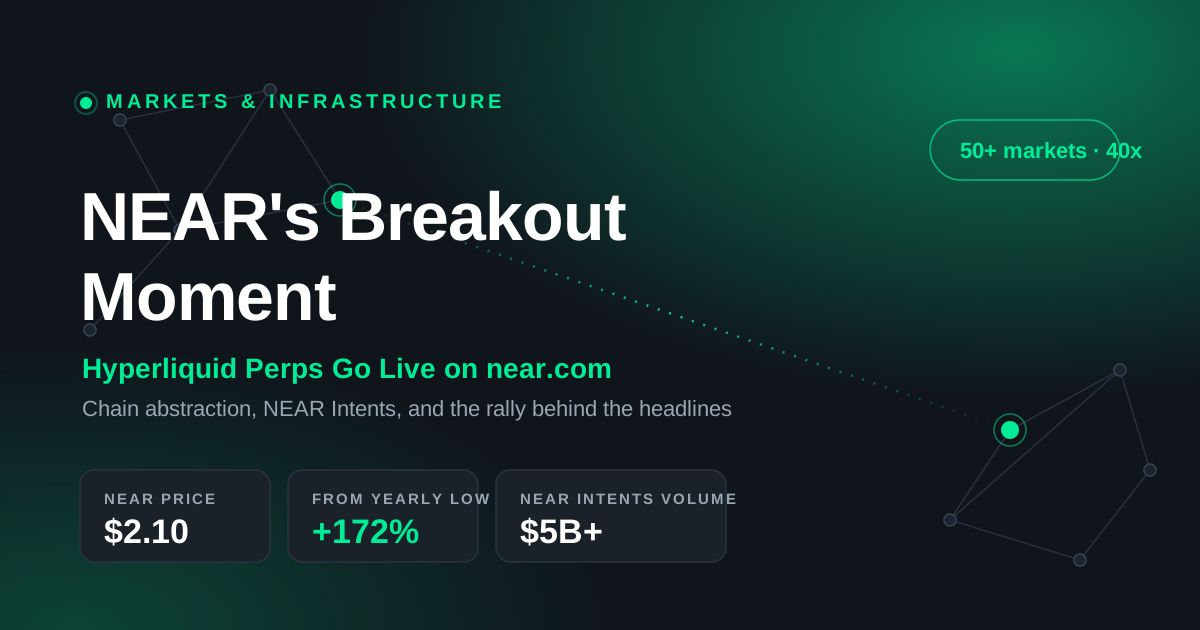 NEAR’s Breakout Moment: A Hyperliquid Integration and a Platform Built for the “Intent Economy”Jun 13, 2026
More interviews
 Why Wall Street is moving toward 24/7 trading in 2026Nov 13, 2026
 How Wallet V is letting AI agents trade while keeping your keysNov 10, 2026
 How Silent Payments Keep Your Bitcoin PrivateNov 9, 2026
 How XYO is building proof in a world of AI fakesNov 5, 2026
 How Cap financed a Hollywood film with onchain creditNov 4, 2026
 How IPX routes box office revenue into token buybacksNov 3, 2026


