
Teymour Farman-Farmaian / Higlobe
Higlobe moves cross-border payments in under 60 seconds at near-zero cost
In this episode
Cross-border payments have been broken for decades — slow settlement, high fees, and opaque FX spreads quietly draining money that should reach contractors, suppliers, and workers around the world.
Teymour Farman-Farmaian, Co-founder and CEO of Higlobe, breaks down how the company built a stablecoin sandwich — bank in, stablecoin in the middle, bank out — that moves funds in under 60 seconds at near-zero cost, without requiring any API integration or crypto knowledge from the business using it. From the 2021 insight that made this viable (marginal cost collapses to near zero when you remove the netting model) to how Higlobe monetizes without charging for transfers, Teymour explains why pricing tends toward zero when the underlying cost structure changes, and what that means for the next decade of global payments. SOC2 Type 2 compliant, MSB-registered, and backed by two bank partners for redundancy — this is what enterprise-grade stablecoin infrastructure looks like in 2026.
You'll learn:
- Why traditional money transfer rails (bank wires, SWIFT, netting models) cost so much and why the 6% industry average hasn't changed in 20 years
- How Higlobe's stablecoin sandwich works end-to-end: where funds enter, what moves them, and how "instant" is defined in practice
- Why pricing tends to zero when marginal cost collapses — and where Higlobe's revenue actually comes from
- How Higlobe competes with Wise, Payoneer, and crypto-native payment companies without charging per transfer
- What SOC2 Type 2, FinCEN MSB registration, and dual bank partners mean for enterprise buyers evaluating risk
- Where stablecoin yield regulation (Genius Act debate) could reshape the competitive landscape for Higlobe, Coinbase, and Circle
- Why Higlobe is protocol-agnostic: the decision framework for switching between stablecoins, Bitcoin-based rails, and CBDCs
- HiGold provides USD accounts for global south users to hold, save, invest, and transfer dollars via stablecoins without traditional banking fees.
- The primary adoption barrier in emerging markets is lack of local on and off-ramps, not technology, requiring country-by-country infrastructure development.
- HiGold operates as a crypto-native company partnering with local exchanges rather than layering stablecoins onto legacy SWIFT-based payment rails.
- Traditional cross-border payments cost 6% and take five days because they rely on netting models and SWIFT infrastructure that HiGold bypasses.
- The global south represents a billion-person middle class market with infinite demand for dollar-denominated accounts due to local currency inflation and instability.
Chapters
Transcript
Read the full transcript
I'm Ashton Addison from the Crypto Coin Show and today on Blockchain Interviews with Taimur Farman Farmaian, co-founder and CEO of Hi Gold here to talk about stablecoin powered global payments, cross-border transfers. Stablecoins are just blowing up right now and it is going to be the settlement layer for global payments. It's very exciting. Taimur, welcome to the show and thank
you for taking the time. Thank you for having me on the show. Yeah, excited to dive into this because not just from you know the genius act and stablecoins becoming more payments becoming more official in the US. This has been known for 10 years at least to the crypto folks that stablecoins are going to be needed needed to do international business and
the costs and the speed are significantly better than any fiat alternative possibly could be. And HiGold has has been deep involved in this and working in international markets as well. And tying that back to the US. So, excited to dive into where exactly we're at right now and where the industry's going and how HiGold fits in there. I'd love to kick
it off with just sort of a high level on what you and the team have have built at HiGold, how that relates to stablecoin payments and stablecoins and then we can dive into all the latest details. So, HiGold provides a US dollar account for users in the global south that want to earn, save,
and spend in US dollars and also invest. Mhm. So, I grew up you can call me two revolution Taimur. I was born in Iran had a revolution, family lost everything, went to Venezuela cuz my dad was in the oil industry. Lost everything there in the Chavez revolution in the 1990s, immigrated to the United States. So, I am let's say traumatized by or scarred
with you know experiences with inflation, with expropriation. And all you know the global south is fascinated by the US dollar because it is though it we think we have inflation here. Everything's packed to the US dollar and the value is relative to the US dollar. So, there is an infinite demand in our countries in the global south. A billion people, I say the billion, the seven
people in this world, the billion of the middle class of these countries that want to hold dollars, want to save in dollars, want to invest in dollars, want to transfer in dollars and they don't want to pay ridiculous fees. So, stablecoin has enabled that and HiGold provides that global account. We're the pioneer in this space. And let me re-rewind a little bit on
this because I picked up you said you know traditionally everyone knew about stablecoin. I disagree with that. Traditionally the OGs in this industry thought about this business in terms of Bitcoin. Oh, we want to keep our money in Bitcoin as a store value. So, all the not all the well-known starter companies in this space really focused on Bitcoin custody, Bitcoin
wallets. You know, you can go to an exchange and trade but if you're going to hold on to an asset is really built around Bitcoin. So, the big transformation, we were the first company in 2019 right before COVID. We sold I remember sitting down with my friends at Paxos, Walter Hestert, some really good people and we're like, "Dudes, we got to do something with stablecoin. We need to
really figure out how to move stablecoin end to end in a way that can prove it as a source of value cuz it's in dollars but it's instant and you know you have the benefits of Bitcoin cuz Bitcoin can be volatile." So, yes, HiGold provides a US dollar account to the global south, to a billion people in the global south. That's our market. So, that they can
hold dollars, invest in dollars, send money in dollars in a way that's super fast and super secure and helps them sleep well at night. Mhm. Yeah, it's a huge market the global south and I've spoken to quite a few crypto startups down there and but and I understand the inflation can be crazy in some of those countries in the south. How what
is the actual adoption look like right now for and the curve of they understand inflation is ruining their fiat currencies, they need to move to stablecoins? Are there technical barriers to adoption in why we can't have a majority percent of the global south moved into something like HiGold easily? So, first of all, every local government wants to control their currency. Mhm.
Right, cuz they want to print more money to pay for programs they can't pay for. Right? It's an indirect way of taxing the population. The population doesn't like that. So, the global south makes it hard for the population to buy dollars cuz the dollar is a kind of hoarded by the US by the local bank, right?
Mhm. So, in Mexico it's kind of hard to
buy cash. But somehow or another there's a loophole where you can buy crypto. And especially you can accept crypto. And stablecoin is a type of crypto. And so right now they haven't differentiated stablecoin from other assets. So, this has grown the market but the real barrier but it's still the digerati that are buying the stablecoin
or want to invest and want to earn in dollars using stablecoin. What is really missing are the invisible on and off ramps in these local countries. You hear this all the time. So, the big problem is not the United States. The problem is down there. How does Maria in Brazil buy stablecoin? She doesn't care about stablecoin. She just wants dollars. So,
you need to have a very good interface where she can picks her money in. It appears as US dollar C in her account and she doesn't know the difference. You know, she doesn't care to know the difference. Right? She doesn't want to transfer to custodied to her own custodial wallet. She doesn't want to care about like encryption keys and stellar and ETH and
seeding. She doesn't want to deal with any of that. So, we are on a mission to build out these rails locally and right now we have the best rails going to six countries and we build these rails out country by country. So, let me go on an aside. You have a lot of companies that will go, "Hey, look, we can go to 150 countries. Like take your money. Let's say you're
an engineer in Brazil. Like hey, you go to a website that says, "Hey, look, take your money in stablecoin. We'll get it to you instantly." But they charge you a ton of money and there's a reason why. It's cuz what they've done is they've got a stablecoin wallet and slapped it onto old world rails. I don't know. The company will pay you in stablecoin. Cool, you can put it on a
debit card maybe but if you want to take it home it's going to take you five days and cuz it's going to go through Swift, you know, all these local things and it's going to come through your your local bank account and you're going to pay 3% on it. So, we don't do that. Our philosophy as a company, we're a crypto native company. We go country by country, Brazil,
Mexico, Philippines, India. We work with the best local exchanges to have a seamless interface so users can move in and out into dollars without even knowing that it's instant. It's there's basically no fee. There is no fee cuz we make money different ways. We'll talk about that. But to your question, we believe when the friction's taken out growth occurs and that is what we've
seen in the countries that we work in. Does that answer your question? Give a little context. Yeah, definitely and you mentioned there about no fees. I think everyone is tired of the fiat payments whether it's Stripe, PayPal or any kind of payment processor. It's always like 3% and then looking at bank traditional rails, there's I don't know what the
percentage is but you know, it's never cheap. And that's the that's the 6%. Yeah, even worse. That's the key with stablecoins but the problem is moving it back into fiat or payment paying internationally, there's always those fees. Right. So, we really work with local partners to make that happen and let me be very upfront. I'm going to make two big statements
here. Number one, I'm going to build on the first statement about the problem we address. We're building a banking product for a whole new market. So, this will resonate. In the United States, we have digital banking in the form of chime but there wasn't much innovation there. It's the same banking system. You just
put it on a mobile app, right? Mhm. In Europe, you end up with significant innovation because Starling or Revolut and the guys at Wise figured out the multi-currency wallet. That's pretty cool. It's not just a mobile banking app but now the Euro guy working in London can earn his pounds, travel in Europe or the Euro and then can go send money back home to Poland in
Zlotys cuz his grandmother needs to get paid. That's three currencies in one continent. That is why Europe really leads in the multi-currency wallet space, right? Revolut is the behemoth in that space. Make sense? Yeah. So, what's interesting about what we're doing is we are pioneering a product that's indigenous to the global south. Mhm. It's not Chime. It's
not Revolut. No one in the global south cares about having 20 different currencies and paying for those. Mhm. What they want is pesos and dollars and the ability to invest and the ability to spend on a debit card and they want a good yield on it and they want to sleep well at night and they want a simple product that they can move in between the dollar world and the and their
world. Does that make sense? So, what is happening here is you have a multi-billion-dollar IPO market for Chime and those guys in the United States. You have a multi-billion-dollar IPO market for Revolut and Wise and Wise is going public and Revolut hasn't. We believe that in the emerging market you are going to have a multi-billion-dollar gorilla that's going to appear out of
this market, which is going to be the king of the global account, the account for the users in the south. Mhm. And we believe that we want to be a contender in that space. Okay, that's my first supposition. You running for the hills yet? Is that Is that Is that a Give me the con- Give me the feedback on that construction before I go to the next next point. No, I think I think that's
great and yeah, there's there's definitely a underutilized market. You know, it's it's tough it you can understand why this these technologies are popular in Europe and there is definitely a piece missing there in the global south that companies can can come in and provide that service in the right way. So, it makes complete sense. So, now I'm going to address the second
point, which is fees. So, we I tend to be again, you can say too revolution Chime or Iran, Venezuela, that's the inflation piece. But, the other piece on this is experience in the field. I was pre-IPO at Google, pre-IPO at Zinga, pre-IPO at Spotify. I was charged with launching Spotify in the United States and then I joined a startup called Xapo, which was
at the world's biggest Bitcoin custodian at the time and we sold that to Coinbase. So, all I'm sharing here is I've seen a lot of this movie before. I'm not saying that I'm going to win, but I'm going to give you some predictions of how it's going to play out and I'm going to try to answer the question about revenues. Mhm. Okay? Okay. So, this is how it's going
to play out. When technology when the marginal cost of a product goes to zero, prices tend to zero. So, what does that mean? That's before Spotify, people were buying music in CDs. Costs money to print, distribute, move the plastic, have a retail store and have the CD, right? That costs like It costs one buck when on you know, five three bucks went to the studio and the
artist, seven bucks went to printing, distribution, sales and all that stuff, right? Yeah. Now, what happens is software changes the world to What happens is you end up with a barbell model. You end up with all that plastic going away, the marginal cost going away because it's all streamed, right? So,
basically only people making money in the music industry are the studios, 3% whatever they keep whatever they keep on the fees and the marketing agent, which is Spotify. They own the distribution. Everyone else has been crushed. Mhm. It's exactly the same kind of because the marginal cost went to zero. So, we believe and the model moved to a subscription
model. So, it's eat all you can. So, we believe in this business in the money transfer business because now you can move money with zero marginal cost using stablecoin. Costs me nothing to move the money to micro cents in gas fees. The pricing on mo- moving money is going to go down really really sharply. So, we as a company are built not to make money on fees. We
make a little bit of money on the foreign exchange fee cuz we have to make money on the foreign exchange when we buy the foreign exchange when we sell it, but we don't take transfer fees, we don't take any other fees. We are built to experiment and try to make money using different methodologies. For example, make money on our debit card. We make money on yield. We're going to
make We make money right now. We're running a really interesting test to provide loans against your US factory on your US receivables. We make money on providing jobs to our community. So, the point I'm making here is this business is going to look like Amazon. We believe. And again, I could be wrong, but I think there's historical precedent for this. It's going to look Amazon.
Amazon doesn't make money selling you the cool hat or the t-shirts or whatever. It makes It covers it makes a little bit of money. Mhm. It's like we make money on foreign exchange. But, the real money it makes is on Prime, which is a subscription service. It's a subscription service that competes with Spotify and Apple. Mhm. Like it's a streaming
service. It's not a retail service. Okay. It makes money on ads to a fraction of it users that to maybe 10 of 100,000 of its billion users that want to spend money on advertising. So, it makes money on ads. A frac- It monetizes a tiny fraction of its user database. And then the third one, which is the smallest fraction but the biggest in terms of or per unit per client revenue is AWS.
People pay billions of dollars to sit on AdWords's on AdWords Sorry about that. On Amazon servers. So, what I'm trying to share with you, when you think about money transfer, you think about Hi Gold. And you look at this little company and you think, "Huh?" What's the philosophy? The philosophy is very straightforward. We're not inventing anything particularly
brilliant. We're developing a cost model and a revenue model that's in sync with the new technology. And that means we believe the cost of moving money is going to go to zero or near zero and we got to develop alternate forms of rev- revenue and adding value to our community. Does that make sense? So, we will My final comment on this, we will end up with a subscription like
Spotify. Mhm. Why? Because my users may want to have unlimited access to jobs or may want to have unlimited access to loans or may have, you know, unlimited to whatever. Like it is with money transfer. It's the package around it. The money transfer is just my relationship hook with my clients. Does that make sense? Yeah, that makes sense.
Again, let's hear it from you. And
every- Everything Everything is really turning into a subscription model nowadays. You know, you'll That's software cuz software is zero marginal cost, right? You don't charge per unit. You Every time you get a piece of software like, you know, I mean that's right. Yeah, you'll have you'll have to subscribe to get your car to drive you to the store in the near future
here. That's right. That's right. But, with the traditional model of PayPal and Wise, they do charge for transfers rather than a subscription. Is that right? That's right. I'm good I think it's cool. I'm all for it. Just watch PayPal's stock price. And I think you'll see Wise's stock price. I'm just saying a lot of people I'm not saying I'm not Look, I
respect these people enormously. Mhm. I'm just saying it's very hard for them to go to the shareholders and say, "We can't make money the way we used to make money." Yeah. So, so you I think I look at a company another company in our space, I'm not going to mention it. They're making 2% on their on their public 2% 200 basis points on fees. Mhm. I'm looking at that and I'm going, "That's
cool. You can So, what happens is another thing, which is really interesting. Okay?" With when dis- disruptive technologies occur. And there's a real buzzword that people use disruptive. I'm really using it in terms of Clay Christensen's definition. He invented it. Which is disruptive means cheaper, worse, usually makes money a different way, Mhm. right?
So, when Google came out, it was cheaper, couldn't cost anything than Encyclopedia Britannica. It was worse cuz it didn't have all the perfect references, right? And it makes money through ads. It doesn't make money by monetizing you. That's the classic disruptive technology, right? When people say they're disruptive, they think they're cheap. No, a cheap technology doesn't
make you disruptive. Like you can get a So, my only point on this is the classic point here is when you have a disruptive technology, the technology moves more quickly than the than the business model. Mhm. Just let that sink in. Technology moves more quickly than the business model. What does that mean?
Let me point Let me point this out. Let me Let me share Let me point out the illustration. When you were at college, did you pay for music, Mr. Ashton? Subscriptions, maybe. You were If you were, you're a dope because because in the aughts, Well,
people were paying
for subscriptions or with to not have advertising. Not necessarily the
music itself.
saying let's start the start the start with the music service. Like in the 2000 2000 period, Kazaa came out. Remember Kazaa? Remember Napster? Of course.
to send you all the music free of charge. No one paid for their freaking music. Okay? No one paid for it. Like 2000 2002 3 4 5, 20 years ago seems like a long time. No one paid for it. It was all
free. It was all crud ripped off music. Then, one guy came along and said, "I'm going to stop sending out viruses. I'm going to do good product. I'm going to try to give some money to the to the to the to the music industry." And that was a guy called Daniel Ek for Spotify and Spotify came out in 2005. It took 6 years for a legit company to come out. And this is important. Stablecoins
were invented in 2014 by Tether. They only became legit in March 2025 with the genius act. So, wild, wild west, very similar. One company comes up and says, "I'm going to give you the money. It's regulated." Spotify then blew into the United States. It's my job. That's what I did. They were charging a 10-buck subscription. Apple, cuz it was the gorilla, didn't
give a damn. It still charged people 99 cents a download. It was streaming money. It wasn't paying the plastic to move, no paying retailers. It was freaking minting money. It was freaking minting money for from 2010 when Spotify arrived in the United States. That's what I helped out with. 2012, I'm sorry. And then, Apple started seeing its market share collapse cuz people like,
"What F am I paying 99 cents a freaking download? I'm just going to pay a subscription." Yeah. June of 2015, you had capitulation. Spotify founded in 2005, capitulation in 2010. So, 2000 So, it took 10 years for the music industry to go to the new business model, but had been minting money on the old
business model. Does that make sense? Yeah. So, this is what's going to happen with a lot of the incumbents in this space. PayPal's going to make money on mint money on money transfer cuz they don't care about the fraction of a fraction of a fraction market share they lose to me. I'm too small. But, when there are enough of me's or a competitor of mine really taking a ding
out of their their their their volume, you're going to see them capitulate and move to a different business model. And that'll happen sometime in the next five five years. Does that make sense? Yeah, I know. It's that 10-year window. And yeah, you're right. It's I also feel like the pain of paying every time there's a transaction or every time there's a song and you're
like, I got to pay every you have to keep thinking about it every time. You're like, subscription, forget about it. And, you know, and then try to maximize the value of that. Let's let's do it as much as we can. That's right. Yeah. So, that makes complete sense. So, with the adoption in the in the global self, what's the what are the main catalysts right now, besides,
you know, each individual country's hyperinflation? How how can you get people to shift towards this technology more? So, right now, you have the middle class, the educated middle class. I think Bitcoin is a bit scary. So, again, the paradigm used to be Bitcoin, but right now, the normal paradigm that people trust, I'm not saying it's right
or wrong, is the US dollar. So, stablecoin really has come in as the gap filler there and it's the adoption is growing massively, much to the consternation of local countries because when it gets to a certain number, I don't know, the Brazilian government may legislate against it, it becomes legal, but it's really hard not to buy a crypto cuz it's on the internet and you can buy
But, again, you get my point. The seamless integration that we have right now is new. It's just started. It's accelerating where someone in Brazil, someone in India India, you can't do it. In Philippines now, you can. Just go in, just put in your pesos and out come some USD dollar. They'll see on it, a little T on it. No one cares, but you're not going out to buy crypto. You're
going to buy a dollar. Yeah. Again, with volatility on Bitcoin, I'm not saying grandma or I'm not worried about grandma, grandpa. I'm just saying people just want steady Eddie. And you know, if you give yield, so what I do with that money is I throw it onto Obvi, I throw it onto, you know, a bunch of really good yield providers and get then my users get
3 4%. Mhm. No risk no risk minimum risk. They can sleep all the night. Their dollar savings are good. Not going anywhere. And they get yield on it. It's not a It's awesome. Better than leaving it in your local pesos that's going to go down in value 10% every month against the dollar. Definitely. You mentioned earlier on India in that list. That's definitely
not in the global south. But I obviously there's a huge tech market there and a big connection to the US with tech workers as well. How does that fit into the picture outside of the global south? So, India is the is the emperor in this business. In India is part of the Anglo world. They speak English. They're they're culturally extremely I mean,
they're they're part of our world in a way that's deeply integrated. Their their their culture, their English, their education system, the immigrant diaspora, the Indian diaspora all over Europe and the United States, Africa, you name it. India is I would say the most global or globalized country in the world. More so than maybe China's the other one, but much
more India. China, the immigration has been very much in Southeast Asia and, you know, pockets here and there, but the Indian diaspora is huge. So, my only point on this is we're launching in India in the next week or so. We will be the first stablecoin provider to be linked into India. A user in the United States will be able to open up a Hi account or a user
in India will be able to open a Hi account. Ingress money in dollars, ingress money in rupees, spit it out the other end however they want to do it. Actually, no, you know, dollars in, rupees out. And the only problem that we have with the India's we don't have a debit card product. We're working on that. But, we will be moving money. We'll be the first
player to move money to India with zero fees. No fees. Mhm. That could be That will be great. And what's interesting about this is people say, "How do you make money on that?" And again, we make money through value-added services. And we make money on trading between foreign exchange trading between stablecoins and the dollar and the local
currency. So, the trading piece on this is actually pretty sophisticated. That's really nice.
Just so you know, just to make a comment on this is stablecoins in India in Asia are a thing. It's a big deal. It's a big deal. Stablecoins were invented in Asia. Tether's was Hong Kong-based, I believe. It's Hong Kong or Singapore. Now, it's just the
octopus out there. People want to be able to move dollars instantly and that's really, you know, the fastest growing market for it. So. A lot of interest. Definitely. And but the reasons behind joining the service might be different than than those in the global south. No, India is really is I consider it part of the global south. It is considered part of
you know, I actually looked up the global south before. I want to be very careful about using, you know, it's it's it's any, you know, it's it they provide an Hi account in that world is going to serve people sending money back home. And Indians at home that are being paid for American software projects or engineering products projects. So, the product we've
built has one leg in India and one leg in the United States and we feel it's going to be very strong. The other areas that are very interesting for this, of course, are other regions that have a lot of Indian users. Europe, for example, the UK, other places that we look into. Yeah, definitely. And how easily or quickly, depending on the country,
Can you join the platform and transition to the stablecoin side? You know, is this something that can be done in a day? For us, we can onboard you If you if you open an Hi account, you'll be onboarded within a day. Like I 24 hours max. It depends on, you know, if you have issues with your paperwork or whether you're onboarding a business or your own operated
businesses. All that's more complicated. If you're a user, you'll have your account within hours. Mhm. And it's So, it's really really nice. You can have your money. It comes into the US dollar account. We put it on yield. We automatically give you the yield. You don't have to move it around. You can put it on your card. You spend your card. You can bring your money
home. It's It's It's a very neat service. Definitely. And do you guys target the small and medium-sized businesses for all of their employees or are you seeing like individual employees or contractors go and sign up for this without sort of their business? That's That's a really really good question. So, every business that you every startup is worried about CAC and
unit economics. Right? So, I probably made a mistake when I started this company with Jeff, we together. We really just focused on the professional user. Mhm. So, we turned down 90% of our user base for the first four years of our existence. Every Everyone would turn up, knock on our door with say, "I'm sorry, we can't serve you." But, it means that my users move
thousands and thousands of dollars a month. So, my unit economics are amazing. I don't do So, I make my users move 5 6,000 dollars a month on average. That's a That's a lot of money. Yeah. So, I don't have $500 users or $100 users or my users the middle-class engineer working for an American company or an exporter selling leather goods from Argentina. That's my client. So, the
point I'm making is we started on the small on the professional market and we are as we speak opening up to the consumer market and that was a piece of the That's what I mean. We're the first to do the stable sandwich stable coin sandwich, but we're not the first to win. There are other companies in the space that are significantly larger than we are.
Their unit economic will never touch ours because we're just just financially off the charts because the clientele we serve, but we realized that we got to grow our volume and stay competitive and really grow our market base and we got to stop turning people down. So we are turning into again as we speak High Globe is product that serves the global south any
user. It could be a person, it could be a business, it could be a owner-operated business that wants to earn, save, keep, transfer in dollars, and invest in dollars as well. But that's what we're we're looking at. Does that Does that make things very clear? In terms of a trajectory, we've really you know, we were we were really focused on quality and we over indexed there and
and every client is a quality client, but we really over indexed on large numbers, high volumes per user and now we're we our waiting list is just ridiculous. We're just going to open the doors to everyone. Mhm. That's really exciting and I can imagine the numbers in India will will be huge. As well.
In India's also something else which is India's particularly interesting also
because the Indian government allows Indians to invest Mhm. Overseas. Yeah. Up to $250,000. You heard that. Mhm. So we believe you know, it doesn't take a genius to realize that makes a difference. Brazil doesn't allow that, Mexico doesn't allow that. So every market is slightly different. But we believe India is an enormous market and really really
you know, waiting lists are just bursting at the seams for you. Very cool. I'm looking forward to seeing that growth and would love to have you back on to hear how it's going in the coming months. For What's the best way for people that are anywhere in the global south, people or businesses to get started and check this out? You know, just go to highglobe.com and
sign up and if you know, sadly we're only in six countries, Argentina, Colombia, Brazil, Mexico. We have a good footprint in Latin America. And we're in Philippines and India. What really differentiates High Globe from anybody else and again you'll see it you know, a bunch of individual actors very large in Mexico, very large in Argentina that are bigger than us in those
local countries. We think we're the largest across those countries. You what you're going to see is what differentiates us is we always have the lowest cost guarantee. Mhm. Our users need to know that we'll never rip them off. We'll never we they can come to us no matter what they do, we will always give them the best price in the market. Again, because we don't really make money on
moving money. We make money on our other services. But we want to cover our costs. So basically what happens is we have like a money back guarantee just like Walmart did in the 19 90s or Amazon did. If you have any problem, just ship it back to us. No other questions asked. So we have a no questions asked policy. You got a problem, you think you got ripped off or
you think someone else gave you a better price cuz you're a special client, just send an email send us an email send us a screenshot and you'll get your money we will we will give you that plus a little headache bonus within you know, 48 hours. So what's really important about us is we have that deep relationship with the local exchange. Okay, I'm going
to spin into another aside. Okay. So I said like there a whole bunch of you know, companies in the space that will take your money in a stable coin put you into 150 countries, right? Yeah. Yep, but it's new tech on old tech. It kind of looks like a Frankenstein. It works, but it takes time and it's expensive. I'm going to put out another one.
I got a lot of comments from digerati or cryptorati people in this space and say, "Timur, what about Argentina? Why you not big in Argentina? Argentina's not one I'm in Argentina, but I'm not taking folks to Argentina." And Timur, why don't you focus on Africa? Mhm. And I have a very hard approach to this. Cuz people say, "Well, crypto's being
used, stable coins being really used in Africa, right? You've heard that, right?"
Mhm. Yeah. So as an entrepreneur do you know what the total GDP of the world percentage of world GDP is Argentina and Africa? I don't. It's less than 4%. Yeah, I can imagine the salaries are not going to be you know, Indian tech level salaries.
less than less than 4%. So I'm cool.
There are multi-billion dollar businesses that are going to appear out of Argentina and out of out of out of Africa and they're very very good on a stable coin players going to Africa very well funded. They're really really good. I am really focused on building for the regulated world which is the rest of the world outside of Argentina and
and Africa. What does that mean? That critique of why you're not in Argentina and why don't you let people So I don't allow people to take money out of stable coin. They have to take it out in local cash. Mhm. People like, "Why don't you allow people to take money out of crypto?" Mhm. Okay. I can do it. But my users don't care in Brazil and Mexico cuz they don't know what to do
with the freaking crypto. They want to spend cash. They want to spend money. They're normal people. They pay their taxes. They want to minimize their taxes. They want to keep the money offshore. But in the end they got to eat. They got to pay their rent. They got to pay the cash. So here's the point. Why do we have this narrow approach of six in our six countries will always
have the lowest cost guarantee? Because when you take your money out of stable coin and you're sitting in Africa or in Argentina you get paid in your Coinbase account, you put it in your finger drive, whatever you take it over to Cueva. A Cueva is a black market dude in Argentina. You stick in the thumb drive, he counts your bit he takes your your
stable coin, whatever else. And what he does he gives you a brick of money that looks like this tied with rubber bands, put in plastic, and you put it in your duffel bag and you walk home. Okay? That transaction is going to cost you 10%. Yeah. You got that cuz you went black market. So you're paying 10%. If you're doing crypto out you're paying black market
rates in Argentina and you're paying back black market rates in Africa. Which is cool. It's a massive market. I really believe the value for High Globe in the long term is building rails for regulated markets for the normal people and that is painful, takes time, is less profitable, is freaking hard to do. But that is why we go country by country and we go deep
with a crypto native partner who get the lowest cost guarantee, we start moving money. Does that make sense? I'm not saying you agree with it. I just want to make sure the picture is clear between Argentina and Africa, regulated not regulated. That's all.
sure. Definitely and yeah, there's there's other businesses trying to do services like that in Africa and there's
huge numbers people-wise, but And
[clears throat]
And those are big businesses like they're the most of them are based out of London. They're outstanding businesses. It's a massive complicated business. I'm just saying as a small business owner that we are here at High Globe I'm focused on different different corridors. One day I'd like to go to
Africa. One day I'd like to do more in Argentina, but it's I really want to focus on lowest cost guaranteed in any country that I go to. Yeah, definitely makes complete sense. I think India is a great huge step. So I'm I'm looking forward to taking that out. And congrats to you guys. Would love to hear more insights as the India part gets established and
what happens after that later later this year in 2026 here. I appreciate the insights into sort of the picture of stable coins and the technology innovation, you know, you've been through it with Spotify and all these pre-IPO companies and just seeing how the world is evolving. It's it's moving fast with technology especially with AI now.
that's it's moving even faster. So thanks for the time, Timur, and would love to follow up again in the near future. Good. Thank you so much.
Related coverage
 Bitcoin $78K. Goldman Files. Schwab Launches. The S&P Hits All-Time Highs. This Week Mattered.Apr 17, 2026
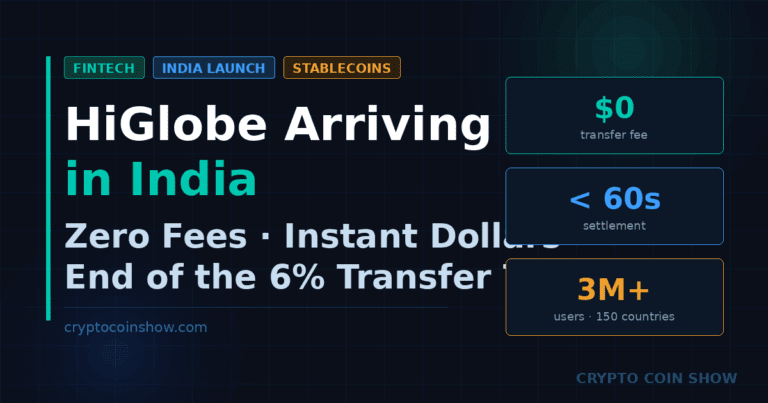 Higlobe Arriving in India —Zero Fees, Instant Dollars, and the End of the 6% Transfer TaxApr 16, 2026
More interviews
 How Robinhood built its own blockchain to control compliance and feesSep 29, 2026
 Geo Protocol founder Yaniv Tal launches Geo Debates, its first productSep 28, 2026
 How Brave is expanding beyond ad blocking with Drew PotterSep 27, 2026
 Why Kevin Carter thinks China is winning the AI raceSep 25, 2026
 Brave's plan to bring self-custody payments to 120 million usersSep 18, 2026
 Arie Trouw on why AI agents now need proof of actionSep 14, 2026