
Charles Hoskinson / Input Output Global
Charles Hoskinson on Cardano smart contracts and blockchain development
In this episode
Today on Blockchain Interviews, we speak with Charles Hoskinson, the CEO and Founder of IOHK, Co-Founder of Ethereum, and brain child of the Cardano Blockchain. We discuss the present and future state of Cardano blockchain, blockchain 3.0 with smart contracts, dapps, and worldwide scalability, the functions missing from bitcoin and ethereum, and what he see's as the Cardano blockchain at the end of 2020. Cardano is a blockchain platform with more advanced features than any protocol yet developed, and the first to evolve out of a scientific philosophy.
IOHK.io · binance.com · mercatox.com
- Cardano was developed using a scientific first-principles approach with peer-reviewed research before building the actual blockchain protocol.
- Third-generation blockchains must address three design requirements: scalability to support a billion users, interoperability with other systems, and sustainability for protocol governance.
- Cardano launched with a federated model to build community and exchange listings before decentralizing through the Shelley release in early 2020.
- The protocol is designed to scale naturally as more stake pool operators join, similar to how BitTorrent becomes faster with more users sharing resources.
- Cardano's 2020 roadmap includes turning on all protocols and focusing on commercialization, with scaling solutions like Hydra planned for release.
Transcript
Read the full transcript
to learn a little bit more about the car down on blockchain today we're getting close to 2020 and I know that you guys have some really big plans for the year if you could start by kicking it off for the audience you know what is the five-year vision from today of the Cardinal blockchain so Coronado is really kind of the first principles projects and what we started it in 2015
it started almost like a DARPA project where we said everything is aspirational we're gonna look at just science and we're gonna write lots of papers and we're gonna learn a huge amount about the fundamental concepts of cryptocurrency so we're gonna learn what is a ledger what is a consensus protocol what is the centralization what's a smart contract
language all these things where we kind of have an idea because people have built something and released something but at the end of the day it's never been rigorously informally discussed in a scientific setting in the university setting in them and through the peer review process so much like a DARPA project we just hired a bunch of scientists and a bunch of engineers and
we spent several years chipping away systematically until eventually we built up this massive corpus of knowledge and then what we did is we said okay let's pick a subset of this knowledge and then let's take that and go ahead actually build something that's useful to society and so in 2017 we started talking about what would a third-generation cryptocurrency looked like so the first
generation was obviously Bitcoin and that's all about payments and pushing value from one person to another and proving out some principles like proof of work for example can create a cryptocurrency and that was a big unknown for a long time second generation was all about smart contracts so you're saying you don't just want to be able to push dumb tokens around they
have to be smart you want to issue your own money you want daffs you want the ability to have a contractual relationship with somebody somewhere in the world and actually put terms and conditions right on the blockchain well what the third generation is all about is saying we like what bitcoins done we like what etherium has done but we need this to scale to a billion people we
need this to be interoperable for all these other finance systems and other blockchains and finally it needs to be sustainable meaning every time we have a disagreement we can't have a Bitcoin cache or an ethereal classic we actually have to have in a way decide who pays and who decides and how the systems are going to basically evolve all the time so what the first part of the project
was about was basically creating a capability where we could put that all together into a coherent vision that we felt could satisfy those three design requirements scalability interoperability and sustainability and what 2020 is about is actually turning on all those protocols and then focusing on the commercialization of the technology so kind of the model would be
like kalo which was a DARPA program at ran from 2003 to 2008 and they said hey we're gonna do this crazy thing we're gonna build an AI that's kind of like her it's kind of like a assistant it's just gonna read all your emails and know everything and be able to help you throughout your life well I was obviously crazy you can't do that however they did learn enough to be able
to create from that Siri which has now led to Cortana and Alexa and all these other personal assistants and so forth so this is much the same way we started with big aspirations of how do we build something that's super secure and cryptographically perfect and can scale to a billion people and what you're going to see in 2020 is basically the realization of the what the closest
engineering approximation of what the science is guided us to very interesting Charles and I really like that you know the third generation is where it goes to the world right because right now we have smart contracts and apps that people have been working on aetherium but there are those scalability issues and I'm sure you're well aware of you know the proof
of work for as a proof of stake and I guess that's a really big part of how you guys are going to scale throughout 2020 and correct me if I'm wrong but card I know is already running on the proof of stake network and you're looking at relaunching it now how is that going to make a difference you know from the scalability that they have on Bitcoin and aetherium to now scaling to
you know worldwide right that's a great question so when we launched our Ghana the first variant of the protocol card on Tehran's it's called or Boris classic and that's what we launched in 2017 a pretty close approximation of it we decided to write it in a federated much like how ripple runs just because the point was to build up a population get exchange lists
it's actually introduced this project to the world because we've been working on it for over two and a half years but when we launched it no one had even heard of it so you know it was important we kind of built up a community and then once you have a community adherents ambassadors exchange listings you have a sufficient level of people in that ecosystem then you can flip a switch and
actually decentralize the protocol and so with the Shelly release that's coming up soon we actually have the incentivize to set coming out this week and then Shelley will come out later next year hopefully an early part of next year basically we say okay we're no longer can actually run the consensus notes our mirco i which cato foundation now the community is going to do that and
there's a lot of science behind how that's going to work and there's a process for how that gradual to say the decentralisation works but here's the point basically the system will naturally get more decentralized over time as the currency becomes more distributed and that cape remember we came up with gets larger which means we'll get more and more stake tools so
we'll start at some number maybe a few hundred then it'll get to a thousand then even more and more and more and then over time the system will eventually be led by perhaps tens of thousands or hundreds of thousands of unique entities and the way that we've designed the protocol as you add more entities you get more capabilities you may get more services you get more
processing power and so forth and that's really the hallmark of a scalable protocol we have plenty of examples of scalable protocols in the ecosystem for example BitTorrent or when you download a very popular movie you get it really quickly because people produce more than they consume if you download an unpopular movie it takes a long time to download it so that's a really scalable
protocol you gain value as you gain users so similarly we tried to design or Boris no way but we had kind of a natural protocol path that could evolve in that direction so if we get to a billion people it's not like we have a billion people consuming resources from one small group you have a billion people who are producing just as much if they consume if not more and as a
consequence the protocol couldn't organically scale to that level and what we're launching soon is kind of the first major milestone there it has tons of great theory behind it and then all throughout 2020 we're going to keep launching more and more capabilities including our scaling solution which is called warp cores Hydra the basho release that's great and it I like the
path that you guys have taken where you started in a more you know semi centralized way so you could control how you're going to build the foundation and then release it to the community and it seems that with the current popular blockchain networks it's this trade-off you know everyone always talks about the trade-off between decentralization and scalability and if you want a scale
it becomes more centralized so I guess that's the battle that you guys have sort of been fighting for the last few years is doing it without becoming too centralized and I've never really understood that trade-off profile because in the other day when you add people you're adding resources to a system and we have so many examples of where those resources can be
productively added it's just you need better protocols and so if you're talking about traditional BFT protocols of paxos or something like that they're absolutely right more people equals more problems but if you're talking about a truly scalable protocol more people means more resources for everybody which means you scale faster so I so I think that
trilemma is a false one and it's just an afterthought of a lack of good protocol design and that's really the advantage of doing the science first because what you'd start with our first principles and you say what's impossible and then what's possible and then where are the trends going to take us and how are things evolving you know the other thing is that you can always take lots
of stuff that traditionally happens on a blockchain and move it off a blockchain and then get some sort of compressed representation to verify that it was done correctly so this is what's dark where is trying to do with these in you see projects like halo with sea cash or they have recursive snarks and basically the concepts of inclusive accountability where you say you have
everything you need for everybody to check that the work was done correctly but the actual processing the proof generation all these things are done off chain and lightning is much the same way just using different primitives in that respect so this whole layer to idea is also very promising for scale so I think the future is going to be a mixture of
those two where you have own first a composition of truly scalable protocols you get just enough to actually coordinating a really large system with lots of stuff going on you've affected heterogeneity that's what stake pulls these things really provide to you and then you have a layer to you solution like lightning or snarks or something like that and
then when you put all these things together you can definitely get transaction processing equivalent to a thesis ease or master quincies and once you have the found a all laid out and scalable you're obviously going to want more smart contracts and apps decentralized applications built on top of the platform you know what does that toolkit look like for developers are you guys
making it really easy for people to develop applications on Cardinal so the first problem with smart contracts and this is something that kind of fell through as we were studying the smart contract model is that there's really bad marketing that's caused us to chase something that's not really practical so with aetherium they keep saying world computer world computer world computer
this is like their mantra and so what that really tells you is I want to build a burrow I have to now build the etherium equivalent of Newbury and that means I want to take all my uber lodge you can put it on the etherion block you the minute you do it's a thousand times more expensive a thousand times slower you terrible quality of service and so forth just doesn't work for
people and the incentives aren't rightly aligned so then what you do as a developer is you take lots of your logic that you had on aetherium and you pull it back into a server so they create this hybrid application where you have off chain and on chain and unfortunately the theory was never really designed to make that naturally orchestrate able so you have all these like monkey patch
things have been put on top to try to make that work well so what we did with card on was we said first and foremost let's go ahead and view an application as this big thing and then let's break it down into services let's break it down into different chunks and then we say okay certain subsets of this application we're gonna run on a blockchain like maybe your Identity
Management or maybe your an issue a token like a loyalty token or something and that's what's gonna live on the ledger but then the vast majority of that Lodge is probably going to live on a node server somewhere on Amazon or something like that so let's make it easy to wire those two worlds together the off chain world in the on chain world and let's let you use the tools in
the off chain world that you're familiar with whether that be JavaScript or Java or C sharp or whatever have you because that's your world and you've already invested lots of money and time and effort learning those tools and techniques and those languages but then when you're dealing with the on chain stuff you basically have dsl x' and flute us and flute is's this language to
basically be the bridge to connect the two worlds and then the dsl czar really is like marlo for example designed to help you interact with things that live on the chain like assets and eventually we can create dsls for identity and supply chains and all kinds of things and the advantage there is you get proved ability so you know it terminates you know you've correctly
written the contract you can use templates and these types of things you can rapidly prototype correctly develop and you get a very strong guarantee that's something like the parity hack or the DAO hack won't happen so I think that paradigm is quite good now the other advantage where we've designed things is with this extended UTX Elmo it's easy for us to layer on the fear in
style accounts model so if we wanted to plop down the EVM at some point in Cardona we could certainly do that if there's a strong market demand for it and both of those sides of the system would be interoperable with each other so Cardinal flutist contract would eventually be able to call an EVM contract and back because that was the interoperability so you can't have two
different stories one is push your logic off chain and put the stuff that really needs to be on chain on chain and the other side of the story is if you've already built a lot of infrastructure for your your DAF on aetherium eventually there'll be a path to port that over to Craig on O and then these things will naturally work their way through but as a final point it's really
important understand that the things we've right for block chains generally they live in a transactional basis so what does that mean well there are five components that so usually with the transaction you have an asset you have entities involved in the transaction that can be one-to-one one-to-many many-to-one many to many you have identity so you know these these people
have some sort of notion of identity then you have metadata associated with the transaction so that can be when it happened where it happened these types of things and it lives within a regulatory environment so you no matter what happens you have to be able to service these things you have to have an easy way for handling these things you have to have an easy way to reason
around how a transaction would occur a great example of why Bitcoin can't work at a global scale is just because it can't do simple things like pull payments for example or contingent settlement that happens all the time if you subscribe to something with your credit card they pull money from your account can't do that easily with a Bitcoin system okay another example
would be contingent settlement so for example you say I'll accept donations only if you sign the donation deed so I can't just put an address up there and take money I have to hide the address until I get confirmation then provide it to you with the Bitcoin style system but with a really well-designed financial system you actually just automate all this stuff so you could run
an exchange where you just expose all your deposit addresses and those contingencies are built in for compliance for example so the person has to go through know your customer and anthe money laundering and only after they've done that can they actually send you a transaction well it's settled to lift on that so if you see it settle you know for a fact that they've done that
correctly so this is really where the third generation is going is thinking around the whole transaction the contractual side of the transaction where the identity lives who are the entities involved what type of assets are you moving and those assets will have built in terms and conditions like especially for security tokens and then you're also going to embed metadata and
I'll litany of other things so now you comply with ATF requirements or what have you and really the magic of Cardno is we thought very carefully about a transaction model that makes it very easy for you to do as a user of the system whether you're a retail user or you just want to send money to Bob and Bob has to pay his taxes or you're a big business and you want to build in very
sophisticated business logic with your transaction that stack will allow you to do both of those eventually well I'm glad that you covered all of those points because there are a lot of things just you know for example pull payments just there's just so many different things that are still needed to be built into blockchains properly and you know I know you always say about
its early days right even though we're we're ten or ten years in it's still early days so it sounds like you guys have really thought this through you know what would you say is the biggest challenge to that you will face in 2020 as you're working on all these great things well we have great competitors now moving into 2020 when we started Cardano was a project in 2015 there's
really just a theory and you know the Bitcoin in its forts and there wasn't a lot of rigor in the space and now we're looking at the Algar ants and the paces and the avalanches and so forth and all of these are led by great people were very smart they've great engineers if scientists working for them there's real science behind it and there's institutional support as well you know
where you have governments and VCS and so forth and so there's going to be a lot of tough tough petition and really it's gonna be a combination of who has the best commercialization strategy and it's gonna be a composition of who could move the fastest to be able to capture some of these emerging markets so we certainly have a strategy but they have
strategies as well and quite large war chests to pursue them but at the end of the day what really excites me the most is it doesn't actually matter who wins as long as whoever wins has the right principles you know we get so competitive in this space and say it's my cryptocurrency or my vision or the highway but you know we're all in this together you know our whole point is
pushing power to the edges getting rid of the middlemen and putting everybody in charge of their own money in their own identity and their own information and so forth and so our hope is that no matter what happens at least whoever wins will carry those principles that we have with card on and if that happens it will be mission accomplished the other thing is all of our
competitors are open source for the most part so we learn from each other and we grow from each other there's this Darwinian evolution to the development of currencies work you stand on the shoulders of giants if Tyrion could not have existed without Bitcoin and we could not have existed with carnival without aetherium the same for Tazo so it could not have existed without
aetherium these new paradigms allow people the freedom to experiment and our hope and one of the big definitions of success in 2020 is can we leave enough of a weight then people will be able to build great experiences and create commercialization on tappable we've constructed if we can achieve that I think 2020 is going to be a great year for our project that's a great way to
look at it Charles are you guys now are you guys looking for any strategic partners or more developers more team members right now and if so how can they reach out and find out more yeah so the Shelly era is all about good centralization and you know the incentivize test that is really the first massive milestone achieving that and then when we launch Shelly then you
know it's it's decentralized huzzah but then you have to be useful seeing smart contracts and that's what the go giddy arise about that's been running in parallel for Shelly era we're getting really close to these things merging together now what we're doing is just like when you build the Xbox you kind of need launch titles we're working privately with a lot of different great
vendors and ideas and we're batting it around try to have five really good really solid well thought out use cases with Gogan to launch parallel to go again so or try to build that in a very pedagogical way meaning that we'll have educational materials tutorials developer tools and these things to follow alongside those use cases so that people can kind of be inspired by that
but we've definitely seen a very large amount of excitement and passion and desire to build something on court on anything just issued a cocoanut card on people really love us and they love what we're doing in the vision the mission they also like the sense of stability you know they know that since we're building this with science and we're building this was formal methods
this protocol is going to be around for quite some time and the governance features will be turning on those features mean that when changes occur they occur in a very systematic organized way so you won't have the rug pulled out from underneath you a lot to clean cache or Theor classic style and then suddenly have this big community flag and have to pick a side so there's
definitely a lot of people that are very excited you know the Cardona foundation Amerigo have done a great job as well just building up infrastructure and partnerships everything from doing the digital identity foundation to a lot of these black chain alliances and so forth and they even have strategic partner people just wake up all day and that's all they do the one problem is that
in our industry a lot of these partnerships you can form they're not very valuable at the moment they're good at openers but they generally are at the prototype or pilot level and then actually convert them over to a permanent relationship is problematic for example more than too long ago when IBM and Samsung got together and they said a theorem is awesome we're really
excited about it and they did a project called the depth and now they're doing their own thing you know IBM for example has fabric so just because you can get a relationship or pilot doesn't mean that relationship and pilot is going to convert it to something that is a permanent relationship with the Bosh's maybe IBM is the Microsoft's of the
world they're much more inclined to do things in-house so I think we have to be as an ecosystem a bit dumb systematic and a bit careful about expectation management so what we tend to focus on is first principles and bringing startups in SMEs into the ecosystem because they don't have preferences and they don't actually have strong desires and they don't actually have the
resource to go build an in-house blockchain solution so they're much more inclined to strategically partner and actually carry that to market with whatever business model they haven't have and that's what we're going to be focusing on in 22 amazing well thank you so much Charles that's all the time that we have an interview today I really appreciate
you coming on and all the best in 2020 with moving forward with car down oh and let's follow up in the near future and see how these releases go so thank you so much thank you so much this was a lot of fun Cheers
Related coverage
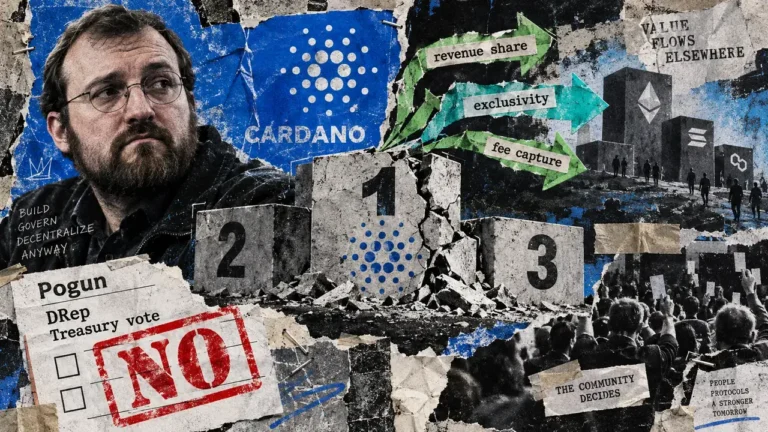 Input Output loses Cardano treasury vote despite committee unanimous backingSep 20, 2026
 Charles Hoskinson Has a Theory for AI Outage Affecting ChatGPT, Claude and GrokSep 3, 2026
 Cardano Advances Decentralization as Specialist Partners Take Ownership of Core InfrastructureJul 29, 2026
 The CLARITY Act’s Window Is ClosingJul 28, 2026
More interviews
 Illia Polosukhin on NEAR's privacy features and AI agents in 2026Oct 1, 2026
 How Robinhood built its own blockchain to control compliance and feesSep 29, 2026
 Geo Protocol founder Yaniv Tal launches Geo Debates, its first productSep 28, 2026
 How Brave is expanding beyond ad blocking with Drew PotterSep 27, 2026
 Why Kevin Carter thinks China is winning the AI raceSep 25, 2026
 Brave's plan to bring self-custody payments to 120 million usersSep 18, 2026