Input Output loses Cardano treasury vote despite committee unanimous backing
Cardano’s delegated representatives let a 12.29 million ADA funding request from Input Output-backed Bitcoin DeFi product Pogun expire without ratification, even as the network’s Constitutional Committee unanimously backed it. The split outcome shows that Input Output’s status as Cardano’s founding development company no longer guarantees automatic access to the network’s treasury.
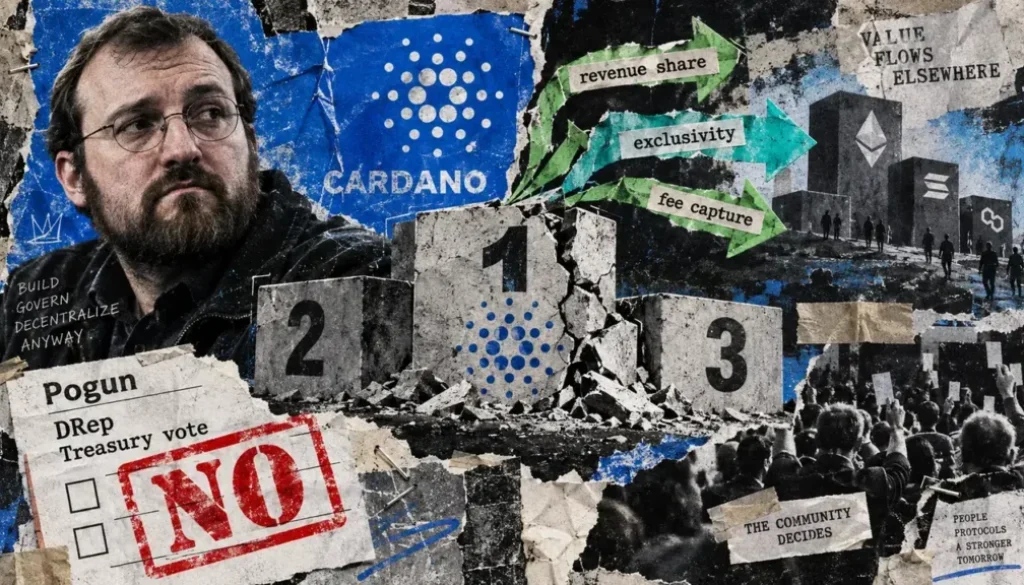
- DReps voted 64.33% against the 12.29 million ADA Pogun request versus 35.67% in favor, killing ratification.
- The Constitutional Committee recorded seven yes votes, or 100% approval, in a separate review of the same proposal.
- Charles Hoskinson says Input Output will pick networks by technical and commercial fit rather than an automatic Cardano-first policy going forward.
- 12.29M ADA requested by Pogun
- 64.33% of DRep voting power against the request, nearly double the 35.67% in favor
- 100% Constitutional Committee approval, contrasting with the DRep rejection on the same proposal
Pogun is a credit and liquidity product designed to bring Bitcoin into decentralized finance, built by Input Output, the company Hoskinson co-founded and the same firm that built much of Cardano’s core protocol. Its proposal asked the treasury for development funding in exchange for a share of future revenue. That request expired without moving forward despite the committee’s full support.
DReps Reject 12.29M ADA Despite Unanimous Committee Backing
The Pogun governance action asked Cardano’s treasury for 12.29 million ADA and expired without ratification or enactment. The final voting summary recorded 35.67% of delegated representative voting power in favor and 64.33% against.
Delegated representatives, or DReps, vote with authority assigned to them by ADA holders and their tally determined whether the withdrawal could advance. The Constitutional Committee’s parallel review produced seven yes votes, equal to 100% approval from that body, a result compatible with but separate from the DRep rejection.
Input Output helped build Cardano and remains a major participant in its ecosystem, but the network’s distinct governance institutions still controlled the funding outcome.
The proposal also carried a defined commercial trade. Input Output’s April 2026 overview said Pogun would return 20% of earnings to the Cardano treasury until the initial funding was repaid, followed by a perpetual 5% return on Cardano-related products. DReps declined that defined upside along with the exposure to a venture whose future revenue and adoption remain unproven.
Hoskinson Sets October Launch for RealFi, Mid-December for Pogun
In a Sept. 18, 2026 broadcast, Hoskinson said Input Output will now choose the strongest network for each product rather than following a Cardano-first-and-forever policy. He still called Cardano the strongest technical choice for Bitcoin DeFi products that connect systems using Bitcoin-like transaction outputs, and said RealFi would launch on Cardano in October 2026 while Pogun would arrive within 90 days of the broadcast, or roughly mid-December 2026.
Those dates remain forward-looking targets rather than confirmed deployments. Hoskinson said a live Pogun could generate transaction fees, total value locked and volume for Cardano, a different economic relationship than the rejected revenue share, since the network would benefit from activity without the funded repayment structure.
The vote also reshapes Pogun’s incentive structure going forward. Hoskinson said the unfunded product will not be exclusive to Cardano, that traffic may route to other networks, and that a competing ecosystem could receive exclusivity in exchange for support.
The on-chain Pogun proposal reviewed for the vote contains the funding request, repayment structure and intended Cardano deployment, but it omits any explicit exclusivity covenant, meaning the exclusivity claim traces to Hoskinson’s statement rather than the written record.
Midnight City V2’s July Deployment Predates the Vote by Two Months
Input Output’s product-by-product approach has roots that predate the Pogun result. Midnight City V2, an agent-based application, was already documented on Midnight in July 2026, making the wider multichain strategy difficult to attribute to a single treasury vote.
That earlier placement suggests Input Output was diversifying deployment venues before Cardano’s governance bodies weighed in on Pogun. The pattern fits a broader industry shift toward multichain DeFi infrastructure, similar to the routing decisions other infrastructure providers have made when choosing where to deploy Bitcoin-linked products.
The CCS read. The real signal for ADA holders is not whether Pogun launches on Cardano, but that treasury discipline now outweighs founder loyalty in DRep decision-making. Institutional allocators watching Cardano’s governance maturity should treat this as evidence the network can say no to its own builder, a precondition for treating the ADA treasury as a credible capital allocator rather than a rubber stamp for Input Output.
Cardano’s institutions retained control over treasury spending while Input Output kept the freedom to negotiate with competing networks for exclusivity or support. Whether Pogun lands on Cardano by its stated mid-December 2026 target, and whether any activity migrates elsewhere in the meantime, will determine if the rejected revenue share or the exclusivity warning ends up mattering more.