EU scales back data center tender as Europe’s AI infrastructure gap widens
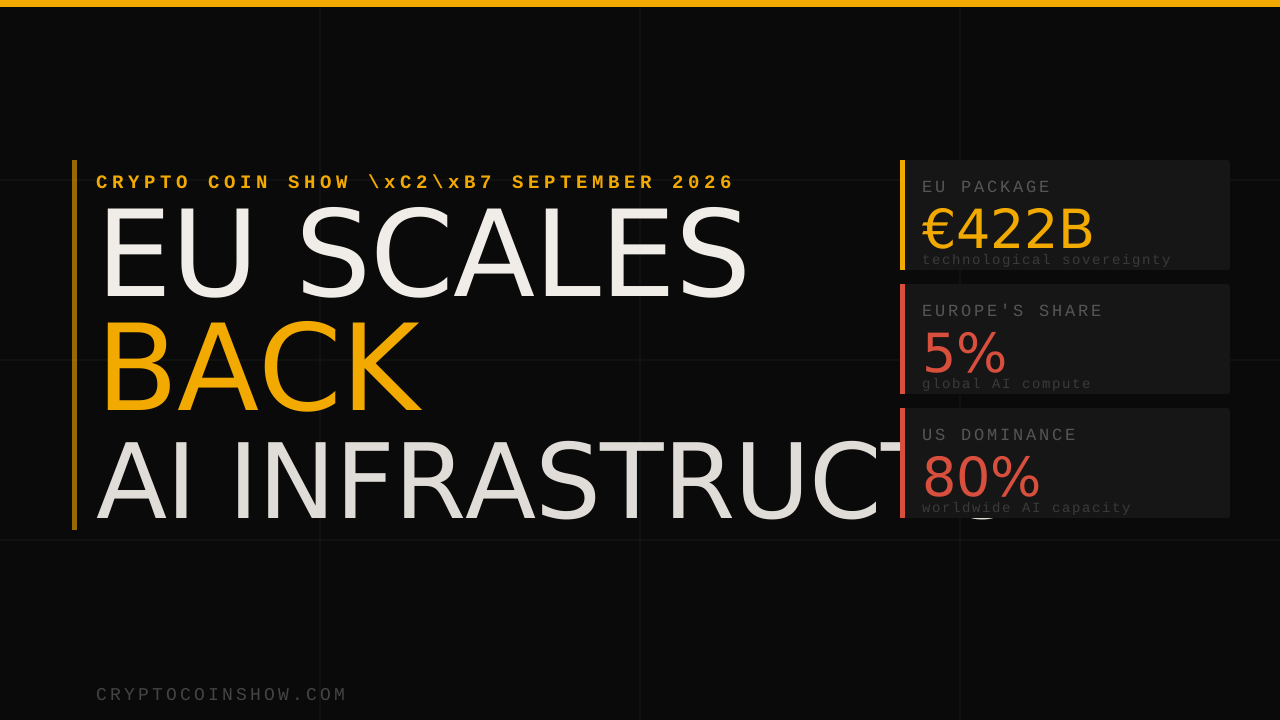
The European Union has scaled back its data center procurement despite announcing a €422 billion ($490 billion) technological sovereignty package, revealing a deepening gap between Europe’s AI infrastructure ambitions and its ability to finance them. The move underscores institutional investors’ and policymakers’ growing concern that Europe risks permanent dependence on American cloud providers even as geopolitical tensions mount over AI access and data control.
- EU reduced advanced chip allocation from 100,000 across five data centers to a phased approach across seven facilities with 25,000-40,000 GPUs each
- Europe controls only 5% of global AI compute capacity while the United States accounts for approximately 80% of the worldwide total
- US tech firms invested more than $400 billion in AI infrastructure in 2025 alone, dwarfing the EU’s €200 billion plan spread across multiple years
- 5% Europe’s share of global AI compute capacity versus 80% for United States
- $400B US investment in AI infrastructure during 2025 alone compared to EU commitment
- 70% Market share held by AWS, Microsoft Azure, and Google Cloud in Europe
The European Commission’s latest data center tender reflects a strategic retreat masked by sovereignty rhetoric. When the bloc unveiled its Technological Sovereignty Package on June 3, officials framed it as a decisive pivot toward independence, pledging €422 billion across data centers, semiconductors, cloud computing, and AI development over the next decade.
The initial procurement plan called for 100,000 advanced chips distributed across five flagship facilities. The revised tender, however, now seeks bids for seven data centers with staggered GPU allocations: four facilities with at least 25,000 GPUs in the first phase and three with at least 40,000 processors.
The reduction signals a fundamental mismatch between ambition and execution.
More significantly, the Commission has shifted financing expectations sharply toward private capital, abandoning the notion of a publicly funded infrastructure program.
This pivot matters acutely to institutional investors because it signals that European policymakers lack the political will or fiscal capacity to fund sovereignty independently, leaving private consortiums and technology firms to shoulder the investment burden while accepting regulatory oversight.
For asset allocators tracking European digital infrastructure and cloud exposure, this structural weakness translates to sustained dependence on American incumbents regardless of policy intentions.
America’s 80% global compute advantage leaves Europe permanently behind at current funding levels
Europe’s compute deficit runs far deeper than procurement delays. The continent currently controls approximately 5% of global AI compute capacity while the United States commands around 80%, a disparity that reflects decades of cumulative American investment in cloud infrastructure and semiconductor manufacturing.
That gap is widening, not narrowing: American technology firms invested more than $400 billion in AI infrastructure during 2025 alone, a single year’s outlay that exceeds the EU’s entire €200 billion commitment spread across the next decade.
The composition of that European commitment makes the comparison even starker. Much of the €200 billion consists of repackaged funding from existing budgets rather than new capital deployed at scale, according to people familiar with the program design.
Meanwhile, AWS, Microsoft Azure, and Google Cloud together control approximately 70% of Europe’s cloud market, a concentration that leaves the region structurally exposed to American policy decisions.
The US Cloud Act grants American authorities the power to compel data handovers from cloud providers regardless of storage location, a legal mechanism that directly undermines European data sovereignty claims.
An Allianz report published in late May found that US firms control roughly 80% of Europe’s cloud compute market and close to 60% of its enterprise software revenue. That dominance means European institutions, governments, and enterprises lack viable alternatives when negotiating infrastructure terms or compliance requirements.
Anthropic model restrictions in June crystallized fears of American gatekeeping over critical AI systems
The urgency of Europe’s sovereignty push intensified sharply on June 13, when the US government restricted foreign access to Anthropic’s most advanced AI models, Mythos and Fable.
The restriction confirmed the existential fear that has animated European policy discussions: American authorities possess the ability to unilaterally cut off access to critical infrastructure and tools, regardless of European reliance or economic impact.
The response from European institutions was swift and visceral. French Prime Minister Sebastien Lecornu stated that France could not rely on tools developed by foreign powers and must develop its own capability.
Telecoms firm Orange, responding directly to the Anthropic restriction, argued that access to AI systems that can “never be switched off on a whim” has become a strategic necessity for European competitiveness and sovereignty.
Those statements reflect not abstract policy preferences but a concrete realization that American national security decisions now function as a form of de facto technology export control directed at allies.
The incident provided fresh political momentum to the Commission’s Cloud and AI Development Act, which targets a tripling of EU data center capacity over five to seven years and imposes strict sovereignty requirements on sensitive public-sector workloads in healthcare, finance, and justice.
However, the scaled-back procurement tender suggests that momentum has not translated into committed capital or binding timelines for execution.
Private financing model and phased GPU rollout create execution risk for sovereignty timeline
The shift toward private-sector financing introduces a fundamental tension in the EU’s sovereignty strategy. Government procurement that mandates strict data residency and compliance requirements typically cannot attract competitive commercial returns, since private capital requires either subsidy, market protection, or guaranteed purchasing commitments.
The Commission’s decision to rely primarily on private investment suggests either that such incentives are being offered implicitly or that the sovereignty requirements will be diluted during negotiation with bidders.
The phased rollout across seven facilities with varying GPU minimums also stretches the timeline for meaningful capacity accumulation. If earlier tranches take 18-24 months to construct and operationalize, Europe’s 5% compute share will likely shrink further relative to continued American expansion.
Institutional investors evaluating exposure to European cloud infrastructure or considering commitments to EU data center funds should recognize that procurement delays and financing uncertainty have moved from policy risk to execution risk.
The question now is whether private consortiums will actually bid and commit capital on terms the Commission finds acceptable.
Unresolved question: Can Europe attract competitive bids without subsidies or protectionist purchasing rules
Competition economist Cristina Caffarra, in early commentary on the proposal, raised the core structural problem: it remains unclear whether the Commission’s plan adequately addresses the fundamental constraint, which is not regulation or policy ambition but the sheer scale of capital required to close a multi-year technology gap against competitors investing four times as much annually.
Private data center operators and chip manufacturers face lower returns on European infrastructure than on American projects, since European cloud markets remain fragmented across national regulations and pricing is compressed by competition from established American incumbents.
The Commission has indicated that the Cloud and AI Development Act could include provisions creating protected procurement markets for European cloud operators in sensitive sectors, effectively guaranteeing revenue streams. If enacted, such protections would shift the risk profile materially in favor of European infrastructure investors.
However, those provisions are not yet finalized, and EU member states have historically resisted restrictions on cloud provider choice when it affects enterprise customers or public-sector agencies.
The critical test will arrive when formal procurement bids open and the Commission must choose between strict sovereignty requirements that deter private bidders or loosened requirements that undermine the program’s original stated purpose. Institutional investors awaiting clarity on Europe’s infrastructure pivot should monitor whether the Commission releases detailed financing terms, bidder incentives, and member-state purchasing commitments within the next two quarters, the absence of such detail would suggest the scaled-back tender reflects deeper political and fiscal constraints than the public narrative acknowledges.
Original reporting: cryptopolitan.com