Strategy’s accumulation of Bitcoin and shift toward perpetual preferred stock financing could improve the company’s capital structure and share performance through the rest of 2026, regardless of proposed selling plans.
Strategy has purchased 145,834 Bitcoin worth roughly $11 billion since January, mostly bought while BTC traded below the company’s estimated average cost of around $75,000.
According to JPMorgan analysts led by managing director Nikolaos Panigirtzoglou, Strategy’s full-year purchases would reach approximately $30 billion, a figure that would exceed the roughly $22 billion the company spent on Bitcoin in each of the two prior years.
“Strategy appears to have re-accelerated its Bitcoin purchases in April, extending a 2026 pattern of increasingly opportunistic buying, responsive to both market conditions and financing availability,” the JPMorgan analysts wrote.
The company now holds 818,334 BTC, worth more than $65 billion at current prices, making it the largest corporate Bitcoin holder globally.
STRC and the dividend trade-off
The second development with direct implications for MSTR shareholders is Strategy’s growing reliance on STRC, its perpetual preferred stock carrying an approximate 11.5% yield.
The STRC pivot carries obligations. The annual preferred share dividend burden runs at roughly 2.2% of its total Bitcoin holding value, or about $1.5 billion, according to TD Cowen’s estimates.
Saylor said earlier this week that the company would “probably” sell Bitcoin in the future to cover those payments, the first time the company has publicly acknowledged a scenario in which it becomes a net seller of any portion of its holdings.
His follow-up post on X, “Buy more bitcoin than you sell,” appeared to frame this as a net-positive equation. The company buys far more Bitcoin through STRC and equity issuance than it would ever need to sell for dividends.
What this means for MSTR
TD Cowen analysts Lance Vitanza and Jonnathan Navarrete raised their price target on MSTR to $395 from $385 on Thursday, citing higher-than-expected capital efficiency from this financing shift.
That target implies more than 110% upside from Wednesday’s closing price of $186.82.
By issuing STRC instead of common equity, Strategy can buy Bitcoin with less dilution to existing MSTR holders. STRC’s outstanding face value now exceeds $8.5 billion.
TD Cowen raised its BTC Yield forecast for Strategy to 18.2% for fiscal 2026 (up from 16.7%) and to 9.6% for fiscal 2027 (up from 5.4%). The firm’s baseline scenario assumes Bitcoin reaches approximately $140,000 by year-end, with a bull case of $175,000.
JPMorgan noted that demand for Strategy shares among investors remains strong across both retail and institutional holders.
For the remaining quarters of the year, the key factors are remain if Strategy can maintain its current buying pace, and how the Bitcoin price moves relative to TD Cowen’s $140,000 baseline.
A stable premium and rising BTC price would add to MSTR’s leverage effect. A reduction in either would destabilize the STRC dividend math and narrow the gap between the $395 target and reality.
Don’t just read crypto news. Understand it. Subscribe to our newsletter. It’s free.
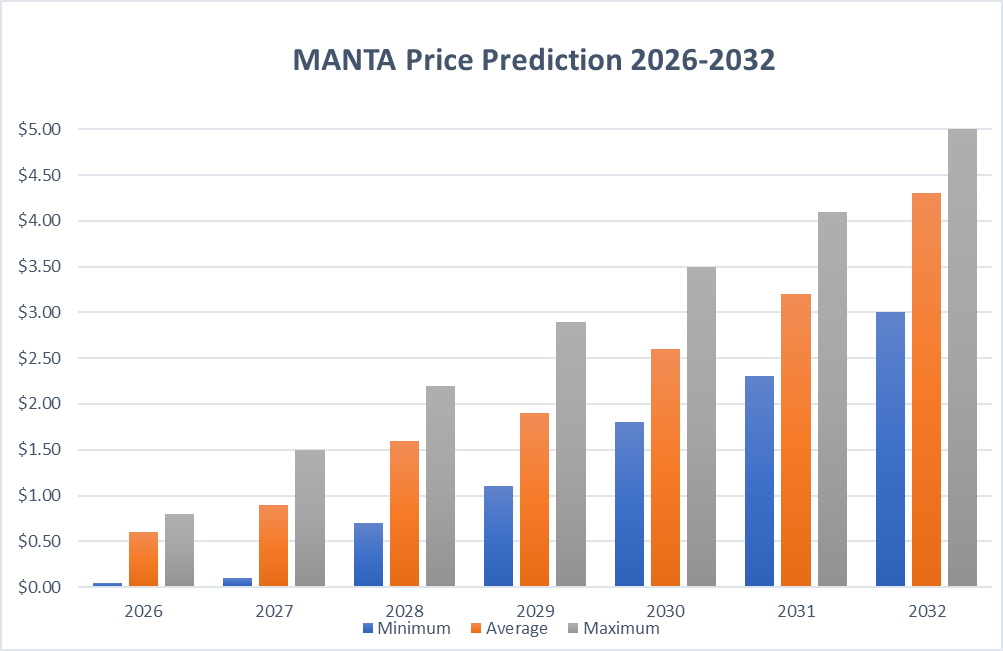
Our Manta price forecast expects Manta price to surge to a maximum level of $0.8 in 2026.
In 2032, Manta price prediction expects Manta price to record a maximum level of $5.
Launched in September 2023, Manta Network gained significant attention within the cryptocurrency community after its token generation event, leading to trending status on major coin aggregators and news outlets.
Beyond the initial buzz, Manta Network presents innovative technology through a modular zero-knowledge (ZK) rollup for Ethereum, featuring Solidity smart contracts and a decentralized identity layer one network focusing on compliance.
This article will explore the details of the Manta Network and examine potential future price movements of its native token, $MANTA, to provide a comprehensive MANTA price prediction.
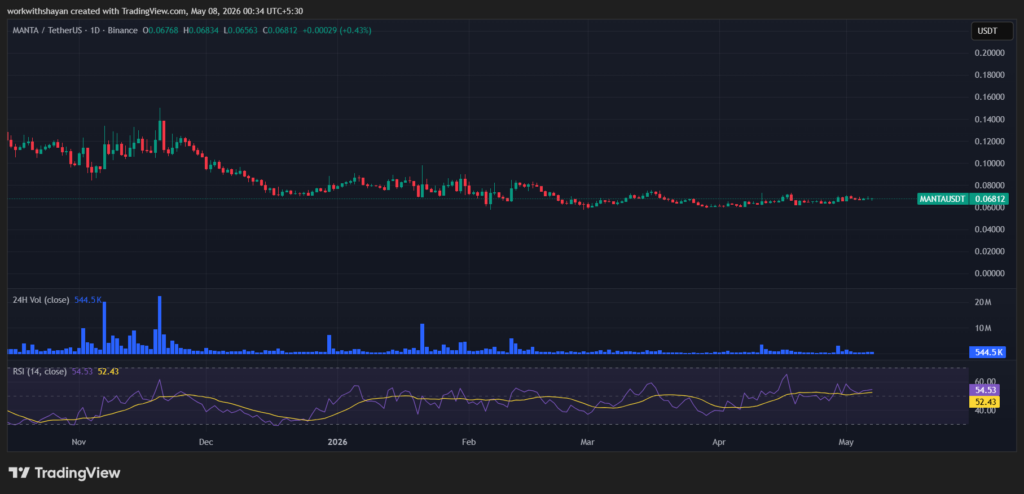
Analyzing the daily price chart of the MANTA token on 7 May, the coin is making an upward push toward $0.068. Currently, buyers are aiming for a hold above immediate Fib levels and they are strongly defending further declines. The 24-hour volume surged to $544K, showing an increase in trading activity today. Manta is trading at $0.068, surging by over 0.6% in the last 24 hours.
The RSI-14 trend line has surged from its previous level and hovers around 54, showing that bulls are preparing to control price momentum. The SMA-14 level suggests volatility in the next few hours.
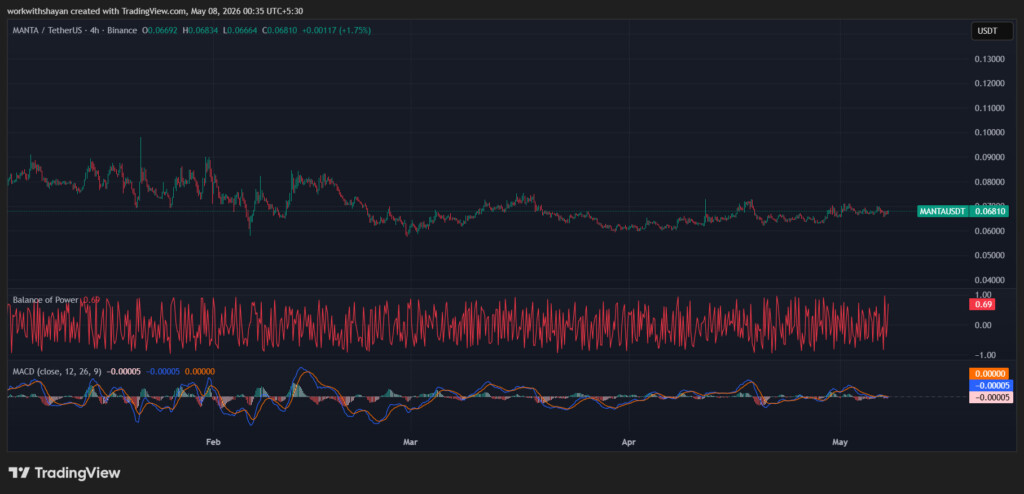
The 4-hour Manta price chart suggests MANTA continues to face bullish activity around EMA lines, creating a positive sentiment on the price chart. However, sellers aim for a correction by holding the price below the EMA20 trend line.
The BoP indicator trades in a positive region at 0.69, hinting that buyers are trying to build pressure near resistance levels and trigger an upward correction.
However, the MACD trend line has formed red candles below the signal line, and the indicator aims for negative momentum, strengthening selling positions.
Manta Price Prediction: Levels and Action
Daily Simple Moving Average (SMA)
Period
Value
Action
SMA 3
$ 0.06744
BUY
SMA 5
$ 0.06758
SELL
SMA 10
$ 0.06716
BUY
SMA 21
$ 0.06648
BUY
SMA 50
$ 0.06493
BUY
SMA 100
$ 0.06793
SELL
SMA 200
$ 0.08112
SELL
Daily Exponential Moving Average (EMA)
Period
Value
Action
EMA 3
$ 0.06762
SELL
EMA 5
$ 0.06755
SELL
EMA 10
$ 0.06716
BUY
EMA 21
$ 0.06645
BUY
EMA 50
$ 0.06637
BUY
EMA 100
$ 0.07123
SELL
EMA 200
$ 0.09213
SELL
What to expect from Manta price analysis next?
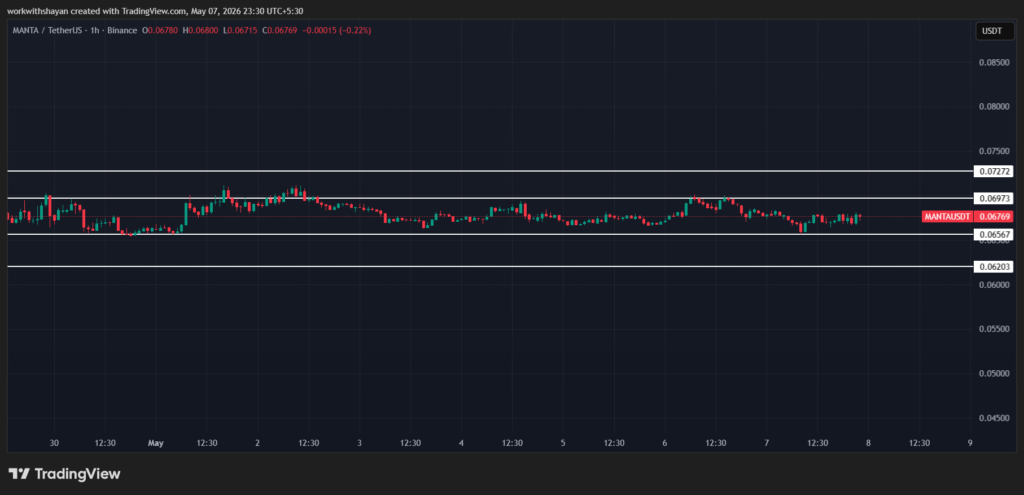
The hourly price chart confirms that bears are making efforts to prevent the Manta price from an immediate surge. However, if the Manta price successfully breaks above $0.06973, it may surge higher and touch the resistance at $0.07272.
If bulls cannot initiate a surge, Manta’s price may drop below the immediate support line at $0.06567, resulting in a correction to $0.06203.
Is MANTA a good investment?
Manta’s rapid rise in DeFi TVL charts and alignment with Ethereum‘s scaling roadmap via technologies like Manta Pacific suggest $MANTA’s potential. Grants support its ecosystem growth, and it leads in ZK technology adoption, promising for blockchain‘s future. However, regulatory concerns over transaction privacy could affect its long-term viability, potentially impacting ZK protocols like $MANTA. Overall, Manta is a good investment if you want a profitable return in the long term.
Why is the Manta price up today?
Manta price triggered strong buying pressure after buyers maintained their demand. This resulted in a push toward $0.068.
Will Manta price recover?
If bulls hold the price above $0.07, we might see further recovery toward immediate resistance channels.
Will Manta price reach $10?
In recent months, the Manta network expanded its offerings and established multiple partnerships. If buying demand continues to increase in the coming years, its price might surpass the $10 mark by 2040.
Will Manta reach $100?
Depending on the current market sentiment, the Manta price might take several years to reach the $100 milestone. We expect the Manta price to achieve $100 by 2060.
Will Manta reach $1000?
$1000 is a distant dream for Manta price. However, if everything remains in favor of the altcoin market, we might even see the Manta price hitting $1K.
Is Manta a good long-term investment?
Investors are bullish on Manta, which has gained significant attention in recent months. If developers continue to build robust utilities for Manta and the roadmap fulfills user demand, it can be a good long-term investment option.
Recent MANTA news/ opinions
Manta Network will end staking rewards on 20 May 2026, stopping new MANTA token emissions and closing its inflationary staking model.
Key timeline for Manta Staking: – Staking rewards will officially stop in two weeks on May 20, 2026, starting from today. – Operators may exit the program at any time starting immediately – After the deadline, no further network rewards will be generated
If the altcoin market witnesses a surge in buying pressure this month, we might see a rebound in the MANTA price. In May, we expect Manta’s price to record a minimum of $0.06 and a maximum of $0.08. The average price is expected to be around $0.07.
Manta Price Prediction
Potential Low
Potential Average
Potential High
Manta Price Prediction May 2026
$0.06
$0.07
$0.08
Manta price prediction 2026
Due to the impact of Bitcoin’s halving, Bitcoin and leading altcoins could reach new highs in 2026. However, some believe the event’s predictability changes because of crypto’s current popularity.
Technical analysis indicates that in 2026, Manta Network is expected to reach a minimum price of $0.05. The MANTA token might attain a maximum price of $0.8, while the average trading price is $0.6.
Manta Price Prediction
Potential Low ($)
Potential Average ($)
Potential High ($)
Manta Price Prediction 2026
0.05
0.6
0.8
Manta price predictions 2027-2032
Year
Minimum Price ($)
Average Price ($)
Maximum Price ($)
2027
0.1
0.9
1.5
2028
0.7
1.6
2.2
2029
1.1
1.9
2.9
2030
1.8
2.6
3.5
2031
2.3
3.2
4.1
2032
3
4.3
5
MANTA Price Prediction for 2027
Ethereum upgrades will benefit Manta Network. With growing interest in privacy tech like ZK solutions, Manta Network is poised to grow, likely increasing its token value. In 2027, Manta Network is projected to have a minimum price of $0.10. The MANTA token is expected to reach a maximum price of $1.50, with an average price of $0.90.
Manta Network Forecast 2028
By 2028, Manta Network is predicted to have a minimum value of $0.70. It may reach a maximum value of $2.20, with an average trading price of $1.60.
Manta Network Price Prediction 2029
Through a detailed technical analysis of past price data, Manta Network is estimated to reach a minimum price of $1.10 in 2029. The token could see a maximum price of $2.90, with an average trading price of $1.90.
Manta Price Prediction 2030
In 2030, the minimum expected price for one Manta Network token is projected to be $1.80. The maximum price could reach $3.50, with an average trading price of $2.60.
Manta Price Prediction 2031
For 2031, the Manta price prediction indicates a minimum of $2.30. According to projections, the MANTA token could achieve a maximum of $4.10, with an average forecast price of $3.20.
Manta Price Prediction 2032
In 2032, the minimum expected price for one Manta Network token is projected to be $3.00. The maximum price could reach $5.00, with an average trading price of $4.30.
At Cryptopolitan, we are bullish on Manta’s price prediction as it flashes bullish on-chain signals amid growing buying demand. Investors are keenly watching the Manta Network market to discern potential movements in its future price trends and analyze changes in Manta Network’s price.
Technical analysis indicates that in 2026, Manta Network is expected to reach a minimum price of $0.05. The MANTA token might attain a maximum price of $0.8, while the average trading price is $0.6.
Manta Historic Price Sentiment
Manta Historic Price Sentiment
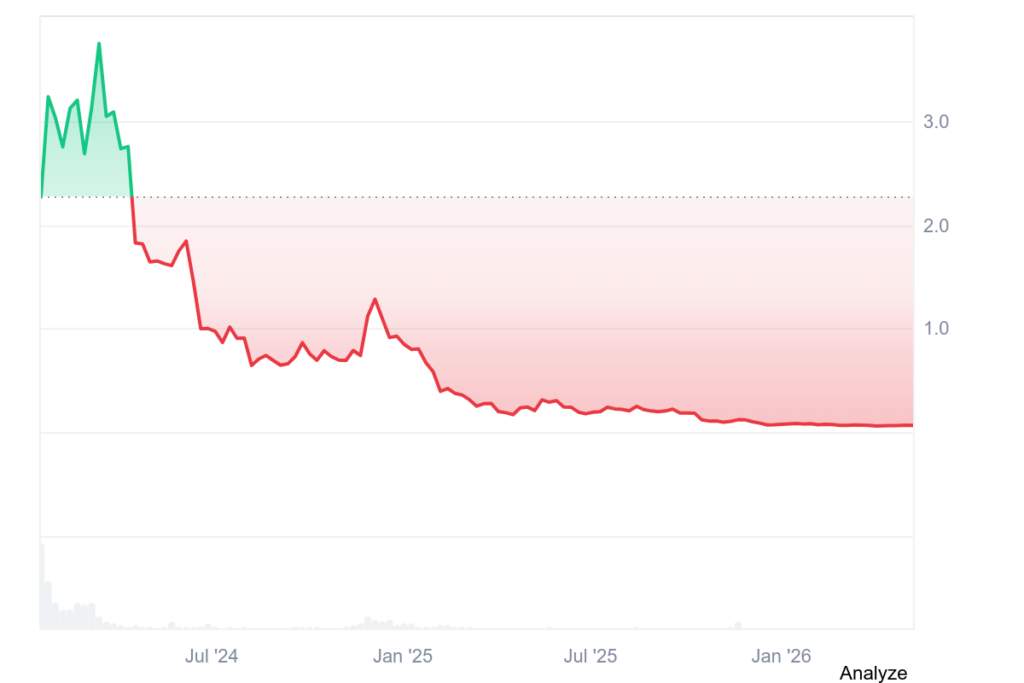
January 18, 2024: MANTA launched on the open market at approximately $2.24.
January 22, 2024: Price rose steadily, exceeding $2.70 before retracting to $2.40.
Bullish Rebound: The following months showed a strong upward trend, with MANTA reaching an all-time high of $4 in March.
April Decline: Momentum faded, and the price declined below $2.
In May, the price of Manta rebounded and is aimed for a retest of the $2 mark.
In recent weeks of June, Manta price declined heavily and dropped below the $1 mark.
In July, Manta price continued its bearish move as it settled below the $1 mark.
In August, the price of Manta surged toward $0.86; however, it later dropped toward $0.6.
In September, Manta surged toward the $0.97 high only to face a rejection.
In October, the price of Manta surged toward $0.85; however, it failed to maintain that momentum.
In November, the MANTA price surged above $1.2 and is currently maintaining above that level. In December, Manta price dropped toward the low of $0.82.
Though Manta started 2025 on a bullish note, it failed to hold its momentum. As a result, the price lost its $1 mark and crashed toward the low of $0.28 in early March.
By the end of March, the price dropped further below $0.2. In April, the price surged toward the high of $0.25 but it later dropped.
In May, the price of Manta surged toward the high of $0.35 but failed to maintain the momentum.
As a result, Manta declined toward $0.22 in early June. By the end of June, MANTA price dropped toward $0.19.
In July, MANTA price surged toward $0.26 but it later declined below $0.2 in early August.
By the end of August, the price of MANTA again dropped below $0.2. By September’s end, MANTA price declined below $0.17.
By the end of October, MANTA price dropped below $0.1. Throughout November, the price consolidated around $0.1.
In December, the price of MANTA dropped significantly toward the low of $0.07. Currently, MANTA is maintaining its price around $0.08 throughout January 2026.
The price of MANTA continued to consolidate around $0.08 in early February.
By the end of February, the MANTA price dropped toward $0.058. In March, MANTA fluctuated a lot, ending at $0.061.
OpenAI cannot close roughly $18 billion in financing tied to its Broadcom (AVGO) custom-chip partnership, The Information reported Thursday. The shortfall is the latest sign that AI infrastructure deals are outrunning the capital available to fund them.
The reported gap covers an early tranche of a multi-year accelerator rollout worth 10 gigawatts of OpenAI-designed chips. The custom silicon program is the centerpiece of the company’s plan to reduce its dependence on Nvidia (NVDA).
OpenAI’s Spending Math Gets Tighter
The original Broadcom agreement, unveiled in October 2025, sketched a hardware buildout pegged at roughly $500 billion. That figure spans chips, networking, power, and data center capacity. The 10-gigawatt rollout was meant to ease OpenAI’s reliance on Nvidia hardware.
OpenAI is projected to burn through about $115 billion cumulatively by 2029, even as revenue scales fast. Recent reporting around missed internal growth targets has already drawn fresh investor scrutiny.
OpenAI’s AI Chip Deal With Broadcom Hits $18 Billion Financing Snag – The Information
Partners have stepped in with their own financing to keep deals moving. Oracle (ORCL) raised $18 billion in bonds last September to back its roughly $300 billion OpenAI commitment.
AI Capex Faces a New Stress Test
Hyperscaler 2026 capital spending is now estimated at $600 to $720 billion. Roughly three-quarters of that total is earmarked for AI infrastructure. Lenders are increasingly cautious that returns will not arrive on schedule.
“The fake Disney-OpenAI deal is reflective of the AI bubble as a whole, where we’re repeatedly told about the existence of multi-billion dollar deals as though they were solid and definitive, like OpenAI’s Broadcom, AMD and $100bn NVIDIA deals,” one user commented.
OpenAI’s options are narrow. The company can restructure the tranche, replace lenders, or trim the chip rollout. Each path will shape how much projected 2026 AI capex actually lands.
Morgan Stanley has joined the cryptocurrency trading market through its ETrade platform and implemented a 50-basis-point charge structure aimed at undercutting major competitors. The move puts the Wall Street giant in direct rivalry with services like Coinbase, Robinhood, and Charles Schwab as it expands access to millions of retail customers.
The Wall Street giant is aggressively repositioning itself in the cryptocurrency trading market by leveraging its $13 billion acquisition of ETrade and a 50-basis-point pricing structure that undercuts major competitors. Before a full launch for all 8.6 million ETrade clients later this year, the service will first support Bitcoin, Ethereum, and Solana.
Morgan Stanley triggers crypto fee war among rivals
BREAKING: $1.5 TRILLION MORGAN STANLEY JUST ANNOUNCED #BITCOIN BUYING ON E*TRADE WILL LAUNCH WITH INDUSTRY LOW PRICES
— The Bitcoin Historian (@pete_rizzo_) May 6, 2026
By implementing a 50-basis-point fee on its E*Trade platform, the bank positions itself as the most affordable mainstream financial player in the retail cryptocurrency market by charging less than Coinbase at 60 basis points, Robinhood at 95 basis points, and Charles Schwab at 75 basis points.
The pricing approach focuses on cost-conscious retail investors as competition increases for beginner traders entering the digital asset market for the first time. Morgan Stanley’s action is indicative of a larger “race to the bottom” in trading costs, in which crypto-native platforms and traditional banking institutions are now directly competing on execution cost rather than product innovation.
Wealth management executive Jed Finn of Morgan Stanley claimed that the strategy’s goal is to “disintermediate the disintermediators,” framing the cryptocurrency deployment as more than a trading expansion. The comment implies a fundamental shift in the company’s perspective, as it now sees cryptocurrency trading as a gateway to a broader digital asset ecosystem encompassing trading, wealth management, and institutional services, rather than a stand-alone product.
The launch illustrates that Morgan Stanley is not running cryptocurrency access as a stand-alone product line but is incorporating it into its broader wealth and brokerage infrastructure. The bank increases exposure to digital assets through a retail investing channel already used by millions of customers by integrating trading directly into the ETrade platform.
According to executives, the endeavor is a part of a larger push to match new digital asset markets with traditional investment services. The approach goes beyond execution services; plans seem to include further integration between cryptocurrency holdings and other investment products on the website.
The expansion also coincides with major financial institutions accelerating their foray into digital assets in response to changes in the US regulatory landscape. Banks investigating cryptocurrency offerings now face fewer barriers due to the more accommodating governmental position, which has accelerated the development of regulated entry points for institutional and individual investors.
Morgan Stanley expands crypto strategy beyond pricing war
Morgan Stanley’s aggressive pricing is just one aspect of a broader push into digital assets that is intensifying industry competitiveness. The bank has been developing a full-stack cryptocurrency strategy over the past few months. This includes plans for additional Ethereum- and Solana-related products, as well as filings for spot Bitcoin and Solana exchange-traded funds (ETFs). This layered approach suggests the firm is positioning itself to compete across custody, asset management, and tokenized markets simultaneously.
Beyond products, the bank is taking ownership of the underlying infrastructure. On February 18, the Wall Street giant submitted an application to the Office of the Comptroller of the Currency (OCC) for a national trust bank charter, which would enable it to directly custody digital assets. The charter would also permit Morgan Stanley to provide trading and staking services inside a controlled environment. If authorized, this would put the bank in direct competition with infrastructure providers and crypto-native custodians, increasing pressure on companies that had hitherto controlled these markets.
According to people familiar with the matter, the bank is also exploring services that would allow clients to convert crypto holdings into ETFs without triggering a sale, while also preparing for potential tokenized equity trading later this year. These initiatives signal a shift toward integrating blockchain-based assets into traditional capital markets.
The bank is reportedly investigating options that would enable customers to convert cryptocurrency holdings into ETFs without initiating a sale, while also preparing for possible tokenized equities trading later this year. These efforts point to a shift toward incorporating blockchain-based assets into conventional capital markets.
This larger drive is taking place with substantial revenue at stake. In 2025, Coinbase brought in $3.32 billion from consumer transactions, while Robinhood recorded about $1 billion from cryptocurrency-related activity.
Still letting the bank keep the best part? Watch our free video on being your own bank.
In a recent interview on Sean Hannity’s YouTube podcast, FBI head Kash Patel lauded AI for helping stop multiple violent attacks on innocent people.
“AI was never used at the FBI till we got there, literally crazy,” Patel said in his characteristically hopped up affect. “I’m using it everywhere.”
Specifically, Patel — who’s been accused of severe issues related to alcohol consumption — alleges that using AI the FBI has been able to foil numerous mass shootings at schools throughout the US.
“We stopped a school massacre in North Carolina because we got a tip from our private-sector partners who are building out AI infrastructure,” he bragged.
As with everything coming out of the Trump administration, we need to take this statement with a Mar-a-Lago-sized grain of salt. While it remains to be seen whether AI has really helped the FBI thwart mass casualty events, there’s extremely compelling evidence that the exact opposite is also true.
For starters, research has shown that AI chatbots are actually twice as likely to encourage humans to commit violent acts than step in and stop them. One Stanford study found that AI chatbots only discourage violence 16.7 percent of the time, while the same chatbots actively supported violent thoughts in an alarming 33.3 percent of cases.
In the real world, this is manifesting into a key pattern of violence. After the second shooting at Florida State University — the 2025 one, not the 2014 one — in which two were killed and seven injured, it was found that the perpetrator had not only confided in ChatGPT about his plans to commit a mass shooting, but used the chatbot to organize the attack.
The mass shooter in Tumbler Ridge, Canada conducted conversations with ChatGPT so disturbing that they were automatically flagged by the company’s internal moderation systems, spurring leadership at the company to debate whether to inform law enforcement; they ultimately didn’t, and the attack killed seven and injured dozens more.
Meanwhile in South Korea, police investigators allege a 21-year-old serial killer used ChatGPT to help plan at least two murders. A Connecticut man with a history of violent mental health episodes was likewise alleged to have killed his mother before taking his own life after long-running conversations with ChatGPT resulted in a disturbing break from reality. One wrongful death suit in Florida alleges Google’s chatbot, Gemini, encouraged a man to kill others in order to procure a “robot body” for his AI lover; failing that, he killed himself.
At the end of the day, the evidence speaks for itself. Not only are AI chatbots not demonstrably preventing violence, they’re actively facilitating it. Unlike any technology before it, these systems provide users contemplating bloodshed with encouragement, tactical advice, and emotional reinforcements. If those in power refuse to acknowledge the reality of AI’s harms, the public will be left defenseless against a technology made toencourage our worst impulses.
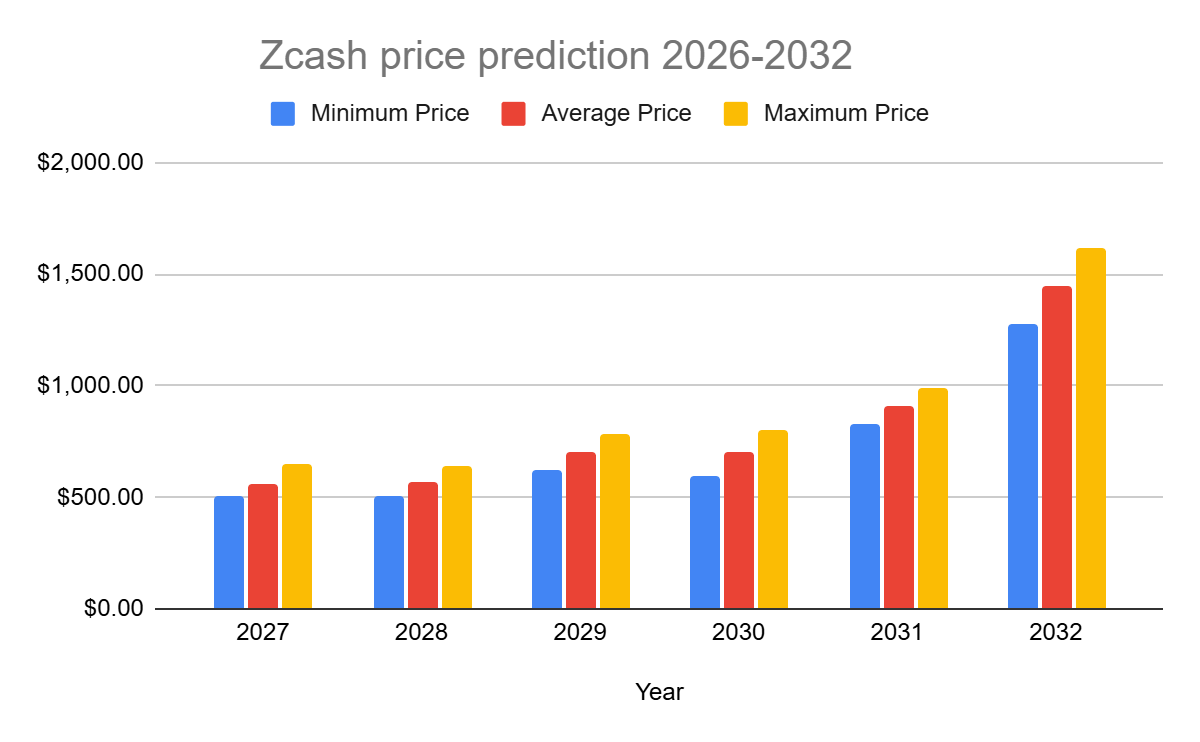
Zcash price prediction for 2026 could reach a maximum value of $ 620.45
By 2029, ZEC could reach a maximum price of $780.00
In 2032, Zcash will range between $1,281.30 to $ 1,620.86
Zooko Wilcox-O’Hearn launched Zcash in 2016, and it has become one of the most sophisticated blockchain-based cryptocurrencies due to its privacy features. The Zcash network uses zero-knowledge proof technology (zk-SNARKs) to allow users to make “shielded” transactions where the value, sender, and receiver addresses are hidden, but the network remains verifiable.
Unlike open blockchains like Bitcoin and Ethereum, where the data of transactions is public but only in pseudo-anonymous form, Zcash has added the option of privacy at the protocol level. This dual-structure means that there is the possibility of both transparent and shielded transactions, making Zcash a special mix of regulatory friendliness and complete financial privacy.
Zcash’s long-term value continues to be a focus area for investors as the global crypto market adjusts to a changing macroeconomic environment, regulatory scrutiny, and growing demand for privacy-focused digital assets.
This analysis explores the future trajectory of Zcash, examining potential price movements from 2026 through 2032.
Zcash Price Prediction: An Overview
Cryptocurrency
Zcash
Token
ZEC
Price
$568.42
Market Cap
$9.45 billion
Trading Volume
$1.91 billion
Circulating Supply
16.66M ZEC
All-time High
$5,941.80 (Oct 29, 2016)
All-time Low
$15.97 (Jul 04, 2024)
24-h High
$606.00
24-h Low
$504.24
Zcash price prediction: Technical analysis
Price Prediction
$ 811.00(49.36%)
Volatility
10.53% (Very High)
50-Day SMA
$305.15
14-Day RSI
66.55 (Neutral)
Market Sentiment
Bullish
Fear & Greed Index
46 (Fear)
Green Days
17/30 (57%)
200-Day SMA
$359.26
Zcash price analysis
Today’s ZEC price analysis shows a recovery from $190 to above $570 after a strong April rally
ZEC Price gained over 30% in 24 hours amid rising volume and bullish momentum
Zcash Support is at $504, with resistance near $600
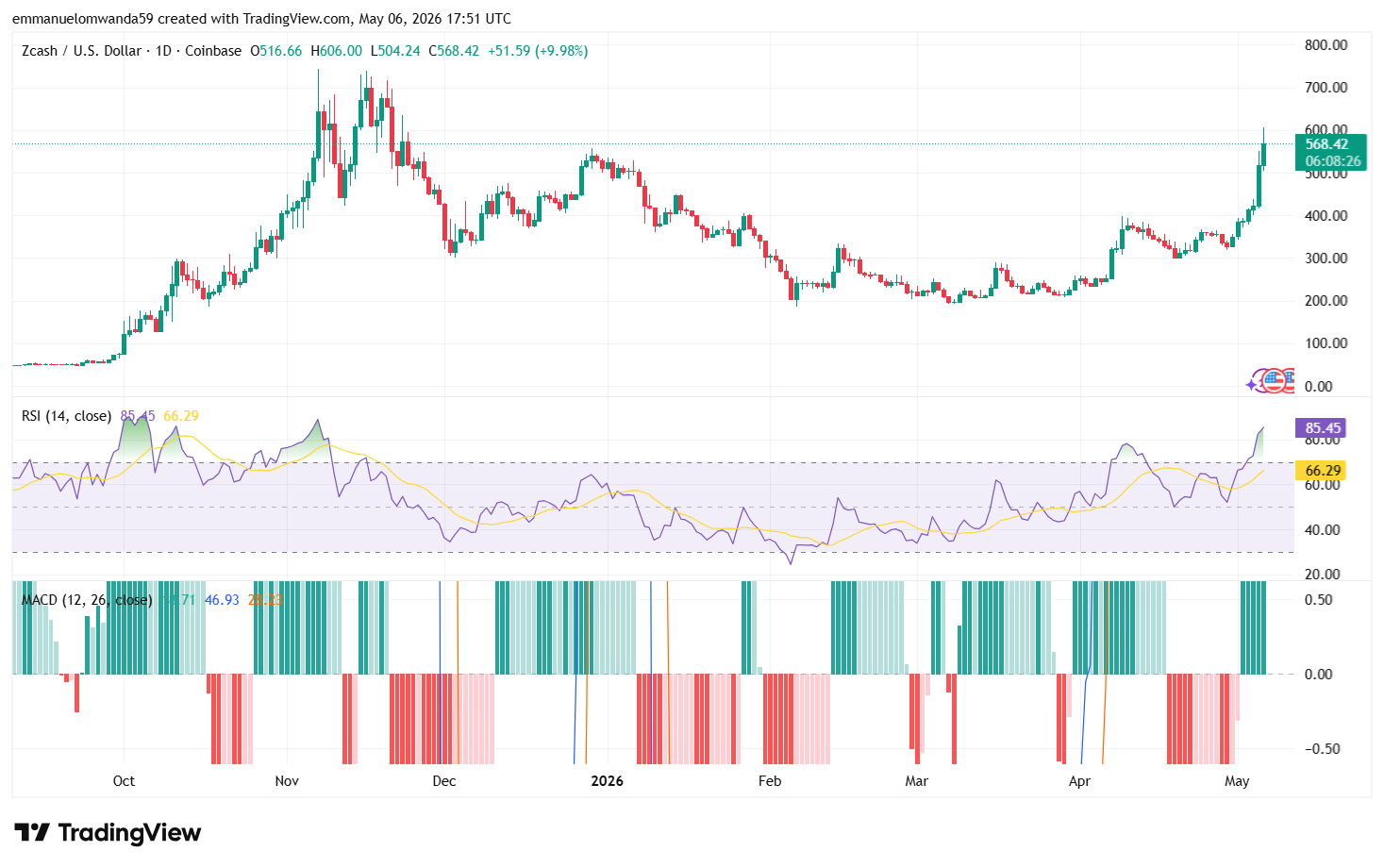
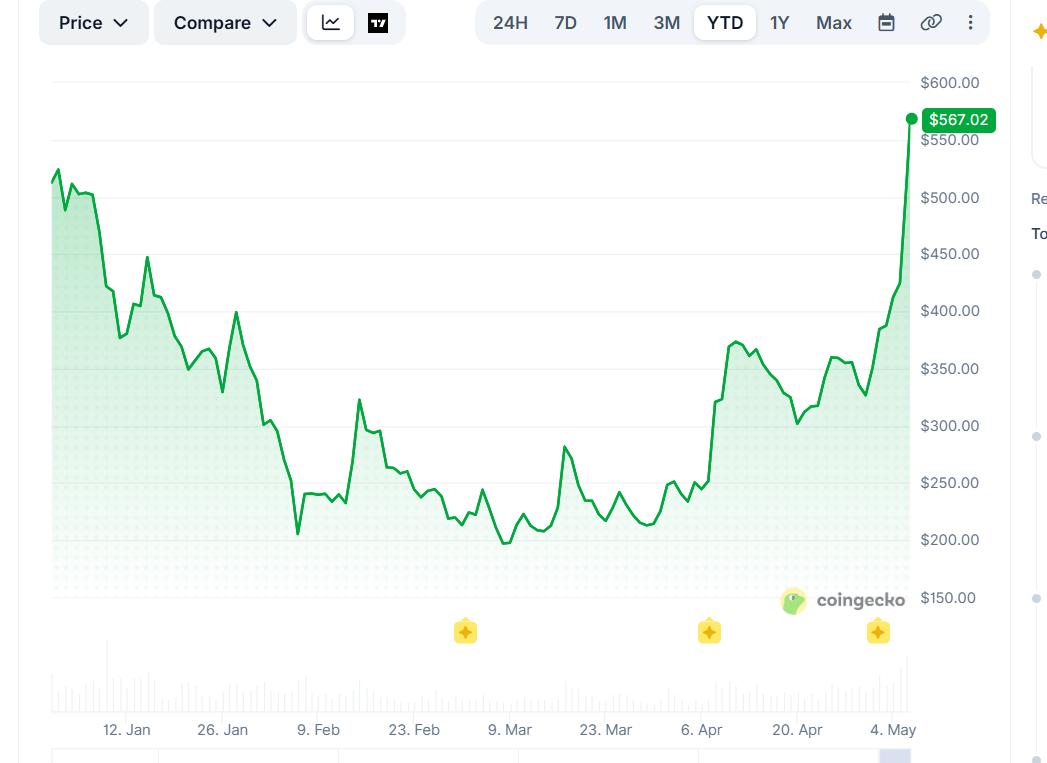
Zcash price analysis for 6 May 2026 shows that ZEC extended its bullish recovery, recovering from the February low at $190 to trade around $567 and $568. In the last 24 hours, Zcash has recorded a 10% surge. There was also a spike in trading volume to $1.91 billion. Market cap also increased to $9.45 billion, reflecting strong market participation.
Zcash price analysis 1-day chart
Analyzing the daily price chart, Zcash experienced strong bullish momentum as buying pressure increased. On the daily time frame, ZEC opened at $516.66, climbed to a high of $606.00, dropped to a low of $504.24, and closed around $568.42.
Price action shows a strong uptrend with consecutive higher highs, showing continued accumulation. However, the rally has pushed Zcash toward a critical resistance near $600, while immediate support is forming around $504 and $520, where buyers are likely to step in if a pullback occurs.
The Relative Strength Index (RSI-14) stands around 85.45, signaling overbought conditions. While this reflects strong momentum, it also indicates a possible short-term cooldown if buyers fail to sustain the current pace.
The daily MACD shows strong bullish momentum, with the MACD line at 46.93 trading well above the signal line at 28.03, supported by expanding green histograms indicating continued upward strength.
ZEC/USD 4-hour price chart
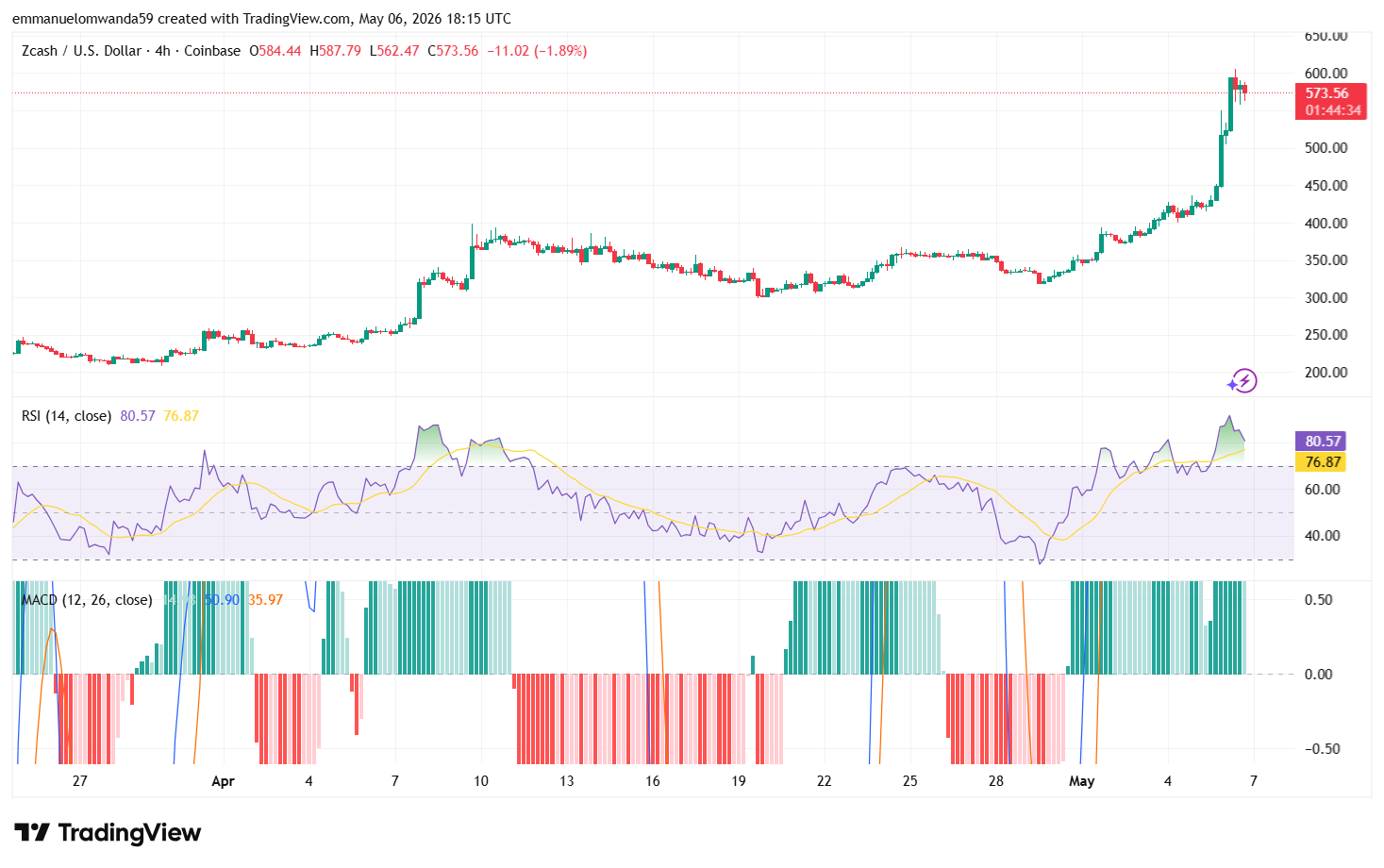
Analyzing the 4-hour chart, Zcash opened at $584.44, climbed to a high of $587.79, before trading near $573.56. The chart shows that bulls remain in control despite a short-term pullback from recent highs.
The RSI (14) is hovering around 80.57, indicating overbought conditions and suggesting a possible near-term consolidation. However, the trend remains bullish as buyers continue defending higher levels.
The MACD indicator shows the MACD line at 50.90 above the signal line at 35.97, with green histograms, confirming continued bullish momentum on the 4-hour timeframe.
What to expect from the Zcash price analysis next?
Zcash may continue its upward move if buyers hold above the $520 and $540 support zone, but the overbought RSI suggests a short consolidation is likely. A breakout above $600 could extend gains, while failure may trigger a pullback toward lower support levels.
Is Zcash a good investment?
Zcash (ZEC) is a digital asset known for its advanced privacy features, including zero-knowledge proofs that enhance transaction confidentiality and increase the utility of the network. For investors, Zcash offers potential profit due to its unique value proposition and growing ecosystem. Liquidity, access to major exchanges, and integrations with various exchanges significantly enhance the ability to buy Zcash and trade it efficiently, making it more accessible to a broader audience.
Notably, approximately 35% of Zcash’s supply is currently off the liquid market, and inflows from ETF approvals could significantly impact its price. Fundamental factors such as account activity, supply and demand dynamics, and market liquidity play a crucial role in influencing Zcash’s price, and these can be affected by events like hacks and regulatory developments. While Zcash appeals to privacy-conscious investors, it is important to consider these fundamental factors, as well as market performance, regulatory risks, and ongoing development, before deciding to invest and assessing whether it is a good time to buy Zcash.
Why is Zcash up today?
Zcash is up today after Multicoin Capital disclosed a significant position, boosting confidence in its privacy-focused narrative and triggering strong buying activity. The rally was further fueled by a short squeeze, with about $62 million in liquidations, alongside broader investor rotation into privacy coins like Monero and Dash.
What is the price prediction for Zcash in 2026?
The ZEC price prediction and Zcash forecast for 2026 indicate that the Zcash price is expected to reach a minimum of $461.76. Most analyst models project a bullish mid-year for Zcash, with the prediction suggesting resistance levels between $500 and $850 if certain catalysts occur. The mid-range target or average price for 2026 is forecast at $541.11, while Zcash could reach a maximum price of $620.45.
Will ZEC reach $500?
ZEC is expected to trade above the $400 to $600 range throughout 2026, suggesting potential for significant price appreciation compared to earlier years. If Zcash can break through key resistance levels within this range, it could unlock additional potential profit for investors.
Will ZEC reach $1000
The likelihood of Zcash (ZEC) reaching $1,000 depends on several factors, including market sentiment, adoption, regulatory changes, and overall cryptocurrency trends. Historically, ZEC peaked near $900 in 2017 but has struggled to regain those levels in recent years.
A long-term forecast for Zcash considers the long-term impact of factors such as institutional adoption, macroeconomic trends, and evolving market sentiment, all of which could play a crucial role in determining whether ZEC can achieve the $1,000 mark. For ZEC to reach $1,000, it would require significant institutional adoption, a surge in demand for privacy coins, and a strong bullish market cycle.
What is the future of Zcash?
Zcash (ZEC) has a promising yet uncertain future, shaped by adoption, regulation, and broader market trends. The overall Zcash outlook is influenced by its unique privacy features, which are increasingly relevant in a world where transparent blockchains can pose risks for institutional users due to heightened financial surveillance and regulatory compliance demands. Zcash appeals to users seeking anonymous transactions, and its price is highly tied to the “Privacy Gold” narrative, which is expected to drive long-term adoption.
However, increasing regulatory scrutiny could limit its availability. The coin’s success also depends on broader crypto market sentiment, competition from other privacy coins like Monero, and ongoing technological upgrades such as Halo. If ZEC gains institutional interest and expands into decentralized finance (DeFi), it may sustain long-term growth. Still, regulatory restrictions and evolving blockchain innovations could present challenges. Its future hinges on balancing privacy features with compliance and usability in the crypto space.
Does ZEC have a good long-term future?
Zcash’s price forecast indicates a generally positive long-term outlook, with a long-term forecast projecting steady price growth over the years. Factors such as regulatory developments and institutional adoption are expected to have a significant long-term impact on Zcash’s future value. By 2032, ZEC is expected to experience substantial price increases, suggesting a good long-term future with moderate to strong growth potential.
Recent news on Zcash
Zcash has released its Zebra 4.4.0 update to fix several critical security vulnerabilities, including issues that could have halted block production or caused network forks due to consensus failures. The update follows the discovery of long-standing flaws in the older zcashd system, prompting developers to accelerate migration toward the newer Zebra infrastructure.
🚨 Zebra 4.4.0 contains fixes for multiple security vulnerabilities, including several consensus-critical issues. We strongly encourage all node operators to upgrade immediately. https://t.co/n9Px2ndtFY
— Zcash Foundation 🛡️ (@ZcashFoundation) May 2, 2026
Zcash price prediction May 2026
Zcash’s price prediction for next month (May 2026) suggests an uptrend, with the potential to reach $587.68 by the end of the month. For the upcoming week and next week, technical indicators point to possible price fluctuations, with tomorrow’s price expected to reflect short-term market sentiment. The minimum price projected for the coin is around $481.35, while the average is around $559.97. There is also a potential short-term impact on Zcash’s price due to market sentiment and recent events, which could influence price movements during this period.
Zcash price prediction
Potential Low
Average Price
Potential High
Zcash price prediction May 2026
$481.35
$559.97
$587.68
Zcash price prediction 2026
The Zcash (ZEC) price is forecast to reach a minimum of $461.76 in 2026. This prediction is informed by on-chain metrics and chain activity, which show increasing utility and engagement within the Zcash ecosystem. Notably, a record high of circulating supply is now held in shielded pools, reflecting rising investor interest and strong network utility. Based on these factors, Zcash could reach a maximum price of $620.45 and an average forecast price of $541.11.
Zcash price prediction
Potential Low
Average Price
Potential High
Zcash price prediction
$461.76
$541.11
$620.45
Zcash price prediction 2027-2032
This ZEC forecast for 2027-2032 is based on models that incorporate both technical and fundamental factors. The mid estimates below represent the average or median price predictions for each year, providing a balanced outlook within the broader forecast spectrum.
Year
Minimum Price
Mid (Average) Price
Maximum Price
2027
$510.00
$560.00
$650.00
2028
$505.85
$572.88
$639.90
2029
$620.00
$700.00
$780.00
2030
$599.94
$700.86
$801.78
2031
$824.41
$905.95
$987.49
2032
$1,281
$1,451.08
$1,620.86
Zcash Price Prediction 2027
Based on market cycle expansion and gradual adoption trends, Zcash is expected to trade at a minimum of $510.00 in 2027. The price could rise to a maximum of $650.00, with an average trading value projected at around $560.00.
Zcash Price Prediction 2028
The price of Zcash is predicted to reach a minimum value of $505.85 in 2028. The Zcash price could reach a maximum value of $639.90 with the average trading price of $572.88 throughout 2028.
Zcash Price Prediction 2029
Based on moderated growth trends, Zcash is projected to trade at a minimum of $620.00 in 2029. The price could rise to a maximum of $780.00, with an average trading value estimated at $700.00.
Zcash Price Prediction 2030
The price of Zcash is predicted to reach a minimum value of $599.94 in 2030. The Zcash price could reach a maximum value of $801.78 with the average trading price of $700.86 throughout 2030.
Zcash Price Prediction 2031
According to our deep technical analysis of past price data of ZEC, in 2031, the price of Zcash is predicted to reach a minimum level of $824.41. The ZEC price can reach a maximum level of $987.49, with the average trading price of $905.95.
Zcash Price Prediction 2032
Zcash price is forecast to reach a lowest possible level of $1,281.30 in 2032. As per our findings, the ZEC price could reach a maximum possible level of $1,620.86 with the average forecast price of $1,451.08.
Analysts use various charts, such as candlestick charts, to provide accurate Zcash price forecasts. These charts help identify trends, support and resistance levels, and offer insights into potential future price movements.
Platform
2026
2027
DigitalCoinPrice
$577.09
$545.24
Coincodex
$542.24
$919.26
Cryptopolitan’s Zcash price prediction
Our prediction suggests that the ZEC token will reach a low of $461 and a maximum price of $620 in the remaining part of 2026.
Zcash launched in 2016 and briefly surged to nearly $6,000 before crashing and stabilizing between $40–$70, with its price moving significantly during rallies and corrections.
In 2017, a partnership with JPMorgan Chase boosted prices to around $400, though it later dropped below $100.
During the 2018 crypto boom, ZEC climbed close to $900 before declining again as the market cooled.
By 2020, bullish momentum pushed Zcash back above $100, supported by network upgrades and its first halving.
In 2021, ZEC peaked above $300, then fell sharply in 2022 to lows near $39.
Throughout 2023, the price remained weak, fluctuating between $24 and $50, with movements often slowing near key support and resistance levels, indicating potential pauses or reversals.
In 2024, Zcash traded mostly between $27 and $45, closing the year near $44.86.
In early 2025, ZEC ranged from $32 to $55, showing a gradual recovery.
By late 2025, strong momentum pushed prices from $120 to over $700, hitting a peak of $744 in November before dropping to around $450–$480 by year-end.
In early 2026, Zcash fell sharply from $560 to $190, then stabilized between $200–$260.
By April 2026, positive market catalysts triggered a rebound, pushing ZEC back to around $318–$328.
At the start of May 2026, Zcash is trading around $577, marking a strong 37% increase, signaling renewed bullish momentum in the market.
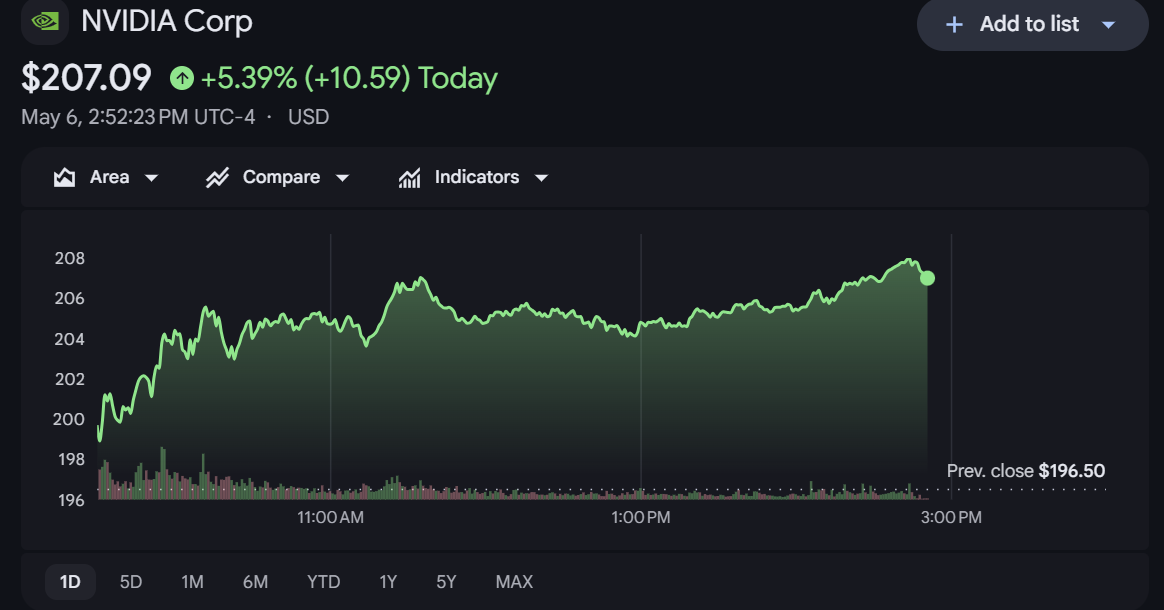
Shares of Nvidia jumped around 5.39% to close at $207.09, bringing the chip company’s total worth back near the $5 trillion mark for the first time since geopolitical tensions sent markets tumbling earlier this year.
The graphics processor manufacturer last touched this valuation level before stock prices fell during market turbulence tied to the Iran conflict in early 2026.
Wednesday’s rally puts Nvidia back among a small group of companies worth $5 trillion.
Nasdaq futures gained more than 1% as news emerged of progress on a peace agreement with Iran, while oil prices dropped sharply.
Nvidia shares climbed over 5% on Wednesday
This combination of events tends to benefit fast-growing technology companies like Nvidia that trade at high price-to-earnings multiples.
Nvidia’s current market value stands at $5.05 trillion, keeping it as the world’s most valuable company.
A filing with securities regulators shows Nvidia received a warrant to purchase up to 15 million Corning shares at $180.00 each, plus another warrant for 3 million more shares at just $0.0001 per share.
Corning’s stock jumped roughly 14% after the news broke.
Beyond the financial arrangement, Corning committed to a major expansion of its American production facilities.
The glassmaker will increase its U.S. optical-connectivity manufacturing by ten times its current size, construct three new factories in North Carolina and Texas, and hire more than 3,000 workers for well-paying positions.
Jensen Huang said in a statement: “AI is driving the largest infrastructure buildout of our time, and a once-in-a-generation opportunity to reinvigorate American manufacturing and supply chains. Together with Corning, we are inventing the future of computing with advanced optical technologies, building the foundation for AI infrastructure where intelligence moves at the speed of light.”
The Corning deal represents the third piece of a supply chain strategy Nvidia started in March.
That month, the company put $4 billion into Coherent and Lumentum, two businesses that make laser components for Nvidia’s Spectrum-X co-packaged optics system.
Competition heats up in AI processor market
While Nvidia works to secure its suppliers, rivals are gaining ground in the chip market.
The company earned $1.37 per share on an adjusted basis and told investors to expect stronger sales ahead.
AMD also said it anticipates growing demand for central processing units as these chips take on more work in artificial intelligence applications.
At the same time, major technology companies are developing their own processors to reduce reliance on Nvidia.
Anthropic PBC plans to spend roughly $200 billion with Alphabet over five years, following Alphabet’s decision to sell its tensor processing unit chips to certain clients.
Amazon.com Inc. said its Trainium custom AI chips have secured more than $225 billion in future revenue agreements.
Meta is also getting ready to use chips it designed in-house.
Bill Stone, who oversees investments at Glenview Trust Company, pointed out the risk Nvidia faces: “The problem with having basically 100% market share is that there’s only one direction for it to go, and it certainly seems like these companies could be credible competitors.”
The company controlled 86% of the AI accelerator market in 2025, the same percentage it held in 2024.
Supporters of the stock argue that AI demand remains so high that multiple companies can succeed.
Alphabet, Amazon, Meta, and Microsoft together expect to spend up to $725 billion this year on data centers and equipment, and these four customers make up about 45% of Nvidia’s total sales.
Nvidia will report its first-quarter earnings on May 20, which investors see as an important test of whether the company can maintain its lead.
The May earnings report will offer a clearer look at how these massive infrastructure investments are impacting the company’s bottom line.
Investors will likely monitor how shifting geopolitical tensions continue to affect market stability.
The Solana Foundation and Google Cloud have launched Pay.sh, a payment gateway designed to let artificial intelligence agents access and pay for application programming interfaces (APIs) using stablecoins.
The system introduces a pay-as-you-go model that allows AI agents to autonomously pay for data, compute, and services, using stablecoins on the Solana blockchain. The move reflects a broader shift toward machine-to-machine commerce.
Pay.sh acts as an API aggregation and payment layer, enabling agents to connect wallets, discover services, and settle payments per request using blockchain-based payment protocols. The model removes the need for traditional onboarding steps such as account creation, identity verification, and billing setup.
For the first time agents can discover, access, and pay-per-request for APIs from Google Cloud including Gemini, BigQuery, Vertex AI, and more using stablecoins on Solana.
The launch comes as developers and infrastructure providers race to build financial systems that AI agents can use independently, something traditional payment rails were never designed to support.
“Payment protocols … are starting to be built,” Rishin Sharma, head of AI growth at the Solana Foundation, said in March, referring to the emergence of systems tailored for autonomous software. “Agents aren’t able to transact in the same way over traditional card networks,” Sharma added, pointing to structural limitations in legacy systems.
He said newer standards, such as x402, are beginning to address that gap. “You can pay using a stablecoin,” Sharma said, describing how agents can directly transact for services.
Google Cloud ties reinforce enterprise positioning
Google Cloud’s involvement adds institutional weight to the initiative, signaling growing interest in blockchain-based infrastructure for enterprise and AI use cases.
The company has previously integrated Solana blockchain data into its BigQuery platform, aiming to expand access to analytics tools for developers and businesses.
“The Solana ecosystem is growing rapidly,” said Dan Albert, executive director of the Solana Foundation, noting that improved data access can support broader adoption.
Race to build agent payment rails
Pay.sh enters a competitive and still-forming market where crypto firms and fintech companies are building payment infrastructure specifically for AI agents.
Platform
Backing
Payment Model
Identity Layer
Key Features
Limitations
Pay.sh
Solana Foundation + Google Cloud
Per-request (stablecoins)
Wallet-based
API aggregation, autonomous payments
Early-stage adoption
x402 ecosystem
Coinbase and partners
Per-request (crypto)
Wallet-based
Open protocol for machine payments
Limited enterprise cloud integration
Stripe agent billing tools
Stripe
Usage-based (fiat)
Account-based
Mature billing infrastructure
Requires accounts, not agent-native
Traditional cloud APIs
Major providers
Subscription / usage billing
Account + API keys
Established ecosystem
Not designed for autonomous agents
Outlook for Pay.sh
Whether Pay.sh gains traction will depend on adoption from both API providers and developers building AI agents. The broader shift toward micro-payments and wallet-based identity could reshape how software interacts with digital services, but it remains in its early stages.
Sharma said the implications could be far-reaching as the technology matures. “These payment frameworks are basically going to be the rails that agents are orchestrating,” he said.
If you want a calmer entry point into DeFi crypto without the usual hype, start with this free video.
Circle Internet Group’s stock jumped nearly 20% on Monday after two US senators announced a bipartisan compromise on one of the most contentious issues holding up federal crypto legislation.
The deal, months in the making, drew loud opposition from the banking industry within hours of its release.
Lawmakers Push Stablecoin Compromise Despite Bank Resistance
In posts published on X on May 5, Senator Thom Tillis said he and Senator Angela Alsobrooks had reached a “consensus-based product” after working with industry stakeholders for months. According to Tillis, the agreement directly addresses one of the banking sector’s biggest concerns: deposit flight.
“Our compromise prohibits stablecoin rewards from resembling interest on bank deposits,” Tillis wrote, adding that banks had been “at the table” throughout negotiations.
At the same time, the proposal still allows crypto companies to offer alternative customer rewards, a concession that keeps parts of the existing business model intact.
The banking industry disagreed. A joint statement from the American Bankers Association, the Bank Policy Institute, the Consumer Bankers Association, the Financial Services Forum, and the Independent Community Bankers of America said the senators were “seeking to achieve the correct policy goal” but that the proposed language “falls short.”
The group cited research suggesting yield-bearing stablecoins could reduce consumer, small-business, and farm loans by one-fifth or more and pledged to send detailed suggestions to lawmakers in the coming days.
Tillis and Alsobrooks did not back down, with the pair saying the deal was locked and pointedly telling the banks that they “respectfully agree to disagree.”
Coinbase Chief Legal Officer Paul Grewal, who attended earlier White House meetings on this exact dispute back in February, was characteristically dry on X:
“I must say I feel obligated to offer my congratulations to the banking trades,” he wrote. “They’ve managed to do the impossible in our country these days: bring sensible Rs and Ds together.”
Circle Stock Rebounds
Markets responded almost immediately to the news, with Circle shares closing May 4 at around $120, up from roughly $100 the previous session. They then climbed further in after-hours trading to about $126.
That marks a sharp reversal from late March, when the stock dropped about 20% in a single day after earlier drafts of the legislation raised concerns about a blanket ban on stablecoin yield.
This time, the reaction has been different. The latest compromise still restricts interest-like payments but leaves room for other forms of rewards, which analysts have previously said match Circle’s existing model. The company already keeps the yield generated from reserves backing its USDC stablecoin rather than passing it on to users.
Solana’s price action continues to flash caution signals, even as momentum indicators suggest oversold conditions. The broader market structure remains tilted to the downside, with bearish waves still unfolding and key support levels under pressure. Until a clear shift in structure and a strong bullish impulse emerge, the risk of further downside remains firmly on the table.
Bearish Structure Dominates Solana On Lower Timeframe
In the current follow-up wave outlook for Solana on the 1-hour timeframe, Elliott Waves Academy highlights that bearish control remains firmly intact. The price has already experienced a strong impulsive decline, marking the first leg of a broader downward trend. This move is likely unfolding as waves 3–5 within wave (1)/(A), suggesting that the market is still in the early stages of a larger bearish cycle.
At this stage, price is approaching the 100% extension of the prior wave, aligning with a key support level of $78.33. This zone is technically significant and could act as a temporary reaction point where buyers attempt to slow down the decline or trigger a short-term bounce. If the market fails to produce a convincing reversal at this support, the bearish structure is expected to extend further through the sub-waves of wave 5, reinforcing sustained selling pressure in the medium term.
From a short-term perspective, a wave 2 corrective rebound may develop before the next leg down. This bounce could take the form of a sharp, channeled recovery, often seen in counter-trend moves. However, any breakdown below key support during or after this correction would confirm that the broader bearish trend remains dominant, making it essential to monitor price action and structure at these levels closely.
Weekly RSI Mirrors 2022 Bear Market Conditions
According to More Crypto Online, the weekly RSI on Solana’s chart is currently showing similarities to the conditions observed during the 2022 bear market, just before the final bottom. This resemblance has drawn attention, as it may offer clues about the market’s current position within a broader cycle.
Many market participants have pointed to the oversold RSI reading seen in February as a signal that a recovery could be underway. However, relying solely on RSI without confirmation from price structure can be misleading, especially in extended bearish phases.
The current setup closely mirrors early 2022, when the market experienced a prolonged period of sideways movement before eventually forming a final low in both price and RSI. That historical pattern suggests that more consolidation or downside could still occur before a true bottom is established. For now, the comparison remains valid until a clear impulsive move to the upside is confirmed. Furthermore, a strong bullish impulse would significantly improve the overall outlook for Solana.