The Hashgraph Group and Mercjnk Introduce EU Digital Product Passport on Hedera for Regulated Supply Chains
The Hashgraph Group and Merck Introduce EU Digital Product Passport on Hedera for Regulated Supply Chains
The Hashgraph Group (THG) has announced a strategic collaboration with science and technology company Merck that extends its TrackTrace Digital Product Passport (DPP) platform. Built on the Hedera network and designed to support compliance requirements for the global supply chain industry, the collaboration aims to meet the EU’s incoming product transparency regulations — ensuring product trust, quality, and improved sustainability across physical goods from first mile to last.
A Single Trust System for Physical and Digital Proof
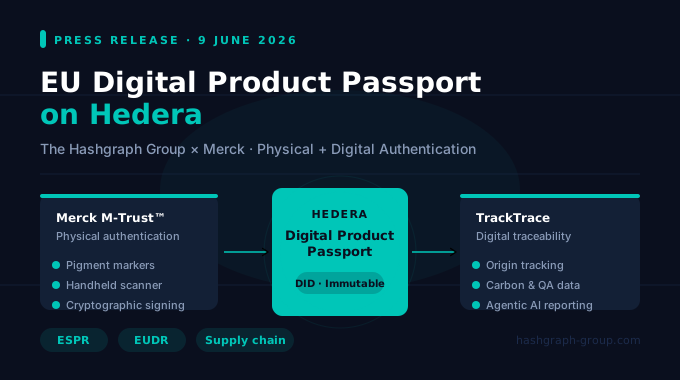
The technical integration brings together THG’s Hedera-powered digital traceability infrastructure with Merck’s M-Trust™ physical authentication technology system. The combined architecture provides the global supply chain ecosystem with a unified proof framework: proof of quality, proof of traceability, proof of authenticity, and proof of value transfer — all anchored to Hedera as a single source of truth.
Where TrackTrace creates tamper-proof digital records of a product’s origin and lifecycle, Merck’s M-Trust™ technology adds the layer digital systems alone cannot deliver: verification that the physical product in your hand is the real thing, not a counterfeit.
Physical Authentication — M-Trust™
Invisible security markers embedded into the product and packaging using Merck’s patented pigment technology. Verified at any point in the supply chain via M-Trust™ handheld scanner.
Cryptographic Signing & On-chain Recording
Each physical verification is cryptographically signed and recorded on the Hedera network, creating a permanent and immutable entry in the product’s Digital Product Passport.
Digital Traceability — TrackTrace
Real-time tracking of origin, ethical sourcing, carbon emissions, and quality assurance data. Every tracked process is issued a decentralised identifier (DID) as a verifiable, immutable record.
Independent Audit & Agentic AI Reporting
Any authorised third party can independently audit a product, process, or claim without relying on a central authority. Integrated Agentic AI automates reporting workflows end to end.
An initial supply chain pilot has already been demonstrated, with a full announcement forthcoming. The combined solution is designed to function across any sector where authenticity, provenance, and regulatory compliance are non-negotiable — from foods and pharmaceuticals to luxury goods and industrial components.
Regulation Is Raising the Bar
New EU rules are tightening what companies must prove about the products they sell. The collaboration between THG and Merck is designed to support the entire supply value chain in meeting these requirements, with traceability and authentication built into the trust system from the ground up.
ESPR — Ecodesign for Sustainable Products Regulation
Requires Digital Product Passports via QR code detailing a product’s origin, composition, sustainability credentials, and full lifecycle. Taking effect from 2026 onwards.
EUDR — EU Deforestation Regulation
Requires importers of commodities including cocoa, coffee, and timber to provide verified, farm-level traceability data — with deforestation-free certification that can be independently audited.
Reliable product traceability also underpins sustainability commitments, ethical sourcing, carbon reporting, and consumer trust. The consequences of weak traceability are already visible: in 2026, cocoa and food fraud risks have risen sharply due to high commodity prices and strict new regulations, leading to increased adulteration and falsified sourcing documentation.
In Their Own Words
“Digital records alone are not sufficient for high-stakes supply chains. Enterprises need to prove the physical product is genuine, not just the paperwork. This unique integration with M-Trust covers all layers from the first mile to the last mile — physical authentication through Merck’s technology and digital verification through TrackTrace — creating the foundation for trusted Digital Product Passports across any industry.”Stefan Deiss — CEO and Co-Founder, The Hashgraph Group
“Product authentication has always required bridging the physical and digital worlds. Integrating M-Trust’s verification with TrackTrace’s digital traceability creates exactly the kind of end-to-end trust infrastructure that enterprises and regulators are asking for. This is what product authentication looks like when it is built for the scale and complexity of modern supply chains.”Dr. Thomas Endress — Executive Director, Head of M-Trust, Group Science & Technology Office, Merck
A Rapid Sequence of Milestones
The Merck collaboration is the latest in a series of platform launches and deployments for The Hashgraph Group as it positions Hedera-based infrastructure for enterprises and governments navigating complex regulatory environments.
With EU Digital Product Passport deadlines approaching and global demand for verifiable supply chain data intensifying, THG is positioning its enterprise Web3 suite for further integrations and sector-specific deployments throughout 2026 and beyond.
About The Hashgraph Group
The Hashgraph Group (THG) is a Swiss-based Web3 and AI technology engineering company operating within the Hedera ecosystem. Specialised in the design, development, and deployment of enterprise-grade solutions on Hedera, THG focuses on building business without barriers by converging agentic intelligence and workflow automation with decentralisation and trusted data infrastructure.
Visit www.hashgraph-group.com to learn more.