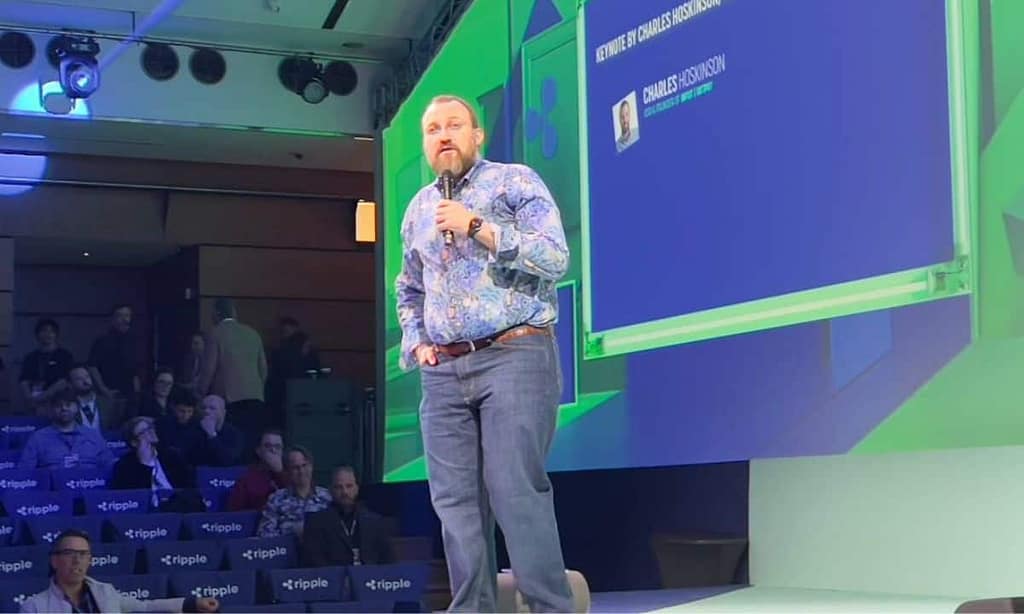
Cardano’s Charles Hoskinson Plots Exit From X to Discord Over ‘Endless Rage’
Cardano co-founder Charles Hoskinson is engineering a mass migration of the ADA community from X to Discord, citing systemic toxicity and coordinated harassment on the social platform. The move signals growing friction between blockchain founders and X’s unmoderated environment, with institutional implications for how decentralized projects manage community governance and brand reputation at scale.
- Hoskinson will retain X presence for livestreams to 1+ million followers but route all future AMAs exclusively to Discord servers
- Analysis of 130 X replies found roughly one in three responses hostile, abusive, or profanity-laden, with patterns suggesting organized amplification
- EMURGO chief Phillip Pon confirmed involvement in coordinating the Discord migration strategy for ecosystem consolidation
- 1 in 3 X replies identified as hostile, abusive, or profanity-filled per community analysis
- 130 responses analyzed to assess toxicity patterns and coordination on platform
- 1M+ followers on X that Hoskinson will continue broadcasting to during transition
Charles Hoskinson announced Thursday that Input Output Global and EMURGO are collaborating to move the Cardano community off X to a moderated Discord server, a significant pivot by a major blockchain ecosystem in response to sustained harassment and platform dysfunction.
The decision marks an escalation in Hoskinson’s months-long complaints about X’s toxicity and follows concrete evidence that negative activity targeting him exhibits hallmarks of coordination rather than organic criticism.
ADA traded up more than 3% following the announcement, though the underlying issue, community fragmentation and reputational damage in a key asset’s social layer, represents a material concern for institutional investors exposed to Cardano’s long-term brand positioning and governance legitimacy.
Hoskinson Cites ‘Endless Rage’ as X Becomes Untenable for Ecosystem Coordination
In a Thursday post announcing the migration, Hoskinson stated bluntly that X had become incompatible with healthy community organization. He described the platform as rife with “drama, lies, endless rage, and embittered people” and framed Discord as offering “happy, positive, well-moderated channels” where substantive discussion could flourish.
The framing was not merely rhetorical; behind the characterization lies a documented pattern of abuse that has preoccupied Hoskinson’s public communications for months.
During an April livestream titled “Remember Kids, X Isn’t Reality,” Hoskinson elaborated on the scale of the problem, revealing that X’s infrastructure had forced him to abandon an artificial intelligence project called Project Nyx designed to automate portions of his online engagement.
X’s requirement that AI-managed accounts display bot labels, intended to enforce transparency, had the unintended effect of suppressing visibility for such posts, making the tool operationally ineffective for a founder managing communications across a sprawling global community.
The incident exposed a structural mismatch between X’s platform rules and the operational needs of decentralized projects attempting to scale community communication without surrendering direct control to moderators.
Hoskinson’s solution reflects a deliberate retreat from algorithmic social platforms toward closed-garden alternatives.
Analysis Reveals Organized Amplification Alongside Genuine Community Frustration
The toxicity Hoskinson describes is not purely subjective. Cardano community member Christian Taylor conducted an analysis of roughly 130 replies to an X post requesting an end to “constant anti-@IOHK_Charles threads,” using AI-powered content analysis to classify patterns.
The results produced a stark quantitative baseline: approximately one in three replies contained hostility, abuse, or profanity. More significantly, the analysis identified structural indicators of coordination: identical language patterns, thinly anonymous accounts, and cross-chain references suggesting organized amplification rather than isolated grievances.
However, Taylor’s assessment also surfaced a complicating factor that institutional investors should weigh carefully. Alongside the toxic overlay and coordinated targeting sat genuine community frustration rooted in material concerns: financial losses sustained by ADA holders, persistent delivery delays on key protocol upgrades, and substantive questions about leadership accountability.
This distinction matters because it suggests the problem is not purely a moderation failure or hostile-actor infiltration, but a combination of legitimate community dissatisfaction, inadequate channels for accountability, and bad-faith amplification that obscures the legitimate signal.
The migration to Discord does not resolve the underlying tensions, it merely relocates them. A closed, moderated environment may reduce coordinated noise, but it also constrains the visibility of critical perspectives and could entrench the perception that Cardano leadership is isolating itself from unfiltered feedback.
Institutional investors monitoring governance health should watch whether the Discord migration improves substantive community dialogue or merely concentrates decision-making power further from external scrutiny.
Hoskinson Retains X Platform Access While Routing Strategic Communication to Discord
A critical detail in Hoskinson’s announcement is that he will not fully abandon X despite the stated migration. Instead, he intends to continue broadcasting livestreams on the platform, leveraging his audience of more than one million followers to maintain reach to investors, media, and casual observers who do not maintain Discord accounts.
This hybrid approach, broadcasting to X but reserving substantive community interaction for Discord, allows Hoskinson to preserve attention-level reach while concentrating governance and strategic discussion in a moderated context.
All future Ask Me Anything sessions will route exclusively through Discord servers maintained by Cardano and Midnight, the privacy-oriented blockchain protocol developed by IOG. This structural change means that real-time founder engagement with the community will no longer occur on a public, algorithmic platform subject to Twitter’s rules and exposure to trolling.
Instead, participation will require Discord membership, creating a de facto membership model for direct access to leadership. For large holders and engaged community members, this may improve the quality of interaction. For casual observers and critics outside the Discord, it reduces transparency and amplifies perceptions of insularity.
Hoskinson’s blunt dismissal of critics, “For those people, I can’t solve stupid”, signals that he views the migration as a break with a dysfunctional audience segment rather than an attempt at reconciliation.
Discord Migration Sets Precedent for Blockchain Projects Fleeing Algorithmic Platforms
Cardano’s exodus is not isolated. Multiple blockchain ecosystems have grown frustrated with X’s unmoderated environment, rising spam, bot activity, and the platform’s reduced algorithmic amplification following Elon Musk’s acquisition.
Unlike traditional corporate communications, where a single social media account suffices, decentralized projects operate across multiple stakeholder groups, developers, holders, validators, researchers, and traders, each with different information needs and engagement norms.
X’s one-size-fits-all feed structure has proven increasingly ill-suited to this complexity, particularly for projects experiencing technical delays or community conflict.
The shift to Discord carries institutional implications worth monitoring. First, it concentrates community power in a centralized, closed platform operated by Discord Inc., which introduces new dependencies and censorship risks that are philosophically at odds with decentralization rhetoric.
Second, it reduces the breadth of founder communication in public markets, potentially lowering information asymmetry and slowing price discovery.
Third, it creates a bifurcated communication structure where official announcements reach algorithmic feeds via livestream, while strategic community dialogue occurs in a walled garden, a model that may confuse retail participants and reduce the quality of market-wide discourse.
Institutional investors should note whether other major ecosystems follow Cardano’s lead or attempt alternative solutions. A broader exodus would signal that X has become operationally unusable for decentralized governance, forcing blockchain projects to rebuild communication infrastructure outside public platforms.
Alternatively, if Cardano’s migration succeeds in reducing toxicity and improving governance quality, it may establish a viable model for ecosystems willing to trade public accessibility for community coherence.
The test of Hoskinson’s strategy will arrive over the next 90 days as the Discord migration proceeds and the first exclusive AMAs occur on the new platform. Watch whether ADA community sentiment measurably improves, whether substantive governance participation increases, and whether critical community voices remain heard or are systematically marginalized in the moderated environment. If the migration merely relocates conflict without resolving accountability questions, institutional confidence in Cardano’s governance maturity may degrade further, creating a headwind for ADA’s institutional adoption.