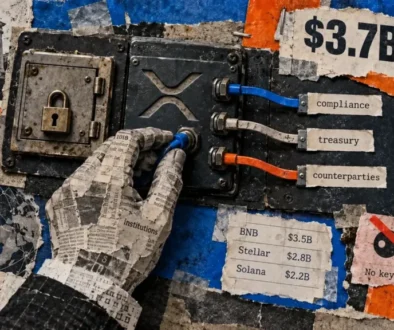
BlackRock’s BUIDL retakes tokenized Treasury crown at $2.8 billion
BlackRock’s BUIDL tokenized Treasury fund has surged to $2.8 billion in assets, reasserting dominance in a rapidly consolidating $16 billion market as major infrastructure providers move toward commercial launch. Institutional investors now face a critical window to assess which tokenization platforms will become the settlement backbone for collateral markets expected to unlock trillions in locked-up assets.
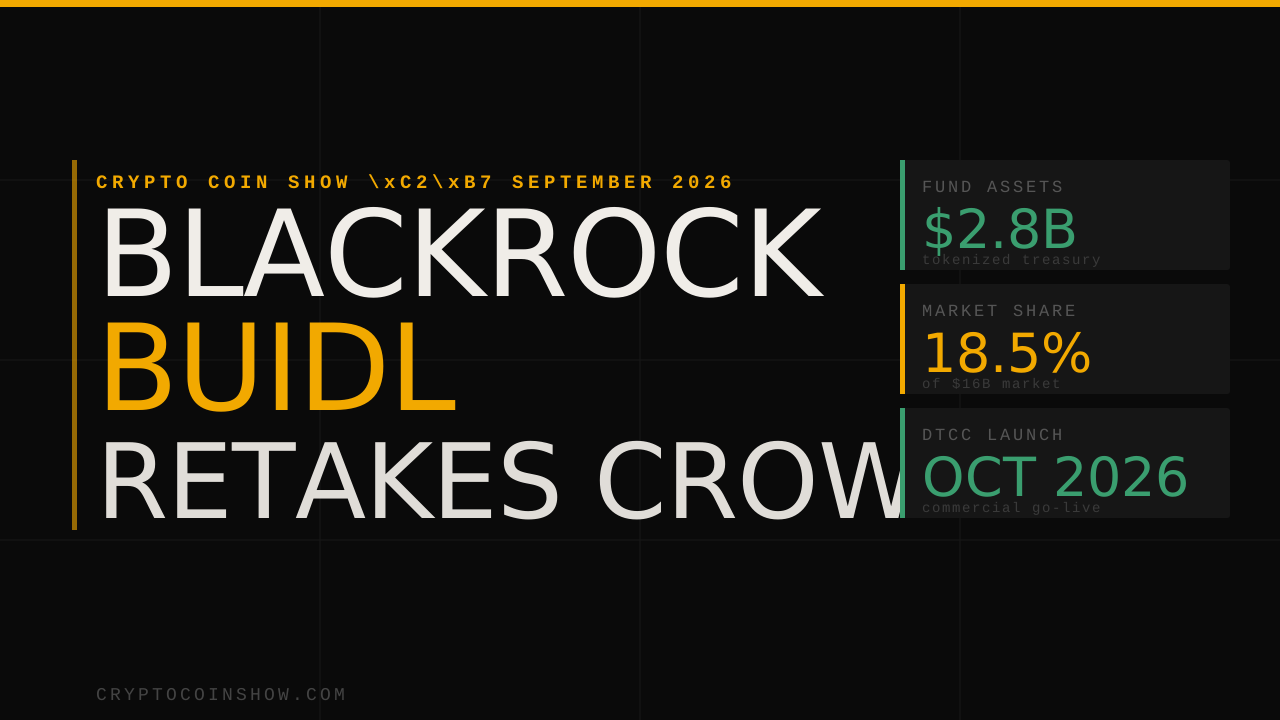
- BlackRock’s BUIDL now holds $2.8 billion, representing 18.5% of the $15.1 billion tokenized Treasury market tracked by data providers.
- DTCC completed production trades on July 15 stress-testing collateral, securities lending, and repo settlement ahead of October 2026 commercial launch.
- ICE and tZERO signed memorandum of understanding on August 31 to build digital transfer and broker-dealer systems, with potential tokenized asset collateral integration at ICE clearing houses.
- $2.8B BlackRock BUIDL assets versus $15.1B total tokenized Treasury market size
- 18.5% BUIDL market share compared to 81.5% split among competitors
- $300T Global high-quality liquid assets versus 10-11% currently used as collateral
BlackRock’s BUIDL fund has recovered to roughly $2.8 billion in assets under management, reclaiming the top position in the tokenized U.S. Treasury market after losing ground to Circle’s USYC in March 2026.
The fund now commands approximately 18.5% of a tokenized Treasury sector that major data trackers value at $15.1 billion, though the broader market size approaches $16 billion when inclusive of competing products.
The recovery reflects sustained institutional appetite for on-chain Treasury exposure, with newcomers including Franklin Templeton and Ondo Finance contributing to recent growth that pushed the overall market up from $15 billion in recent weeks.
Securitize, the infrastructure provider that built and operates BUIDL, manages the fund across eight blockchains including Ethereum, Solana, Aptos, and BNB Chain, capturing asset-servicing fees that drove the company to record first-quarter 2026 revenue before its recent NYSE listing.
BlackRock Reclaims Treasury Leadership After Five-Month Gap to Circle
The leadership swap between BUIDL and Circle’s USYC reflects the volatility and competitive intensity in institutional tokenization products. Circle’s USYC briefly held the crown following its March 2026 debut, but the shift back to BlackRock’s product underscores the weight of the asset manager’s brand and distribution reach with large capital allocators.
BUIDL’s recovery to $2.8 billion arrived as the broader tokenized Treasury sector continued expanding, indicating that market growth outpaced any single product’s gains.
The market structure reveals significant concentration risk. BUIDL’s 18.5% share leaves 81.5% distributed among USYC and a fragmented roster of smaller competitors, creating a two-horse dynamic that resembles earlier phases of the stablecoin market.
This consolidation pattern suggests institutional investors are converging on a handful of trusted platforms backed by established financial players rather than experimenting with niche alternatives.
Securitize’s role as infrastructure provider to the largest tokenized Treasury fund has proven commercially decisive. The company’s record first-quarter revenue performance directly tied to BUIDL asset-servicing fees, followed immediately by its NYSE listing, demonstrated to public markets that tokenization infrastructure could achieve profitable, scalable operations.
This validation carries weight for institutional allocators who historically required profitability and regulatory clarity before deploying capital into emerging financial infrastructure.
DTCC Completes Stress Tests as October Launch Date Approaches
The Depository Trust and Clearing Corporation, which clears the vast majority of U.S. equity trades, moved closer to its October 2026 commercial launch of tokenization services after completing production-level stress tests on July 15.
Those tests evaluated collateral pledges, securities lending, Treasury and repo settlement, and central counterparty margin workflows across the Canton Network and Hyperledger Besu blockchains. The completion signals operational readiness and marks a critical de-risking event for institutions waiting for regulated infrastructure before expanding tokenized asset positions.
The SEC granted DTCC a no-action letter on December 11, 2025, providing three years of regulatory cover to operate its tokenization service on pre-approved blockchains. This regulatory foundation proved essential; without explicit SEC permission, even a systemically important infrastructure operator faces uncertainty in launching blockchain-based settlement systems.
The no-action letter eliminates regulatory ambiguity that otherwise would have frozen institutional participation.
DTCC’s Industry Working Group now includes more than 50 firms spanning asset managers, banks, and exchanges: BlackRock, JPMorgan, Goldman Sachs, NYSE, Nasdaq, Circle, and Ondo. The breadth of participation signals institutional consensus that DTCC’s infrastructure will become the standard settlement layer for high-value tokenized assets.
DTCC itself cited $300 trillion in global high-quality liquid assets as the addressable market, noting that only 10 to 11 percent currently functions as collateral, implying that successful tokenization could unlock roughly $270 trillion in asset velocity.
ICE and tZERO Partner on Digital Broker Infrastructure for NYSE Platform
Intercontinental Exchange and blockchain infrastructure firm tZERO signed a memorandum of understanding on August 31, 2026, to develop digital transfer agent and broker-dealer systems supporting ICE’s planned NYSE-affiliated Digital Trading Platform.
The partnership assigns tZERO responsibility for building core systems, while ICE provides funding and gains access to tZERO’s patent portfolio covering 23 patent families and 103 individual patents related to tokenized assets.
The two firms explicitly considered integrating tokenized assets as collateral at ICE’s clearing houses, expanding the use case beyond trading into core risk management infrastructure.
This partnership represents a distinct architectural approach from DTCC’s centralized clearing model.
Rather than routing all trades through a single cleared settlement platform, ICE and tZERO’s model distributes broker-dealer and transfer agent functions across compatible blockchain networks, allowing participants to maintain systems closer to their operations while remaining compatible with ICE’s clearing infrastructure.
Institutional investors will face a choice between two competing models as both near deployment.
The capital investment by ICE into tZERO’s latest funding round signals long-term commitment and stakes ICE’s balance sheet alongside technical resources. For institutional allocators, this commitment suggests that ICE expects tokenized assets to become material to future trading workflows, justifying the capital and engineering expense.
The combination of NYSE branding, ICE’s clearing infrastructure, and tZERO’s patent portfolio creates a formidable competitive offering against DTCC’s model.
DTCC’s October 2026 commercial launch will occur first, giving that platform a critical window to establish market share and operational credibility before ICE’s Digital Trading Platform reaches deployment. The next key checkpoint arrives when DTCC publishes data on live transaction volume and participant adoption in the weeks following October launch, metrics that will determine whether the $300 trillion addressable collateral market translates into actual on-chain activity or remains aspirational. Simultaneously, watch for ICE’s formal timeline on the NYSE Digital Trading Platform launch and any announcements from DTCC or ICE participants about migration patterns or multi-platform strategies.
Original reporting: cryptopolitan.com