
Sam Hallene / CMT Digital
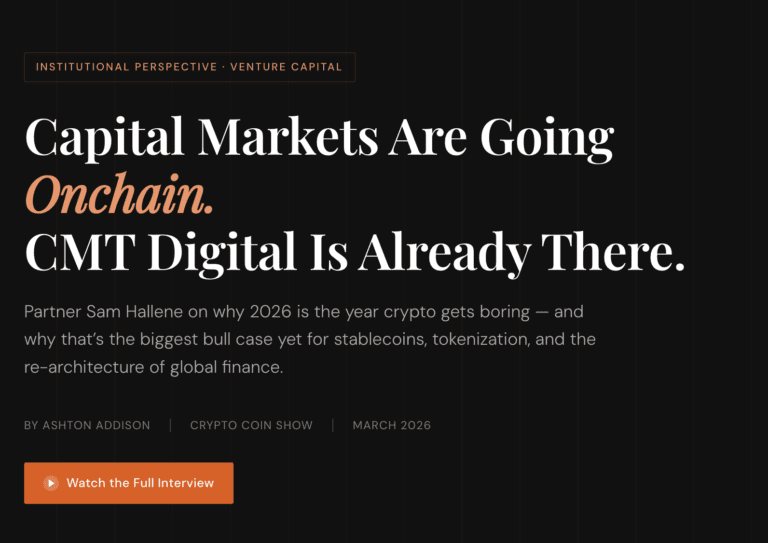
CMT Digital on stablecoins and tokenization reshaping capital markets in 2026
In this episode
Crypto feels loud, but the real shift is quiet — capital markets and payment rails are being rebuilt under the hood.
Sam Hallene of CMT Digital breaks down what matters in crypto in 2026 as the industry moves from narratives to infrastructure, and why stablecoins, tokenized Treasuries, and institutional onchain settlement are turning into the real adoption curve.
Get a clear view of where institutions are actually moving onchain (and why), how to think about market structure, and what founders should understand about building and fundraising when the next cycle is driven by utility, not hype.
cmt.digital · Watch on Refinitiv
- CMT Digital's 2026 thesis focuses on crypto becoming infrastructure-driven rather than narrative-driven, with stablecoins, tokenization, and institutional onchain settlement as primary adoption vectors.
- Regulatory clarity from the SEC, CFTC, and pending legislation like the Genius Act and market structure bill are enabling capital markets to move onchain at scale.
- Cost savings from unified ledger settlement create competitive advantages that force industry-wide adoption, as demonstrated by Figure's reduction of loan origination costs from 25-26 basis points to 150 basis points.
- CMT Digital has deployed capital into over 100 companies including Circle, Coinbase, and ConsenSys, with the venture arm becoming the primary focus since 2017.
- Onchain capital markets enable new financial instruments and cross-collateralization possibilities unavailable in traditional systems, particularly benefiting emerging markets with limited capital access.
Chapters
Transcript
Read the full transcript
I'm Ashton Addison from the Crypto Coin Show, and today on Blockchain Interviews, we have Sam Hallene, partner at CMT Digital, a crypto venture capital and prop trading firm, and division of CMT Group, here to discuss all things crypto, the shifts from narratives to infrastructure, where the institutions are moving and investing, and moving markets on chain, and much more. Sam,
welcome to the show, and thanks for taking the time. Ashton, thanks for having me. Great to be here. Yeah, excited to dive into all of this knowledge that you have, and you've been in crypto quite a while, and then working with CMT Digital. I'd love to hear a little bit on your background, first of all, and then how that relates to your day-to-day at CMT.
Yeah, absolutely. I guess I'll start with crypto. I read the Bitcoin white paper for the first time in 2015. Actually, a friend who was at CMT at the time told me to read the Bitcoin white paper. I was an economics student, always interested in money, and the soundness of money, and printing money, and so Bitcoin was right up my alley. Mhm.
I graduated from school in 2017, spent a very brief stint at a bank here in Chicago, and then, that same friend who told me to I guess I owe this guy. He really helped influence my career. He recruited me over to CMT. To actually in an operational capacity to help
make the back end of a multi-national, multi-asset class trading firm more seamless, which is an incredible, kind of foray into the guts of financial plumbing. But, the promise was that I would get to look at all the cool and interesting stuff that was happening in the crypto world. You know, if I did my school work during the
day. You know, fast forward almost nine years. I helped to run the venture capital group here at CMT Digital. I am one of five partners and some background on CMT Digital. CMT Digital is the blockchain and digital assets focused trading, investing, and legal and regulatory advocacy subsidiary of a larger CMT Group. The CMT Group is 29 years old
at this point and has it really got its start it at the beginning of the electronic trading era. So, as markets were moving online, the founders of the CMT Group, two of where my partners on the CMT Digital venture capital side of the business, saw the opportunity to go electronic and capture the edge that, you know, being
kind of first in the electronic scene would would bring. And we've seen the evolution of market structure both in, you know, established capital markets like the United States as well as some of the more emergent markets around the world, be it Southeast Asia, Latin Latin America. So it's an interesting vantage point when you pair that with crypto. We got into
crypto in 2013. Really from a an interest in the counterparty risk. So, Bitcoin, you know, as a as a trading firm you're always trying to eliminate counterparty risk or mitigate it to the best extent possible. In 2013, Bitcoin was this new and novel thing that we thought might work as a as a mitigate to counterparty risk. And so we were interested from
from that standpoint. When we when when the Ethereum white paper came out and you know, we started paying attention to Ethereum and really in 20 really in 2016 we realized that with the advent of smart contracts you could start to build financial logic on chain and you know this thesis started to form that you know potentially blockchain could be
the backbone for the world's valuable assets and for finance and capital markets broadly and that sounded a lot to us like a long-term kind of venture capital thesis and not so much a you know trading and out of this thing any given day. And so we started to set up a venture capital arm of CMT Digital in 2017 that
has really become the main focus of CMT Digital over the last several years. We've raised four venture capital funds have deployed into over 100 companies some of the leading companies in the space like Circle, Coinbase, ConsenSys, Athena and many others and have really seen this thesis come to life and we'll get into it today I'm
sure but this is undoubtedly the most interesting time to be in this space if you believe that capital markets are are coming out chain. So happy to be having this conversation now. Definitely super happy to hear it and see the evolution from the original thesis around the time of the Ethereum white paper. I've been a believer since then as well and it is just expanded out
to every and all industry and continues to we're still pretty early on. And with those 100 investments I'd love to hear sort of what the what the crypto 2026 thesis is. We can touch on you know a lot of the advancements from last year afterwards but there's so many different avenues, where there's tokenization, real world assets, all the different
service industries and infrastructures. What's the 2026 thesis for CMT Digital? Yeah, I think that 2026 is really the year that crypto becomes boring. And I say that with a big smile on my face, but I think that a lot of the volatility, the you know, kind of eye-popping meme coin mania, that is a part of crypto, but I think now
we're with the regulatory clarity that we're getting in the United States and with the with the genius act that will be going effective in I think June or July, with the potential for clarity act, a market structure bill, and just yesterday the guidance that was given jointly by the SEC and the CFTC, there's really this
air coverage to bring our capital markets on chain. And so, we want to invest in the entrepreneurs that are building, you know, venture style businesses that are that are kind of sprinting towards that, be it in the in the stable coin space, in the tokenization space, prediction markets are really interesting. You know, as tokenizing truth or
tokenizing sentiment, and we just can't just wait to see the derivations of how traditional business models will change as as as they come on chain. We've seen we're we're I always give this example cuz he just does it so well. We were early investors in a company called Figure, which started to originate home equity lines of credit on chain. They
published a paper in 2019 saying that they could probably achieve 26 25 26 basis points in the notional of savings in the notional origination cost of a of a loan. And they've ended up, you know, bringing that number up to about a percent and a half, 150 basis points. So, there's real cost savings by bringing everything onto a unified ledger.
And I always think of cost savings is kind of like a black hole because if you have a different cost structure than your competitor, you're just going to be able to outcompete them, out-advertise them. You're just going to be able to use those dollars in different ways, more productive ways, than than a competitor. And so, it kind of forces everyone to adopt. And we're
seeing that with stablecoins. We're seeing that with an early example in Figure. And I think we're just going to see a lot more of that as 2026 goes on and into the future. Def- definitely. And you know, [clears throat] you said you said it with a smile, the boring businesses. There's so many investors that I've spoken to, my mentors, that, you know,
have been investing before crypto, when young people got in and saw the excitement, and that's the reason that they started investing. But the mentors, you know, they love boring businesses because as long as they're generating revenues, profit, they're growing, might be boring, but, you know, it's growing. Yeah. And I you know, I tongue-in-cheek say say
boring because I really I really think that the, you know, the prospect of our capital markets moving onto DeFi rails and having new possibilities for, you know, interoperability, cross-collateralization of assets, and new financial financial instruments, just by by virtue of what you can do on chain that you can't do off chain, like that's extremely exciting.
Certainly here in the United States, but also globally, you know, where it's not as easy to access capital markets as it is in the United States. So, it's a major change. It's going to be absolutely amazing to watch what happens you know, in the next couple of years here. And I feel just extremely fortunate to have a front row seat. Definitely. And with the regulatory
updates in the last 12 to 18 months, it's still in progress and as we saw yesterday, they're still coming out with more. But for what happened in 2025 with the genius act and stable coins, how does that affect how CMT digital is making decisions? Yeah, I think it's no longer consent no longer contrary to say that the that the future of fintech is stable coins.
And the from the highest level we're seeing the push for stable coin adoption. The US Treasury wants to sell Treasuries. And stable coins at this point are the marginal buyer of US Treasuries. It's not China, it's not some of the
countries that we used to rely on to be large consumers of US Treasuries. And so the stable coin complex is the marginal buyer of a Treasury bill. And that incentive to promote this stable coin space from Treasury is I think going to fuel a lot of adoption in the stable coin
world. And then, you know, that is going to be So, we're going to we're going to tokenize the dollar and then the dollar is going to flow into and start to see all these new use cases on chain. And so, the And the genius act gives institutions the rules of the road to issue a compliant stablecoin. So, that you know, that now you hear
basically every Fang is contemplating or actively working on the issuance of a stablecoin and that's by virtue of the genius act being passed. So, we're going to see the push to stablecoin rails, I think, dramatically. And then that's just going to be the
conduit to accessing broader DeFi and further moving our capital markets into DeFi and on chain. Definitely. The tokenization of the capital [clears throat] markets is super exciting. And the stablecoins is a major step towards that. I'm curious your thoughts on stablecoins and you know, there's sort of one or two dominant ones, but with the ability to
create your own stablecoin, although it's it's fast and cheap compared to you know, all of the fiat currencies, but when you're looking at an investment and they're like, okay, we're creating our own coin, does every protocol and payment rail need their own coin? Or where do you balance that? Yeah, it's a great question. I mean, I think distribution is king. So,
You know, Tether's done a great job of capturing the stablecoin demand from the global south or from a population that generally wants access to the dollar but does not maybe trust US institutions. And I think there's a real mode in there. And then I think Circle's done a good job of capturing the business community
To date. You know, I think these models will come under pressure from yield sharing and from companies that have massive distribution you know, issuing their their own stable coins. We'll see how all those stable coins work and behave in practice, if they're if they're actually
permissionless or if they're, you know, kind of kind of gated. I think it is, you know, interesting in so far as you can embed a, you know, loyalty program into a stable coin. So, you know, Amazon, if you shop at Whole Foods, you know, and you used to you use your stable coin to pay, you could get some sort of discount or, you know, some sort of points system. And so I
think like we'll see that as a as a differentiator, but you know, under a genius compliant stable coin issuer you know, there's not really much that you can do with like the collateral base to differentiate yourself. And I think that's a really good thing. So it will be interesting. I do think this will ultimately be kind of an oligopolistic
Market and a lot remains to be seen with the Clarity Act and if we get yield sharing because that is I don't think it's an understatement to say that will, if yield sharing is allowable, totally change the banking model as we know it and we'll see a lot of deposits, you know, flee into fintech apps and
in places where they can get paid relative to what you're paid in, you know, a savings account or even like a money market account sometimes. Definitely. That's that was going to be my next point. It's great to have that foundation in the genius act that if this is a you know, US-based stablecoin it's hard to differentiate, you know, when when
there's the regulation, but the yield factor is, [clears throat] you know, you know, back when when stablecoins were first in their experimental phases, it was like, okay, where where was the best yield? But now just comparing it to traditional banks, everyone knows that, you know, everyone who has ever used stablecoins or seen the yields in DeFi knows that
the yields are generally a lot higher than than banking. How How do you think that plays out? The timeline for that in allowing yield that is, you know, more lucrative than than traditional banks and then actually people that have cash sitting on the sides moving that into digital assets. Yeah. Just to level set to the clear the genius act said that a stablecoin
issuer cannot share the yield on the stablecoin, but it doesn't preclude, you know, call it like a partner institution, a place where the it doesn't it doesn't preclude that the issuer from entering into yield sharing agreements with, you know, issuers or sorry, with partners. Mhm. So think like Circle and Coinbase, for example. You know,
Coinbase can share the yield that they get and Circle likes that because Coinbase has, again, the distribution. What and so and so that arrangement is allowed under the genius act. With the clarity act, the big debate in the in the Senate Banking Committee right now, actually in the Senate Banking Committee, is that whether partners can share yield. So, whether the Coinbase can
share yield vis-a-vis direct interest, you know, payments or some sort of marketing expense. And that is going to be crucial for banks. How does it play out? You know, I don't I don't really have a crystal crystal ball. I mean, I do think that there's a strong incentive structure
for Treasury to want to allow yield sharing because that makes stable coins more interesting to you know, to me even, right? Relative to how holding them in my US bank account because I can kind of instantly transact and with them whenever I want. That said, there's a very strong, you know, banking lobby that is fighting
tooth and nail against this right now. So, I don't have any unique insight into how it's going to play out. You know, I can identify the incentive structures, but it's really like we need to get something done quickly. And so, I think we'll we'll we'll probably see if I had to guess we'll probably see a yield sharing ban.
But it's going to be extremely difficult to enforce that in practice. And so, you'll see kind of a patchwork of loopholes that pop up on yield sharing and you know, that aren't that aren't illegal in isolation, but certainly violate this the spirit, you know, of no yield sharing. And it's going to be like whack-a-mole you know, on that
on that front and you'll see a lot of, you know, probably a lot of lawsuits come out from you know, against like the Robinhoods and Coinbase's of the world. Mhm. Definitely. Yeah, I think there's going to be some it the service providers, they want it to happen. It's just a matter of going through that experimentation to figure out the perfect fit and
and we'll see, you know, the banks lobbying against it until it goes through and then they'll have to adopt it hopefully and integrate it into the traditional system.
Right. Which is I think very positive for the consumer and for the US. Definitely. And the you know, it the markets will just be so much more efficient if you can deploy, [clears throat]
you know, one click something that's a stable coin already in yield into something else, you know, you're removing a lot of friction and commerce can just happen easier if it's already in digital assets. Absolutely. Yeah. I want to jump into tokenization. If stable coins is really needed as that important foundation and now we're seeing tokenization of
the capital markets, you know, starting with some more money markets and things like that, but it's trickling its way down to everything in the stock market. Where do you think is the clearest example of where tokenization improves capital efficiency right now? I like to I always like to go back to figure I can give another example as well in a second, but you know, when you
when you originate home equity line of credit, you have to have provenance to the documents that you use to underwrite and then you have to service a loan on a, you know, regular basis. and so, if you can have perfect provenance of, you know, the origination, what documents were, used and, you know, cryptographically verified and then you
can have, you know, kind of a record all along the way on the health of the loan, it makes it much easier for a potential buyer to purchase that, that asset. When you just have this very cleanly packaged repository of information all in one space. And so, I think that is a really powerful use case for blockchain. We're seeing it in action,
you know, figures now up a public company, and, we're super excited about, you know, what they've done to showcase the, tokenization of a of a of a loan. And we think that liquid markets are going to be created for other types of loans. So, we invested in a company called Nuity that's based here in Chicago. They originate SBA 7A,
Loans. So, it's a really productive, public-private partnership where, the SBA, if you meet a certain credit box, guarantees a portion of the loan. So, basically, that guarantee makes the capital keep cheaper to small businesses here in the United States and allows them to, you know, grow effectively. This company originate,
Nuity, is, going to, originate loans on chain and, they're going to, hopefully create a liquid marketplace for the takeout of these loans, on, blockchain rails. And then, you know, given the homogeneity of these products, you know, the hope is that
it will become a DeFi asset. So, you can you know, buy these loans, use them as collateral, and we'll see what comes of that. But if we can originate more of these things because there are partners that like these assets and could take them out on blockchain rails, that already is a step change 10x improvement in the business model for
Newity and for you know, the origination of small credit in the United States, small business credit in the United States, which I think again is a profoundly good thing. Definitely. Access to capital as a small business is super important and you know, the US already has pretty good leg up on the world, but if we can improve that even more,
There's a reason, you know, they're leading and have the greatest financial markets globally.
[snorts]
So, there some great examples and there's already things happening with tokenization. I think when I speak to other firms, tokenized treasuries and money market stuff in the financial markets seems like that's the first base, but how do we
move that to tokenize everything, which I know some of the slogans of the these tokenization companies that I've spoke to. What are the pieces that I think are missing to make it to the next step of tokenizing things that are a little bit harder to tokenize? Well, I think regulatory clarity is probably the biggest thing that will that will get us there. I think people
want to do this. I think there are good case studies out there for the efficiencies that, you know, this brings. But we need to you have have a clarity act, I think, in order, you know, to understand fully, you know, what a digital asset security is, even though there's been interpretive guidance from from the Atkins SEC
On, you know, how you can create how how how you can tokenize a security, things like that. I think something to happen fullsomely until we have you know, a clarity act. So, I think that's crucially important. I also think it's kind of obvious with the benefit of hindsight that we tokenize dollars first. You know, there's like extreme product market fit for tokenized
dollars globally, but also most assets globally, you know, financial assets are denominated in the dollar. So, if the dollar was like sub for some reason not on blockchain rails and then you had, you know, like some equity trading on blockchain rails, like it wouldn't make a lot of sense. Like, I think it I think with the benefit of hindsight it's like
perfectly rational that like we tokenize the dollar first and then like because the dollar is the quote currency for, you know, most financial assets in the world, it makes sense that these assets follow the dollar onto blockchain rails. Yeah, that makes complete sense. Got to have it all on there. Otherwise, you know, it's it's like the small businesses that are doing commerce
in digital assets and then when you have to go back, it's the pain comes back of like, "Oh, no." [laughter] Oh, I know. Yeah. It's slow and expensive. Yeah. I have to I send a bank wire I go to the bank and send a bank wire every now and now and again, you know, just to remember how painful it [laughter] is. Definitely. You know, at the beginning we talked about prop
trading and investing derivatives. I'm curious on the derivative side, what's the most important part of crypto derivatives or tokenized derivatives for trading right now? There's so much very interesting There's so many interesting companies that are building in the derivative space and there's so much to
talk about with respect to market structure and I think CMT has a decently unique purview in this space just so in so far as being you having our trading history or you know we trading in the digital asset space and then and then also the venture venture capital you know perspective. I think you know broadly you need
Trusted intermediaries to you know warehouse risk and so you know we're we're investors in FalconX. We're investors and we recently led the series A round at STS Digital. And these are principal dealers that have great experience management teams that are bringing liquidity to the
crypto derivatives marketplaces. I also think that the perpetual future that was popularized by BitMEX and invented by Arthur Hayes is a product you know I like crypto kind of claims that the perp as it as it's invention. I think that's great. I think it's true. And we're going to see a lot of real world
you know perps real world asset perps come on chain and I'm really excited for that. I mean I think the perp, you know, has its downfalls with or downsides with you know, just the way that these venues have to match orders and then the auto deleveraging that can happen in you know, in really volatile times. But it also has you know, a striking
simplicity and an elegance that I think certainly retail traders gravitate towards and I think more and more we'll see the professional traders kind of gravitate towards the perp as as well. You know, I think hyperliquid listed the oil perp futures and you know, obviously unfortunate
extremely unfortunate events that happened recently but good timing for hyperliquid in so far as the open interest is just skyrocketed in those assets. I think we're just going to see more and more of that. So the perp is a great financial invention and you know, most if not all you know, perpetual futures are traded on blockchain rails and then we just need
the market you know, infrastructure to mature a little bit. I think STS and FalconX our portfolio companies are pushing the ball forward in that domain and then you know, we'll start to get more prime brokerage in the space which will you know, help to introduce more liquidity and evolve the asset into the next phase of you know, crypto market structure.
Definitely. Yeah, it's really exciting and I did see that hyperliquid oil listing and it's only going to continue and then you know, those high frequency traders are just going to move to the platforms that have obviously faster and cheaper and better once that liquidity is there. I liquidity is obviously super important. Mhm. Yeah. Absolutely. I want to also touch
on prediction markets because they've been so hot and they've really extended outside of crypto and
[snorts]
in politics, in sports, and everything. And the investments for example from from New York Stock Exchange and you know, we're reaching 10 billion dollar valuations from what the early crypto investors were like, oh, this is just another crypto company,
but it's become so much more than that. Is CMT involved in on the prediction market side and where do you see that heading? Prediction markets are extremely interesting. We recently made an investment in a in a company called TBD. TBD.vote is the is the website. And they take an interesting So, I think the prediction market space, you know, creating an analogous pro-
or substitute products for Polymarket or Kalshi and winning is going to be extremely difficult. They've raised, you know, now at this point billions of dollars. They have very deep distribution and they're great products. So, I think it's going to be hard to you know, win in that space
unless you have, you know, significant distribution. We invested in TBD as a sentiment market. So, they are a two-sided company. The first side is a polling platform. So, anybody can spin up any poll, they can incentivize it how they want, and TBD has registered users that are KYC'd
And their demographic age, etc. information is known, so you could say, "Hey, I want to poll this I want to I want to poll, you know, Argentinians on, you know, their their view of, you know, Milei's presidency, right?" And you can do that through TVD. And then you and then and then on the other side the users can vote or sorry, they can
they can wager on the outcome of those polls. And those polls can be resolved in any arbitrary time frame, so you don't have to wait till 2028 to see who, you know, wins the presidential election, you can resolve those polls, you know, tomorrow. So, it's it's more of a sentiment market, it's not necessarily a prediction market, but we think that it
is societally interesting, accomplishes a lot of the same stopping is and it and the feedback loops and the return profiles are potentially greater because the resolution binary resolution happens you know, on any arbitrary time frame instead of like, you know, 4 5 years from now or, you know, tomorrow. And then also the resolution mechanism is
known, it's based on a group of voters instead of a, you know, an oracle kind of a consortium. So, you know, I think these are the types of businesses that are still interesting from an investment standpoint in the prediction market space. I think from the from the societal interestingness standpoint, Polymarket and Kalshi are incredibly [snorts]
Interesting, and I just think we're going to see the start and we're just seeing the start of it, you know, now as they're mentioned, you know, more and more on talk shows and podcasts and relied on as a source of information, Yeah, universally. Definitely. Yeah, I know that's really interesting with the sentiment market and being able to
resolve something, you know, like just take a poll and whatever it is and by the end of this month for something that, you know, the actual decision of the presidency is a few years away. That makes complete sense. But I feel like it's also something that these major prediction markets, they're just a feature they can implement as well.
I think so. I mean, I think that they can. Focus is everything. And you know, it's it is a different model from, you know, what these these markets have right now. It's it's a different, you know, it's a different resolution mechanism. It's a different, user base that they have to court for voting as opposed to,
you know, just, betting on the outcomes. So, you know, we like that, Corey and his team from TBD are intimately focused on this opportunity. It's not impossible to replicate, but it's pretty difficult. Mhm. For sure. You know, we don't have a lot of time left, Sam, but there's been so many great insights. I would love to hear your
thoughts, you know, from the perspective of a founder who's doing a tokenization or capital markets and trying to raise capital, what's important to understand about, the current scene right now in raising capital? Yeah, I think it's I think it's a difficult time to raise capital. I think there's a sentiment mismatch on how just how positive
the future for crypto is, overtly based on the remarks from different government agencies, CEOs of major companies, and you know, I think just the live progress of, you know, stablecoin evolution, the continual institutionalization of Bitcoin and Ethereum. So, it's extremely positive, but I think sentiment is kind of meh because Bitcoin
is, you know, sub 75K and you know, the altcoin market is pretty dead. And I think a lot of people use that as a as a litmus for, you know, the progress of our of our space. So, I long story short, it's it's difficult to raise capital right now. You know, we are open for business. We're actually investing and deploying and there are
several other, you know, really great firms that are that are also active. And I think now has never been better a better time to start a company. So, if you can get funded, and you know, you have a you have a good idea, a lot of the kind of binary variables that would you know, eliminate your successes of your chances of success are are now
very much, you know, not variables anymore or, you know, have swung extremely positive. And so, I think right now is the most interesting time to be investing in the space. The most interesting time to be building in the space that we've ever experienced that I personally ever experienced you know, over the 10 years that I've
been in the space. Yeah, no, I agree. It is super exciting and there's so many advancements and there's a bit of a sentiment mismatch with at least the price of Bitcoin being down, but you know, the smart long-term investors, that's when they buy. They're not buying it when it's exciting at the top. So, yeah, I it's it's definitely great time to be working
on all these little industries that we've been talking about and trying new startups, especially with AI that to help you with your work lean workforce to be able to produce fast. Yeah, absolutely. It's become a key piece of our underwriting process. How are you using AI? We're really trying to reinvent our firm as well with some of these tools. It's just an
incredible world that we're entering into with you know crypto AI, maybe quantum as well. So Definitely, yeah, would love to follow up on that AI and quantum in our next discussion. What's the best way for people to follow along with CMT Digital's research and portfolio companies and you know, if they're starting a company, how to reach out? Yeah, I think following us on
Twitter at CMT Digital is probably the best spot for real-time information. You'll see all of our why we invested pieces, our thesis, some of our more deeper research pieces, our podcast interviews. So Twitter's the place to go. Sounds great. I will leave that in the in the show notes below and appreciate all your insights into all of this. I'm
going to also going to put a little bit on some of the portfolio companies that we mentioned today out of the many that we that we highlighted. I'm going to look into those as well because they're all innovative and doing cool things. Thank you Sam for your insights and yeah, would love to follow up in the near future. Yeah, thanks for hosting me. This was
great. Great questions and I am very excited for the next time we chat.
Mhm.
Related coverage
More interviews
 How Robinhood built its own blockchain to control compliance and feesSep 29, 2026
 Geo Protocol founder Yaniv Tal launches Geo Debates, its first productSep 28, 2026
 How Brave is expanding beyond ad blocking with Drew PotterSep 27, 2026
 Why Kevin Carter thinks China is winning the AI raceSep 25, 2026
 Brave's plan to bring self-custody payments to 120 million usersSep 18, 2026
 Arie Trouw on why AI agents now need proof of actionSep 14, 2026