Trump backs the U.S. taking ownership stakes in major AI firms
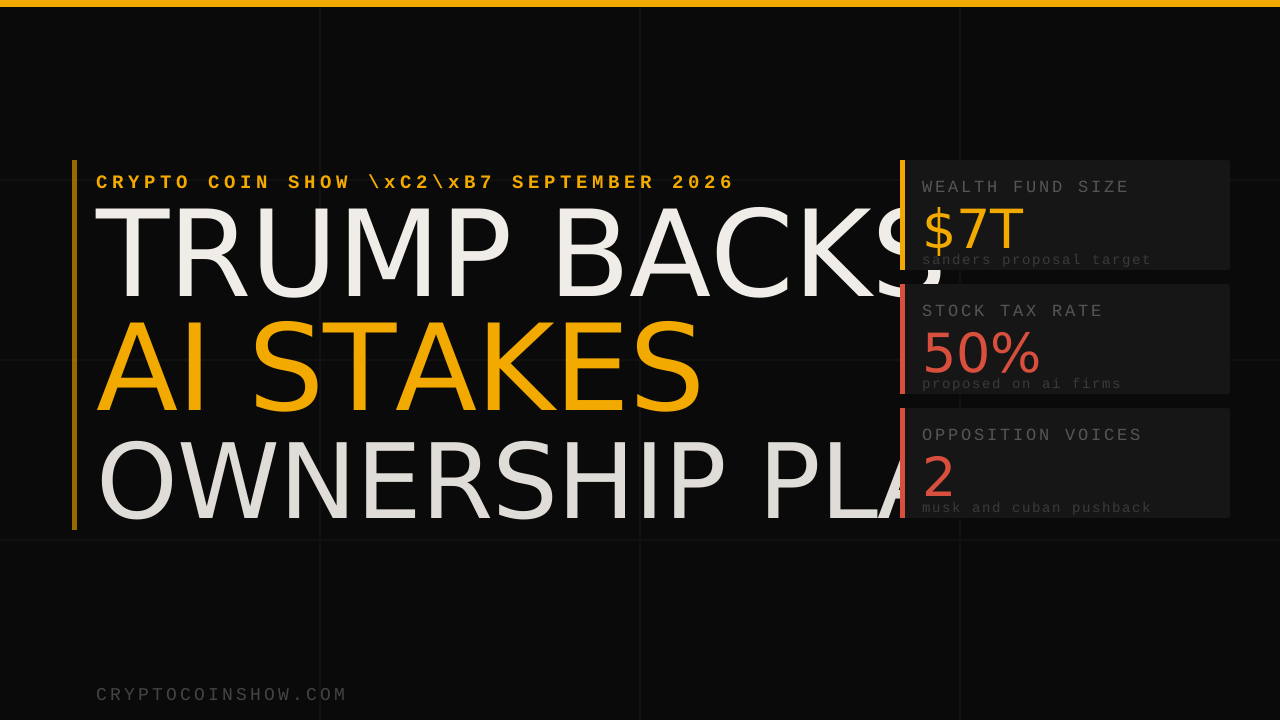
The Trump administration is exploring direct government ownership stakes in major U.S. AI companies as a mechanism to distribute gains from artificial intelligence to ordinary Americans, a proposal that marks a sharp departure from traditional Republican fiscal doctrine. The plan, detailed by Vice President JD Vance, has already prompted pushback from Elon Musk and entrepreneur Mark Cuban, while Senator Bernie Sanders introduced parallel legislation that would impose a 50% stock tax on leading AI firms to fund a $7 trillion sovereign wealth vehicle.
- Vice President JD Vance stated Trump supports U.S. government ownership of major AI companies through a sovereign wealth fund model.
- Senator Bernie Sanders introduced the American AI Sovereign Wealth Fund Act, projecting a $7 trillion fund paying $1,000 annually per American.
- Treasury Secretary Scott Bessent and Commerce Secretary Howard Lutnick have proposed competing internal structures for deploying AI equity stakes.
- $7 trillion Projected value of Sanders’ proposed federal AI fund versus current legislative baseline.
- 50% Stock tax rate Sanders’ bill would impose on major AI firms, versus zero under current law.
- $1,000 Annual payment to Americans Sanders projects from fund distribution, versus no current dividend mechanism.
The proposal to place government ownership stakes in artificial intelligence leaders represents one of the most unconventional economic policy initiatives from a Republican administration in recent memory. Vice President JD Vance disclosed the concept during a Thursday appearance on “The Diary Of A CEO,” framing it as a sovereign wealth fund mechanism rather than traditional equity investment.
Vance characterized the position as ideologically unusual for a conservative White House, acknowledging that direct government ownership of private corporations sits at odds with Republican free-market orthodoxy.
The timing reflects broader concern among Trump officials that AI-generated wealth will concentrate among shareholders and company founders unless the federal government intervenes structurally.
Vance dismissed relying on corporate taxation alone to distribute AI prosperity, calling taxation “a very modern liberal concept” that could perpetuate wealth inequality.
His alternative proposal centered on workforce participation rather than passive redistribution. Vance suggested labor unions as a potential model, arguing workers require direct stakes in high-value firms.
The statement signals the administration’s willingness to embrace state capitalism principles historically associated with sovereign wealth funds in Norway, Singapore, and the United Arab Emirates, not Republican economic theory. No formal policy framework has been adopted, and no timeline for implementation has been announced.
Vance backs government stakes as alternative to taxation and direct redistribution
The vice president’s endorsement reflects a calculation that AI companies will accumulate extraordinary profits over the coming decade, creating a legitimacy crisis if wealth remains narrowly concentrated. Vance noted skepticism toward relying on taxes alone to spread benefits, even if AI firms accumulate trillions of dollars over the next ten to twenty years.
His framing rejects the libertarian argument that government should simply allow markets to function; instead, it proposes pre-emptive ownership as a hedge against political backlash and social instability. The framing also sidesteps direct wealth redistribution, which polls show resonates poorly with swing voters Vance and Trump seek to retain.
The sovereign wealth fund model offers political cover by positioning the proposal as capital stewardship rather than socialism or confiscatory taxation. Vance’s language, calling Trump “a very unconventional person” for embracing the concept, signals awareness that the position breaks with Republican donor expectations.
Major technology investors and venture capital firms have not yet mobilized against the proposal, possibly because no formal legislation has been introduced from the Trump administration and no specific firms have been named as targets.
Musk and Cuban challenge both mechanics and feasibility of government ownership plan
Elon Musk rapidly countered Vance’s proposal via social media on Saturday, arguing that direct cash payments to citizens would prove simpler and more effective than government equity holdings. Musk wrote that it would be “better just to send money directly to the people from the Treasury,” rejecting the sovereign wealth fund model as needlessly complex.
He addressed the inflation concern most often raised against direct payments, contending that AI and robotics automation would increase the supply of goods and services faster than any money supply expansion.
Musk predicted the United States would face deflation pressures rather than inflation within the decade, a forecast that contradicts conventional economic modeling and would require AI productivity gains far exceeding current consensus estimates.
So long as the increase in goods & services exceeds the increase in the money supply, which I expect from AI and robots, there will not be inflation.
Elon Musk, Tesla and X owner
Musk went further, predicting “we will desperately be fighting deflation,” a claim that depends entirely on AI delivering productivity gains beyond current forecasts.
Entrepreneur and investor Mark Cuban raised separate structural objections to the government ownership concept on the same day. Cuban argued that announcing a half-measure, placing major AI stocks into a government fund, does not constitute a coherent economic policy.
He noted that leading AI firms would still require hundreds of billions of dollars in additional capital raises for data centers and model development, meaning government ownership stakes might provide minimal benefit to taxpayers while diluting shareholder returns.
Cuban also highlighted a governance problem: who has authority to represent taxpayer interests in negotiations with AI company boards. “Certainly not politicians,” he said, pointing to the corruption and misalignment risks inherent in government-managed equity stakes.
Sanders introduces competing $7 trillion sovereign wealth fund legislation without administration support
Senator Bernie Sanders unveiled the American AI Sovereign Wealth Fund Act on Thursday, proposing a more aggressive intervention than the Trump administration has outlined. His bill would impose a one-time 50% stock tax on major AI companies, with proceeds flowing into a federal fund Sanders projects could reach $7 trillion within the decade.
Sanders’ office estimates the fund would generate approximately $1,000 in annual payments to every American, creating a universal AI dividend. The proposal explicitly frames AI as a common resource whose gains should be widely shared rather than concentrated among shareholders and executives.
Sanders’ legislative framework provides a concrete mechanism, the stock tax, that the Trump administration has not yet specified.
His projections assume AI companies will generate sufficient profits to sustain both valuations high enough to support a $7 trillion fund and earnings sufficient to justify those valuations, a circular assumption that depends on AI delivering sustained exponential growth.
The bill received limited attention from mainstream media and no endorsement from the Trump White House, despite the administration’s stated interest in government ownership stakes. The timing suggests Sanders introduced the legislation to pre-empt or define the terms of any Trump-backed AI dividend proposal.
Treasury and Commerce Secretaries divide on whether stakes fund personal accounts or central sovereign fund
Inside the Trump administration, Cabinet-level disagreement has already emerged over the structure of government AI stakes, according to sources familiar with internal discussions. Treasury Secretary Scott Bessent advocated for directing any acquired AI equity into Trump Accounts, a personal investment vehicle that would allow individual Americans to hold direct stakes in companies.
Commerce Secretary Howard Lutnick, by contrast, preferred a centralized sovereign wealth fund model that would aggregate ownership and distribute proceeds to all citizens equally. The two approaches reflect fundamentally different philosophies: Bessent’s model emphasizes individual wealth accumulation, while Lutnick’s emphasizes equal distribution and collective national ownership.
These internal debates occurred before the Trump administration’s export controls on Anthropic, suggesting AI policy divisions predate recent geopolitical tensions.
No decision has been made between the competing approaches, and the cabinet members have not publicly articulated their positions. The disagreement signals that any formal proposal from the Trump administration will face internal negotiations that could delay or reshape the concept.
A promised meeting between Trump and industry CEOs has not been scheduled, despite Trump’s earlier public statement that such a meeting would occur. The delay suggests either lower political priority than initial rhetoric indicated, or waiting for industry to organize a coordinated response.
The next concrete test will be whether Trump meets with AI company leaders and whether any formal legislative language emerges from his administration. Industry executives have not mobilized publicly against the proposal, possibly calculating that engagement is preferable to ignoring a policy direction backed by the vice president and two senior Cabinet members. Watch for Treasury and Commerce to resolve their internal disagreement, and for any statement from the administration’s principal AI firms, OpenAI, Anthropic, Meta, Google,