
Polymarket fires US CEO after $10 million fraud attempt exposes compliance gaps
Polymarket’s $10 million fraud attempt and ongoing insider-trading investigations expose critical gaps in compliance at a prediction-market platform valued at $21 billion, raising questions about whether rapid growth in the sector has outpaced the regulatory infrastructure required of institutional trading venues. For crypto investors and institutions considering entry into prediction markets, the incident signals enforcement risk and operational fragility at the dominant US player.
- Attackers used stolen debit cards to fund 4,000 deposits across Polymarket accounts, triggering 80% fraud rejection rates versus industry norms of 1%.
- Polymarket’s US compliance chief resigned and the US division CEO was fired after an internal audit flagged $10 million fraud exposure.
- More than 80 Polymarket accounts have been flagged by the New York Times for suspicious trading, while the CFTC separately opened investigations tied to nonpublic information on pardons, Iran contracts and Google search results.
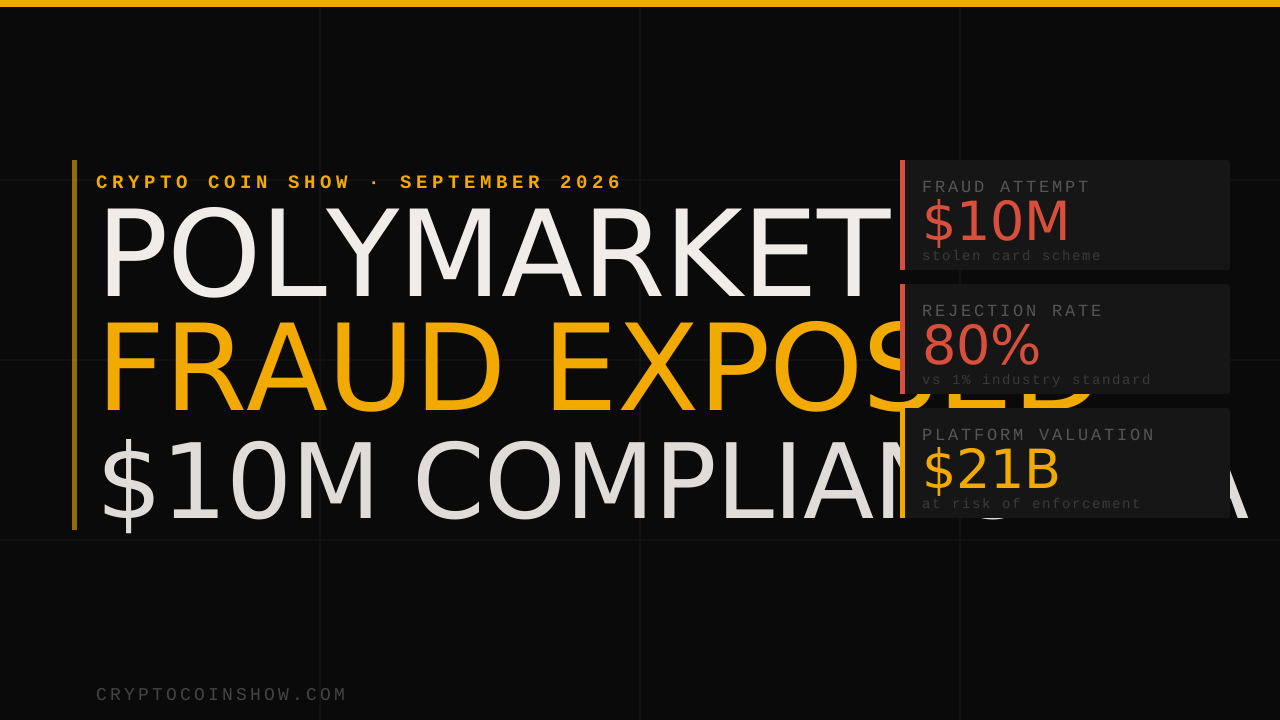
- $10M in attempted stolen-card fraud targeting Polymarket users in one operation
- 80% fraud rejection rate at peak versus 1% industry standard
- $21B current valuation for Polymarket, planning fundraising and potential public listing
In February, Polymarket suffered an attempted fraud operation targeting $10 million in user deposits, according to reporting by Cryptopolitan. Payment processor Checkout.com flagged a surge in suspicious debit-card activity linked to stolen cards being added to thousands of new accounts. Seven users drove most of the attack; one deposited nearly 4,000 times. The operation forced Polymarket leadership to confront a structural question: whether a $21 billion prediction-market operator had built compliance and market-integrity safeguards proportional to its ambition to become a regulated trading platform and go public.
Polymarket CEO pushed growth despite compliance warning signals
When fraud rates spiked to 80% of deposits above the 1% industry norm, internal debate erupted over whether Polymarket should relax its withdrawal-reversal policy to improve user experience. Some staff flagged money-laundering risk; executives argued existing controls were sufficient. CEO Shaney Coplan directed employees to press ahead with expansion regardless of regulatory friction, according to the Wall Street Journal report.
The consequences were swift. Andrew Clifford, head of US compliance, resigned after publishing an internal audit detailing the fraud exposure.
Justin Hertzberg, CEO of Polymarket’s US division, was fired along with other executives responsible for regulatory compliance and anti-money laundering policies. Polymarket later hired a former FBI agent to its risk team, appointed Warren Jenson, former Amazon finance chief, as its first CFO, limited debit-card linking capacity, and contracted Riskified for enhanced fraud detection.
By May, fraud rates returned to industry norms. A review by Sullivan & Cromwell concluded Polymarket complied with regulations, though the departures and remedial hires suggest internal governance had lagged operational growth.
Insider-trading investigations target 80 flagged accounts across political and corporate information
The fraud incident compounds a second integrity crisis: the New York Times first reported that more than 80 Polymarket accounts have been flagged for suspicious trading on nearly 30 subjects, including nonpublic information on government decisions and corporate announcements. One group bet $140,000 on an Israeli military action against Iran and converted the position into $600,000 in gains. A US Special Forces soldier allegedly used classified information to profit over $400,000 from trades on Venezuelan political outcomes.
WIRED reported that CFTC Chairman Michael Selig authorized investigations into trades linked to Biden pardons, Iran contracts and Google search results. According to the CFTC, misuse of material nonpublic information could result in an infraction of commodities law. Polymarket operates as a Designated Contract Market (DCM) and thus falls under full CFTC policing authority over prohibited trading practices including fraud, manipulation, disruptive trading and wash sales.
Kalshi has already taken enforcement action in similar cases, penalizing a political candidate who traded on his own candidacy and fining a MrBeast video editor after finding reasonable cause that he used nonpublic information about upcoming videos. Those precedents establish that the CFTC will prosecute insider trading on prediction markets with the same vigor it applies to commodity futures.
Prediction-market scale now material to crypto price discovery and institutional risk
Prediction markets moved $63.5 billion in volume during 2025, with Polymarket and Kalshi together handling $52.7 billion in the first 86 days of 2026, according to research firm Artemis.
Intercontinental Exchange owns a stake in Polymarket valued at approximately $1.6 billion, representing roughly 22% of the company’s holdings. That exposure means compliance failures at Polymarket now carry spillover risk for a major equity exchange.
A Stanford-SMU study found that Polymarket’s five-minute Bitcoin contracts were associated with suspicious settlement-time spikes in spot order flow and sharp price reversals, absorbing retail losses during manipulated cycles. Fifteen-minute contracts showed far weaker effects, suggesting that prediction-market design directly touches crypto price discovery at short time horizons.
Weak controls on prediction markets raise costs for banks, regulators and institutional traders seeking to enter the sector, fragment liquidity across jurisdictions and delay integration of prediction markets with crypto finance. JPMorgan closed Polymarket’s bank account in August over regulatory concerns. The New York City Council opened a probe into prediction-market marketing practices after reporting of fake trades promoted by influencers without clear disclosure of payment relationships.
The CCS read. Polymarket’s compliance gaps do not invalidate prediction markets as an asset class; they expose the infrastructure deficit. Institutional capital will not enter a venue where insider traders, account takeovers and stolen-card operations persist. The CFTC’s enforcement advisory signals that it will treat prediction-market violations the same as futures violations, meaning DCMs must now hire senior compliance talent and invest in surveillance. Polymarket’s $21 billion valuation assumes it can go public or raise at scale; regulators and banks will not permit that until the insider-trading investigations close and audit trails become institutional-grade.
Watch for the CFTC to file enforcement actions against the 80+ flagged Polymarket accounts and against any individual traders identified in ongoing investigations into Biden pardons, Iran contracts and Google information. The outcome will determine whether Polymarket can clear regulatory decks for a public offering and whether rival venues like Kalshi can establish themselves as the compliance-first alternative. The pending decision is whether Polymarket’s remedial hires and enhanced fraud controls satisfy CFTC expectations or whether the agency moves to suspend or revoke the platform’s DCM license.