
Solana beats Bitcoin on one key metric, but a single software bug could still take down the network
Solana’s 19-validator coordination threshold for censorship exceeds Bitcoin’s 3-pool requirement, but shared software dependencies and concentrated infrastructure create distinct failure modes that institutions cannot ignore when evaluating settlement-layer risk. The ARK Invest and Glassnode framework reveals that a single metric cannot capture the full decentralization picture, each network requires separate analysis of ownership, hosting, client software, and exit speed.
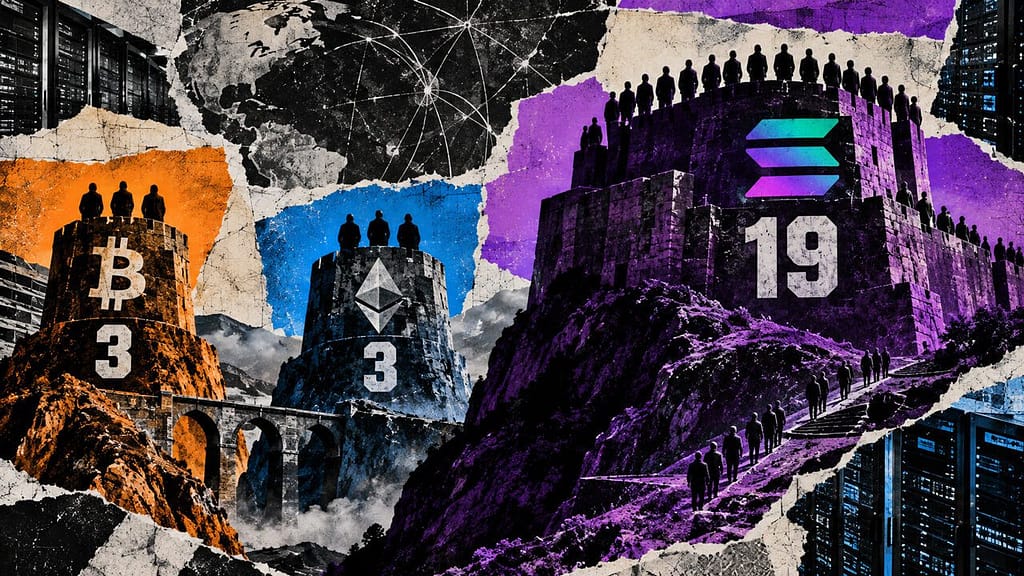
- ARK Invest and Glassnode set Solana’s critical resilience threshold at 19 validators, versus 3 for Bitcoin and 3 for Ethereum, based on coordination needed to reach protocol-relevant control points.
- Solana’s Agave and Jito software run approximately 92% of stake, creating a software-failure risk independent of validator count or stake concentration.
- Data-center dependencies, node visibility, client diversity and validator exit speed introduce separate capture risks that validator counts alone do not measure.
- 19 Solana validators needed to reach 33.4% voting-power threshold for consensus disruption
- 92% Solana stake running Agave/Jito client software in April 2025
- 3 Bitcoin mining pools coordinating 59.04% of observed blocks in September 2025
ARK Invest and Glassnode published a joint scorecard on September 1 measuring the smallest group of block-production entities required to cross a protocol-relevant control threshold. The framework, reported first by CryptoSlate, placed that threshold at three entities for Bitcoin and Ethereum and 19 for Solana. Bitcoin ranked highest in the composite decentralization ranking, reflecting multiple forms of network resilience beyond any single coordination measure. The apparent tension between Solana’s higher validator count and Bitcoin’s first-place finish reflects fundamentally different exposure profiles: block-production concentration is one risk vector, while ownership dispersion, infrastructure dependencies, software homogeneity, auditability and exit velocity describe others.
Three Bitcoin pools coordinated 59% of blocks despite dispersed underlying miner ownership
A September 6 mining snapshot attributed 26.88% of Bitcoin blocks to Foundry USA, 16.91% to AntPool and 15.25% to F2Pool. The three pools coordinated block templates for 59.04% of observed production, consistent with the report’s three-pool result. Pool labels measure coordination at the template-selection layer, not ultimate hardware ownership.
Individual miners supply work to a pool coordinator and retain the ability to redirect hash rate.
The report estimates that a miner could withdraw a 1% Bitcoin position in roughly 30 seconds by switching off hardware. This mobility makes pool concentration important for short-term censorship and template selection while leaving the underlying machines distributed across thousands of operators. A seven-day mining snapshot confirmed the three-pool threshold, validating the framework’s measurement of coordination risk at the protocol layer.
Solana’s 92% software concentration poses a separate failure mode from validator count
Solana Compass, an independent network dashboard, showed a Nakamoto coefficient of 18 on September 6, the fewest validators whose combined stake reaches 33.4% of voting power. ARK and Glassnode reported 19, while the Solana Foundation’s June 2025 health report recorded 20. All three measures describe the same coordination threshold for consensus disruption or censorship.
Software dependencies reshape that risk profile materially. The Solana Foundation reported that approximately 92% of stake ran Agave or Jito clients in April 2025, with about 7% using Firedancer or the hybrid Frankendancer. A shared-codebase bug could disable the network simultaneously across validator pools that appear nominally separate in stake-distribution metrics.
This exposure is independent of whether coordination requires three validators or nineteen.
Client diversity on Ethereum illustrates the principle. Rated Network showed Geth at 50.17% of measured execution clients on that network, creating similar vulnerability to a single implementation failure. Unlike Bitcoin miners, who can switch pools instantly, Ethereum validators and Solana operators cannot redirect stake without navigating protocol exit queues.
The separation between consensus risk and software risk requires separate institutional analysis.
Data-center concentration and exit speed determine whether measured decentralization persists under duress
Infrastructure dependencies give nominally separate entities correlated failure modes. Solana’s Nakamoto coefficient describes validator independence by stake, but the Solana Foundation’s 2025 report counted more than 100 data-center providers, with TeraSwitch and Latitude hosting 45.70% of stake between them.
A regional outage, targeted law enforcement action or network-operator decision could disable a significant stake concentration without requiring deliberate collusion among validators.
Exit speed determines how long concentrated influence can persist under coercion. Bitcoin miners can redirect work without waiting for a protocol queue, making pool concentration temporary during a defection.
Ethereum validators follow a rate-limited exit process; ARK and Glassnode estimated weeks to clear stake under stressed conditions, though current exit queues were nearly empty in early September. On Solana, validators cannot instantly unstake without triggering a withdrawal delay, leaving them exposed to legal pressure or infrastructure incidents during a congested exit queue.
Institutions evaluating a blockchain as settlement infrastructure must pair each threat with the corresponding measure: transaction censorship and finality disruption require stake and hash-rate concentration at the relevant protocol threshold; coordinated legal pressure and infrastructure outages require validator and node maps by provider and jurisdiction; software faults require client-share and codebase analysis; and persistent capture requires beneficial-ownership tracking, delegation sources, and verified withdrawal timelines. The ARK-Glassnode framework provides the initial ranking, but a complete decentralization review requires the full map, including who supplies the stake, where machines operate, which software they run, how quickly participants can leave, and how independently users can verify the ledger before committing to a protocol as core settlement infrastructure.