
Eric Trump and Musk attack Bloomberg over SpaceX coverage
SpaceX’s financial results reveal mounting losses and extended timelines despite record launch volume, raising questions about the company’s path to profitability as it pursues the capital-intensive Starship program. For institutional investors tracking commercial space as an emerging asset class, the widening gap between SpaceX’s operational scale and financial performance demands closer scrutiny of execution risk and funding sustainability.
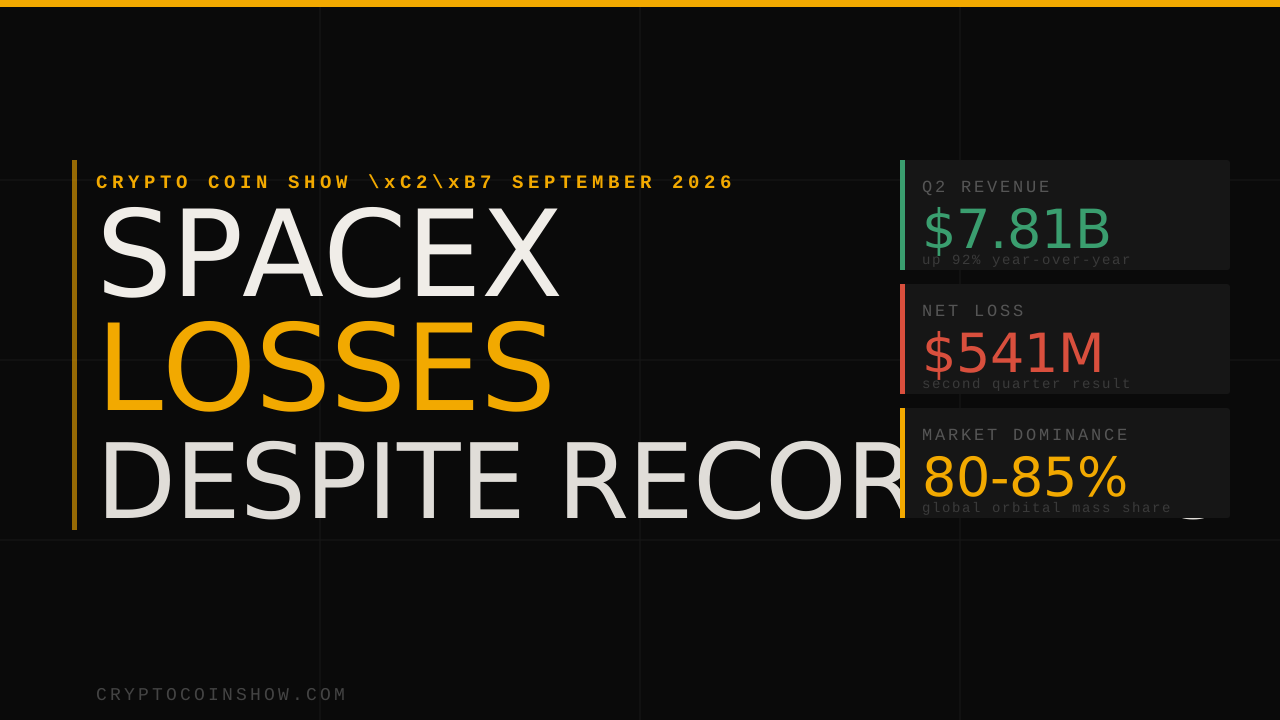
- SpaceX commanded 80 to 85 percent of global orbital mass in 2025, compared to China’s 8 to 10 percent market share.
- The company posted $7.81 billion in second-quarter revenue, up 92 percent year-over-year, but reported a $541 million net loss.
- Starship development has consumed over $15 billion to date, with the company targeting payload delivery capability in the second half of 2026.
- 80-85% SpaceX orbital mass share versus China’s 8-10 percent in 2025
- $7.81B Second-quarter revenue up 92 percent from prior year
- $15B+ Total Starship program spending through early 2026
SpaceX has emerged as the dominant player in commercial launch, accounting for the vast majority of payload mass reaching orbit as competitors lag significantly behind. The company’s market dominance, however, coexists with financial metrics that complicate the narrative of unqualified success.
Second-quarter results showed $7.81 billion in revenue alongside a $541 million net loss and $18.37 billion in quarterly capital expenditure, illustrating the steep investment curve required to maintain operational leadership and advance next-generation systems.
The tension between SpaceX’s operational achievement and its financial position has drawn public scrutiny from multiple quarters. Eric Trump recently defended the company’s performance metrics on social media, citing launch statistics and noting 165 successful Falcon flights with zero failures.
His intervention followed Bloomberg coverage characterizing SpaceX as “overpromising and underdelivering,” a charge that touches on Elon Musk’s broader track record of announcing milestones that require extended timelines or substantial capital revisions to meet.
SpaceX’s $541 Million Net Loss Masks Rapid Revenue Growth but Signals Profitability Challenges
The financial picture emerging from SpaceX’s latest reporting cycle presents a paradox: the company is scaling revenue at a 92 percent year-over-year clip while simultaneously burning cash at an accelerating rate. Second-quarter revenue of $7.81 billion marks substantial growth, yet the $541 million net loss in the same period demonstrates that top-line expansion has not translated into earnings.
Quarterly capital expenditure of $18.37 billion dwarfs operating revenue, a ratio that underscores the capital intensity of SpaceX’s business model and its dependence on external funding or retained earnings to finance operations.
The scale of capital consumption becomes clearer when viewed against the Starship program specifically. Development spending for Starship has reached $15 billion cumulatively, with $3 billion deployed in 2025 and nearly $900 million already spent in early 2026.
This trajectory suggests annual Starship expenditure will remain in the single-digit billions range unless the company accelerates development further.
For institutional investors accustomed to traditional aerospace or satellite operators, the cash burn profile is unusually steep and raises legitimate questions about the company’s access to capital and the timeline for achieving positive free cash flow.
SpaceX’s profitability challenge reflects the sequential nature of space industry economics: the company must achieve operational milestones before revenue models can mature. Starlink, which represents SpaceX’s primary near-term revenue diversifier beyond government contracts, remains incomplete.
Company executives stated that a planned Starlink upgrade will not become fully available to customers until approximately 1,000 new satellites enter orbit, a deployment that remains months away at minimum. Until that constellation is operational, Starlink cannot contribute proportionally to consolidated revenue, leaving SpaceX dependent on Falcon launches and government contracts.
Starship Program Faces Regulatory Hurdle Before Thirteenth Test Flight Can Proceed
SpaceX’s ambitious Starship program, central to the company’s long-term strategy and a key driver of current capital consumption, remains contingent on regulatory approval for its next developmental milestone. Company executives confirmed that the 13th Starship test flight requires clearance from federal authorities before launch can occur.
This gating factor introduces an element of timing uncertainty into the company’s execution roadmap and highlights the continued role of regulatory bodies in shaping SpaceX’s operational schedule.
The regulatory approval requirement reflects standing environmental and safety review protocols applicable to high-energy rocket tests, particularly at SpaceX’s Starbase facility in Texas.
While SpaceX has successfully navigated multiple test flights and received approvals for earlier Starship missions, each successive test brings increased payload and complexity, potentially extending review timelines.
The approval process, though typically measured in weeks or months rather than years, represents a potential constraint on SpaceX’s ability to execute on its stated development cadence and demonstrates that even operationally dominant companies remain subject to external gating mechanisms.
Looking beyond the immediate test campaign, SpaceX’s timeline for Starship achieving operational payload delivery remains extended. Company executives told investors they expect Starship to begin delivering payloads to orbit in the second half of 2026, a target now approximately 18 months away.
This milestone carries significance beyond engineering achievement: it marks the transition from development to initial revenue generation for Starship systems, a shift that could begin to justify the accumulated $15 billion investment and address questions about the program’s financial return on investment.
Until that milestone is reached, Starship spending will continue to compress near-term profitability without offsetting revenue contributions.
Extended Starship Timelines and Funding Requirements Test Investor Patience and Capital Access
The combination of aggressive capital spending, extended development timelines, and deferred revenue contributions from Starship and the Starlink constellation upgrade creates a distinctive risk profile for institutional investors monitoring SpaceX. The company faces mounting pressure to demonstrate that its capital intensity today will generate proportional financial returns in 2026 and beyond.
Delays in either Starship payload operations or Starlink constellation completion would compress profitability expectations further and potentially necessitate additional funding rounds or restructured timelines.
SpaceX’s ability to finance its current spending trajectory depends on multiple factors beyond operational execution. The company operates in a private capital environment where external investors, government contracts, and internal cash generation all contribute to funding.
Recent reporting on company valuations and funding discussions suggests investor appetite remains robust, but that appetite is not unlimited. Should development timelines slip materially or capital requirements exceed projections, SpaceX may face more rigorous investor scrutiny around capital efficiency and return horizons.
The broader context for institutional investors involves the emerging commercial space sector’s dependence on companies with access to extraordinary capital and willingness to absorb multi-year operating losses in pursuit of long-term market position.
SpaceX’s dominance in launch, while operationally evident, has not yet generated the financial returns or positive free cash flow that might justify valuation multiples applied to mature technology companies.
That transition, from market share leader to profitable operator, remains ahead of the company and will likely dominate investor conversations through 2026 as Starship and Starlink milestones either materialize or slip further.
The critical near-term catalyst for SpaceX’s financial narrative will be the 13th Starship test flight approval, expected within weeks, followed by the company’s ability to achieve the second-half 2026 target for initial payload operations and the timeline for full Starlink constellation deployment to 1,000 satellites. Institutional investors should monitor whether either milestone slips, and whether SpaceX’s next funding round, if required, occurs at a valuation that reflects revised profitability expectations or continued investor confidence in the company’s long-term competitive position.