
Payward launches first U.S.-regulated onchain perpetual futures via Hyperliquid
Payward seeks to launch U.S.-regulated onchain perpetual futures via Hyperliquid’s new HIP-3 framework, marking the first time American traders would access this market legally since its prohibition nearly a decade ago. The move tests whether institutional-grade compliance can coexist with blockchain settlement in derivatives trading.
- Bitnomial exchange and NinjaTrader Clearing will jointly operate HIP-3 perpetuals for U.S. clients under CFTC oversight
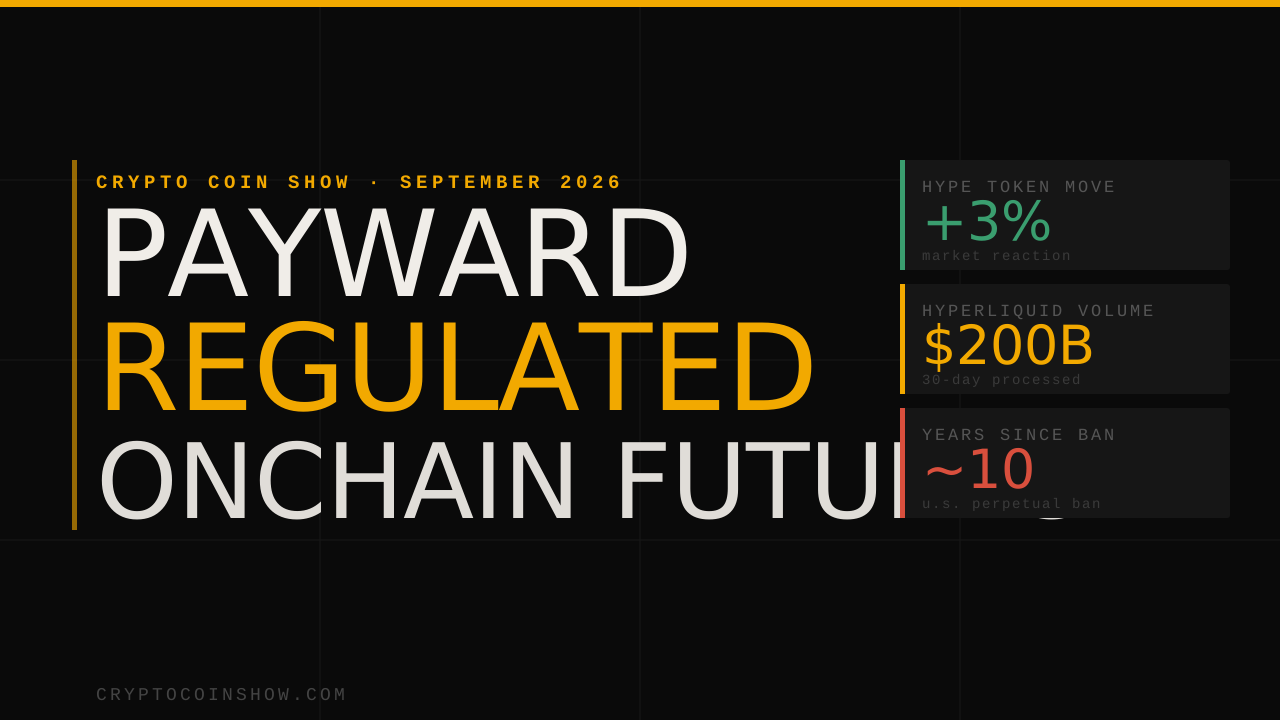
- HYPE token rose 3% on the announcement; Hyperliquid processed $200 billion in volume over 30 days
- Payward signals additional onchain products for U.S. clients pending regulatory approval, following this launch
- $85 trillion global perpetual futures trading volume in 2025 versus less than $1 trillion accessible to U.S. traders
- 3% HYPE token gain within hours of Payward’s announcement on September 16
- $200 billion Hyperliquid trading volume over 30 days, ranking it the most active onchain venue since 2023
Payward, the holding company behind Kraken, announced plans to become the first U.S.-regulated exchange offering onchain perpetual futures to American clients, according to first reporting on September 16. The product will launch on Hyperliquid, an onchain derivatives protocol, using the exchange’s newly introduced HIP-3 framework that enables permissioned markets on a public blockchain. Each trade executes and settles on Hyperliquid’s transparent order book, with regulatory custody and clearing handled through Payward’s existing CFTC-regulated infrastructure.
Bitnomial and NinjaTrader split custody and clearing of Hyperliquid perpetuals
Payward’s two regulated subsidiaries will divide operational responsibility. Bitnomial, a CFTC-regulated exchange and clearinghouse, runs the HIP-3 markets and manages all clearing and settlement. NinjaTrader Clearing, a registered futures commission merchant and NFA member, holds client accounts and handles onboarding. Only traders approved by both entities gain access to the contracts.
Jon Pham, Payward’s head of U.S. derivatives, explained the workflow: a U.S. client opens a futures account with Payward’s registered broker, then trades perpetual contracts on Hyperliquid using that account. The same clearinghouse already supports the crypto perpetuals Payward offers domestically, creating operational continuity.
HIP-3 allowlists permit Payward to run markets while preserving Hyperliquid’s decentralized base layer
Hyperliquid co-founder Jeffrey Yan introduced HIP-3 earlier this month as a permissioning feature letting market deployers create allowlisted trading venues on the protocol’s otherwise open infrastructure. The innovation lets regulated exchanges like Payward control access and enforce compliance without modifying the underlying blockchain or closing existing public markets.
Payward intends to be the first registered U.S. exchange to deploy builder-controlled perpetuals this way. The company handles both market operation and regulatory obligations, creating a novel hybrid: blockchain settlement with exchange-level governance. This structure sidesteps the traditional offshore-or-banned binary that has left American traders unable to access a market that generated $85 trillion in global volume during 2025, per CoinGecko’s 2026 State of Crypto Perpetuals Report.
Token and volume metrics surged immediately; regulatory approval still pending
HYPE, Hyperliquid’s native token, gained 3% within hours of the Payward announcement, while HYPE futures open interest on Binance increased 7% over the same window.
Hyperliquid has operated since 2023 and ranks as CoinGecko’s most active onchain perpetuals venue. Over the past 30 days, the protocol processed $200 billion in trading volume, demonstrating scale. Payward itself reported 6.6 million funded accounts as of June 30, 2026, with client assets backed by more than 100% in reserves according to an independent third-party audit.
The contracts would trade under Bitnomial Exchange LLC’s rulebook once regulators approve the structure; Payward has signaled that additional onchain products for U.S. clients are expected to follow.
The CCS read. We see this as Payward placing a regulatory bet that will determine whether compliance infrastructure can scale to onchain derivatives without becoming either stale or centralized. Approval signals that U.S. regulators view blockchain settlement as compatible with futures oversight. Rejection would reinforce the offshore-only assumption that has governed perpetuals since 2016.
The outcome hinges on CFTC sign-off of the Bitnomial and NinjaTrader dual-custody model. Payward has not named an expected approval date, but market moves in HYPE futures suggest institutional traders are already pricing in a favorable decision. Watch for any formal filing with the CFTC or a statement from either Bitnomial or NinjaTrader Clearing confirming the next regulatory checkpoint.