
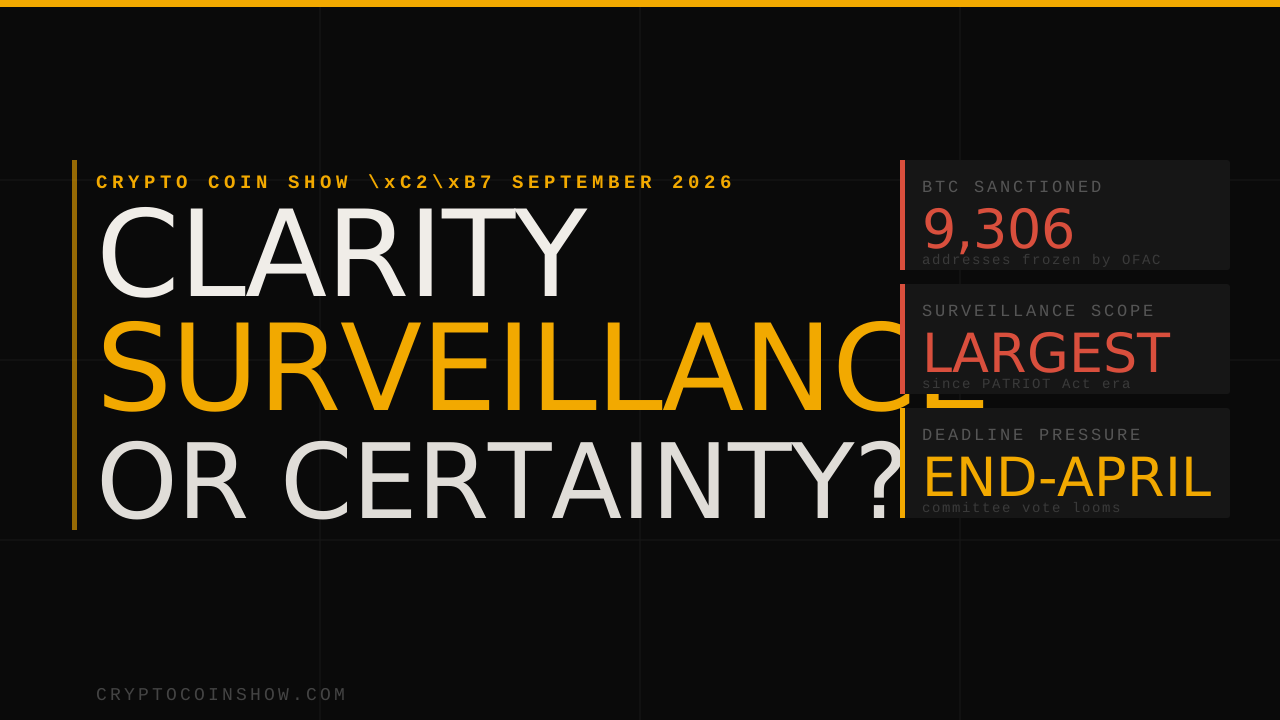
Is the CLARITY Act a surveillance bill in disguise?
The CLARITY Act, positioned as regulatory clarity for crypto, contains provisions that would represent the largest expansion of financial surveillance powers since the USA PATRIOT Act, according to Galaxy Digital’s research head, a trade-off that institutional investors must weigh against promised regulatory certainty. The bill’s committee deadline of end-April 2026 will determine whether it advances this year, making near-term advocacy and negotiation critical to institutional strategy.
- OFAC has sanctioned 518 Bitcoin addresses holding net 9,306 BTC worth $707 million currently.
- Alex Thorn warns CLARITY Act represents largest financial surveillance expansion since USA PATRIOT Act.
- Committee passage deadline is end of April 2026; failure to pass then means extremely low odds for 2026.
- 518 Bitcoin addresses sanctioned by OFAC historically, cumulative measure of enforcement reach.
- $707 million current value of OFAC-sanctioned address holdings compared to prior sanction volume.
- April 2026 committee deadline that determines odds of CLARITY Act passage this year.
The U.S. Senate has returned from recess to debate the Digital Asset Market CLARITY Act, a bill designed to establish long-overdue regulatory frameworks for cryptocurrency.
Yet the legislation has triggered sharp pushback from major institutional stakeholders, who argue that while it promises regulatory clarity, a demand the sector has voiced for years, it simultaneously hands the U.S. Treasury sweeping new surveillance and asset-seizure powers.
Galaxy Digital’s head of research, Alex Thorn, articulated the central tension in a January 2026 client note: the bill’s “fine print” would grant the Treasury capabilities comparable in scope to the post-9/11 expansion of financial surveillance embedded in the USA PATRIOT Act.
The stakes are material for institutional crypto investors evaluating market entry, compliance costs, and regulatory risk.
Treasury Surveillance Expansion Dwarfs Current OFAC Enforcement Reach
To understand the scope of the CLARITY Act’s surveillance provisions, Thorn conducted a detailed analysis of the Office of Foreign Assets Control’s (OFAC) existing enforcement footprint. Over its history, OFAC has sanctioned 518 Bitcoin addresses.
These addresses have collectively received 249,814 BTC, sent 239,708 BTC, and currently hold a net balance of approximately 9,306 BTC, worth roughly $707 million at current valuations. This inventory represents the cumulative result of years of case-by-case enforcement targeting specific illicit finance threats, from terrorist financing to sanctions evasion.
The CLARITY Act would not merely codify these existing powers; it would expand them substantially. Thorn notes that OFAC’s Specially Designated Nationals (SDN) list is only one tool in the Treasury’s current arsenal.
The bill introduces new mechanisms to intercept illicit assets, grant law enforcement “targeted tools to combat money laundering, terrorist financing, and sanctions evasion,” and establish compliance frameworks that extend beyond traditional financial institutions.
Supporters on the Senate Banking Committee argue these provisions are necessary to “crack down on illicit finance” while protecting software developers and promoting innovation.
However, the gap between stated intent and statutory language is where institutional concern crystallizes. The bill’s drafters have included what some call loopholes: a “Keep Your Coins Act” section prevents outright bans on self-custody, yet it contains carve-outs that still allow Treasury intervention in cases involving illicit finance.
For large asset managers and trading firms, this creates dual regulatory uncertainty: compliance requirements remain undefined, yet the potential for retroactive enforcement is amplified.
Broad Security Reclassification and DeFi Monitoring Requirements Create New Compliance Burdens
A second major institutional concern centers on the bill’s treatment of digital asset classification and decentralized finance oversight. The CLARITY Act automatically classifies new digital tokens as securities with virtually no statutory pathway to reclassification, a provision that Cardano founder Charles Hoskinson has criticized as stifling competition and innovation.
For investment firms evaluating emerging blockchain projects, this creates a regulatory straightjacket: any new token launch faces immediate securities law obligations regardless of its technical or economic characteristics.
The bill’s introduction of “Distributed Ledger Application Layers” language poses an additional compliance risk for institutional players that interface with DeFi protocols.
These provisions could force DeFi front-end operators and software applications to implement user-monitoring systems, effectively extending financial surveillance obligations into decentralized environments where they have historically been absent.
For hedge funds, market makers, and other institutional liquidity providers that route orders through DeFi interfaces, this creates operational friction and potential liability.
Hoskinson has warned that the legislation’s broad provisions could be exploited by future political administrations regardless of party affiliation, a concern that speaks to institutional risk management. If regulatory authority becomes politicized, the surveillance infrastructure embedded in the CLARITY Act could be weaponized against legal market participants during periods of ideological shift.
This structural risk is difficult to price into compliance budgets or hedging strategies.
Wall Street Lobbying and April 2026 Committee Deadline Will Determine Legislative Outcome
The bill’s current trajectory hinges on two competing forces: genuine industry demand for regulatory certainty, and institutional opposition to surveillance expansion.
Thorn warned in March that if the CLARITY Act does not pass committee by the end of April 2026, the odds of passage this year become “extremely low.” Reports indicate that negotiators are close to a deal on stablecoin yield frameworks, one of several outstanding technical hurdles, but substantial disagreement remains on surveillance scope and token classification.
Wall Street giants including JPMorgan Chase and Citadel are actively lobbying on the bill, though their specific positions, whether they favor or oppose particular provisions, remain partially opaque to public scrutiny.
For institutional crypto investors, the April deadline functions as a decision point. If the bill advances out of committee in the next sixty days, passage is likely and compliance planning becomes urgent. If negotiations stall and the committee deadline passes, industry participants gain another year of de facto regulatory flexibility while broader market structure evolves.
Neither outcome eliminates underlying uncertainty: passage triggers immediate compliance buildout; failure triggers continued political pressure for alternative legislation.
The next concrete development to monitor is the Senate Banking Committee’s stance on surveillance provisions and token classification language in the weeks leading to the April 2026 deadline. Institutional investors should track whether JPMorgan, Citadel, and other major lobbying participants publicly disclose their positions on these specific provisions, disclosure that would signal whether Wall Street firms view the surveillance framework as acceptable or plan active opposition. Charles Hoskinson and other blockchain foundation leaders have indicated they will submit formal testimony; the substance and reception of that testimony in committee will determine whether negotiators move toward compromise or whether ideological distance widens.