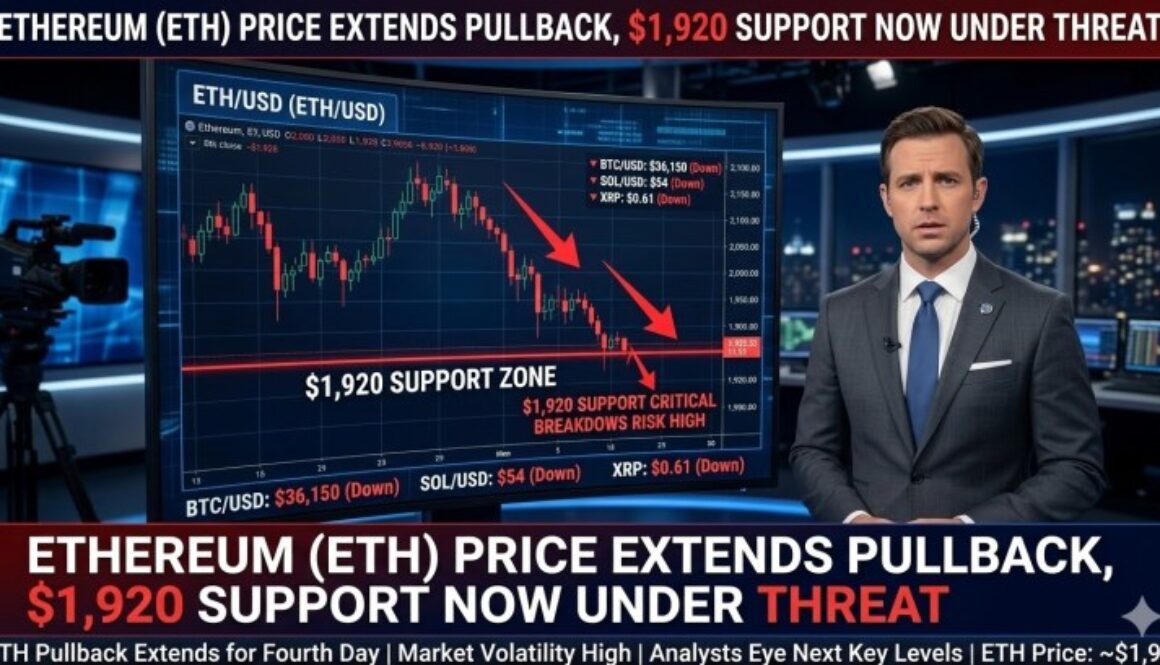
Ethereum Price Extends Pullback, $1,920 Support Now Under Threat
Ethereum has entered a notable correction phase, with the second-largest cryptocurrency by market capitalization struggling to maintain its footing above critical support levels. ETH has retreated below the $2,000 threshold, and analysts are now closely watching whether the $1,920 support holds as the ethereum price pullback extends deeper into technically vulnerable territory.
Current Market Positioning
The recent decline has broken through several key technical barriers that previously supported bullish momentum. Ethereum slipped below the $2,020 zone, where a significant bullish trend line had provided structural support on the hourly timeframe. This breach represents a shift in near-term sentiment.
The cryptocurrency has already tested levels as low as $1,912, marking a fresh intraday low. Currently, ETH is consolidating below the 23.6% Fibonacci retracement level, derived from the downward move spanning from the $2,200 swing high to the recent $1,912 bottom. This placement suggests the correction retains room to extend further.
The technical breakdown below the bullish trend line signals that near-term momentum has shifted materially.
— Technical Analysis, CCS
ETH is now trading beneath both $1,980 and the 100-hourly Simple Moving Average, two technical anchors that traders typically monitor for trend confirmation. The major support zone sits at $1,920, with secondary support levels positioned at $1,880 and $1,850.
Bull Case: Path to Recovery
If buyers step in and successfully defend the $1,920 support level, Ethereum could potentially initiate a recovery attempt. The immediate resistance target would be $1,980, a level that could act as a stepping stone for further upside momentum.
A decisive close above $2,020 would signal that the bulls have regained structural control. From there, the next meaningful resistance appears near $2,050, which aligns with the 50% Fibonacci retracement of the recent decline. Clearing this level would open the door toward $2,120.
In a sustained bullish scenario, Ethereum could eventually test its $2,200 resistance zone, with some analysts suggesting an extension toward $2,250 remains possible if momentum builds. However, this outcome requires swift reversal of the current bearish technical setup.
Bear Case: Deeper Decline Risks
The downside risk merits serious consideration. Should the $1,920 support fail to hold, Ethereum faces a cascade of lower support levels that could quickly become relevant. The $1,880 zone represents the first major defensive barrier below current prices.
A clean breakdown beneath $1,880 would likely accelerate selling pressure toward $1,850. Extended losses could push price discovery toward $1,810, with the $1,750 level serving as the principal support floor in a severe pullback scenario.
The hourly MACD has begun gathering momentum within bearish territory, while the Relative Strength Index (RSI) has declined below the neutral 50 level. These indicators suggest that selling pressure remains active and that oversold conditions have not yet materialized.
The combination of a broken trend line, moving average resistance, and negative technical indicators creates an unfavorable setup for bulls in the immediate term. Traders should remain cautious until evidence of renewed support emerges at key levels.
Industry Context and Smart Contract Evolution
Ethereum’s current price weakness occurs within a broader evolution of the smart contract platform ecosystem. As the dominant decentralized application layer, Ethereum processes billions in transaction volume daily across decentralized finance (DeFi), non-fungible tokens (NFTs), and governance protocols. The network’s technical infrastructure continues advancing through upgrades focused on scalability, security, and energy efficiency.
The cryptocurrency sector as a whole has experienced significant maturation over recent years, with institutional adoption expanding and regulatory frameworks gradually clarifying. This institutional participation has introduced more sophisticated trading dynamics and reduced reliance purely on retail sentiment. During correction phases like the current Ethereum pullback, institutional traders often employ systematic hedging strategies that can amplify technical breakdowns.
Ethereum’s position as the foundation for thousands of decentralized applications creates unique demand dynamics compared to Bitcoin. While Bitcoin functions primarily as digital store of value, Ethereum’s utility extends to powering economic activity across multiple blockchain-based ecosystems. This fundamental distinction means Ethereum corrections often reflect technical adjustments rather than fundamental deterioration in network utility.
Market Implications and Trading Volume Dynamics
The magnitude of Ethereum’s current pullback carries implications for the broader digital asset market. As the second-largest cryptocurrency by market capitalization—with aggregate value exceeding $250 billion—significant Ethereum movements influence sentiment across smaller altcoins and emerging blockchain platforms. Many projects built on Ethereum or competing smart contract networks experience amplified volatility during ETH corrections.
Trading volume patterns during this pullback will prove instructive for determining whether selling represents distribution from institutional holders or technical liquidations from overleveraged positions. High volume on the move below $2,020 would suggest conviction behind the sell-off, while declining volume might indicate exhaustion of selling pressure and potential reversal setup.
The decentralized finance sector, which locks tens of billions in Ethereum-based protocols, experiences particular sensitivity to ETH price action. Declining Ethereum prices can trigger liquidation cascades in leveraged DeFi positions, creating feedback loops that accelerate downward movements. Conversely, stabilization at key support levels often attracts new buyers seeking discounted entry points into the ecosystem.
Broader Context
Ethereum’s pullback follows weakness in Bitcoin and broader crypto markets, underscoring how the largest cryptocurrencies remain correlated during correction phases. The breakdown below $2,000 is particularly significant because round numbers often function as psychological barriers and attract algorithmic buying or selling.
Recent volatility has reminded participants that even digital assets with substantial on-chain utility and large developer ecosystems remain subject to technical retracements and sentiment shifts. The ethereum price action over the coming hours will likely determine whether this pullback represents a healthy consolidation or the beginning of a deeper corrective phase.
Market participants monitoring crypto price movements should pay close attention to volume metrics and whether selling volume increases as prices approach critical support levels. Light volume on breakdowns can sometimes signal exhaustion, while heavy volume confirms conviction behind the move.
The $1,920 support zone has become the critical battleground between bulls and bears in the short term.
— Market Analysis, CCS
Macroeconomic Factors and Risk Management
Broader macroeconomic conditions increasingly influence cryptocurrency price discovery. Interest rate expectations, inflation trends, and equity market performance create headwinds or tailwinds for risk assets including digital cryptocurrencies. During periods of rising rate expectations or equity market stress, investors often reduce exposure to volatile assets, creating additional selling pressure on altcoins like Ethereum.
Risk management becomes paramount during corrective phases. Traders maintaining leveraged positions face heightened liquidation risk as prices approach critical support levels. The use of stop-loss orders, while protective against catastrophic losses, can contribute to cascading liquidations during volatile moves, particularly in futures markets where leverage amplifies small price moves into significant account impacts.
Long-term investors evaluating accumulation strategies should consider that Ethereum’s fundamental metrics—including developer activity, transaction volume, and ecosystem growth—remain largely independent of short-term price corrections. Historical analysis suggests that major cryptocurrency corrections often represent accumulation opportunities for participants with conviction in underlying technology and adoption trajectories.
The next 24 to 48 hours will likely prove decisive for determining whether Ethereum stabilizes or extends its pullback further. Traders should monitor hourly closes above or below the major support and resistance levels outlined above, as these breakpoints typically precede larger directional moves.
For long-term holders, current weakness may present a potential accumulation opportunity if underlying fundamentals remain intact. The continued expansion of Ethereum’s developer community, increasing institutional participation in staking, and growing cross-chain interoperability initiatives suggest the network’s long-term trajectory remains constructive despite near-term price weakness.
For short-term traders, the bearish technical setup suggests maintaining a defensive posture until clear evidence of reversal appears. Trading discipline becomes essential during volatile correction phases, with pre-planned exit strategies and risk parameters proving more reliable than reactive decision-making based on intraday price fluctuations.
Get weekly blockchain insights via the CCS Insider newsletter.