Ethereum Price Inches Higher, Building Pressure for a Follow-Through
Ethereum price is navigating a critical recovery phase after failing to sustain gains above $3,220, with the digital asset now testing intermediate support levels as traders assess whether the recent pullback will reverse or deepen further.
Current Price Action and Technical Setup
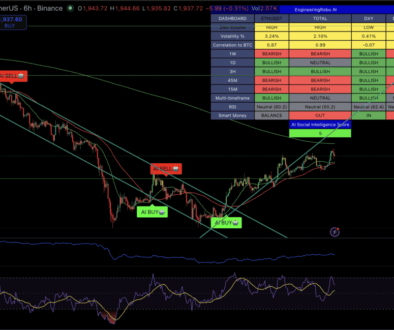
Ethereum encountered resistance at the $3,220 mark and subsequently declined below $3,200 and $3,120, triggering a corrective phase that brought ETH down to a low near $3,050. The cryptocurrency is currently consolidating losses around the $3,180 level, which sits below the 100-hourly Simple Moving Average.
A notable development on the hourly chart involves a break above a bearish trend line that previously capped gains near $3,100. This technical signal suggests some structural weakness in the downtrend, providing a potential foundation for recovery attempts in the near term.
The ability to hold support above $3,050 will be critical in determining whether Ethereum can mount a sustained recovery or faces additional selling pressure.
— CCS Technical Analysis
The price action has tested the 23.6% Fibonacci retracement level of the decline from the $3,308 swing high, a classical technical zone where buyers often enter positions. Traders are now watching to see whether this level provides sufficient support to launch the next leg higher.
The $3,050 level represents the most significant near-term support. A decisive break below this zone could trigger a test of $3,020 and potentially $3,000, opening the door to a more extended correction.
Market Context and Ethereum’s Strategic Position
Ethereum’s current price volatility occurs within a broader market environment marked by evolving sentiment toward decentralized finance, layer-2 scaling solutions, and institutional adoption of digital assets. As the second-largest cryptocurrency by market capitalization, Ethereum commands significant attention from both retail and institutional traders, with its price movements often setting the tone for alternative cryptocurrencies.
The Ethereum network continues to process substantial transaction volumes across decentralized exchanges, lending protocols, and NFT platforms. Staking rewards and the ongoing transition toward proof-of-stake consensus have created additional dynamics affecting token supply and demand. Layer-2 solutions like Arbitrum and Optimism have grown substantially, with billions in total value locked, though these developments exist somewhat independently from spot price action in the short term.
Regulatory clarity in major markets, particularly regarding how Ethereum may be classified as either a commodity or security, influences longer-term investor positioning. Recent developments in the United States and European Union regarding cryptocurrency frameworks have added layers of complexity to institutional adoption timelines, creating both uncertainty and opportunity for sophisticated market participants.
Upside Scenarios and Resistance Targets
Should Ethereum stabilize above $3,050 and push higher, the immediate resistance zone sits near $3,150. Breaking through this level would bring the $3,180 mark and the 50% Fibonacci retracement level into play as the next meaningful hurdle.
A sustained move above $3,180 would establish momentum toward $3,210, where substantial resistance has developed. Clearing this level appears necessary for Ethereum to challenge the $3,250 zone, which would represent a psychological and technical turning point.
If bulls can establish control above $3,250, the technical picture shifts meaningfully. In this scenario, Ethereum could advance toward the $3,300 resistance zone or even approach $3,320 in the coming days, reclaiming losses from the recent downturn and setting up potential continuation higher. Recovery to these levels would signal renewed buying interest from institutional participants and could attract fresh capital flows into the cryptocurrency.
The path toward these higher targets depends on sustained buying interest and the ability to hold intermediate support levels as the price climbs. For investors tracking Ethereum price movements, these technical levels provide important markers for evaluating the strength of any recovery attempt.
Scenario for Further Decline
Should Ethereum fail to clear $3,180 resistance, a fresh decline becomes the more probable outcome. Initial downside support appears near $3,080, though this may prove insufficient to halt selling momentum in a weaker market environment.
The $3,050 zone represents the first major support level. A clean break below this point would open the door toward $3,020, and potential further losses could extend toward the $3,000 psychological level, which has historically attracted strong buying interest. Extended declines could eventually test the $2,950 zone, representing an approximate 8 percent decline from current consolidation levels.
The technical indicator picture shows mixed signals, with momentum building in the bullish zone but the Relative Strength Index still positioned below the 50 midpoint, suggesting room for further gains but not overwhelming strength.
— CCS Technical Indicators
The MACD indicator is gaining bullish momentum, a positive development. However, the RSI remains below the 50 zone, indicating that buying pressure has not yet reached overbought conditions. This combination suggests Ethereum retains upside potential but without excessive froth that would warn of imminent selling.
MACD momentum is strengthening in bullish territory, while the RSI sits below 50, reflecting a recovery phase without excessive overbought conditions. This configuration typically precedes measured upside moves rather than explosive rallies.
Industry Implications and Market Drivers
Ethereum’s price trajectory carries implications for the broader cryptocurrency ecosystem and decentralized finance sector. Many DeFi protocols depend on Ethereum’s network effects and security, with governance tokens and application tokens frequently trading in correlation with ETH prices. A sustained recovery could reinvigorate development activity and user engagement across DeFi platforms.
Mining and staking operations represent significant constituencies with financial exposure to Ethereum prices. Network validators currently earn approximately 3-4 percent annual rewards on staked ETH, creating long-term holder incentives that typically provide price support during drawdowns. This structural difference from proof-of-work cryptocurrencies adds a stabilizing element to Ethereum’s valuation.
Enterprise adoption trends, particularly among traditional financial institutions building blockchain infrastructure, often follow crypto price momentum. Extended weakness could temporarily dampen institutional exploration of Ethereum-based solutions, while recovery momentum tends to attract development budgets and partnership announcements from major corporations.
Key Takeaways for Traders
Ethereum’s current positioning represents a classic consolidation pattern following a significant decline. The cryptocurrency has not yet proven it can sustain a meaningful recovery above the critical $3,180 resistance level.
Three critical price zones deserve close monitoring. First, the $3,050 support level must hold to prevent a broader retest lower. Second, the $3,180-$3,210 resistance cluster will determine whether the recovery has genuine follow-through. Third, a move above $3,250 would signal that the corrective phase has ended and a new advance is beginning.
Volatility remains elevated across crypto markets, and cryptocurrency price movements continue to reflect shifting sentiment regarding macroeconomic conditions and digital asset demand. Ethereum’s ability to establish a stable base near current levels will provide important guidance for the broader market.
For longer-term investors, the current weakness represents an opportunity to evaluate entry points near support zones. For active traders, maintaining discipline around the identified support and resistance levels remains essential, as false breakouts in either direction could generate whipsaws in choppy market conditions.
The coming 24-48 hours should clarify whether this recovery has the structural foundation to push toward higher resistance or whether additional consolidation or decline is more likely. Monitoring volume alongside price action will provide additional confirmation of buyer or seller conviction at critical junctures.
Keep tabs on crypto market news for developments that might shift the technical picture, as macro events can rapidly change trader positioning and override purely technical analysis. Understanding both the technical mechanics and fundamental drivers of Ethereum’s valuation will serve investors well through this volatile period.
Get weekly blockchain insights via the CCS Insider newsletter.