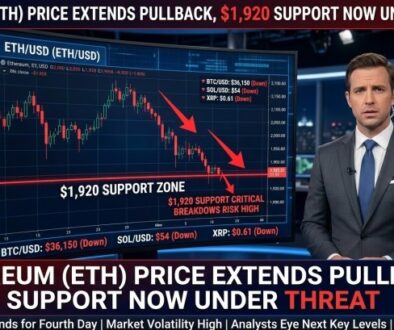
Ethereum Price Dumps To $2,700, Bulls Scramble To Defend Support

Ethereum has retreated sharply to test critical support levels after failing to sustain momentum above $3,050, with the digital asset now trading near $2,700 as sellers maintain control of price action. The 10% decline reflects broader weakness across major cryptocurrencies and signals that key technical barriers remain formidable obstacles for bulls attempting to establish a recovery.
Current Market Structure and Technical Setup
Ether’s decline accelerated after the asset failed to hold ground above $2,880, pushing through multiple support zones in rapid succession. The price has now settled below both the $2,800 level and the 100-hour simple moving average, a technical indicator that often guides short-term trader positioning.
On the hourly timeframe, a steep bearish trend line has formed with resistance positioned near $2,820. This technical barrier, combined with resistance at $2,860 (which aligns with the 50% Fibonacci retracement of the recent $3,040-to-$2,680 decline), creates a congested zone where bulls must establish conviction.
The technical setup presents a critical junction for Ethereum as price action consolidates near key support levels, with the direction of the next impulse move likely to determine sentiment in the near term.
— CCS Technical Analysis Desk
$2,700 (immediate), $2,680 (first major support), $2,620 (secondary support), $2,500 (primary support floor)
Bull Scenario and Upside Targets
If Ethereum manages to hold above $2,700, the technical picture could shift materially in favor of buyers. A consolidation and bounce from current levels would need to clear $2,765 as an initial hurdle before targeting $2,820.
Should bulls successfully breach the $2,820 trend line resistance, the path opens toward $2,860 and the 50% retracement level. Breaking through this zone would place $2,900 and the $3,000 psychological level directly in scope, potentially extending toward the recent $3,050 swing high.
The sustainability of any recovery depends heavily on volume participation and whether institutional positioning turns constructive. Read more on Ethereum price trends for detailed long-term analysis.
If $2,700 holds and buyers reclaim $2,820, Ethereum could test $2,900 and potentially challenge $3,050 resistance in the near term.
Bearish Risks and Downside Support
The downside case materializes if Ethereum fails to defend the $2,820 resistance and momentum remains weak. Initial support sits at $2,700, but a decisive breakdown would target the $2,680 zone where a recent low was established.
Should sellers push through $2,680, the $2,620 level becomes the next line of defense. Further deterioration would open exposure to $2,550, with the $2,500 level representing primary support on the daily timeframe. A sustained move below these major supports would signal a more significant technical breakdown requiring reassessment of the broader trend.
Monitoring volume during any move below $2,700 will be critical—elevated selling pressure on high volume would confirm weakness, while low-volume declines might represent capitulation that precedes reversal.
Indicator Signals and Momentum Assessment
Current momentum indicators reflect the recent weakness in Ethereum’s price action. The hourly MACD has begun to gain momentum within bearish territory, suggesting that downside pressure remains intact without clear evidence of reversal.
The hourly RSI has dipped below the 50 midpoint, a level that often marks the threshold between neutral and bearish readings. When RSI operates below 50, the technical advantage shifts to sellers, though readings are not yet at extreme oversold levels that typically precede sharp bounces.
These indicators align with the price structure, reinforcing the notion that buyers need to demonstrate clear intent by reclaiming technical resistance before a sustained recovery can be credible. View current cryptocurrency prices for real-time data across major assets.
Ethereum’s struggle mirrors weakness across the broader cryptocurrency market, with Bitcoin and other major digital assets experiencing similar pressure from profit-taking and shifting risk sentiment. The interconnected nature of crypto markets means that ethereum price action often reflects broader sentiment shifts rather than asset-specific developments.
Traders are watching whether this pullback represents a healthy consolidation within a longer uptrend or the beginning of a more significant correction. The technical setup over the next 24-48 hours should provide clarity on which scenario is unfolding.
For investors and active traders monitoring cryptocurrency market news, the key will be watching whether each bounce attempt finds buyers at higher levels or faces continued rejection at resistance zones.
Ethereum’s Role in the Broader DeFi Ecosystem
Ethereum’s price performance carries significance far beyond its standalone valuation. As the leading smart contract platform by market capitalization and ecosystem development, Ethereum serves as the backbone for decentralized finance (DeFi), non-fungible token (NFT) markets, and layer-two scaling solutions. The network hosts thousands of decentralized applications across lending protocols, automated market makers, and staking platforms that collectively secure over $50 billion in total value locked.
When Ethereum experiences significant price weakness, it often triggers ripple effects throughout the DeFi ecosystem. Users may face increased gas fees relative to their transaction values, reducing activity on less capital-intensive protocols. Additionally, collateral-based lending platforms like Aave and Compound experience margin call cascades when ETH prices drop sharply, as users who pledged Ethereum as collateral face liquidation if the underlying asset declines beyond their loan-to-value thresholds.
Institutional adoption of Ethereum has accelerated in recent years, with major asset managers and hedge funds incorporating the asset into cryptocurrency allocation strategies. Ethereum futures contracts on major exchanges like CME provide additional price discovery mechanisms and allow sophisticated traders to establish directional positions or hedge exposure. The current weakness has generated significant interest in spot accumulation among longer-term holders, suggesting potential support from fundamental conviction rather than purely technical bounces.
Industry Sentiment and Market Implications
Current market sentiment reflects uncertainty regarding macroeconomic conditions, regulatory developments, and the sustainability of digital asset valuations. The cryptocurrency industry has matured considerably over the past five years, with increasing correlation to traditional risk assets during market stress. This means that weakness in equity markets, rising interest rates, or negative news regarding inflation often translates directly into cryptocurrency price pressure.
Regulatory clarity remains a pivotal consideration for Ethereum’s longer-term outlook. The transition to proof-of-stake consensus in 2022 significantly reduced Ethereum’s energy consumption, addressing a major criticism from environmentally-conscious investors and policymakers. However, regulatory frameworks governing cryptocurrency exchanges, custodians, and decentralized finance platforms continue to evolve globally. Clear, supportive regulation could accelerate institutional adoption, while restrictive policies might limit growth prospects.
The competitive landscape for layer-one blockchains has intensified, with platforms like Solana, Polygon, and Avalanche offering alternative environments for decentralized application development. Despite this competition, Ethereum maintains network effect advantages through its established developer community, security reputation, and liquidity concentration. The success of layer-two scaling solutions such as Arbitrum and Optimism has also strengthened Ethereum’s position by addressing historical limitations around transaction throughput and cost.
Technical Recovery Catalysts and Risk Factors
Several catalysts could potentially reverse Ethereum’s current downtrend. Positive developments in institutional custody solutions, announcements of major enterprise adoption of DeFi protocols, or technical breakthroughs in scaling solutions could reignite bullish sentiment. Additionally, changes in macroeconomic conditions—such as moderating inflation data or shifts in Federal Reserve policy expectations—would likely support broader risk asset recovery including cryptocurrencies.
Conversely, downside risks include sustained macroeconomic headwinds, regulatory setbacks, major security incidents affecting prominent DeFi platforms, or technical failures in layer-two implementations. Market participants should monitor developments in these areas closely, as they could materially impact the probability of either upside or downside scenarios playing out.
Conclusion and Trading Implications
Ethereum’s current consolidation near $2,700 represents a critical inflection point that will likely define directional bias for the coming weeks. The technical setup strongly suggests that the next significant move will emerge from either decisive strength above $2,820 or weakness below $2,680, with intermediate range-bound action potentially characterizing the near term.
For traders operating across different time horizons, the current environment offers distinct challenges and opportunities. Short-term traders should maintain disciplined risk management around key technical levels, recognizing that momentum indicators suggest weakness remains in control. Medium-term investors face a decision point: whether to accumulate on weakness based on long-term conviction regarding Ethereum’s utility and adoption, or to await clearer confirmation of recovery momentum before establishing or expanding positions.
The broader context surrounding Ethereum—including its fundamental role in the DeFi ecosystem, improving scalability infrastructure, and institutional adoption trajectory—suggests that periods of weakness may present accumulation opportunities for investors with appropriate time horizons and risk tolerance. However, near-term technical analysis clearly indicates that confirmation of support and reversal patterns remains essential before committing fresh capital with conviction. The coming 24-48 hours will be critical in determining whether Ethereum establishes a foundation for recovery or continues deteriorating toward lower support levels.
Original reporting: newsbtc.com
Get weekly blockchain insights via the CCS Insider newsletter.