
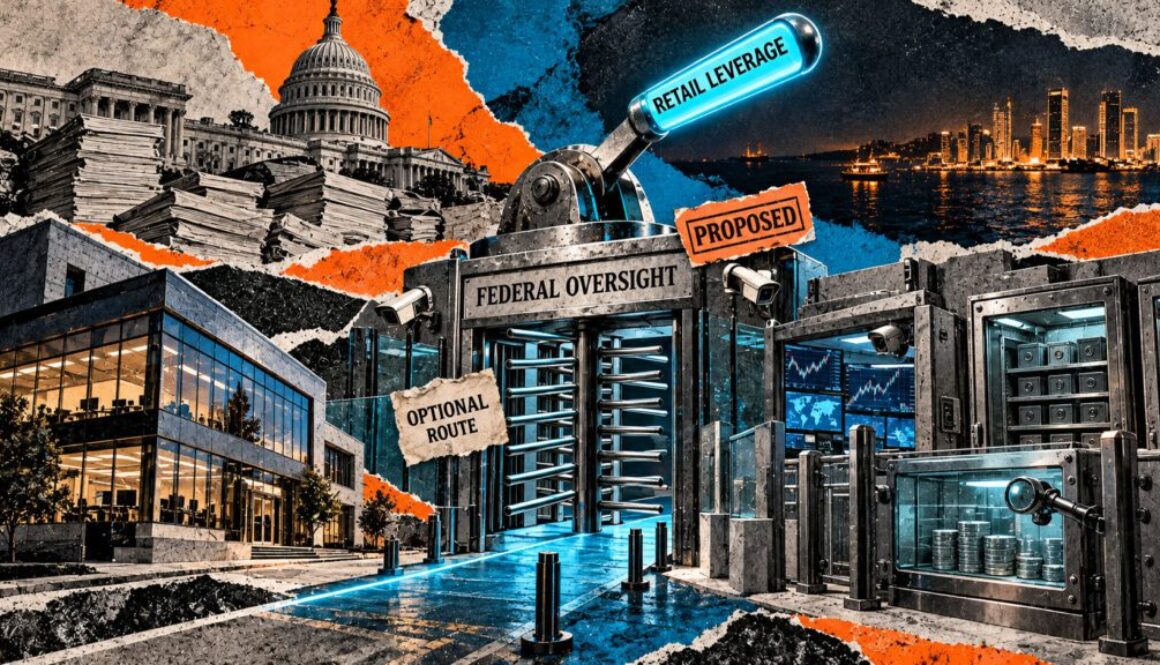
CFTC opens rulemaking for retail crypto leverage to compete with offshore trading
The CFTC has opened rulemaking for a federal framework allowing US crypto exchanges to offer retail leverage and margin trading, the largest regulatory incentive yet to repatriate trading from offshore venues. The move tests whether access to leveraged products can persuade platforms to accept deeper federal oversight without waiting for Congress to pass comprehensive spot-market legislation.
- CFTC published an Advanced Notice of Proposed Rulemaking on October 5 to establish Regulation Crypto Asset Transactions (CTX) and Regulation Crypto Asset Markets (CAM)
- Federal registration would allow crypto exchanges to offer retail leveraged and financed trading under new rules, while maintaining state licensing for ordinary spot activity
- The framework leaves unresolved leverage limits, capital standards, and how intermediation through futures commission merchants could reshape exchange custody and brokerage models
- 28 days Deadline for transfers to customer wallets to satisfy commodity exchange delivery exception for certain transactions
The Commodity Futures Trading Commission published an Advanced Notice of Proposed Rulemaking on October 5 designed to create a national framework for retail crypto leverage. The framework would sit alongside existing state money-transmitter licensing and the CFTC’s existing designated contract market regime for derivatives, creating what the agency describes as a “uniform national regulatory framework” for platforms offering margined, leveraged, or financed transactions in crypto assets. Participation is voluntary: the CFTC acknowledged it lacks congressional authority to compel platforms onto federally regulated venues. The real incentive is access to leveraged products, historically the domain of offshore exchanges, that state licensing alone does not permit.
CFTC ties leverage to FTX-era safeguards and proof of reserves
CFTC Chairman Michael Selig framed the initiative as a direct response to FTX’s bankruptcy, emphasizing preventive safeguards over post-hoc enforcement.
The lesson from FTX’s failure should have been obvious. A person should not have to register as an introducing broker simply because that person shipped code.
Michael Selig, CFTC Chairman Platforms choosing to offer leveraged retail crypto trading under CAM would face requirements governing financial integrity, surveillance, conflicts of interest and operational safeguards, the same core obligations that apply to designated contract markets for futures. The agency is also considering crypto-specific criteria: exchanges would need to assess token concentration, distribution methods, vesting schedules, lockups, programmatic issuance and buybacks when determining whether an asset can be traded without appearing readily susceptible to manipulation.
Proof-of-reserves requirements would apply to exchanges holding customer property in omnibus accounts, a safeguard Selig directly linked to risks FTX exposed.
Customer trades routed through registered futures commission merchants would bring accounts under capital, disclosure and segregation requirements, plus Bank Secrecy Act obligations including anti-money laundering controls, customer identification and suspicious-activity reporting.
That structural requirement carries real cost: FCM intermediation could force platforms to separate exchange operations from brokerage and custody functions, a vertical integration that many crypto venues have relied on. Whether major US exchanges view leverage as valuable enough to accept that trade-off remains the central economic question the framework does not resolve.
Three regulatory paths create ladder, but leverage limits still undefined
The CFTC is relying on Section 2(c)(2)(D) of the Commodity Exchange Act, which authorizes regulation of certain leveraged retail commodity transactions.
The resulting structure would create three distinct paths: ordinary spot exchanges could remain under state licensing supplemented by the CFTC’s existing anti-fraud authority; platforms offering leveraged or financed retail crypto transactions could register under the new CTX/CAM framework; and venues offering futures, perpetuals and other derivatives would continue under the existing designated contract market regime.
Hyperliquid Policy Center said the structure could give market participants a clearer regulatory ladder, with state licensing covering ordinary spot activity, federal CFTC oversight applying where leverage is introduced, and the existing derivatives framework covering futures and perpetual contracts. The proposal directly addresses one of the largest product gaps between US exchanges and offshore rivals: leveraged trading and perpetual contracts have historically driven volumes on offshore venues and generated substantial trading economics unavailable to US platforms under current constraints.
Critical details remain unspecified in the ANPRM. The agency is seeking comment on leverage limits, capital standards, custody models, and the extent to which FCM intermediation would reshape existing exchange business structures, leaving market participants without clarity on the precise regulatory cost of entry.
CFTC signals developer protection, but onchain market boundaries unclear
The CFTC also began defining where decentralized venues and software developers fit within federal commodities law. Selig said the agency is considering how to treat developers who publish software without taking customer orders, controlling execution or holding customer assets. The CTX proposal would clarify the Commodity Exchange Act’s “actual delivery” exception by treating transfers to a customer’s non-custodial external wallet within 28 days as generally satisfying the exemption from exchange-trading requirements for certain leveraged retail commodity transactions. That protection applies only to retail spot leverage under the delivery exception, not to derivatives or centralized venues.
The agency is consulting developers about where control resides in onchain venues and when software activity begins to resemble regulated financial intermediation. That question touches the architecture of decentralized exchanges and automated market makers, but the CFTC has signaled it will not require registration simply for publishing code.
The framework thus extends implicit protection to developers while the agency continues consulting on the boundary between software and intermediation.
The October 5 action is an advance notice seeking public comment; detailed rules governing leverage, asset eligibility, custody and intermediary requirements remain unwritten.
The CCS read. We see the CFTC testing a straightforward hypothesis: that leverage access alone can repatriate trading volume from offshore to regulated US venues without congressional action. That bet depends on major exchange economics, whether the revenue gains from offering leveraged products outweigh the cost of FCM intermediation and vertical separation. Institutional custody and flow providers now face a question the source does not resolve: whether the new framework’s reserve and segregation requirements will offer better protection than current state licensing, or whether offshore margins remain structurally cheaper.
The next critical step is the comment period, during which major US exchanges, offshore platforms, futures commission merchants and developers will signal whether they view the framework as a viable path to federal registration. If major platforms decline to participate because leverage gains do not justify FCM intermediation costs, the CFTC will face its central unresolved challenge: whether regulatory framework design alone can compete with the structural economics that have kept trading concentrated offshore. Comments are due 60 days from Federal Register publication; watch whether Coinbase, Kraken or other major venues file support or flag specific requirements as prohibitive.