
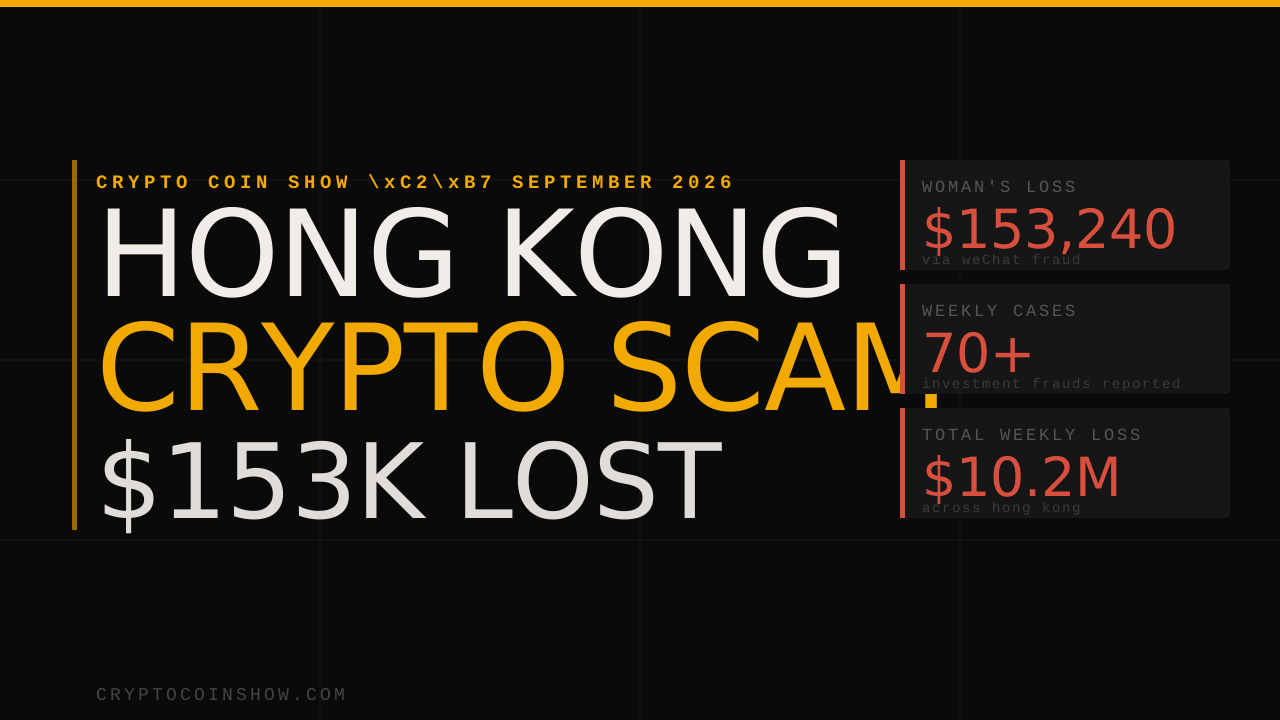
Hong Kong woman loses $153,240 in WeChat crypto scam
A Hong Kong woman lost $153,240 to a cryptocurrency investment scam orchestrated entirely through WeChat, part of a sharp surge in crypto-targeted fraud across the territory that saw over 70 cases and $10.2 million in losses reported in a single week. The incident exposes how fake trading platforms and AI-augmented social engineering have made retail crypto investment targets increasingly vulnerable to coordinated theft schemes that exploit the irreversibility of blockchain transactions.
- Woman in her 40s lost HK$1.2 million, equivalent to four years of her salary, to WeChat-based cryptocurrency scammer over 50 days
- Hong Kong police reported 70+ online investment fraud cases in one week with combined losses exceeding HK$80 million or US$10.2 million
- About 60% of cryptocurrency wallet deposits now flow to scammers using AI tools, up sharply from 2024 baseline levels
- HK$1.2M Amount lost by single victim, equivalent to four years of salary
- 70+ Online investment fraud cases reported to Hong Kong police in one week
- 456% Year-over-year rise in generative AI-powered scam reports May 2024 to April 2025
Hong Kong police released details Monday of a cryptocurrency investment fraud that extracted HK$1.2 million from a woman in her 40s through a carefully orchestrated scheme that relied on fake portfolio displays and false profit promises.
The victim met an individual on WeChat who presented himself as a cryptocurrency investment specialist, then guided her to open an account on a fabricated website designed to display illusory gains.
Over approximately 50 days, the woman watched her portfolio appear to grow, creating the impression of legitimate returns that convinced her to send multiple payments to bank accounts and cryptocurrency wallets controlled by the perpetrator.
The scammer employed a standard pressure tactic: demanding additional deposits as a prerequisite for withdrawal. When the victim attempted to access her supposed gains, she discovered the price charts were entirely fabricated and that the scammer maintained complete control over all displayed figures.
The loss represented four years of the victim’s salary, making it a catastrophic financial blow for a middle-income earner.
Hong Kong police data reveals 70-case fraud wave in single week as crypto scams accelerate
The individual case is not isolated. Hong Kong authorities reported receiving more than 70 online investment fraud complaints within a single week, with cumulative losses exceeding HK$80 million. This concentration represents an operational surge in social engineering attacks targeting retail investors, particularly those with limited cryptocurrency market experience.
Romance fraud cases have risen 8.2% year-over-year, from 1,010 reported incidents in 2024 to 1,093 cases in 2025, according to data released through the Hong Kong police CyberDefender platform.
In a parallel case, a woman in her 50s lost HK$31 million, the largest single-victim theft reported locally, after a scammer impersonated a prospective tenant on a property listing platform, then directed her toward fake cryptocurrency investments. The pattern reveals how perpetrators exploit multiple social platforms sequentially, building apparent legitimacy before pivoting to financial fraud.
Scammers typically initiate contact through messaging applications and peer-to-peer trading sites, establishing rapport through consistent daily communication before distributing links to counterfeit investment platforms and requesting transfers to unaffiliated bank accounts and wallets.
The cryptocurrency channel remains attractive to perpetrators because transactions settle rapidly, prove difficult or impossible to reverse, and typically operate outside conventional consumer protection frameworks.
Chainalysis data shows 60% of crypto deposits now route to AI-assisted scammers
Cryptocurrency-specific fraud has intensified substantially due to the integration of artificial intelligence tools into scam operations. Chainalysis research indicates that approximately 60% of all deposits flowing into cryptocurrency wallets now proceed to scammers employing AI capabilities, a significant escalation from prior-year baselines.
This shift has accelerated fraud velocity by automating social engineering messaging, personalizing phishing campaigns, and generating synthetic media used to impersonate legitimate investment professionals.
TRM Labs data corroborates this trend, showing a 456% increase in generative AI-powered scam reports between May 2024 and April 2025. The technology has enabled individual perpetrators to scale operations that previously required teams, while simultaneously degrading detection because AI-generated communications pass basic authenticity filters that might catch lower-effort fraud attempts.
Fake trading platforms and portfolio dashboards, the specific attack vector used against the Hong Kong victim, remain ubiquitous across the fraud ecosystem. These websites display professional design elements and real-time price fluctuations, creating surface-level legitimacy that satisfies retail investor due diligence expectations.
However, the operator controls every metric displayed on-screen, generating fabricated gains specifically calibrated to build confidence before triggering withdrawal demands that expose the scam.
Cryptocurrency’s irreversibility and regulatory arbitrage make it ideal for criminal cash extraction
The shift toward cryptocurrency-denominated scams reflects structural properties of blockchain that distinguish it from traditional financial channels. Once a victim sends cryptocurrency to a wallet address, the transaction becomes effectively immutable, even law enforcement typically cannot reverse transfers or freeze accounts held by private key holders.
This contrasts sharply with banking systems, where transactions can be disputed, reversed, or frozen through regulatory intervention.
Additionally, most cryptocurrency transactions occur in jurisdictions with minimal consumer protection regulation and weak know-your-customer enforcement on receipt wallets. A victim in Hong Kong who loses funds to a WeChat scammer has little regulatory recourse, since the funds typically route through exchanges or mixing services in jurisdictions with limited cooperation frameworks.
This arbitrage between strict consumer protections in developed markets and minimal oversight in crypto-friendly jurisdictions creates a structural vulnerability that criminals exploit systematically.
Hong Kong authorities face mounting pressure as fraud reporting accelerates despite enforcement efforts
The surge in reported fraud cases, and particularly the concentration of complaints within single-week windows, suggests that police resources face significant strain. The CyberDefender platform, which serves as the public reporting channel, has published warnings and educational content, yet incident velocity continues rising.
This gap between awareness campaigns and fraud rate trends indicates that victim education alone has proven insufficient as a countermeasure.
International regulatory coordination presents an additional obstacle. Perpetrators frequently operate across multiple jurisdictions, with the actual account holder in one country, the fake platform hosted in another, and the receiving wallet address controlled from a third.
Hong Kong authorities cannot unilaterally freeze assets held by non-residents in foreign exchanges or decentralized finance protocols, limiting their capacity for asset recovery even after cases are solved.
The Hong Kong Police CyberDefender unit has not yet announced specific new enforcement initiatives or prosecution details following the recent surge in complaints, leaving unclear whether authorities plan heightened cooperation with cryptocurrency exchanges to trace deposits or pursue criminal charges against cross-border perpetrator networks. Watch for updated guidance from Hong Kong authorities on whether they will mandate enhanced identity verification on local cryptocurrency platforms, or whether they will seek assistance from Interpol or regional law enforcement bodies to identify and prosecute the scammers behind the 70+ cases reported this week.