
KB Financial Group tests KRW stablecoin for payments and remittances
South Korea’s largest bank has successfully tested a won-denominated stablecoin for domestic payments and cross-border remittances, cutting transfer costs by 87% and settlement times from days to three minutes. The pilot signals institutional adoption of blockchain rails by major financial incumbents seeking to compete with faster, cheaper alternatives to legacy banking infrastructure.
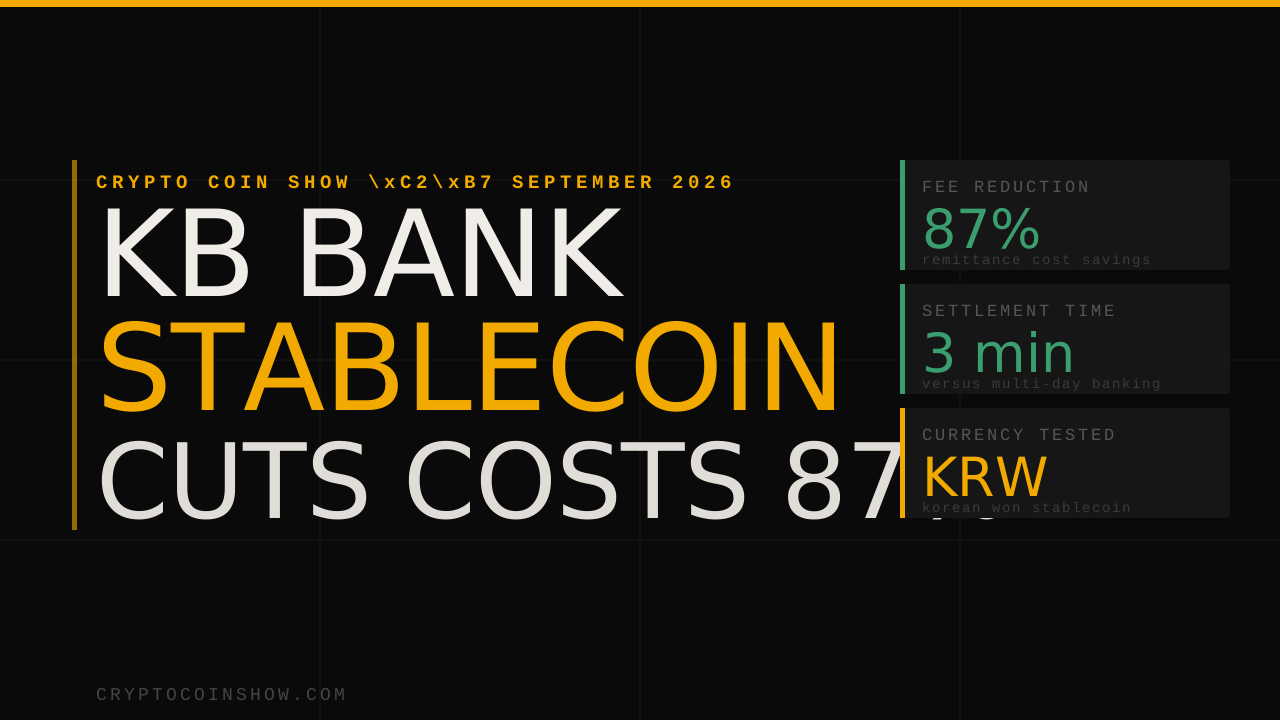
- KB Financial Group completed a KRW stablecoin pilot on the Kaia blockchain, reducing remittance fees by 87% and transfer times to 3 minutes versus multi-day traditional banking settlement.
- The test converted Korean Won stablecoins to Dollar stablecoins via Kaia’s on-chain liquidity, then settled to a Vietnamese bank account, demonstrating cross-border infrastructure viability.
- South Korea’s largest banks, KB Kookmin and Shinhan Card, are now actively testing stablecoin rails, signaling systemic shift toward blockchain-based payment infrastructure among regulated financial incumbents.
- 87% Cost reduction in remittance fees during KB Financial’s stablecoin pilot versus traditional banking channels
- 3 minutes Settlement time achieved in cross-border transfer test, compared to multi-day traditional international wire transfers
- $266.7 billion Total assets of KB Kookmin bank, establishing scale and institutional credibility of test participant
KB Financial Group, parent of KB Kookmin, South Korea’s largest bank with 584.9 trillion won ($266.7 billion) in assets, completed a proof-of-concept stablecoin pilot on May 17 that addressed the full lifecycle of digital currency issuance, payments, and settlement within an integrated framework.
The test, conducted in collaboration with payment processor KG Inicis, the Kaia blockchain network, and digital asset infrastructure provider OpenAsset, demonstrated both offline retail payments and international remittances using a won-denominated stablecoin.
Unlike speculative cryptocurrency experiments, this pilot targeted practical banking use cases: point-of-sale transactions at Holly’s coffee franchise locations in Seoul processed via QR code, and verified cross-border remittances to Vietnam.
KB Financial Cuts Remittance Costs by 87% Using On-Chain Liquidity Conversion
The most significant operational finding from KB’s pilot was the dramatic reduction in cross-border remittance friction. The test converted Korean Won stablecoins into Dollar stablecoins using Kaia’s on-chain liquidity pools, then settled the dollar-denominated value into a Vietnamese bank account through a local partner institution.
This flow eliminated several inefficiencies inherent in traditional SWIFT-based transfers: pre-funding requirements, correspondent bank fees, and multi-day settlement windows. According to local reports, the pilot achieved an 87% cost reduction compared to legacy remittance channels and collapsed settlement time from multiple days to just three minutes.
For institutional investors, these mechanics matter because they expose the fundamental economics driving traditional banks toward blockchain rails. Cross-border remittances generate substantial fee income for banking incumbents but deliver poor user experience and high friction costs.
Stablecoin-based alternatives bypass correspondent banking networks entirely, settling directly between on-chain liquidity pools and regulated bank accounts. This architectural simplification, removing intermediaries rather than adding layers, is why financial institutions view stablecoins differently than speculative tokens.
KB’s use of Kaia, a public blockchain, rather than a proprietary or permissioned network, also signals institutional comfort with transparent, auditable settlement infrastructure.
The protocol’s liquidity pools enabled direct conversion without requiring KB to maintain pre-funded accounts in multiple jurisdictions, a structural advantage over legacy banking corridors where inefficiency often stems from the cost and complexity of maintaining 24-hour liquidity coverage.
South Korea’s Banking Sector Accelerates Stablecoin Testing Amid Regulatory Clarity
KB Financial’s pilot is not an isolated experiment but part of a broader acceleration among South Korea’s largest financial institutions. Shinhan Card, one of the country’s largest credit card companies, signed a memorandum of understanding with the Solana Foundation in late April to test stablecoin payments infrastructure.
These parallel initiatives from multiple systemically important financial institutions suggest regulatory confidence rather than regulatory ambiguity.
South Korea’s Financial Services Commission and Financial Supervisory Service have signaled openness to bank-led stablecoin experiments within defined guardrails, creating space for pilots that would face immediate regulatory friction in other jurisdictions.
The institutional adoption pattern reflects how stablecoins are reshaping Asia’s payments landscape. Banks across the region are prioritizing stablecoin-based settlement infrastructure capable of processing transactions in less than one hour, a dramatic improvement over traditional banking rails that typically require two to five business days for international transfers.
The economic case is straightforward: stablecoins reduce settlement costs, eliminate pre-funding requirements, and enable 24/7 liquidity management rather than constraining banks to legacy T+2 or T+3 settlement cycles.
For institutional investors and market participants, this matters because it establishes a new competitive dynamic. When the largest banks in a major economy simultaneously test blockchain-based payment infrastructure, regulatory approval and commercial deployment become less questions of technology adoption and more questions of timing and market coordination.
South Korea’s approach, permitting large incumbents to pilot stablecoins on public blockchains under defined supervision, may accelerate adoption timelines relative to jurisdictions pursuing purely permissioned or central bank digital currency (CBDC) models.
Holly’s Coffee QR Payment Test Validates Offline User Experience for Retail Adoption
Beyond remittances, KB’s pilot included an offline payment component that addressed a critical adoption barrier: ease of use for merchants and consumers without technical expertise. Holly’s, a Seoul-based coffee franchise, conducted point-of-sale tests allowing customers to pay via QR codes without installing cryptocurrency wallets or managing private keys.
This detail matters more than it initially appears. Most stablecoin and blockchain adoption narratives assume users will embrace new technology because it is superior; in practice, retail adoption depends on parity or superiority in user experience relative to existing payment methods.
QR-based offline payments, already familiar from mobile payment apps like Alipay and WeChat Pay, remove the technical friction that has historically constrained blockchain payment adoption.
The test architecture suggests KB Financial approached the problem with institutional discipline: define the use case first (retail payments at scale), then design the technology to serve it rather than forcing users to adapt to blockchain primitives.
This methodology contrasts sharply with earlier cryptocurrency payment experiments that asked users to adopt unfamiliar interfaces and wallet management practices. By leveraging QR codes and existing point-of-sale infrastructure, KB reduced adoption friction to near zero.
This approach also reveals how stablecoins differ economically from both cryptocurrencies and traditional digital payments. A merchant using Holly’s accepts stablecoin payments backed by 1:1 reserve backing and regulatory guardrails, not speculative tokens whose value fluctuates against the Korean Won. Settlement occurs in minutes to bank accounts, not in hours or days.
The economic incentive for merchants becomes adoption of slightly new payment infrastructure that improves settlement speed and reduces fraud risk, rather than speculative bet-taking on cryptocurrency appreciation.
KB Financial’s Official Roadmap Points Toward Commercial Deployment by Year-End
Following the pilot’s successful completion, a KB Financial Group official stated: “We will do our utmost to provide lifestyle-oriented digital financial services that customers can experience in their daily lives by combining blockchain technology with financial infrastructure based on verified stability and trust.” The language signals intent to move beyond pilots toward productization.
Phrases like “daily lives” and “experience” indicate KB is framing stablecoins not as experimental financial engineering but as consumer-grade infrastructure comparable to existing mobile payment apps.
The timeline remains undefined in public statements, but the completion of end-to-end pilot testing, covering issuance, payments, settlement, cross-border transfers, and retail point-of-sale, typically precedes commercial launch by 6 to 18 months.
KB Financial must now navigate regulatory approval for production deployment, coordination with Vietnam and other remittance destination countries to ensure banking partner participation, and integration with its existing retail banking infrastructure. Each step requires regulatory sign-off but no longer requires proof of concept validation.
For institutional investors monitoring blockchain adoption in traditional finance, KB’s next move will be whether it deploys the stablecoin as a closed-loop payment system (only KB customers) or opens it to other Korean banks and fintech platforms.