
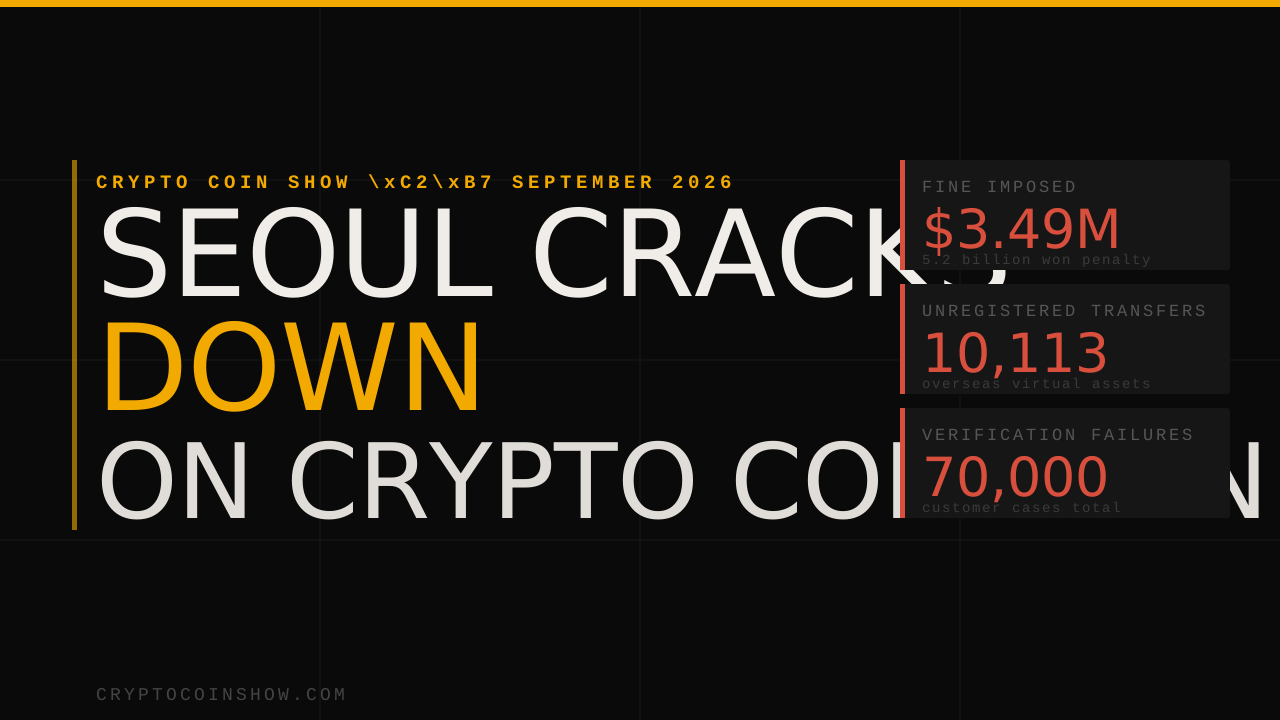
South Korea’s FIU hands Coinone exchange a $3.49 million fine over AML breaches
South Korea’s Financial Intelligence Unit has fined Coinone 5.2 billion won ($3.49 million) and imposed a three-month partial suspension for systematic anti-money laundering failures, marking the second major exchange sanction in two months and signaling intensified regulatory enforcement that will reshape compliance costs across the region’s crypto infrastructure.
- Coinone facilitated 10,113 unregistered overseas virtual asset transfers and failed to verify customers in approximately 70,000 cases total.
- Three-month partial suspension begins April 29, 2025, blocking new customer deposits and withdrawals but allowing existing users to trade normally.
- FIU action follows near-identical March sanction against rival Bithumb, suggesting sustained regulator focus on AML compliance across South Korean exchanges.
- 5.2B won Fine amount equivalent to $3.49 million USD at current rates
- 70,000 Total customer verification failures spanning ID checks and transaction restrictions
- 30% Share of Korean virtual asset market transaction volume from automated trading programs
South Korea’s Financial Intelligence Unit confirmed enforcement action against Coinone on April 29, 2025, imposing a fine of 5.2 billion won alongside a three-month partial business suspension for violating the Specific Financial Information Act.
An on-site FIU inspection conducted between April and May 2025 uncovered the exchange had processed approximately 10,113 virtual asset transfer transactions with 16 overseas operators that lacked proper registration or reporting documentation.
The regulator identified systemic deficiencies across customer due diligence, with Coinone failing to verify users in roughly 70,000 separate cases, including 40,000 improper identity verifications and 30,000 instances of allowing transactions from unverified accounts.
Coinone’s Three-Month Suspension Blocks New Customer Onboarding While Protecting Existing Trading
The partial suspension structure imposed by the FIU creates an asymmetric impact on Coinone’s user base. New customers cannot deposit or withdraw virtual assets during the three-month restriction period, effectively freezing the exchange’s ability to expand its customer base until late July 2025.
Existing customers retain full trading access and continued fiat currency services, preserving some revenue streams but narrowing Coinone’s growth runway substantially during a critical market period.
This enforcement approach differs from complete shutdowns imposed in other jurisdictions and reflects South Korea’s regulatory preference for targeted remediation rather than market exit. The FIU also issued a formal reprimand to Coinone CEO Cha Myung-hoon, personalizing accountability within the exchange’s leadership structure.
Coinone’s public response acknowledged the decision and stated the company is “strictly aware” of the violations and pursuing improvements to address identified deficiencies.
The exchange has not yet decided whether to pursue an administrative lawsuit, stating it will conduct a board-level review before determining next steps.
Bithumb’s March Suspension Establishes Pattern of Escalating Compliance Enforcement
The Coinone action follows near-identical enforcement against Bithumb, South Korea’s largest exchange, which received a six-month partial suspension in March 2025 for comparable AML violations. The sequential timing and similar sanction structure suggest the FIU has shifted from isolated enforcement actions to sustained, systematic review of major exchange operators.
Two major competitors facing suspensions within two months signals institutional investors that compliance deficiencies are widespread enough to trigger coordinated regulatory response across the sector.
The distinction between Coinone’s three-month and Bithumb’s six-month suspension likely reflects the severity or recency of violations at each exchange. Bithumb’s longer restriction period may indicate more entrenched compliance failures or a pattern of prior warnings, whereas Coinone’s shorter suspension could reflect earlier detection and less egregious systemic breaches.
However, both suspensions target the same core vulnerability: inadequate customer verification and failure to monitor overseas fund transfers for illicit activity.
This enforcement pattern creates competitive pressure on smaller exchanges to demonstrate rapid compliance remediation or face similar restrictions. The reputational cost of a public FIU sanction also deters institutional capital deployment, as regulated funds face governance restrictions on holding assets at sanctioned platforms.
Coinone’s suspension through late July 2025 coincides with peak institutional trading season in Asia, amplifying the opportunity cost of the restriction.
South Korea’s Expanded AML Framework Tightens Controls on Major Shareholders and Operators
The FIU’s enforcement action reflects legal amendments passed by the National Assembly in January 2025, which expanded anti-money laundering requirements to include background checks on major exchange shareholders.
This regulatory expansion moves beyond traditional transaction monitoring into ownership structure validation, effectively requiring exchanges to prove that beneficial owners lack criminal history or sanctions exposure. The shift targets potential vectors for regulatory capture or infiltration by organized crime networks seeking to exploit crypto market infrastructure.
These ownership-level checks impose new operational burdens on existing exchanges and raise barriers to entry for new market entrants lacking transparent capitalization or established compliance track records.
Institutional investors evaluating South Korean exchange partnerships must now conduct parallel due diligence on shareholding structures, adding complexity to custody and trading venue selection. The expanded framework also signals that the FIU views ownership transparency as central to AML effectiveness, rather than treating compliance as a purely operational matter.
Compliance teams at institutional crypto funds now face expanded documentation requirements for any South Korean exchange engagement, potentially extending settlement timelines for fund deployment into Korean markets.
Financial Supervisory Service Targets Automated Trading Schemes Accounting for 30% of Market Volume
Concurrent with the Coinone enforcement, South Korea’s Financial Supervisory Service launched a targeted investigation into market manipulation conducted through automated trading programs and APIs.
The FSS identified that API-driven trading currently accounts for approximately 30% of total transaction volume in the Korean virtual asset market, yet authorities suspect this infrastructure is being weaponized to defraud retail investors through artificial volume creation. The investigation marks a second regulatory front addressing systemic market integrity failures beyond AML compliance.
The FSS documented specific manipulation schemes including “painting the tape,” in which a trader used APIs to execute rapid micro-trades of 5,000 to 10,000 won (roughly $3.50 to $7.00) per transaction to create false volume signals.
These artificial transactions created visual price momentum on exchange order books, after which the operator manually placed large buy orders at elevated prices to attract retail capital. Once retail investors positioned into the manipulated price spike, the orchestrator exited, leaving retail holders with losses while capturing spread profits from inflated execution prices.
This two-pronged regulatory action, simultaneous AML enforcement and market manipulation investigation, suggests South Korean authorities view exchange compliance failures and predatory trading as interconnected systemic risks.
Institutional investors considering Korean market exposure must now assess not only whether their chosen venue complies with AML standards but also whether its technological infrastructure is sufficiently transparent to detect and prevent API-based manipulation.
The 30% API transaction share indicates the scale at which these risks operate: nearly one-third of all Korean crypto trading flows through infrastructure that regulators now explicitly monitor for fraud.
Institutional Compliance Costs Rise as South Korea Demands Rapid Remediation Across Sector
The combined enforcement actions create immediate operational costs for exchanges and custody providers serving South Korean markets. Compliance teams must expand background check procedures, implement more granular transaction monitoring to detect undisclosed foreign transfers, and audit customer verification records to identify and remediate failures retroactively.
Coinone’s need to address 70,000 verification failures suggests the FIU will demand detailed remediation plans, likely including retrospective customer re-verification and transaction reviews that consume thousands of staff hours.
For institutional crypto investors, these enforcement actions raise the cost of executing large positions on South Korean exchanges during the compliance remediation period. Coinone’s new customer restrictions eliminate the possibility of deploying fresh capital through the exchange until late July 2025, requiring investors to redirect flows to competing venues or delay Korean market positioning.
The uncertainty around Coinone’s potential administrative lawsuit against the FIU introduces additional timing risk, as a successful appeal could trigger sanction reversal, whereas a failed challenge would lock in the three-month suspension and potentially signal to other regulators that Coinone’s compliance culture remains inadequate.
<p class="ccs-watch