

Avalanche price prediction 2026-2032: Time to buy AVAX?
Key takeaways:
- Our Avalanche price prediction anticipates a high of $22.10 in 2026.
- In 2028, the price range is expected to be between $29.97 and $35.18, with an average price of $30.82.
- In 2031, the range is likely to be between $95.99 and $109.93, with an average price of $99.25.
AVAX experienced significant price fluctuations this year. This record came amid a drop in the crypto market valuation and regional tensions in the Middle East.
While the Avalanche network has been making strides, the AVAX price has left investors particularly questioning its trajectory. Will AVAX go up? Is AVAX a good investment? Let’s explore these and more in our Cryptopolitan price prediction from 2026 to 2032.
Overview
| Cryptocurrency | Avalanche |
| Symbol | AVAX |
| Current price | $9.00 |
| Market cap | $3.88B |
| Trading volume | $191.42M |
| Circulating supply | 431.77M |
| All-time high | $146.22 on Nov 21, 2021 |
| All-time low | $2.79 on Dec 31, 2020 |
| 24-hour high | $9.13 |
| 24-hour low | $8.65 |
Avalanche price prediction: Technical analysis
| Metric | Value |
| Volatility (30-day variation) | 4.48% (Medium) |
| 50-day SMA | $9.34 |
| 200-day SMA | $14.43 |
| Sentiment | Bearish |
| Green days | 16/30 (53%) |
| Fear and Greed Index | 9 (Extreme Greed) |
Avalanche price analysis
On April 3, the AVAX price rose 4.20% over 24 hours and fell 5.60% over 30 days. Its trading volume dropped (33.62%) to $191M in 24 hours, showing less trading interest.
AVAX/USD 1-day chart analysis
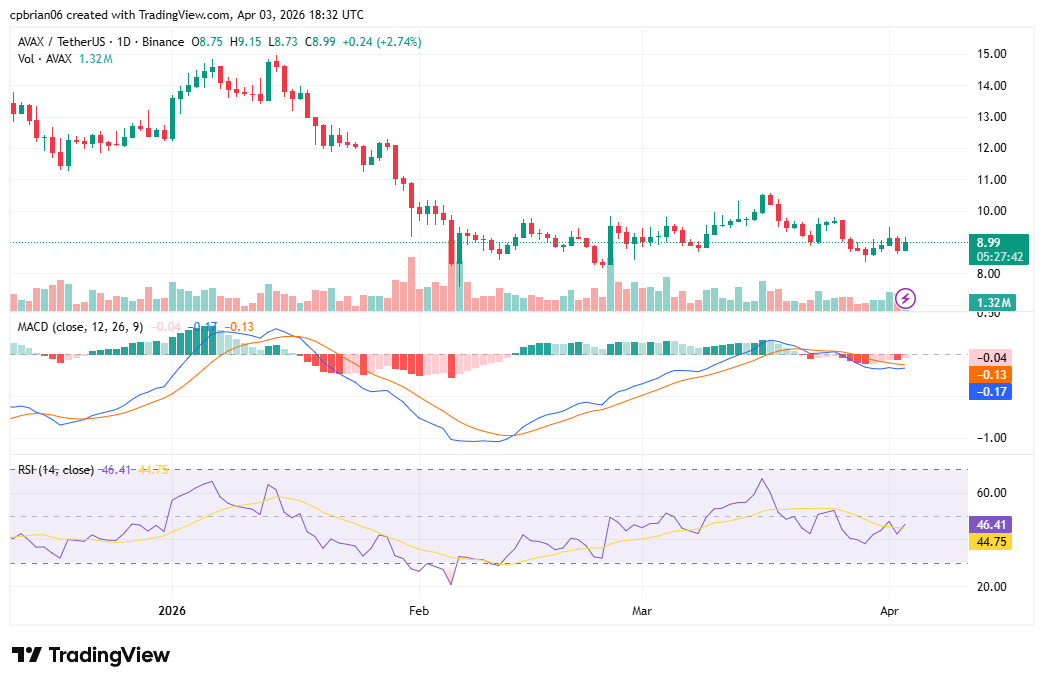
This month, AVAX remained bearish, falling below $10 and recently below $9. The coin now has a bearish Relative Strength Index (RSI). The William Alligator trendlines indicate waning volatility, while the MACD histograms show negative momentum. AVAX has support at $8.58.
AVAX/USD 4-hour chart analysis
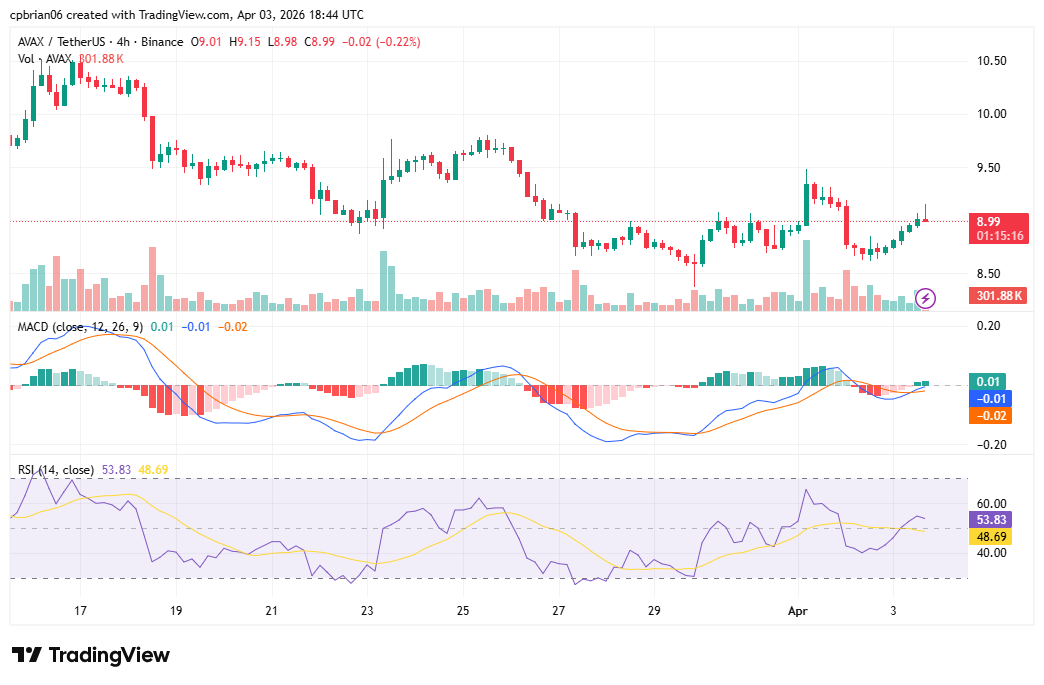
Over the short term, AVAX remained volatile, ranging between $8 and $10. Its momentum rose in the last 24 hours as it bounced off support levels. Its relative strength index (53.83) shows it is in neutral territory.
Avalanche technical indicators: Levels and action
Daily simple moving average (SMA)
| Period | Value ($) | Action |
| SMA 3 | 10.90 | SELL |
| SMA 5 | 9.94 | SELL |
| SMA 10 | 9.22 | SELL |
| SMA 21 | 9.39 | SELL |
| SMA 50 | 9.34 | SELL |
| SMA 100 | 11.02 | SELL |
| SMA 200 | 14.43 | SELL |
Daily exponential moving average (EMA)
| Period | Value ($) | Action |
| EMA 3 | 9.28 | SELL |
| EMA 5 | 9.59 | SELL |
| EMA 10 | 10.44 | SELL |
| EMA 21 | 11.46 | SELL |
| EMA 50 | 12.97 | SELL |
| EMA 100 | 15.48 | SELL |
| EMA 200 | 18.54 | SELL |
What to expect from the AVAX price analysis next?
Technical analysis of Avalanche price movements suggests it is bearish. The charts show that its momentum is rising, suggesting it will drop over the short term.
Why is Avalanche down?
AVAX is caught in a market-wide downdraft, with its technical breakdown amplifying the sell-off. While positive developments like the ETF filing provide long-term optionality, they are not offsetting near-term macro fears.
Will AVAX reach $50?
According to the Cryptopolitan price prediction, AVAX is expected to cross $50 in 2029, reaching a maximum price of $52.03.
Will AVAX reach $100?
According to the Cryptopolitan price prediction, AVAX will reach $100 in 2031, with a maximum price of $109.93.
Can Avalanche reach $1,000?
It remains highly unlikely that AVAX will reach $1,000 before 2031. At that market capitalization, it could be more valuable than Ethereum.
Can Avalanche reach $10,000?
It remains highly unlikely that AVAX will reach $10,000 before 2031.
How much will Avalanche be worth in 2026?
As 2026 unfolds, we anticipate it will trade between $7.00 and $22.10, with an average price of $18.89.
Does Avalanche have a good long-term future?
According to Cryptopolitan price predictions, AVAX will trade higher in the coming years. However, factors like market crashes or negative regulations could invalidate this bullish theory.
Is Avalanche a good crypto to buy?
Chart analysis suggests that Avalanche is recovering and currently gearing up for a closer move to $20 despite the overall bearish momentum.
AVAX price prediction April 2026
For April, AVAX will trade between $9.10 and $13.10, with an average price of $10.01.
| Month | Potential low ($) | Potential average ($) | Potential high ($) |
| April | 7.59 | 10.01 | 13.10 |
Avalanche price prediction 2026
As 2026 unfolds, its future price movements suggest it will trade between $7.00 and $22.10, with an average price of $12.89.
| Year | Potential low ($) | Potential average ($) | Potential high ($) |
| 2026 | 7.00 | 12.89 | 22.10 |
Avalanche price prediction 2027-2032
| Year | Potential low ($) | Potential average ($) | Potential high ($) |
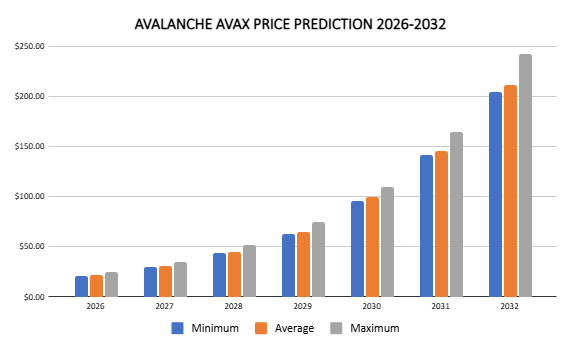
| 2027 | 20.4900 | 22.2100 | 24.7600 |
| 2028 | 29.9700 | 30.8200 | 35.1800 |
| 2029 | 43.5500 | 44.7900 | 52.0300 |
| 2030 | 62.8400 | 65.07 | 74.7400 |
| 2031 | 95.9900 | 99.25 | 109.9300 |
| 2032 | 141.6400 | 145.6100 | 164.6400 |
AVAX price prediction 2027
Avalanche price prediction climbs even higher into 2027. According to the projection, the price will range from $20.49 to $24.76, with an average trading price of $22.21.
Avalanche crypto price prediction 2028
Our Avalanche price prediction indicates further price acceleration. It will trade between $29.97 and $35.18, with an average of $30.82.
Avalanche price prediction 2029
According to the AVAX coin price prediction for 2029, the price of AVAX will range from a minimum price of $43.55 to a maximum price of $52.03. The average price will be $44.79.
Avalanche AVAX price prediction 2030
According to the Avalanche price prediction for 2030, we anticipate a range of $62.84 to $74.74, with an average price of $65.07.
Avalanche price prediction 2031
The Avalanche price forecast ranges from $95.99 to $109.93, with an average closing price of $99.25.
Avalanche price prediction 2032
The Avalanche AVAX price forecast indicates it will trade between $141.64 and $164.64, with an average trading price of $145.61.
Avalanche market price prediction: Analysts’ AVAX price forecast
| Platform | 2026 | 2027 | 2028 |
| Coincodex | $7.56 | $7.54 | $7.40 |
| Gate.com | $9.00 | $9.03 | $11.94 |
Cryptopolitan Avalanche price prediction
Our predictions indicate that Avalanche will achieve a high level of $22.10 in 2026. In 2027, it will range between $20.49 and $24.76, with an average price of $22.10. In 2031, the range will be between $95.99 and $109.93, with an average of $99.25. Note that the predictions are not investment advice. Seek independent consultation or do your own research.
Avalanche historic price sentiment
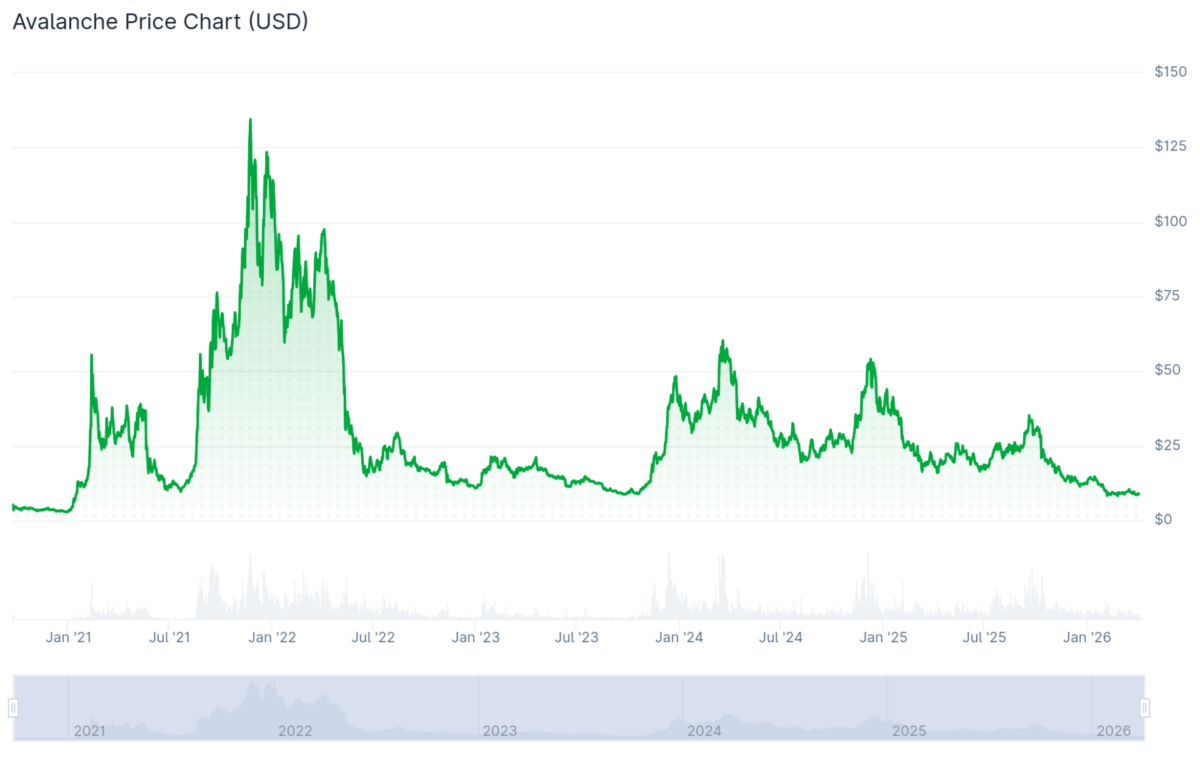
Avalanche price history. Image source CoinGecko
- In July 2020, Avalanche completed its public sale, raising $42 million in under 4.5 hours. The tokens were distributed after the mainnet launch in September.
- On Dec 31, 2020, it fell to an all-time low of $2.79.
- In September 2021, the Ava Labs Foundation received a $230 million investment from Polychain and Three Arrows Capital Group by purchasing AVAX.
- In November 2021, following an agreement with Deloitte to improve US disaster relief funding, AVAX moved to the top 10 cryptocurrencies by market capitalization. At that time, AVAX reached an all-time high of $146.22.
- In Aug 2022, a whistleblower, ‘crypto leaks’, published a report accusing Ava Labs of secret deals with a law firm to destabilize its competitors. Ava Labs CEO Emin Gün Sirer denied any involvement in a shady deal with the Roche Freedman law firm.
- In 2023, AVAX maintained a bullish trend from January to May, after which bears took control of the market. It resumed the positive momentum in October, rising to $49.96.
- In 2024, it crossed the $60 mark in March.
- The rise coincided with a record high in AVAX inscriptions, with over 100 million ASC-20 minted since their introduction in June 2023.
- The uptrend reversed in April 2024; by July, it had fallen to $24.40. In August, it was at $21, and in September and October, it was at $27.
- It turned bullish in November 2024, rising from as low as $23 to $55 in December.
- It corrected later and traded at $42 into 2025. The drop continued into January; by June, it had fallen below $20. In July, it traded at $18, and in September, at $23. In October, it rose above $30.
- It then reversed, and by December, had dropped to $14. It maintained the price into January 2026. It later turned bearish, and in March and April, it reached $9.