Seoul opposition bill chooses 2030 for the 22% crypto levy
South Korea’s opposition bloc is attempting to delay the nation’s 22% cryptocurrency tax by three years to January 1, 2030, directly contradicting the government’s reaffirmed commitment to implement taxation starting in 2027. The delay would affect roughly 13 million Korean crypto traders and represents a critical test of whether institutional investors can expect regulatory predictability in one of Asia’s largest crypto markets.
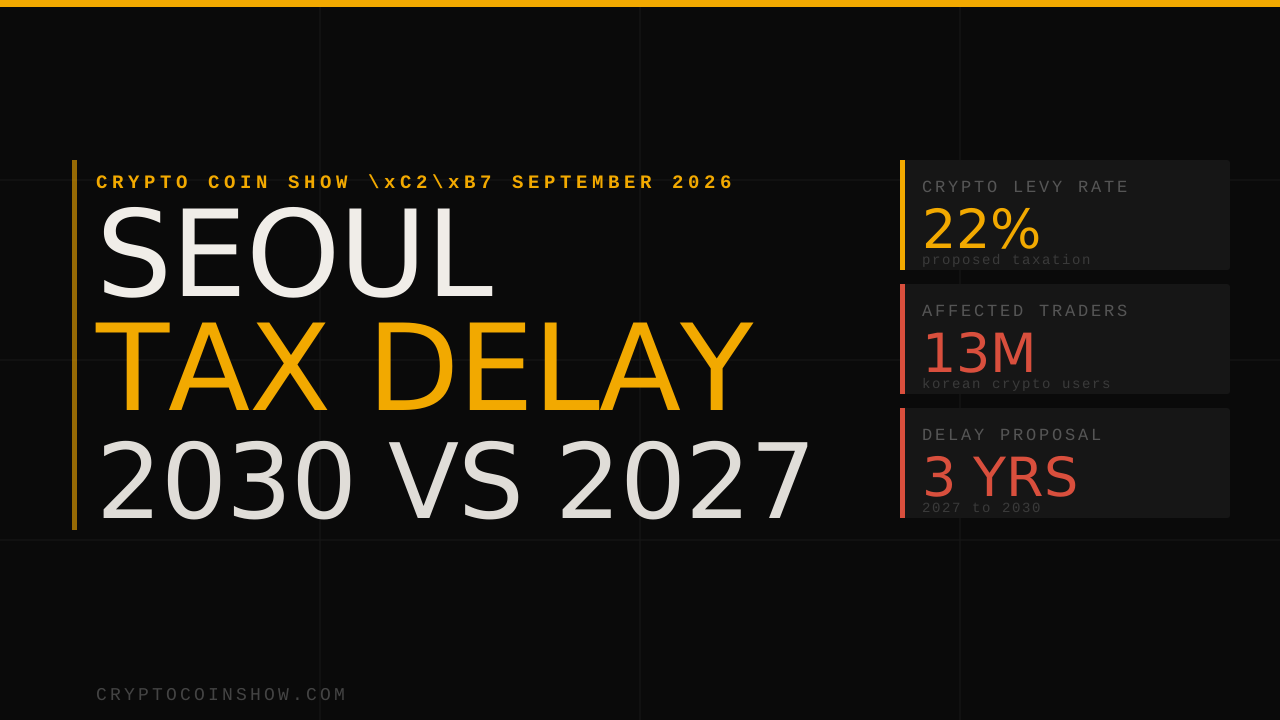
- Opposition lawmaker Jeong Seong-guk proposed delaying the 22% crypto tax from 2027 to 2030, citing need for regulatory framework review and investor protections.
- South Korea’s finance ministry finalized its 2026 tax reform package on July 29 with no further delays, reaffirming the 2027 start date as scheduled.
- The 22% rate combines a 20% national income tax and 2% local tax, applying only to annual crypto gains exceeding 2.5 million won, approximately $1,800.
- 22% Combined national and local tax rate on crypto gains starting 2027
- 13 million South Korean individuals who trade crypto and would face the new tax
- 2030 Proposed delay date versus government’s 2027 implementation timeline
The clash between South Korea’s Ministry of Economy and Finance and the opposition People Power Party has exposed a fundamental split over the nation’s approach to cryptocurrency taxation.
Finance Minister Koo Yun-cheol, who also serves as deputy prime minister, explicitly stated the government’s position on July 29 during a National Assembly Finance and Economic Planning Committee meeting: the 22% tax would proceed as scheduled in 2027, with no further extension beyond the already delayed timeline.
That same week, Representative Jeong Seong-guk filed an amendment to the Income Tax Act proposing to push the effective date forward three additional years to January 1, 2030. The proposal directly contradicts recent ministerial guidance and forces lawmakers to choose between the government’s tax agenda and industry calls for extended preparation time.
Opposition delays crypto tax to 2030 amid regulatory framework gaps
Jeong’s amendment rests on the claim that South Korea lacks sufficient time to complete a robust regulatory framework, strengthen investor protections, and build the technical infrastructure necessary to administer crypto taxation fairly. According to Jeong’s position, reaching the statutory deadline in 2027 does not automatically justify implementation if the underlying systems remain incomplete.
The lawmaker argues that taxpayers need confidence in how the system operates before collection begins, positioning the delay as a prudent measure rather than an indefinite postponement.
This argument carries weight in institutional circles because it identifies real implementation risks. Tax authorities must design systems that track gains across multiple exchanges, handle decentralized finance income, manage foreign trading accounts, and provide audit trails acceptable to both regulators and market participants.
The complexity of crypto-asset valuation, particularly on dates when transactions occurred, presents technical challenges that legacy tax systems were not designed to address. A three-year extension would provide time to pilot systems, train tax officials, and establish clear guidance for traders and custodians.
The opposition’s framing also invokes investor protection concerns, though specifics on that front remain vague in Jeong’s public statements.
Finance ministry locks in 2027 start despite previous delays
South Korea’s tax authority has already delayed crypto taxation twice. Lawmakers initially approved the 22% tax framework in 2020 with a 2022 start date, then postponed it to 2023, and subsequently moved it again to 2027. The repeated delays have created uncertainty in the market and frustrated government revenue planners.
Finance Minister Koo’s July 29 statement, delivered just days before Jeong filed his amendment, reflects clear resolve to stop the pattern of extensions and establish a fixed implementation date.
The 22% rate itself combines a 20% national income tax and a 2% local tax on what South Korea classifies as “other income,” a category that includes crypto gains from buying, selling, and lending digital assets such as Bitcoin and Ether. The tax applies only to traders whose annual gains exceed 2.5 million won, roughly $1,800.
The finance ministry illustrated the impact with a concrete example: a trader earning 5 million won from Bitcoin in a single year would face a tax bill of 550,000 won (approximately $400) after applying the exemption. Income earned during calendar year 2027 would be reported and taxed in May 2028, following South Korea’s standard tax filing schedule.
One feature of the framework has drawn particular criticism from traders and some lawmakers: crypto losses cannot be carried forward to offset future gains. Under the current structure, a trader who loses money in one year and profits the following year must still pay tax on the subsequent gain, unable to net losses against that income.
Finance Minister Koo has defended this approach by noting that stock trading in South Korea receives no loss carryforward either, treating both asset classes similarly. Koo acknowledged the government would review the issue after the tax takes effect if data suggests adjustment is warranted.
Competing bills expose deeper ideological divide on crypto taxation
Jeong’s three-year delay proposal is not the only legislative challenge to the 2027 framework. Lawmaker Song Eon-seok, also from the People Power Party, filed a separate bill in March that would abolish the crypto income tax provision entirely.
Song’s approach frames crypto taxation as a parity issue: gains on cryptocurrency investments face a 22% levy while gains on regular stock investments are effectively tax-free in South Korea, which has no capital gains tax system. This argument positions the crypto tax as an unfair burden on one asset class while another remains untaxed.
Finance Minister Koo has addressed the international comparison dimension of this debate by noting that the United States, Japan, and the United Kingdom all tax cryptocurrency as capital gains, establishing a clear precedent in major economies.
However, Koo acknowledged that South Korea’s tax system operates differently, lacking a comprehensive capital gains tax framework that would apply equally across asset classes. That structural difference means crypto taxation exists in a unique legal and policy context, neither as a capital gains tax nor as a truly parallel income tax to stock trading.
The competing bills, Jeong’s delay and Song’s abolition, represent genuinely different policy positions rather than marginal disagreements over timing.
Institutional investors face unpredictability in critical Asian market
For institutional investors and cryptocurrency custodians operating in South Korea, the present legislative moment creates material uncertainty. The country is home to approximately 13 million crypto traders, constituting one of Asia’s most active and densely populated retail crypto markets.
Institutional platforms, exchanges, and custody providers must prepare compliance infrastructure based on the assumption that 2027 is the operative date, yet a plausible legislative path exists to delay implementation by three years.
That possibility creates planning risks: systems built for 2027 implementation may face requests for substantial modification if the effective date shifts to 2030, and compliance personnel cannot confidently plan hiring and training timelines.
The stakes extend to how foreign institutional participants view South Korea as a regulatory jurisdiction. Repeated delays to major policy implementations signal either genuine technical difficulty in the implementing agency or instability in legislative consensus.
Three separate postponements of a major tax framework, scheduled for 2022, then 2023, then 2027, and now potentially 2030, suggest that long-term policy predictability may be difficult to achieve in the South Korean crypto market, at least through the current legislative cycle.
Institutional market participants also recognize that the 22% rate itself may face future challenge. If the tax takes effect in 2027 and produces tax revenue while simultaneously demonstrating that crypto traders can comply with the framework, political pressure to raise or lower the rate, or to alter the loss carryforward rules, may emerge.
The finance ministry’s commitment to review the loss carryforward question after implementation begins signals openness to modification, though that uncertainty compounds long-term planning challenges.
The critical next step lies with the National Assembly Finance and Economic Planning Committee, which must decide whether to advance Jeong’s amendment for floor consideration. If the committee schedules a vote on the delay proposal before the fall legislative session ends, it will become clear whether opposition lawmakers can muster support to override the government’s stated position. Finance Minister Koo has provided no indication of flexibility on the 2027 date, making the committee’s action the immediate