
Robinhood acquires minority stakes in Crypto.com and OG.com for event contracts expansion
Robinhood’s investment in Crypto.com and OG.com signals the mainstream broker’s pivot toward prediction markets as a core revenue driver, expanding beyond its blockchain network fees into tokenized event contracts ahead of the 2024 U.S. election cycle. For institutional traders, the deal underscores how traditional brokerages are now actively competing with pure-play prediction-market platforms like Kalshi and Polymarket for market share in an asset class that has grown tenfold year-over-year.
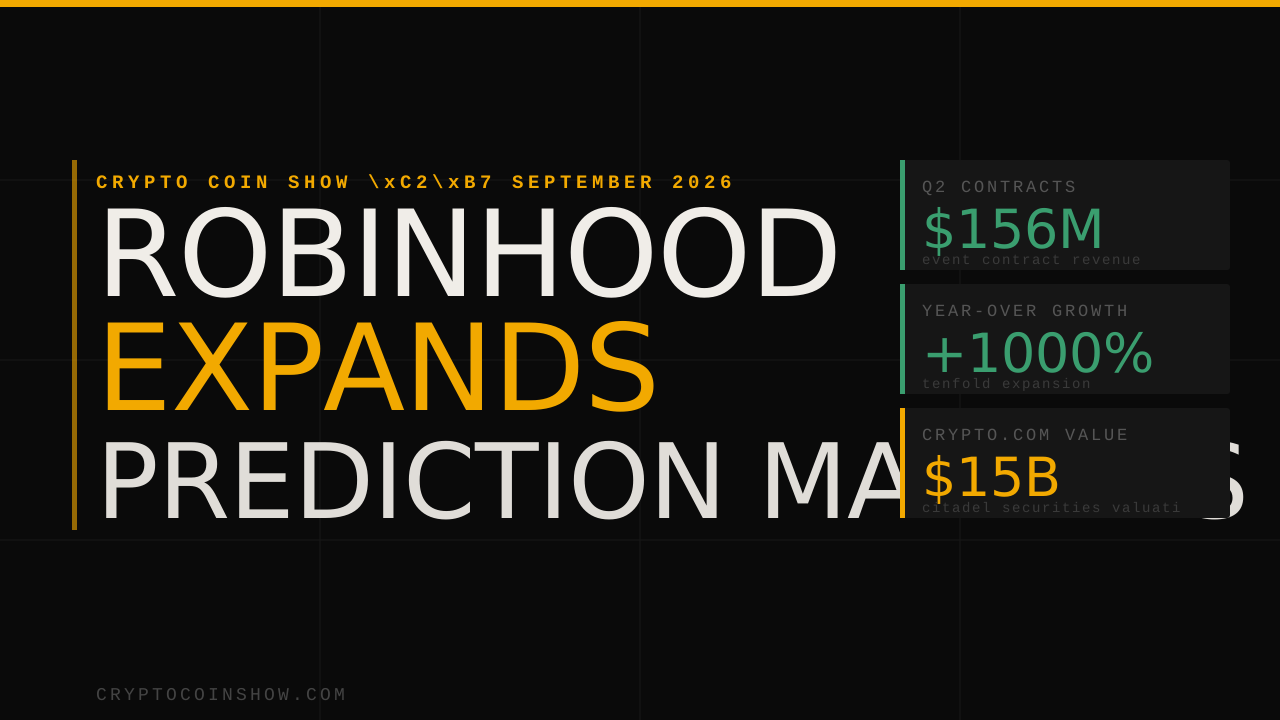
- Robinhood earned $156 million from event contracts in Q2 2024, more than tenfold growth from the prior year period.
- Robinhood agreed to take minority stakes in both Crypto.com (valued at $15 billion by Citadel Securities in July) and its spinoff OG.com (valued at $5 billion).
- The deal begins September 8 and comes as overall prediction-market trading volume across Kalshi and Polymarket combined exceeds $130 billion annually.
- $156M Robinhood’s Q2 event contract revenue, more than tenfold prior year increase
- 13.6B Event contracts traded hit record volume, up more than tenfold year-over-year
- $608K Average daily revenue on Robinhood Chain over first 70 days since launch
Robinhood Markets has agreed to list yes-or-no event contracts from Crypto.com on its retail trading platform, while acquiring minority ownership stakes in both the exchange and OG.com, its recently spun-off prediction-markets subsidiary, according to reporting on the multi-year deal. The investment amount was not disclosed, though Citadel Securities valued Crypto.com at $15 billion and OG.com at $5 billion in a separate investment round last month. Robinhood will begin offering OG.com contracts to its users on September 8, positioning the broker to capture additional volume ahead of the fall election season and football season betting surge.
Robinhood’s Q2 Event Contract Revenue Jumps to $156 Million Amid Tenfold Growth
Robinhood’s prediction-markets business has become a material revenue driver faster than traditional trading desks anticipated. The broker generated $156 million from event contracts in the second quarter of 2024, a more-than-tenfold increase from the same period a year earlier, while overall net revenue for the quarter reached $1.31 billion, a 32% increase year-over-year.
Event contracts themselves hit a trading record of 13.6 billion contracts, also up more than tenfold annually, signaling rapid adoption among retail participants.
The scale of this growth has attracted institutional capital and major competitors. Combined trading volume on Kalshi and Polymarket, the two largest dedicated prediction-market platforms, has surpassed $130 billion annually, and major technology companies including Meta, along with established sportsbooks like FanDuel and DraftKings, are now moving into the space.
This convergence of retail brokers, pure-play platforms, and traditional media and sports operators has created a fragmented but rapidly expanding market in which Robinhood’s scale advantage, its existing retail customer base and brand trust, offers a distinct edge.
Robinhood Chain Generates $608,000 Daily After 70-Day Launch Window
Robinhood’s proprietary blockchain, launched earlier this year, has emerged as one of the highest-grossing networks in crypto, with on-chain tracker EmberCN reporting $42.58 million in total revenue (17,171 ETH) over its first 70 days, an average of roughly $608,000 per day. At peak periods, the network has generated $4.01 million in daily fees, rivaling or exceeding networks like Ethereum in total fee capture. Robinhood retains approximately 90% of the network’s fee revenue, with Arbitrum, the underlying technology provider, receiving the remainder.
Tokenized stocks have become the primary driver of blockchain activity, now accounting for roughly 27% of on-chain volume. Analysts at Bernstein maintained an “Outperform” rating on Robinhood stock and raised their 2028 price target for annual platform fees to $160 million, up from their previous estimate of $130 million.
However, tokenized-stock products have drawn regulatory and corporate scrutiny, AMC Entertainment CEO Adam Aron has publicly called Robinhood’s AMC-linked tokens “outrageous” and stated they carry no affiliation with the company, but Robinhood has declined to remove them from its platform.
Crypto.com IPO Path Remains Undefined as Strategic Stakes Shift Ownership
Crypto.com CEO Kris Marszalek has signaled the exchange is moving toward an initial public offering, though no timeline has been established.
The Robinhood stake acquisition, combined with Citadel Securities’ recent valuation round, signals continued institutional interest in the platform despite a regulatory environment that remains uncertain for both prediction markets and tokenized equity products.
The spinoff of OG.com as a standalone entity follows similar industry trends toward separating higher-velocity trading venues from core exchange infrastructure.
Robinhood’s market launch of OG.com contracts on September 8 will be the first real test of whether the broker’s retail customer acquisition power can meaningfully shift volume away from Kalshi and Polymarket. Watch whether tokenized-stock trading expands beyond AMC and how aggressively Meta, FanDuel, and DraftKings pursue their own prediction-market offerings; the intensity of that competition, combined with any regulatory action on tokenized securities, will determine whether Robinhood’s blockchain network sustains its current fee capture over the next two quarters.